The Legacy of Alasdair MacIntyre
Written by NR Symposium
What to make of the work and influence of the legendary philosopher and academic in the wake of his death at 96.
Share this story
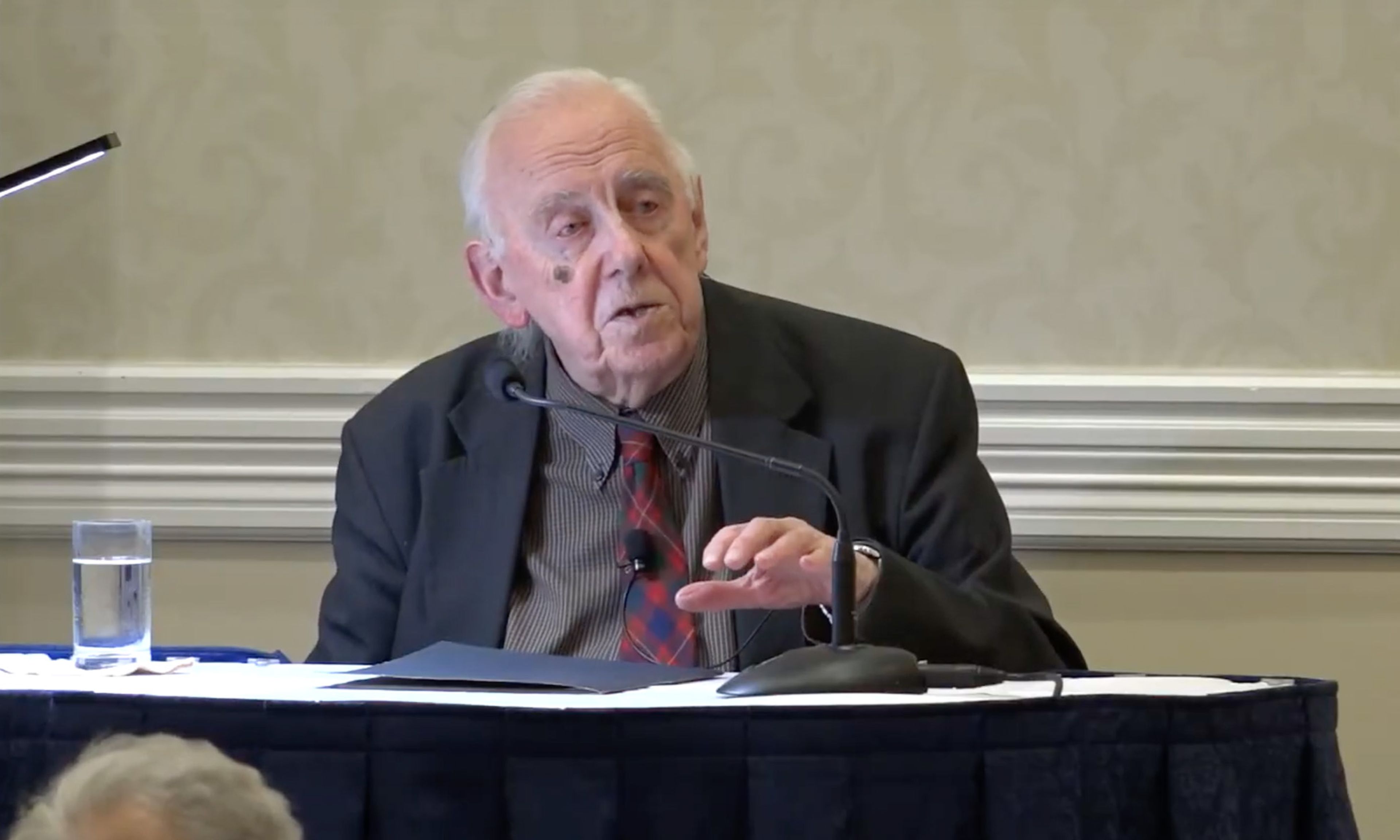
Alasdair MacIntyre
On May 21, the Scottish-born philosopher, academic, and virtue ethicist Alasdair MacIntyre died at 96. His prolific academic career began in the United Kingdom, then continued in the United States starting in 1969. From 1985 onward, he made his scholarly perch at the University of Notre Dame. In such works as his landmark 1981 text After Virtue, he argued that the modern world had severed itself from sources of meaning and morality; he devoted his life to attempting a reconnection. That life took him from Marxism to Catholicism to a wide-ranging critique of what he called liberalism, which he considered the individualist obsession of modernity. We have invited some friends to provide an assessment of MacIntyre’s legacy.
— Jack Butler, submissions editor, National Review Online
* * *
MacIntyre THe PLanTER
By Rachel Lu
Here’s a challenge that sometimes arises when I talk to non-philosophers about Alasdair MacIntyre. They want to know, in effect, why he was such a big deal. It’s a fair question. Many of us in the philosophy world admired him intensely; we should be able to explain why. I have found, just anecdotally, that people outside the philosophy world are less likely to “get” MacIntyre or admire his work. Though he did unquestionably have an impact on other disciplines, many seem to view him a bit askance. They have reservations. Sometimes many. They ask what they should read to get a glimpse of his genius, and I shift a little in my chair. His A Short History of Ethics might be the best entry point. But, in truth, none of MacIntyre’s written work is terribly accessible to general audiences.
Should we see this as a failure on his part? Unquestionably, some very great thinkers have been “philosopher’s philosophers.” No normal person wants to read the Tractatus or Being and Time. But it’s a bit painful to say this of MacIntyre, because he clearly didn’t wish to be a creature of the ivory tower. He was intensely interested in bringing philosophy into human life as lived, and even had a particular fascination with decidedly non-elite communities, from fishing villages to prisons to community-level women’s organizations in Africa. It doesn’t seem like that interest was mutual. Perhaps somewhere out there, there are underwater-basket-weaving communities thrilling to After Virtue, but I suspect not. It’s really quite a difficult book. Lots of inside baseball.
Perhaps we might say that he was a brilliant man with fascinating ideas, who happened to be a poor communicator. Except he wasn’t. For some of us, MacIntyre was the man who placed philosophy in a new light, showing how it could be, even in these disenchanted times, a thing of real beauty and nobility. He combined the rigor of a trained analytic thinker with a steadfast refusal to abandon the quest for wisdom and the good. When I was an undergraduate, his lectures held me spellbound. I can’t agree that he was a poor communicator.
Perhaps the situation is more like this. MacIntyre was a philosopher. But philosophy today is in poor shape. He understood this, and indeed made his reputation by arguing that very point. But what should one do when one is strongly inclined, by talent and natural interest, to work a field that happens to be in a shabby state? Start a campaign to attract more talent or wealthier donors, or perhaps some government largesse? Give up and move to a lateral field, accepting that we don’t always get to do the thing we most love?
Those would be common responses. MacIntyre’s was far more radical. He did write a report, as it were, on the unhappy state of philosophy, but after that he just settled in and worked the field. He was extremely willing to take trouble to mentor others who showed sincere interest in helping with the work (as I myself experienced). But he had no interest in forming committees, passing legislation, starting public information campaigns. Neither was he willing to pack it in, transferring his energies to economics or history or political theory. When non-philosophers ask me why MacIntyre mattered, I think the underlying question may really be: Why does philosophy matter? Does it still matter in our time?
We should be eager to answer that question, taking every opportunity to explain the value of examining the unexamined life. But this has never been an easy sell, and it’s particularly hard today when people live in a world of distractions and memes, with propaganda blaring from a thousand devices, and endless “consumer options” obscuring those defining life choices that ultimately shape us as human beings. MacIntyre understood how hard it is today for people even to grasp what virtue is, let alone cultivate it. Fortunately, there are certain soils that never truly lose their richness, even if people stop planting there.
So, he planted. I think he did inspire a fair number of people to dedicate themselves to “retail-level” efforts to cultivate greater appreciation of philosophy. It’s encouraging to see some of those efforts, for instance in the revitalized classical education movement. MacIntyre himself, though, was most gifted at doing philosophy, and at speaking to the kinds of people who could be persuaded to disciple themselves to Lady Philosophy. (Perhaps someone should?)
When I heard that MacIntyre had died, my mind flashed to the final line of Plato’s Phaedo. “Crito, we owe a rooster to Asclepius. Pay it, and don't forget.”
These were Socrates’ final words. Asclepius was the god of healing, so by honoring him Socrates presumably meant his disciples to recognize the blessing of casting aside the maladies and limitations of this fallen world. MacIntyre labored 96 years in a world he clearly understood to be deeply fallen. He earned his release. We will not forget.
Rachel Lu is an associate editor of Law & Liberty and a contributing writer at National Review and America magazine.
* * *
REFLECTIONS ON A GIANT
By Robert P. George
The philosopher Alasdair MacIntyre, who died recently at age 96, was known for being pugnacious in argument and blunt -- even fierce -- in his criticism of people and ideas of which he disapproved. I was pleasantly surprised, therefore, when visiting the University of Notre Dame for the first time some 30 years ago, to be invited to lunch and given a tour by him of the campus. I was a young, not very well known academic, but one who had written a review of one of his books that, though appreciative, was not uncritical. Professor MacIntyre -- already a towering figure in moral and political philosophy -- had read the review but could not have been more gracious to its author.
MacIntyre’s thought was central to a revival of Aristotelian moral philosophy in which virtues are linked to a comprehensive account of human flourishing -- what Aristotle himself termed eudaimonia. Prior to the Aristotelian revival -- associated not only with MacIntyre, but also with Elizabeth Anscombe, Philippa Foot, Peter Geach, John McDowell, David Wiggins, John Finnis, and others -- the principal options in moral philosophy were typically presented as some form of Kantian deontology, on the one side, and Benthamite utilitarianism, on the other. MacIntyre (like the other philosophers I mentioned) found these alternatives deeply unsatisfactory.
MacIntyrean “virtue ethics” levels a decisive challenge to the utilitarian thesis that all human goods can be weighed and measured -- that morally upright decision-making can be reduced to an aggregative underlying principle, such as providing the greatest happiness to the greatest number. But in adopting a sort of via media, virtue ethics also contrasts with deontology’s formalism, which fails to recognize that the more-than-merely-instrumental goods -- those intrinsically desirable ends and purposes that people rightly pursue for their own sakes, such as friendship, marriage and family, knowledge, beauty, integrity, and friendship with God -- constitute the starting points of moral reflection and comprise the integral components of human well-being and fulfillment.
MacIntyre’s approach to moral and political philosophy -- best exemplified by his magisterial books After Virtue (1981) and Whose Justice? Which Rationality? (1988) -- was further defined by his articulation of the significant sense in which human beings’ moral reflection is “tradition-dependent.” In a major contribution to reflection on moral experience, he usefully described how it is that people are not permanently imprisoned in the particular tradition or culture into which they were born (or into which they previously moved or converted), because he showed how traditions themselves provide the resources for their own internal critique. He advanced -- and indeed, his own life modeled -- the thesis that traditions (which may be secular or religious) enter into moments of fundamental epistemological crises for their adherents when the traditions generate important questions that they themselves do not have adequate resources to answer.
In such cases, the sincere truth-seeker will be forced to look outside his tradition in search of a superior tradition -- that is, a superior set of resources -- which can provide the tools to answer the questions still in need of resolution. MacIntyre lived this dynamic in his own philosophical conversion from Marxism -- he was cognizant of Marxism’s tenuous moral foundations, even if he remained sympathetic to some of its conclusions -- to Aristotelian-Thomism. He later became a religious convert to Catholicism.
While MacIntyre rightly acknowledged that there are significant senses in which moral reflection is tradition-dependent, it is also necessary to identify the significant ways in which it is not -- for example, by articulating the universal precepts and truth-claims that always ground sound moral reflection. It is in this realm that I believe MacIntyre fell a bit short. In my view, he did not manage to construct sufficient guardrails to ensure his tradition-dependent account of moral reflection was protected from collapsing into a form of relativism.
In his searing attack on contemporary liberalism and what he described as the Enlightenment conception of practical reason in Whose Justice? Which Rationality?, MacIntyre, in my judgment, somewhat obscured the potential force of his critique by eschewing discussion and analysis of the universal principles of practical reason that can, and should, ground universal truth-claims about concepts of, say, justice, the common good, human dignity (an idea about which MacIntyre was skeptical), human rights (about which he was even more skeptical), and moral duties.
MacIntyre famously voiced something approaching contempt for concepts of human (or “natural”) rights and human dignity -- ideas commonly associated with certain strains of Enlightenment-era liberalism, to be sure, but which also occupy prominent and indispensable roles in profoundly non-liberal traditions making universal claims, such as contemporary articulations of natural law theory.
I made this point -- although in my youthful hubris I stated it too harshly -- in a 1989 review of Whose Justice? Which Rationality?. In my review, I noted that MacIntyre’s decision to wield his tradition-dependent “moral particularism” as a
weapon against liberal moral and political thought . . . stops him from drawing upon the best resources of the tradition he himself views as the best alternative to liberalism. It mires him in an ultimately relativistic position that can be described as ‘Thomism’ only by the grace of inverted commas.
Here, it seems to me that the via media would have been to point out that liberalism, like Marxism, was unable to answer the first-order questions that inevitably arise from its answers to concrete controversies of the modern era -- first-order questions such as, “Why should we believe that people have rights?” or, “Where do rights come from?” But natural law theory -- insofar as it provides the more philosophically cogent, non-liberal grounding for the rights that liberalism sometimes, if inadequately, identifies -- is able to provide the answers.
Alasdair MacIntyre, a giant of 20th- and 21st-century philosophy, requiescat in pace.
Robert P. George is the McCormick Professor of Jurisprudence at Princeton and the author of Seeking Truth and Speaking Truth: Law and Morality in Our Cultural Moment.
* * *
ALASDAIR MACINTYRE AND THE 'TURN TO THOMAS'
By Susan Hanssen
Alasdair MacIntyre was one of a stream of intellectuals who converted to Christianity over the course of the Cold War. Historian Adam Schwartz calls this river of converts to Catholicism among public intellectuals in the 20th century the “Third Spring” of English Catholicism.
The “First Spring” of English Catholicism was prior to the Reformation. The 19th century “Second Spring” began with John Henry Newman’s conversion at Oxford in 1845; Newman himself coined the term. The 20th century “Third Spring” included a wide variety of writers: G. K. Chesterton, Christopher Dawson, Jacques Maritain, Russell Kirk, Sir Kenneth Clark, Mortimer J. Adler, E. F. Schumacher, and Fr. Richard John Neuhaus, to name a few. Already at the beginning of the century, Henry Adams, of the American political dynasty, noted this trend. After suffering a stroke, he wrote to ask an old friend, “Shall we go to Rome?”: “To die in Rome is not so swell a thing as it used to be but it is a decent thing to do, still.”
Perhaps the current, ongoing reflection on Alasdair MacIntyre’s journey will spark a new interest in this understudied part of British and American intellectual history.
*
The first sign that Alasdair Macintyre was joining this stream of intellectual converts was his most famous book, After Virtue (1981). Despite never earning a doctorate and publishing in a variety of disciplines despite the academic tendency towards hyper-specialization, MacIntyre nevertheless stood very much in the center of the Marxist academic mainstream.
After Virtue began by portraying the total collapse of moral discourse. MacIntyre argued that the histrionic shouting matches between ungrounded right-claims and utilitarian calculations revealed the disappearance of any common ground necessary for rational moral exchange. The “incommensurability” of the paradigms of moral discourse produced a dead end.
After Virtue became a historical whodunnit, tracking backwards into emotivism and rationalism of the 19th century, and further back until MacIntyre proclaimed the evident failure of the Enlightenment project in the total “lack of predictive power” of the social sciences. The centerpiece of the book was a chapter entitled “Nietzsche or Aristotle?” After this, MacIntyre began over from the beginning, progressing from the Greeks through the medievals up to the 18th century, telling a new, doubtless very different story about the evolution of moral discourse from the one that justified the creation of the social sciences in the modern research university in the 19th century.
MacIntyre ended by arguing that an older form of moral inquiry was actually immune to the Nietzschean deconstruction of Enlightenment rationality. This older form of inquiry he called “tradition” narrative accounts of how a network of practices are ordered to the ultimate end of human life. In After Virtue, Macintyre points to the Aristotelian origins of “tradition,” but increasingly in his later work, especially Three Rival Versions of Moral Enquiry, he placed Thomas Aquinas at the center of his narrative and his conception of “tradition.”
*
Everyone who has written about the “Third Spring” of English-speaking Catholicism has acknowledged that the spark that ran among the stubble was the writing of G. K. Chesterton. When he was at the height of his academic celebrity in the 1990s, I once asked Alasdair MacIntyre at what age he had first encountered G. K. Chesterton’s writing. It had struck me that, in many ways, swathes of MacIntyre’s writing are academic rewritings of ideas found in highly concentrated and highly poetic form in Chesterton.
MacIntyre answered that he read Chesterton during his teenage years.
MacIntyre’s history of philosophy is delineated brilliantly in the two opening chapters of Chesterton’s 1908 Orthodoxy: “The Maniac” deals with the empiricist and rationalist project of justifying morality without reference to any cosmic, metaphysical, or theological whole, and the obsessive specialization of the social sciences; and “The Suicide of Thought” deals with the voluntarist and emotivist “sorties” to escape that dead end.
The return to St. Thomas Aquinas to escape this dead end was at the core of both Chesterton and MacIntyre’s conversions. This “turn to Thomas" was the massive project of Pope Leo XIII at beginning of the 20th century. (Pope Leo XIV has pointed to his predecessor Leo XIII as his intellectual inspiration.) Pope Leo XIII’s two most important encyclicals -- Aeterni Patris, which recommended the study of Thomas Aquinas; and Rerum Novarum, which applied Thomistic insights to social problems -- reached out for “Two Thomisms” (philosophical and moral) to solve the problems of “Two Modernities” (radical existential skepticism and the disintegration of natural communities).
Future intellectual historians will view diagnosing the ills of modernity and turning to Thomas Aquinas as a central element of 20th century intellectual life. Chesterton at the beginning of the century and MacIntyre at the end serve as perfect bookends for the story of “Third Spring” of English Catholicism.
Susan Hanssen is associate professor of History at the University of Dallas.
* * *
ALASDAIR MACINTYRE's QUEST FOR GOD
By David McPherson
In the wake of Alasdair MacIntyre’s recent passing at age 96, public remembrances have rightly focused on his seminal 1981 work, After Virtue, and its role in the rival of the classical tradition of virtue ethics. What is less commented on is that this work was followed by his conversion to the Catholic faith from atheistic Marxism, which was perhaps foreshadowed by the book’s famous conclusion calling for a new St. Benedict. Subsequently, religious themes became prominent in MacIntyre’s work, especially in the last 20 years of his life.
It is hard to think of a more well known recent philosopher undergoing such a religious conversion. In this, as in so many other ways, MacIntyre stood opposed to the dominant tendencies of his age. Here, he stood against the growing trend toward secularization in the North Atlantic West. To understand how one might be drawn to God in an increasingly secularized culture, it is instructive to consider MacIntyre’s quest for God on three levels: as a response to modern anomie, as a philosophical quest, and as a desire-driven quest.
In After Virtue, MacIntyre diagnosed modern anomie in terms of the “grave disorder” of moral discourse following the failure of the “Enlightenment project” to provide a rational vindication for morality apart from a teleological worldview. This project gave rise to liberal individualism in a secularized culture where “the price paid for liberation from what appeared to be the external authority of traditional morality was the loss of any authoritative content from the would-be moral utterances of the newly autonomous agent.” MacIntyre thus thought we faced a choice of “Nietzsche or Aristotle”: that is, pursuit of will to power or a return to “the tradition of the virtues.”
He advocated the latter, which ultimately led him to embrace a Thomistic Aristotelianism because he took the normative authority of the virtues to require a teleologically ordered universe, and he maintained that “the only type of teleologically ordered universe in which we have good reason to believe is a theistic universe.”
But do we have good reason to be theists? Here we come to MacIntyre’s philosophical quest for God. In “On Being a Theistic Philosopher in a Secularized Culture” (2011), he writes that the difference between theism and atheism is not merely a disagreement about God, but a disagreement about everything:
To be a theist is to understand every particular as, by reason of its finitude and its contingency, pointing towards God. It is to believe that, if we try to understand finite particulars independently of their relationship to God, we are bound to misunderstand them. It is to hold that all explanation and understanding that does not refer us to God both as first cause and as final end is incomplete, and that foremost among the finite particulars of which this is true are we ourselves as human beings.
MacIntyre deploys here both the cosmological argument -- arguing from contingency back to a necessary being -- and the teleological argument, appealing to the apparent fine-tuning of the universe for life and intelligence. Indeed, MacIntyre suggests human beings need to be understood as orientated towards a final end. In God, Philosophy, Universities (2009), he writes of human beings: “Their aspiration to complete and perfect their understanding of the order of things and of their place within it is matched by an aspiration to achieve a relationship with a fully and finally adequate object of desire, an end to which, if they understand themselves rightly (on the theistic view), they are directed by their nature.”
This brings us to the desire-driven quest for God, where MacIntyre contends that “the deepest desire of every [human] being, whether they acknowledge it or not, is to be at one with God.” In the final paragraph of his final book, Ethics in the Conflicts of Modernity (2016), he writes:
[There] is no particular finite good the achievement of which perfects and completes one’s life. There is always something else and something more to be attained, whatever one’s attainments. . . . [There] is presupposed some further good, an object of desire beyond all particular finite goods, a good toward which desire tends insofar as it remains unsatisfied by even the most desirable of finite goods, as in good lives it does. But here the enquiries of politics and ethics end. Here natural theology begins.
MacIntyre identifies an important truth about the human condition: We have restless hearts that take us beyond ourselves and orient us toward an ultimate object of devotion. If MacIntyre is right, then this points to the truth of a teleological worldview; if not, then it would prove Sartre right that human life is a “useless passion.” But it is to MacIntyre’s credit that he shows us so clearly what is at stake in the quest for God.
David McPherson is a professor of philosophy at the Hamilton School of Classical and Civic Education at the University of Florida. He is the author of Virtue and Meaning: A Neo-Aristotelian Perspective (Cambridge, 2020), The Virtues of Limits (Oxford, 2022), and Spiritual Alienation and the Quest for God (Oxford, forthcoming).

About the Author
National Review symposia are discussions featuring contributors to and friends of the magazine.
Featured Tags
Advertisement
Advertisement





Comments