The Media Are Hamas’s Greatest Weapon
Written by Daniel J. Samet
Israel is fighting against not only genocidal terrorists but also their media enablers.
Share this story
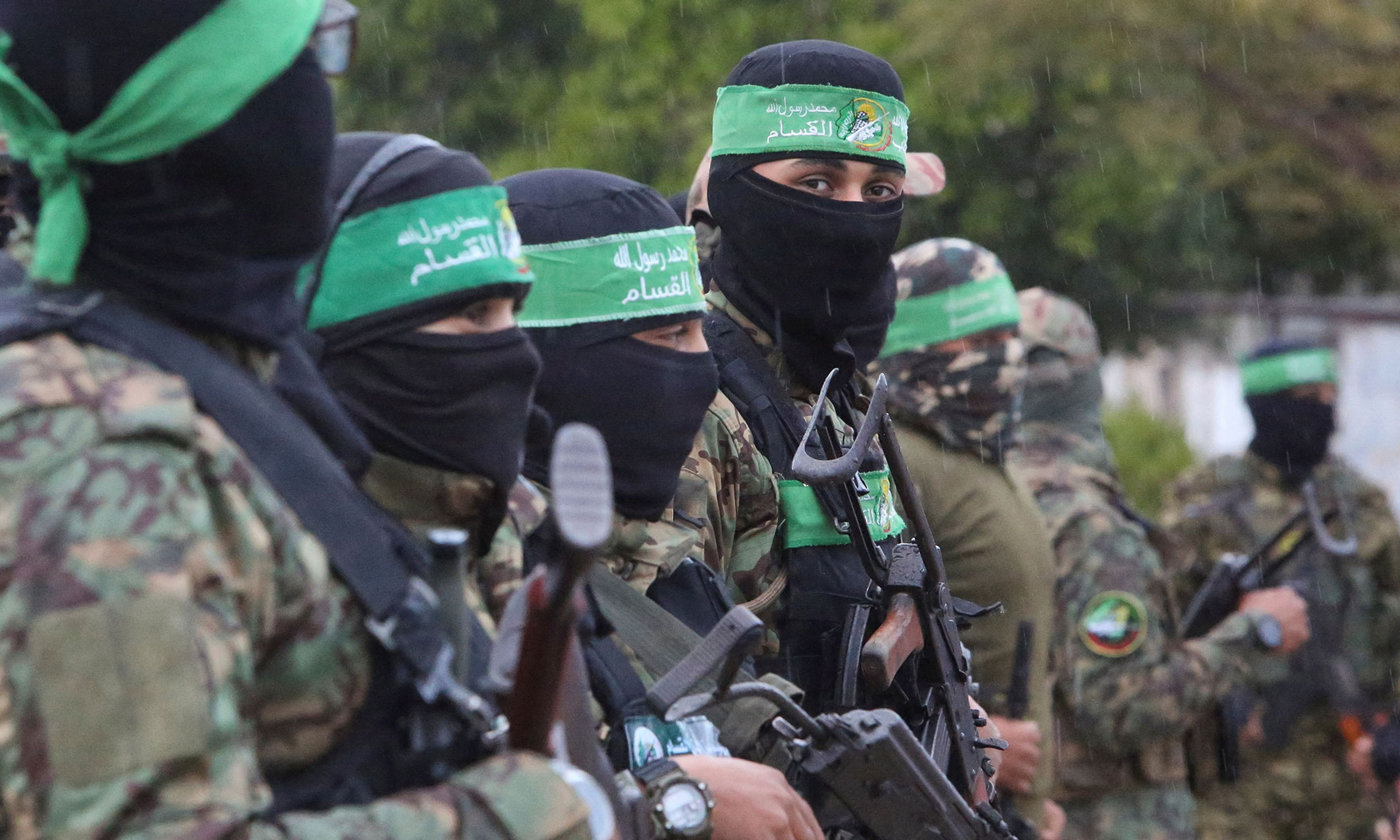
Hamas soldiers in Rafah, southern Gaza Strip, February 22, 2025, as several Israeli hostages from Oct. 7, 2023 were handed over.
Never in the field of human conflict was so much untruth given to so many readers by so many outlets. Over the past two years, the mainstream media have bent over backward to abet Hamas’s information war on Israel.
The latest example came on October 19, when the New York Times published a headline reading “Israel Strikes Gaza and Temporarily Halts Aid, Saying Hamas Broke Truce.” The story also buried the lede in reporting that Israel had “accus[ed] Hamas of violating the truce by firing on its soldiers, killing two.” The last bit is true: the IDF lost two men at the hands of the terrorist group. But the NYT failed to report that the cease-fire was broken by Hamas.
It wasn’t just the Gray Lady that manipulated the story to the terrorist group’s benefit. “Israel launches strikes in Gaza after accusing Hamas of violating ceasefire,” read a USA Today headline. “Israel’s government said Sunday it struck ‘dozens of Hamas terror targets’ across Gaza in response to earlier attacks against its troops by Hamas militants in southern Gaza,” reported NPR. The story is Israel’s retaliation, not Hamas’s instigation.
To call this a pattern would be an understatement. Mainstream media are curiously deferential to Hamas and incredulous toward Israel. The terrorist group undoubtedly counted on compliant media to run interference for it when it launched the October 7 attacks.
Hamas’s goal is to buy time, sow discord between Washington and Jerusalem, and drive worldwide pressure against Israel. Mainstream outlets have played a central role on the last count. Israel is fighting against not only genocidal terrorists but also their media enablers. If Hamas lives to fight another day, it will have the media to thank.
The press have been keen to vilify Israel at every juncture during the war. In their telling, the IDF can do no right and is the cause of all that goes wrong in Gaza. In October 2023, shortly after the war began, Western outlets blamed the explosion of a rocket at al-Ahli Hospital on Israel, when in fact Palestinian Islamic Jihad had fired it. Reporters also parroted casualty figures from the Hamas-run Gaza Health Ministry, even though Hamas makes no distinction between terrorists and civilians. And earlier this year, outlets published photos of emaciated Gazans as evidence of widespread starvation without acknowledging that they suffered from preexisting medical conditions.
European media outlets routinely deride Israel and provide cover for Hamas. Take the BBC, which failed to cut its livestream broadcast of British duo Bob Vylan leading chants of “death to the IDF” at the Glastonbury Festival in June. One month earlier, BBC presenter Gary Lineker shared a social media post likening Zionists to rats. The BBC also lends Hamas legitimacy by refusing to call its members “terrorists.”
Media organizations are supposed to be skeptical, especially amid the fog of war. Yet they have been venomously unfair to Israel, a parliamentary democracy, in its just war against Hamas, a terrorist group. What could possibly explain this other than the fact that these reporters and editors loathe Israel?
Many have attended elite schools where it is fashionable, if not obligatory, to be anti-Zionist. Israel is anathema to the worldwide revolution against injustice in which they have been trained to participate. They see the Israeli-Palestinian conflict as another battle in the ongoing struggle between oppressor and oppressed. Rather than reporting the news, they spin it to the detriment of the only Jewish state on the planet.
Compare the press’s treatment of Israel to its treatment of Ukraine, another democracy in an existential war. Ukraine has received overwhelmingly positive coverage from mainstream media, and Ukrainians have typically been portrayed as valiant defenders of their country. Taiwan, under threat from China, also receives relatively favorable treatment. Only Israel is defamed.
Thanks to this coverage, sympathy for Israel has all but disappeared overseas. European public opinion is now firmly against Israel. Although things are better in America, pro-Israel sentiment has waned. In July, 60 percent of Americans said they disapproved of Israel’s war in Gaza, compared to 45 percent who said the same thing in November 2023. Last year, President Trump told Prime Minister Benjamin Netanyahu that his country needed to “finish up” the war because of fading international support. “Israel has to be very careful because you are losing a lot of the world,” the president said. After months of further media smears, these words are more relevant than ever. Israel may be winning on the battlefield, but it’s losing in the information space.
War is horrible, and the reporting from Gaza should capture as much. But outlets have an obligation to get the facts right. Consumers of media around the world have been duped into thinking that Israel is an irredeemable aggressor. The consequences have been tragic. Western governments have recognized a nonexistent Palestinian state, suspended arms sales to Israel, and allowed antisemitic demonstrations to run roughshod over their cities.
Hamas could not ask for better friends than those in the media. Far more than its terror tunnels, small arms, or rockets, the press has been its strongest weapon against Israel.

About the Author
Daniel J. Samet is a Jeane Kirkpatrick Fellow at the American Enterprise Institute and the author of U.S. Defense Policy toward Israel: A Cold War History.
Featured Tags
Advertisement
Advertisement


Comments