The Opposite Errors of Two American Statesmen
Written by Dan McLaughlin
Alexander Stephens and Charles Sumner demonstrated the limits of political principle
Share this story
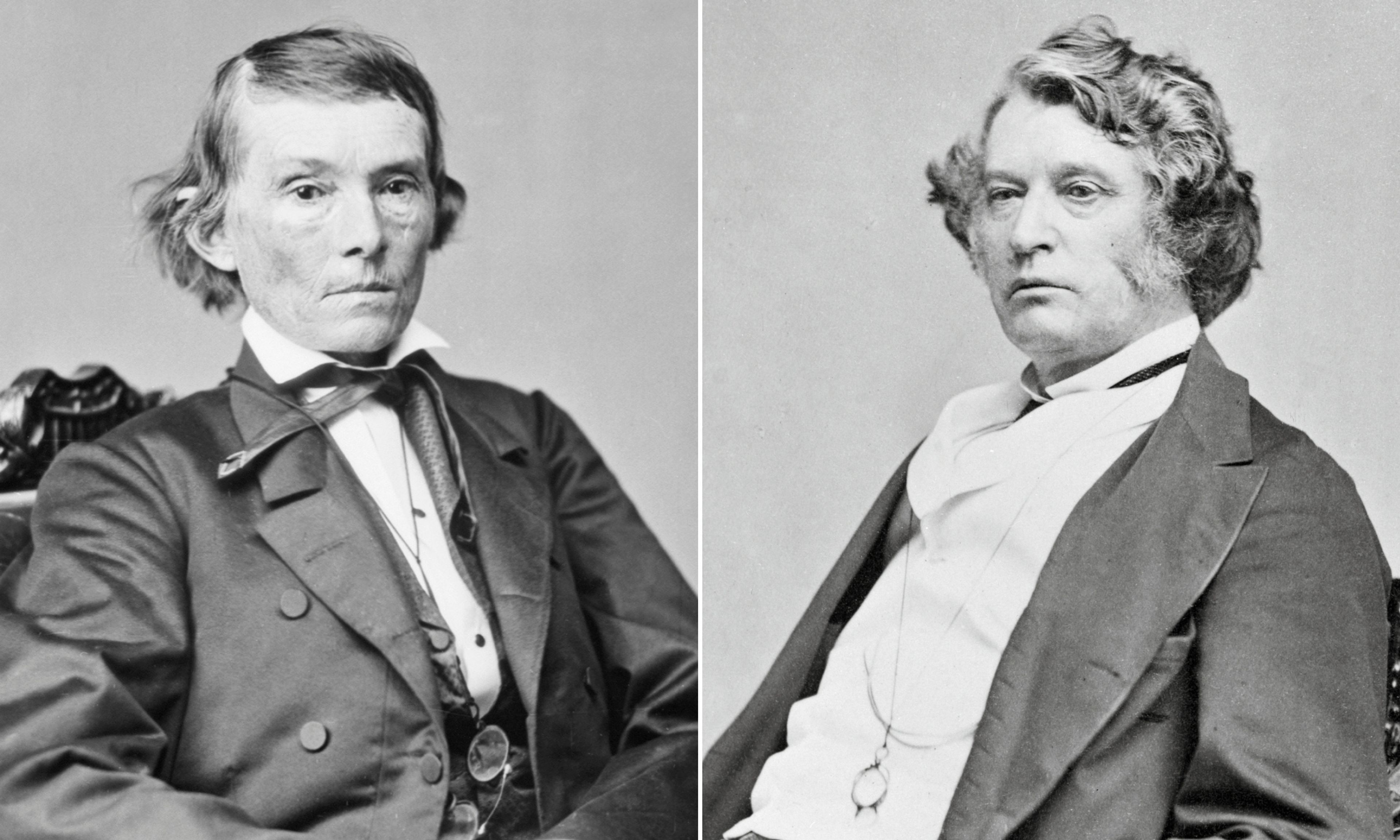
Alexander Stephens, left, and Charles Sumner
In politics, principle plays a vital role. But it has never been everything. For the statesman as for the democratic politician, principle guides, persuades, prioritizes, and justifies. Applied prudently, it is a compass, not a straitjacket. We can see the limits of principle in the competing careers of two mid-19th-century American statesmen: Alexander Hamilton Stephens, born on a Georgia farm in 1812, and Charles Sumner, born in Boston in 1811.
Stephens was born to play the intellectual in politics. Pallid and skeletal, he drew comparisons to an animated corpse. He dosed himself with whiskey to endure an assortment of debilitating ailments. Orphaned at 14, trained as a Presbyterian minister, he never married and partook of none of the pastimes of Southern manhood. He was drawn to the life of the mind.
From his election to Congress in 1842, through the vice presidency of the Confederacy, to his death in office as governor of Georgia in 1883, Stephens cultivated a self-image of a man of principle. Even his middle name was self-chosen for his Hamiltonian ideology, in honor of a mentor. He repeatedly took principled stands at odds with his party in Washington, his government in Richmond, and his own political self-interest. As he wrote after the Civil War: “Times change, and men often change with them, but principles never!”
Stephens was a fervent admirer of Edmund Burke, who argued that men of principle should choose the “honourable connection” of party even at the cost of disagreeable compromises in order to see their ideas put into practice -- but that men could leave their party over great questions. The Georgian’s commitments had a clear hierarchy. When facing a conflict with higher principles, nothing got in his way -- he lost friendships, abandoned policy positions, changed parties, and betrayed his country. Yet he never did so for what Jefferson called “light and transient causes.” For principle, he fought and compromised, sought war and peace, and went to prison.
Nearly a beau ideal of principled politics, Stephens rigorously thought through his ideas and took pains to defend his positions. He didn’t seek personal advantage and made no enemies except over matters of principle. Following the code of Southern honor, he challenged four men to duels (all declined, but one stabbed Stephens, almost fatally) -- never over personal slights but to defend political stances against charges of dishonor or disloyalty.
Raised in the traditions of American politics, he did the job the right way. From time to time, he stood bravely for good causes. Yet, in the end, nearly everything he fought for came to wrack and ruin. His name is a blot in the history books because his highest principles were wicked and wrong.
At 22, Stephens joined the new Whig Party. A devotee of John Marshall and the rule of law, he was horrified, upon meeting Andrew Jackson, at Jackson’s disinterest in legalities. He rejected state nullification of federal laws and vigilantism. In an early sign of his character, when Georgia elected him to the House as part of an at-large slate, he argued that the House should not seat the state’s delegation -- including himself -- because it violated federal law requiring single-member districts. He treasured a note of praise from John Quincy Adams, with whom he got on well despite profound differences on slavery.
Stephens tried to keep sectional divisions from dissolving the country or his party. He supported the annexation of Texas but opposed the Mexican War for seeking territory that would destabilize sectional balance -- distinguishing the two because Texas already had slavery, so annexation did not raise the question of whether to spread it there. He labored in 1852 to craft a pro–Compromise of 1850 Whig platform. When presidential nominee Winfield Scott repudiated the platform, Stephens cast a protest vote for a dead man.
In 1854, Stephens not only crossed party lines to back Stephen Douglas’s Kansas-Nebraska Act, he became its floor leader in the House, deploying his mastery of House rules to break an impasse and drag the bill to victory. It was a triumph of his political skill but also the most destructive legislation in American history. Finding his stance rejected by his party, he became a Democrat. He led the floor fight for the fraudulent pro-slavery Lecompton Constitution in Kansas -- opposed by Douglas -- out of desperation to prove that staying within the system was worth it.
A staunch defender of constitutional liberty, Stephens was repelled by the anti-immigrant Know-Nothings. But his vision of liberty entirely excluded black Americans. On his plantation, Liberty Hall -- named without apparent irony -- he treated his own slaves comparatively well. But he unblinkingly defended the peculiar institution in all its brutality.
He retired to Georgia in 1859, warning of the coming crisis. He backed Douglas in 1860, scorning the “rule or ruin” Southern extremists and cautioning that slavery was “much more secure in the Union than out of it.” Stephens spoke eloquently that fall against secession, on the Burkean ground that it was “revolution” by “demagogues” against accepting election results: “Revolutions are much easier started than controlled.” He would await instead some overt provocation by his old friend Abraham Lincoln. He expected Lincoln to govern well; Lincoln considered him for his cabinet. Unlike Sam Houston, whose conscience led him to leave public life rather than aid secession, Stephens felt honor-bound to aid Georgia: “My destiny is with the South; whatever awaits her people, awaits me.” He was key to persuading wavering Virginia to join the Confederacy, with vast consequences for the war.
Stephens declared his philosophy of the Confederacy in a now notorious speech, branding America’s founding ideas “fundamentally wrong”:
They rested upon the assumption of the equality of races. This was an error. It was a sandy foundation. . . . Our new government is founded upon exactly the opposite idea; its foundations are laid, its corner-stone rests, upon the great truth that the negro is not equal to the white man; that slavery subordination to the superior race is his natural and normal condition. This, our new government, is the first, in the history of the world, based upon this great physical, philosophical, and moral truth.
The speech undermined Confederate diplomacy, laying bare to anti-slavery Europe what others would have concealed.
As vice president, Stephens had better strategic sense than Jefferson Davis, who ignored his counsel. But he would not stay quiet on civil liberties. He objected to conscription, to requisitions, to suspensions of habeas corpus, and to suppression of dissent as violations of “ancient liberties” and state sovereignty. “Away with the idea of getting independence first, and looking for liberty afterwards,” he said; better defeat by enemies than to lose liberties to “professed friends.” He led the peace commission in February 1865, where he and Lincoln reunited warmly, but neither man would budge from his convictions. After the war, he returned to Congress and wrote didactic defenses of his stances. His final years were spent embittered by failure.
In the end, we may regard Stephens, as we do Robert E. Lee, as a moral tragedy. Like Lee, he lent good gifts and good instincts to a terrible cause. His devotion to his “corner-stone,” however sincere, undermined all else. Standing earnestly for principle is not enough. To leave the world a better place, one must stand not only for conscience but for right and truth.
Sumner was tall, handsome, gifted with an orator’s voice, and possessed of the noblest principles of pure classical liberalism. He wanted liberty and full legal equality for black Americans and for women. He tried to strike “white” from the naturalization laws. He was against aggressive war and imperialism. He abhorred secession and excoriated slavery and its apologetics ceaselessly and without patience for cant.
But Sumner was utterly lacking in prudence or tact, and his preening, humorless self-regard endlessly undermined his principles. Despite his own reverence for Burke, he was so impatient with the existing order that he often declared that “nothing can be settled which is not right.” Sumner was effective at driving wedges into the existing parties and settlements of the 1850s, but he was wholly unsuited to practical leadership.
Sumner was said to be the only man Lincoln truly disliked, regarding him as pompous and preachy. The easygoing Grant detested him: “He has not the manliness ever to admit an error. I feel a greater contempt for him than any other man in the Senate.” Told that Sumner didn’t believe in the Bible, Ulysses S. Grant quipped, “Well, he didn’t write it.” And those were Sumner’s political allies. No family man, he married for the first time at 55 but divorced his wife for abandonment.
In 1848, Lincoln backed the slaveholder Zachary Taylor for president, seeing him (correctly) as less apt to expand slavery than the Democrats. Sumner rallied the “Conscience Whigs” who cast protest votes for Martin Van Buren. He sought “a new crystallization of parties, in which there shall be one grand Northern party of Freedom.” Elected to the Senate from Massachusetts as a political novice in 1851, Sumner never learned to be an effective legislator.
He had much in common, in temperament, with his contemporary William Gladstone, the British statesman, whom he admired. But Gladstone, a Christian family man, entered politics early, cultivated key mentors, and made himself indispensable with his command of public finances. Sumner did none of this. He was better at dividing: he helped Salmon P. Chase and Joshua Giddings pen the “Appeal to the Independent Democrats” in January 1854 that rallied opposition to Kansas-Nebraska, helping lay the foundation for the birth of the Republican Party.
Sumner’s 1856 “Crime Against Kansas” speech was in a righteous cause, but Sumner -- who told Chase beforehand, “My soul is wrung by this outrage, & I shall pour it forth” -- let his dudgeon get the best of him. As one journalist said of his customary speaking style, “He works his adjectives so hard that if they ever catch him alone, they will murder him.” This day, he laid on the personal invective, mocking his elderly South Carolina colleague Andrew Butler. Douglas muttered, “That damn fool will get himself killed by some other damn fool.” He almost did, beaten senseless by Butler’s cousin on the Senate floor. The assault radicalized the North and galvanized the South. The most consequential thing Sumner ever did in Congress was to be so obnoxious that he was almost murdered.
The psychological trauma kept Sumner out of Washington for years. Returning to chair the Senate Foreign Relations Committee, he spent years in a guerrilla campaign to sabotage his onetime ally, Secretary of State William Seward. He goaded his close friend Chase into undermining Lincoln and tried to seize control of foreign policy after Seward was stabbed during the Lincoln assassination. An Anglophile who corresponded widely with British elites and a dove during the 1861 Trent war scare with Britain, Sumner turned on a dime into the loudest hater of England over its sales of commerce-raiding ships to the Confederacy.
Sumner’s rectitude was considered so immovable that Lincoln wouldn’t even approach him to make concessions on a railroad bill to win votes needed to pass the 13th Amendment and ban slavery. His subsequent breach with Grant was exacerbated by his criticisms of corruption and nepotism. Yet he could be selective. Early in the war, he was successfully courted by the notoriously corrupt Secretary of War Simon Cameron, who posed as a stauncher abolitionist than the pragmatic Lincoln. He also tried to get Grant to rescind the firing of a friend in exchange for supporting a treaty.
Predictably, Sumner took the hardest-line Radical Republican view of every controversy in Reconstruction and the failed impeachment of Andrew Johnson. Restoring his prominence with maximalist demands for Britain to evacuate the Western Hemisphere and pay the whole cost of the Civil War (outraging Gladstone), Sumner swiftly fell out with Grant as bitterly as with Seward. He sank Grant’s plans to annex the Dominican Republic, held up even minor ambassadorial appointments out of pique, and compared the conquering Union general to a “Ku Klux” and his secretary of state to “Mephistopheles.” An embarrassed bipartisan Senate voted 33–9 to strip him of his committee chairmanship. His departure cleared the way for Grant’s 1871–72 rapprochement with Gladstone, which laid the foundation for the U.S.-U.K. “special relationship.”
Sumner reverted to his 1848 form, backing Horace Greeley’s campaign against Grant and even appealing to black voters to abandon Grant while Greeley was running against Reconstruction and defending the Klan. An appalled Frederick Douglass, once Sumner’s friend, declared, “If Mr. Sumner shall persevere in his present policy, I shall . . . regard him as the worst foe the colored race has on this continent.” Sumner got his dying wish when the Civil Rights Act of 1875 was enacted months after his death. Once again, he was a more effective lawmaker as a symbol.
Sumner did more good as a political revolutionary who helped drive the nation’s confrontation with slavery than as a lawmaker. Stephens modeled many conservative virtues, but he spoiled them by embracing an evil as his highest good. Sumner preached a purer classically liberal philosophy but without the conservative virtues of prudence, pragmatism, humility, and civility. Both men tried to live by their principles. But statesmanship requires both sides of the coin.

About the Author
Dan McLaughlin is a senior writer at National Review Online and a fellow at National Review Institute.
Featured Tags
Advertisement
Advertisement


Comments