The President’s Not-So-Reassuring Iran Address
Written by Elliott Abrams
President Trump could have done a better job assuaging the concerns of the American public.
Share this story
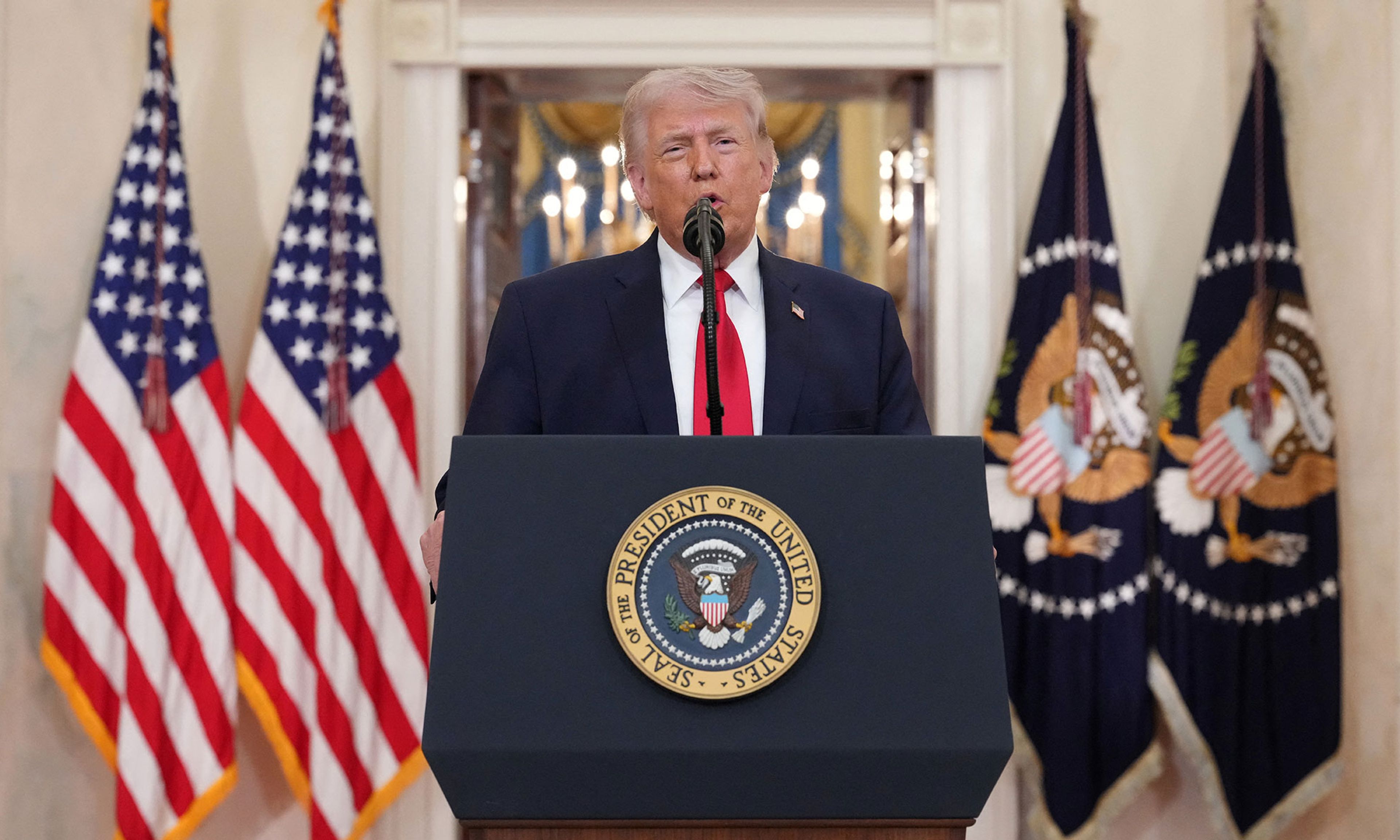
President Donald Trump delivers an address to the nation about the Iran war at the White House in Washington, D.C., April 1, 2026.
Finally last night, President Trump addressed the nation about the Iran war. Few supporters of the war will have found it a reassuring speech.
First, as a performance, it was unimpressive. The president read his lines too fast, and instead of emphasizing the key words or passages, he added comments that were sometimes irrelevant, other times disturbing, and often inaccurate. Do Americans really want to bomb Iran or anyone else “back the Stone Ages where they belong”? Does anyone believe the second-level Revolutionary Guard officers who’ve replaced those killed are actually “less radical and much more reasonable”? In what possible sense was Iran trying to build “a nuclear weapon like nobody's ever seen before”?
It would have been far better for the president to speak more plainly about the great achievements of these four weeks of combat. And the best parts of the speech were his explanations of our purpose: to prevent the world’s greatest state sponsor of terrorism from developing a nuclear weapon and from threatening its neighbors — and us — with intercontinental ballistic missiles and other growing military assets.
What did the president say about the future? Many predictions had suggested he would announce ending the war quickly, due to fear of the political effects of high oil prices and the falling stock market. But Donald Trump is always unpredictable and always thinking about bargaining to come. In the speech, he seemed to promise two to three more weeks of even heavier bombing, and by mid-April, it appears that both we and Israel will be getting to the bottom of our target lists. In early March, the White House and the Pentagon predicted the war would take four to six weeks, so they are pretty much on schedule.
And the war may end sooner. Pakistan is sending messages back and forth about a cease-fire. In my view, there will be no peace treaty to end the war, for two reasons. The two sides are too far apart in our demands, and there’s no individual or structure now in Tehran able to make the compromises any such multi-page agreement would require. So the likely end will come in a simple deal to stop shooting.
That leaves the Strait of Hormuz, and here the president is saying “don’t look at me, it’s an international responsibility.” He’s at least partially right: Why can’t there be an international maritime force protecting the strait from Iran? The European Union navies combine in EUNAVFOR Atalanta and the Maritime Security Centre Indian Ocean, joint efforts against piracy and to enhance maritime security off the Horn of Africa, in the Red Sea, Gulf of Aden, and Persian Gulf. The Combined Maritime Force is a 46-nation effort led by the United States with similar goals.
The point is that there are precedents and building blocks. It is regrettable that instead of urging (or leading) pragmatic, positive action, the president most often turns to insults of allies and threats to leave NATO. On Wednesday, British Prime Minister Keir Starmer invited more than 35 countries to a meeting on strait security, in London. That’s a start. There is no reason why a large multinational naval coalition cannot patrol the strait once this war ends, presumably in April.
As I’ve written elsewhere, the president’s kind words about those who are actually fighting on our side (he mentioned Israel, Saudi Arabia, Qatar, the UAE, Kuwait, and Bahrain, though except for Israel they are actually doing nothing but self-defense) makes his coldness to Ukraine even more indefensible. Ukraine is on our side too, helping our allies defend against the Iranian drones they know so well because Iran sells them to Russia. And like Israel, they fight patriotically and effectively. It is long past time for the president to square up who’s on our side and who’s against us, and to see Ukraine as a key ally and Russia as one of our worst enemies.
The speech seemed more like an effort to silence the critics who kept asking “why doesn’t the president speak to the nation?” than an important message he felt compelled to deliver on all the networks. Given that he speaks to the press almost every day, this kind of set speech may be superfluous in getting through to the public. And reading speeches isn’t his forte anyway. Back to Truth Social!

About the Author
Elliott Abrams was special representative for Venezuela in the Trump first term and assistant secretary of state for Latin America and the Caribbean in the Reagan administration.
Featured Tags
Advertisement
Advertisement
Comments