Share this story
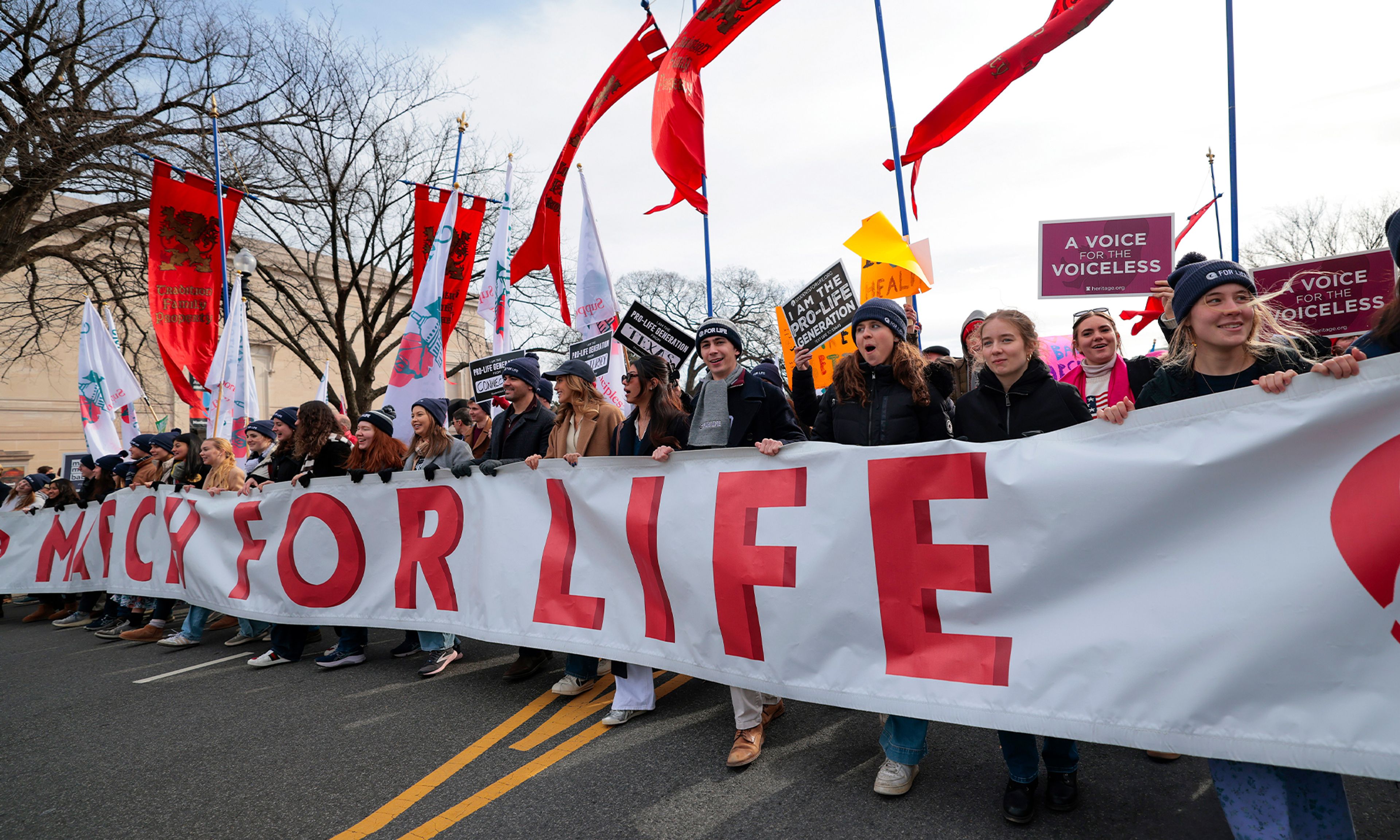
Pro-life demonstrators take part in the March for Life in Washington, D.C., January 23, 2026.
Let’s start with the good news. The American people have not made their peace with abortion and may even be inching in a pro-life direction. The latest Marist Poll showed that 37 percent of Americans still identify as pro-life, which is not thrilling given that roughly half the country was pro-life only a decade ago. Yet the complete picture gives real grounds for optimism. In the years since Dobbs v. Jackson Women’s Health Organization, the Supreme Court ruling that overturned Roe v. Wade, campaigns and interest groups have spent hundreds of millions on pro-choice messaging. Despite years of vilification, a formidable mass of pro-lifers have refused to budge. The movement has a remarkably stable core, and raw numbers are also misleading insofar as many people who now identify as “pro-choice” continue to support a range of pro-life goals, such as restrictions on late-term abortions and on mail-order abortion pills.
There are other encouraging data points, too. The pro-life movement seems to be regaining some momentum. A recent report from 19th News/SurveyMonkey, a left-leaning nonprofit that conducts online surveys on political issues, indicated that pro-lifers, for the first time since Dobbs, have reemerged as the more energized camp among Americans who view abortion as a priority. That’s a great relief after a few intense years in which the Democrats capitalized significantly on the post-Dobbs backlash. If that fury is now ebbing, pro-lifers may have a chance to regain their stride, especially given promising trends among young people, which really represent the best news of all. The latest Gallup data show a noteworthy uptick in the number of young adults (18–29) who identify as pro-life. The young also show increased support for restrictions on abortion. In the immediate aftermath of Dobbs, Zoomers appeared poised to become the most pro-choice generation in history, but that gap has effectively vanished in the space of just a few years. This should be a source of hope for pro-lifers. Young Americans are rethinking some things.
Then there’s the bad news. Politically, pro-lifers are frustrated. The movement may be picking up steam, but the Trump administration doesn’t seem to have noticed. They’ve offered some symbolic gestures, such as pardoning pro-life activists and sending Vice President JD Vance to speak at the March for Life. That can hardly make up for the administration’s willingness to facilitate the availability of mail-order abortion pills or to support technologies like in vitro fertilization, which involve the large-scale destruction of human embryos. Every dollar withheld from Planned Parenthood is good news, but that disruption in funding is only temporary, while the outcome of current debates about life issues could have much further-reaching consequences. Do today’s Republican leaders view pro-lifers as an important voice in that conversation? Do they feel obliged to give them a meaningful role in shaping Republican policy? It doesn’t look like it.
It’s possible that could change, and certainly pro-lifers should continue applying pressure on this administration as they can. But they also need to look to the future. For the most part, the second Trump administration has simply placated social conservatives, treating them as sympathetic has-beens whose heyday has passed. There is no good reason to accept that. Social conservatives still are a sizable contingent of the American electorate; they hold deep convictions, are engaged with serious issues, and maintain a formidable network of institutions and organizers. This is not the end of the road. But the pro-life movement does need to pause, take stock, and position itself for the next chapter in American political life. Hopefully, what’s yet to come is the formation of a more stable coalitional politics in which social conservatives can work toward their goals with greater success.
It will be an adjustment. The past decade has been volatile on the right, marked by giddy highs and wretched lows as Donald Trump’s mercurial agenda sets the tone for the rest of the party. If the next chapter is less personality-driven, that might on balance be good for the right, for America, and for the pro-life movement. But coalitions have their own challenges. Many social conservatives still harbor hard feelings toward old coalitional allies (free-market economists or neoconservatives) who didn’t always conceal their embarrassment at having to share a convention stage with so many Jesus freaks. A new coalition might have a different makeup, but we shouldn’t fool ourselves. The same thing would happen in any plausible configuration. Coalitions build on shared interests, but that doesn’t always imply a shared vision. Sometimes your allies just don’t like you all that much. It should be worth tolerating a little disdain for the sake of political gains, but after years of populist politics, the muscle for toleration may have atrophied a bit.
Of course it is genuinely important to survey the electoral landscape and ask, “Whom can we work with? Who might be willing to work with us?” Those questions are hard to answer right now, in the face of so many shifting variables. Some elements on the right do seem relatively stable; for instance, one certainly hopes that originalists and other sober-minded constitutionalists will remain a significant influence. But it’s anyone’s guess where American foreign policy will go over the next few years. Economic policy is very much in flux. Immigration hawks will likely have some role in a new right-wing coalition, but that issue is fast evolving, its trajectory hard to predict. A further fascinating question concerns the tech billionaires and their recent flirtation with right-wing politics. Where will they end up? How will their agenda change, and how will it affect the right’s priorities and platform?
Perhaps the hardest question concerns the shape of Trump’s shadow. Will we see the next incarnation of the American right building on Trump’s legacy, or running from it? Most likely there will be some of each, since politics always has cyclical elements. For social conservatives, this means preparing for different possible scenarios. They need to distill their own priorities, craft their own message, and be alert to opportunities. At its best, the pro-life movement has shown a remarkable capacity to blend an inspiring, humanizing vision with grounded, incrementalist strategy. Both attributes will be needed in years to come.
In recent years, pro-lifers have discussed what achievable goals they should aim for, widely agreeing that strategy must vary by state in accord with local political realities. Reasonable goals might include conscience protections for physicians and other health-care professionals, bans on later-term abortions, and an end to taxpayer funding for providers of abortion and IVF. At the national level, pro-lifers should continue pressing for tighter restrictions on abortion-inducing drugs such as mifepristone and misoprostol, which can generally be obtained even in states with stringent restrictions on abortion. Incrementalism by nature involves a constantly shifting set of goals and objectives, but pro-lifers, unified by deep conviction and a driving vision, historically have been fairly adept at managing that.
Today, though, it may be the vision that needs the most work. Up front, that may seem surprising, because the movement’s defining principles haven’t changed; it’s the culture that keeps moving. The pro-life cause was built from the beginning around the deep conviction that every person matters. Every single human being is precious, unique, and worthy of love. That has always been the core message, and the world still needs to hear it.
As culture changes, however, pro-life talking points may need some adjustment, too. Threats to prenatal life are arguably greater today than ever before, but for reasons somewhat different from those in the past. A few decades ago, abortion was viewed primarily through the lens of the “crisis pregnancy,” an all-too-common occurrence thanks to sexual libertinism and family breakdown. Pro-lifers responded by advising the young to “wait until marriage” while also offering services for pregnant women in difficult circumstances. Today, unwanted pregnancies surely still happen, but “wait until marriage” is an awfully quaint-sounding message for young generations who are increasingly leery of marriage, pregnancy, and even sex. Meanwhile, self-described natalists include people who regard it as not merely ethical but even morally imperative to use reproductive technology to select the healthiest and fittest children while discarding the rest. More embryos are now lost through the IVF process than through induced abortions. Not everyone who makes use of IVF is equally callous about the loss of prenatal life, and certainly there is a moral difference between intentionally destroying human life and engaging in medical practices that foreseeably put it at great risk. But the reality is that efforts to create life are now a major source of concern for anyone who is consistently pro-life.
These are significant challenges for the pro-life movement. It’s no longer enough to promote sexual discipline and a pro-family ethos; the movement needs a message and a vision that respond to these new realities. This is especially challenging given that the public is broadly supportive of IVF, particularly as a means of enabling infertile couples to have a family. Things were simpler back when the pro-life movement was clearly the “pro-baby” camp, lining up against hard-charging feminists in pantsuits. Today, it might be pro-lifers who get backed into arguing that there’s more to life than parenting.
The landscape is daunting. The questions are hard. Ultimately, though, it’s at this moment that we most need serious people to step up and offer a message worth hearing. That message should be rooted in the conviction that has guided the pro-life movement all along: human life is intrinsically precious. Children are not projects, pets, or utility maximizers. Their value is not dependent on their “quality of life” or how adults in their community feel about them. It’s a message that applies to the impoverished woman coping with an out-of-wedlock pregnancy as well as the affluent couple looking to select the perfect embryo. The right to life has been a guiding star for social conservatives for many decades, and it can be still.
From the 1980s through the Trump revolution, that message helped to ground Reaganite conservatism, supplying both a core of voters and a hefty moral ballast. The pro-life movement has been one of the most transformative political phenomena in American history, with deep roots in both Judeo-Christian tradition and the American political tradition. Pro-lifers need to draw courage from that and also from the very real signs that the young, in particular, are actively seeking better and richer answers to their own generation’s defining questions. The American people have not made their peace with abortion. The debate about life issues continues. No matter what the future holds for the political right, social conservatives need to ensure that their voice is heard -- firm, authoritative, and always pro-life.

About the Author
Rachel Lu is an associate editor of Law & Liberty and a contributing writer at America magazine.
Featured Tags
Advertisement
Advertisement




Comments