The Resurrection of a Shipwrecked Sailor
Written by Jack Crowe
Connecting a lost captain to his modern descendants
Share this story
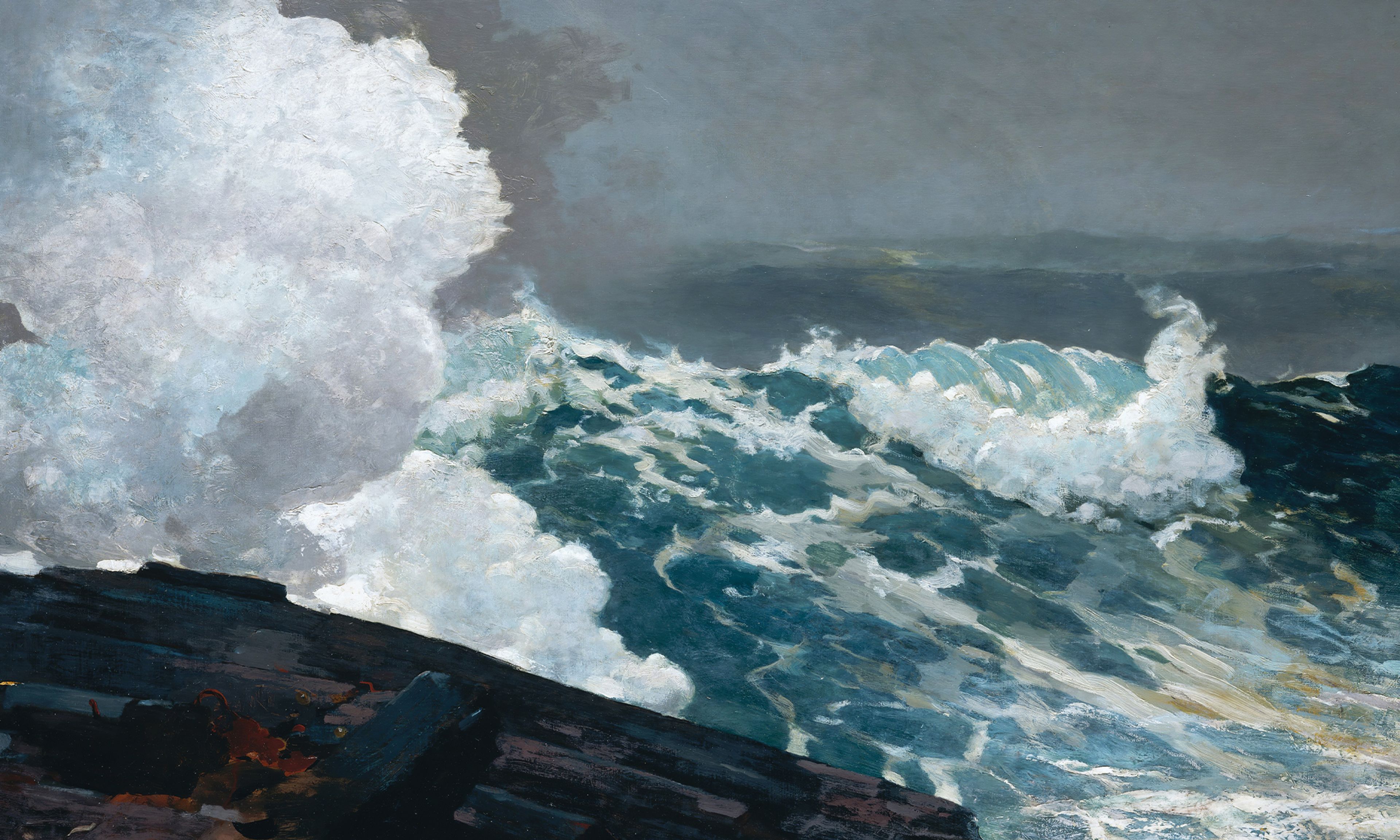
Winslow Homer, <i>Northeaster</i>, 1895
Credit: Heritage Images / Getty Images
“A number of wrecks have been passed at sea whose melancholy story we fear will never be told.”
-- The Sailor’s Magazine,
February 1845
Nothing about the way Captain Henry Goodsell lived or died was unusual for his time and place. That we know his name at all, more than 180 years after he drowned off the coast of New Jersey, is miraculous.
Goodsell’s ship, the Oriental, ran aground and broke up on Brigantine Shoal, roughly half a mile offshore, in December 1844, resulting in his death and the deaths of his crewmen. That should have been the end of Goodsell’s story; as with the countless sailors lost to the sea before and since, Goodsell’s family would have no definitive answers about his final moments and no grave at which to mourn.
A story of discovery began more than 100 years later when human remains began washing up on New Jersey’s beaches. First, a piece of a skull was found along the shoreline in Longport in 1995; next, bone fragments were found on the beach in Margate, less than two miles away; then, in 2013, skeletal remains washed up in nearby Ocean City. Using DNA testing, authorities were able to determine that the remains all belonged to the same male body -- but they couldn’t identify who that person was. So, they took to calling him “Scattered Man.”
Thanks to modern genealogical science, good old-fashioned police work, and the unwitting participation of dozens of Goodsell’s descendants, in early 2025, Scattered Man reclaimed his identity as Captain Henry Goodsell.
Before the railroad caught on as the country’s most reliable and affordable shipping method, if you wanted to move a large quantity of goods up and down the East Coast, you relied on men like Goodsell, the master and owner of the 70-foot, 95-ton, two-masted schooner Oriental.
Like so much else about Goodsell’s life, the route he’d be taking that fateful December was typical of an Atlantic intercoastal merchant vessel, starting out in his native Bridgeport, Conn., stopping off in Manhattan, and continuing down the coast to Philadelphia.
Goodsell left Bridgeport with a cargo of saddletrees, the wooden frames that undergird the leather of a saddle; 60 tons of marble, bound for Girard College, a Philadelphia prep school that was then being built; and a load of cheese and onions.
Also aboard were four crew members, likely local men who, like Goodsell, had grown up in the maritime trade. Goodsell would probably have finished his formal schooling around 16 and then spent several years before the mast as an apprentice before taking on more senior roles aboard various ships. At age 29, he owned and operated his own vessel, which put him solidly in the middle class and allowed him to provide a comfortable living for his wife and two young children.
The Goodsell family was well established in the area: The saddletrees Henry was hauling were crafted by his older brother Burr, whose products were evidently in demand up and down the East Coast. That Burr Goodsell would have relied on a family member to transport his goods was typical for the time; merchants understandably wanted to ship their precious cargo with someone they could trust and, more importantly, someone they could hold accountable if things went wrong. And, in the case of the Oriental, things seemed to have gone wrong quickly.
In the mid-1800s, it typically took about a day and a half to sail from Bridgeport to Manhattan on a schooner like the one Goodsell captained. It took Goodsell three days. The delay was likely the result of rough weather -- New England experienced an unusually stormy December in 1844 -- and the ship may have sustained damage that would later play into the wreck.
After a brief stop in Manhattan, the Oriental continued south down the coast, until disaster struck just half a mile off the coast of New Jersey.
Goodsell was born in 1815 to William Goodsell and Prudence Nichols Goodsell. William owned a butcher shop but is referred to in historical records as “Captain,” so it’s safe to assume that he was reared in the maritime trade like many other young men in coastal New England at that time. Henry was one of seven children, one of whom died in infancy.
Henry married Eliza Wakeman in 1836 at age 21, but she died just a month after they wed. Three years later, he married Sarah Emerson Martin. They had two children, William Henry, born in 1842, and Sarah Letitia, born in 1843. The children would grow up not knowing their father.
“No one can have visited freely among the families of seamen, without receiving a very vivid impression of the peculiar horrors to which they are exposed,” the Reverend John S. C. Abbott observed in an article about a Nantucket man, one of his parishioners, who drowned while on a whaling voyage the same year Goodsell drowned.
Abbott notes that, in his congregation of 700, there was not a single person who hadn’t lost a close friend or family member to the sea. While Nantucket was home to the particularly dangerous whaling trade, which entailed yearslong journeys around the Horn of Africa, the population of Goodsell’s hometown of Bridgeport would have been similarly affected by the dangers of sailing life.
The New Jersey State Police initially believed that the skull fragment that washed up on the beach in Margate in 1995 belonged to a modern person because it contained a tooth with a gold filling. This being New Jersey, Cairenn Binder, assistant director of Ramapo College Investigative Genetic Genealogical Center (IGGC), made the next logical leap.
“I was really thinking The Sopranos, like somebody who had been thrown overboard from a boat,” Binder told me.
The IGGC team was further confused by the police forensics lab’s determination that the bones showed no signs of having been submerged in salt water for a long period of time. So where did Goodsell’s bones spend the last 180 years?
“That’s part of the mystery that we’ll never be able to solve,” Binder said. But when the IGGC team uploaded Scattered Man’s DNA to a third-party database, the most recent matches that turned up were from the 17th and 18th centuries -- and given that the bones were found spread across several miles of beach, Binder and the team of some 25 volunteers started considering the possibility of a shipwreck.
The investigative genealogical work that the IGGC team does is a combination of modern DNA science and old-fashioned genealogical work, like family-tree-building.
All the DNA matches the team received came from people living in the Litchfield, Conn., area who had a common ancestor with Scattered Man dating back several hundred years, so the team revised its search to focus on ships that sailed from New England down the coast.
When Goodsell felt the hull of the Oriental run aground late on the night of December 4, 1844, he must have known the end was near. Brigantine Shoal, a sandbar off the coast of Atlantic City, has claimed more than 300 ships since the 1700s, as noted by Paul C. Burgess in his Annals of Brigantine (1964). The shoal rises abruptly out of the depths of the Atlantic, lurking just five or six feet beneath the surface at low tide.
The water in the Atlantic in December typically hovers around 40 degrees Fahrenheit, a temperature that can cause death by hypothermia in as little as 30 minutes. A standard Coast Guard rule of thumb has it that if a person capsizes in 50-degree water, he has a 50/50 chance of being able to swim 50 yards before succumbing to hypothermia. The water in the Atlantic the night that Goodsell ran aground was likely even colder.
The tragedy was compounded by the fact that the schooner ran aground and broke up within sight of the shore. Bystanders watched helplessly from Brigantine Beach as Goodsell and his crew drowned. The massive blocks of marble stowed in Goodsell’s hull may have played a role in the disaster. “It appears she was standing for the shore, having probably sprung a leak, and that she suddenly went down head foremost, at the distance of half or three quarters of a mile from the beach,” reads one account from the Bridgeport Standard. “Five or six persons (so says the Absecom Postmaster) were seen on board just before she sunk. The storm was so tremendous that no help could be given from the shore.”
On July 18, 1850, six years after the Oriental’s doomed voyage, a 530-ton vessel en route to Manhattan from Italy ran aground on Fire Island, a barrier island off New York’s Long Island, in a storm.
Like the Oriental, the Elizabeth was carrying marble. It was also carrying the feminist writer Margaret Fuller, her husband Marquis Giovanni Ossoli, and their son, Angelino, all three of whom would perish in the wreck.
Fuller’s prominence -- her death was a loss for American letters and the 19th-century feminist movement -- ensured that the shipwreck tragedy would be thoroughly documented. In this case, the record was written by a literary titan. Fuller’s close friend Ralph Waldo Emerson dispatched Henry David Thoreau, another friend of Fuller’s, to Fire Island just six days after the wreck to interview survivors and locals who’d watched the ship break apart from the beach.
On the night she sank, the Elizabeth was piloted by an inexperienced first mate. The ship was battered by gale-force winds and towering waves, and the first mate mistook the Fire Island Lighthouse for the Navesink Light off Cape May, N.J. Instead of sailing into the mouth of New York Harbor, he sailed directly into Fire Island; when the vessel struck sand, some portion of the 100 tons of Italian marble sitting below deck punctured the vessel’s hull.
Laying out the scene as described to him by members of the crew, Thoreau wrote, “The marble caused that at the first thump she broke her knees off like pipe staves.” The “knees” are the curved pieces of wood that give the hull of a ship its shape.
As water began pouring into the ship, Fuller asked the first mate to gather what little money she had brought on board along with some heirloom pieces of jewelry. The 40-year-old mother, returning to the U.S. with her husband and child in tow for the first time, then gave her life vest to a sailor, asking him to swim to shore to seek help while she sat on the deck of the ship as it broke apart.
“The Ossolis sat still & silent,” Thoreau wrote, relaying the scene as described to him by the Elizabeth’s first mate. “The child did not cry -- Margaret sat flat on the deck in her white night dress with her back to the bulwarks on the upper-windward side her feet toward the foremast -- the sea breaking over all. . . .”
Given the water temperature in December, when Goodsell and his crew went down with the Oriental, they had virtually no chance of survival. Fuller and her family, whose vessel wrecked in July, would have had a decent chance if bystanders had acted quickly.
But the massive waves pounding the beach that night kept Fuller’s would-be rescuers onshore, as Thoreau noted with more than a hint of derision: “The men on shore had not courage enough to launch the lifeboat. . . . The men sat for an hour or two on the side of the boat, doing nothing, but now & then picking up a hat that came ashore.”
According to a local couple who spoke with Thoreau, the lifeboat did not reach the wreck until noon, some nine hours after the ship ran aground.
Thoreau speculates that, had the lifeboat made it to the Elizabeth even an hour and a half earlier, Fuller and her family would have been saved. The wreck -- and Fuller’s death -- are widely credited with having led to the first government-sponsored lifeguarding service on area beaches.
Asailor’s life in the mid-19th century was certainly dangerous -- but perhaps even worse, it was maddeningly unpredictable. Wind, waves, and the whims of a fickle, transient, and sometimes drunk crew dictated when a ship might arrive at its destination -- or whether it would arrive at all.
In 1844, Goodsell was one of 105 sailors who lost their lives at sea, as The Sailor’s Magazine reported in 1845. The Oriental was one of 208 vessels wrecked at sea, 82 of which were schooners of the kind Goodsell captained. Twenty vessels were lost and never found.
In his last letter to his wife, written on August 16, 1850, about his impending voyage from Pensacola, Fla., to Maine, Captain Joseph Baker Loring explained: “We may be becalmed 15 or 20 days at a time in the Gulf of Mexico, so there is no telling with any degree of certainty how long it will take.”
Setting sail with a cargo of timber, Loring was aware that he might run into a hurricane on his way up the coast. His stoicism in confronting that fact shows just how ready the sailors of Goodsell’s era were to face mortal danger.
“If we can be so fortunate as to steer clear of hurricanes going home I shall like it,” Loring wrote, as if describing what he’d like for dinner that night.
Yet a tender line in his letter may suggest the sea captain’s awareness that any voyage might be his last: “Would that I could be with you even for one short moment,” he wrote.
Loring and his crew were not fortunate. They set sail aboard the Caroline on August 22, 1850, and were never seen again.
Sailors in the Caroline’s vicinity reported a hurricane shortly after the ship left Pensacola, and it was assumed that the ship went down with all hands -- that’s as much information as Mary Wilson Loring ever got about her husband’s disappearance.
Loring’s life and death and his wife’s loss perfectly capture the harsh reality of the maritime trade of the mid-19th century. So commonplace was this sort of loss in coastal communities that it affected the design of houses: hence the “widow’s walk,” a platform atop the roof of homes facing the sea, where the wife of a sailor might pace, awaiting her husband’s return.
The IGGC team was pretty sure they were dealing with a shipwreck, and they knew that Scattered Man’s family came from the Connecticut area, so they began comparing shipwreck records from New Jersey with Connecticut records and eventually identified the Oriental, captained by one Henry Goodsell.
Over the course of several months in late 2024, the IGGC team compiled a list of about 40 people they believed to be relatives, most of them very distant ones, of Goodsell.
One of those descendants, Tim Ruth, who lives in California, got a strange voicemail from a New Jersey State Police detective. When he called the detective back, he learned that the DNA he had uploaded to a genealogical database had been flagged in the Scattered Man research, along with the DNA uploaded by his mother. He was the fourth cousin six times removed of Captain Henry Goodsell. To identify an ancestor common to Ruth and Goodsell, you have to go back nine generations, to a man who was born in 1618.
Ruth told me that after listening to the voicemail from the detective, he received a call from his aunt in Ohio. A local police officer had come by to explain that they were looking for her nephew. The police had also contacted Ruth’s mother, whose DNA was also identified as a match with Goodsell.
It was an odd experience, he said, having a police officer tell you about a long-forgotten branch of your family.
Eventually, with the help of those relatives, the IGGC team identified a woman they believed to be Goodsell’s great-great-granddaughter, who agreed to turn over a DNA sample to confirm her lineage. It matched that of Scattered Man.
After decades at sea, Captain Henry Goodsell had made landfall.

About the Author
Jack Crowe is the senior news editor of National Review Online.
Featured Tags
Advertisement
Advertisement


Comments