Share this story
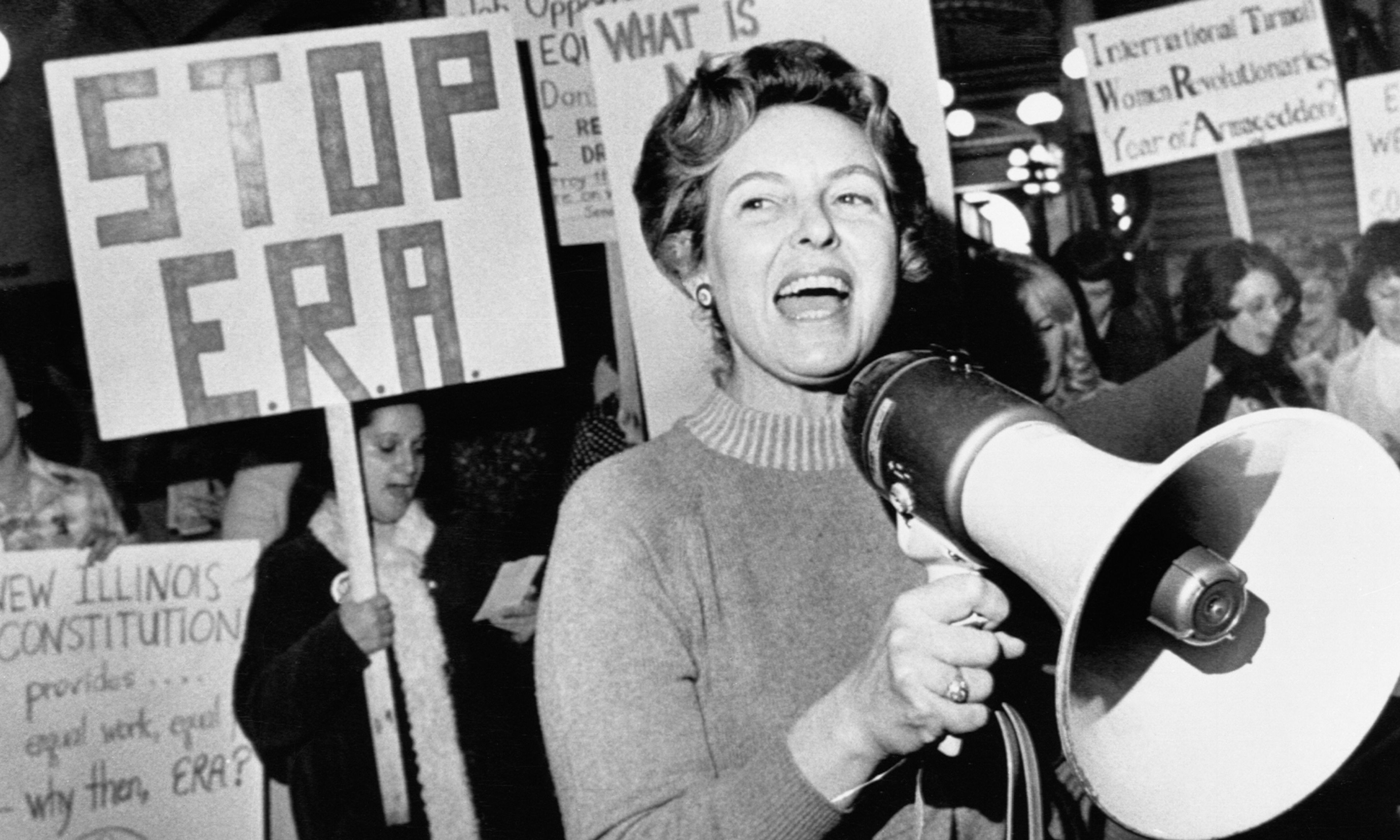
Phyllis Schlafly, 1976
There is a curious comfort in revisiting Phyllis Schlafly’s A Choice Not an Echo, the book that propelled Barry Goldwater to the Republican presidential nomination in 1964 and established Schlafly as a major national influencer. Half a century after its original publication, the book still crackles with a certain energy. Schlafly had a wonderful knack for the pithy phrase, the savvy slur, the damning detail. Mean-spirited and conspiratorial, she trained her guns on fellow Republicans, eager for factional conflict. It’s shameless propaganda. And yet, from a comfortable distance, it’s also a rollicking good read. It’s oddly reassuring to be reminded that the political sphere has its own enduring (if ugly) truths, and that shills and sophists will always be with us.
Should we, at least in part, lament this reality? It’s a hard question, and Schlafly represents a fascinating test case. She played a major role in bringing movement conservatism into the national spotlight. And she was a propagandist through and through, a true virtuoso of the paranoid style.
Consider for a moment the strange sequence of events surrounding this momentous little book. Goldwater first emerged on the national scene in 1952, when he defeated the highly respected Ernest McFarland in Arizona’s senatorial race. He soon caught the eye of movement conservatives, who loved Goldwater’s profile as a straight-talking, principled man who hated communism and loved free enterprise. Conservatism itself was in a formative phase in the 1950s, as it defined its key principles and consolidated around the core of intellectuals assembled at the fledgling National Review. Goldwater seemed ideally suited to bring this new strain of conservatism to electoral politics, challenging the Eisenhower Republicans for control of the party. In 1960, his book The Conscience of a Conservative (ghostwritten by L. Brent Bozell of NR) made a strong case for liberty, limited government, free markets, and a principled constitutionalism, thus cementing Goldwater’s place as conservatism’s political standard-bearer. But even though the book made a splash among college students and grassroots activists, Goldwater remained at the margins of the party, with very long odds of securing the Republican nomination.
Then came Schlafly. Her scathing polemic spared only a few pages for a rehearsal of Goldwater’s virtues, but it was merciless in its indictment of the “little group of secret kingmakers,” the political elites who met in a royal suite of the Waldorf Astoria hotel in 1936 and, through the ’40s and ’50s, controlled “the choice of the Republican presidential nominee just as completely as the Paris dressmakers control the length of women’s skirts.” In Schlafly’s telling, real electoral decisions were made in supersecret, smoke-filled meetings. Public political events were essentially staged set pieces, coordinated to the smallest detail by the political puppet masters in accord with their “psychological warfare techniques.” American voters were being treated to a kind of democracy pageant in which media, polls, and politicians all played their assigned roles in supporting and protecting the true Inner Party. They didn’t greatly care who won the elections, because all candidates were mere stooges for the uniparty. “The strategy of politics, like an iceberg,” she warned darkly, “is eight-ninths under the surface.”
Schlafly’s phrase, “a choice not an echo,” captured the tenor of Goldwater’s campaign so perfectly that he adopted it in announcing his candidacy in 1964. It seemed evident to both that the American people were ready to break with uniparty politics. Schlafly assured her readers that the Republicans “could not lose” if they offered the strong, substantive platform that voters undoubtedly craved. The kingmakers, she argued, made perverse policy choices because they wanted communism to continue, having positioned themselves to profit from the foreign aid ostensibly justified by the effort to stop communism. In fact, the “Red empire” would already have collapsed under its own weight had not the American government repeatedly rescued it in service of this nefarious agenda. New Deal programs were another elite boondoggle that ordinary, freedom-loving Americans would gladly forgo. Though her signature phrase mentioned “choice,” Schlafly never truly dealt in trade-offs. Truth and justice were the American way, sure to triumph if only democracy could be freed from the kingmakers’ iron grip.
A Choice Not an Echo was equally noteworthy for its success and its failure. As a propaganda piece, it was devastating, and the marketing and distribution were stunning. Cold-shouldered by the mainstream presses, Schlafly decided to self-publish, circulating the book through a massive network of volunteers. This method played perfectly to her strengths. Politically active housewives (so crucial to the activism of her later career) were mobilized to distribute the book, sometimes selling it from the trunks of their cars. Copies were placed in community centers, on convention chairs, and in the hands of donors and political operatives. Schlafly unleashed the wave of grassroots energy that Goldwater successfully rode to his shocking 1964 convention victory. He promptly used his new platform to denounce the “Eastern Establishment,” broadcasting to all that a new era was dawning for the American right. It was a heady hour for movement conservatives, their first true moment in the sun. It never would have happened without Schlafly. The next episode was less glorious. Goldwater lost the election, badly. Americans, it turned out, were not really so eager to break with the uniparty and Lyndon Johnson’s Great Society. The Eastern Establishment sneered, and conservatives went back to the drawing board.
Decades later, they are still debating the lessons of the failed Goldwater campaign. To some, it has the romantic aura of a noble lost cause. Others view it more philosophically as a salutary lesson in the importance of balancing principle with practicality, something the nascent conservative movement in the 1960s had yet to learn. In this latter interpretation, the Goldwater fiasco represented the growing pains of a movement that would rise again in a more mature form under the leadership of Ronald Reagan. The ideas were good, but the moment was not yet ripe.
Rereading Schlafly’s missive, one is forced to consider a less hopeful lesson. Perhaps the Goldwater takeover really wasn’t so principled in the first place. Perhaps its longest-surviving legacy will be not conservative principle or intellectual integrity but a power-hungry populism that seems to wax strongest whenever the right is frustrated and losing its way. Perhaps the “last man standing” among those rising conservative stars will turn out to be a woman, who taught the right never to compromise and never to believe people who tell you things you don’t want to hear.
Undoubtedly, Schlafly was right about certain things. It was perfectly true, for instance, that a relatively small group of center-right moderates exercised disproportionate influence over the Republican Party. It was true, as she related, that they used some fairly ruthless political tactics to secure the 1952 Republican nomination for Dwight Eisenhower over the base’s preferred choice, Robert Taft. Even so, Schlafly’s broader narrative is hyperbolic to the point of farce. Does anyone today believe that the Eisenhower Republicans secretly schemed to perpetuate communism like the Inner Party puppet masters of 1984? Even if politicians wanted to manipulate the public with meticulously scripted political events, as Schlafly alleged, are they capable of that much cooperation? Goldwater Republicans tend to be remembered as “too principled for their own good,” but A Choice Not an Echo hardly fits that profile. It’s agitprop. It’s sensationalism. This was clickbait before there were clicks.
The book feels eerily contemporary for another reason. Schlafly is telling the populist story with plot points that are now as familiar to us as “once upon a time” and “happily ever after.” The nation is imperiled not by real threats in a dangerous world but by malevolent elites who sabotage American interests for purely selfish reasons. Ordinary Americans, being good and true, want sensible policies (and would mostly agree with her about what those are); if polls or analysts suggest otherwise, that’s because they’re manipulative liars. Everything depends on the breaking of the elite stranglehold.
Does this sound familiar? Is it at all surprising that Schlafly’s last significant political act, just before her death in 2016, was to give her blessing to Donald Trump?
It’s not necessary to choose among these possible morals. All hold some measure of truth. Mid-century movement conservatives did have some noble goals and principles, many of which bore fruit in later years. Schlafly herself had immense gifts, among them a truly extraordinary level of moxie (reminiscent of our current president’s), which sometimes gave her an awe-inspiring ability to carry the whole world before her. Her achievements were genuinely remarkable, especially for a mother of six. Unfortunately, her defining story was not true, or not true enough. It has echoed across the decades, but some of those echoes have been noxious.
Propaganda will always be part of politics, but if we want better choices, we may need to tell truer stories. Only stories of that kind can secure our freedom.

About the Author
Rachel Lu is an associate editor of Law & Liberty and a contributing writer at America magazine.
Featured Tags
Advertisement
Advertisement
Comments