The Spirit Airlines Bailout Is a Bad Idea Built on a Worse Precedent
Written by Veronique de Rugy & Gary Leff
Once the federal government signals that struggling carriers can descend on Washington for relief, the line forms quickly.
Share this story
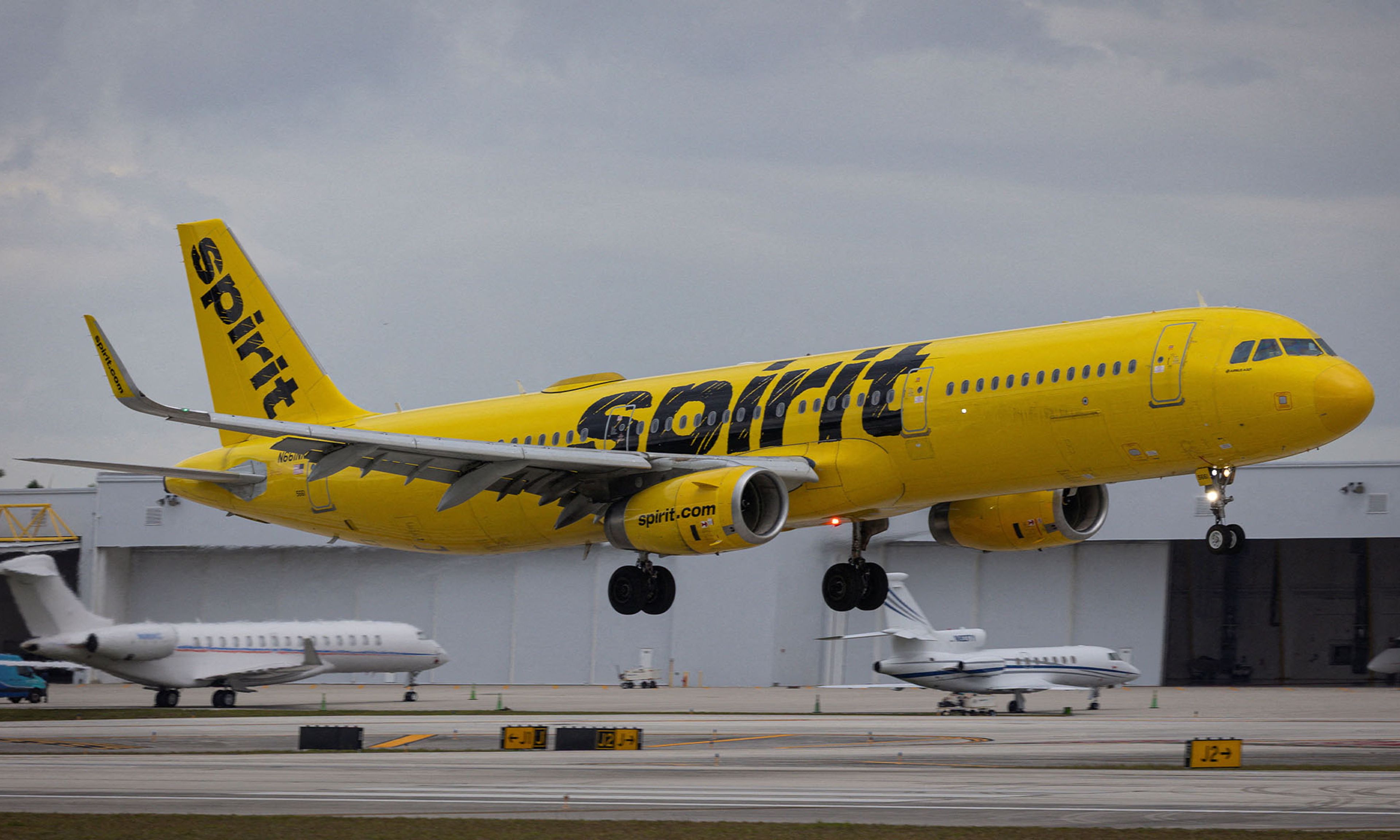
A Spirit Airlines flight arrives at Fort Lauderdale - Hollywood International Airport, in Fort Lauderdale, Fla., April 23, 2026.
The Trump administration is considering a $500 million bailout for Spirit Airlines, and, judging by some accounts, this isn’t merely a cash injection. Reportedly, the deal would give the federal government warrants to acquire 90 percent of the airline’s equity. If so, Washington would hold the power to become the controlling owner at any moment of its choosing. For a company in bankruptcy with no meaningful private investors waiting in the wings, that is nationalization in everything but the paperwork.
If this goes through, the government would be buying an airline that’s in its second bankruptcy in less than a year -- an airline that serves less than 1.5 percent of the domestic market, reduced sharply by both its bankruptcy restructuring and widespread engine groundings, with no credible plan to return to profitability
This is a bad idea that deserves to be called what it is: Washington nationalizing a problem it partially created with a misguided application of antitrust, for a company that consumers don’t want, at the expense of its competitors, and handing taxpayers the bill.
Start with the timeline. Spirit didn’t arrive on the government’s doorstep after exhausting every private option. It arrived after the Biden Justice Department blocked its best private option. Spirit had a deal with JetBlue. A federal judge, persuaded by the government’s argument that the merger had to be stopped to protect price-sensitive consumers, killed it. The theory was that Spirit’s ultra-low fares were a public good worth preserving through antitrust intervention. These were shaky grounds for intervening, in part because Spirit’s fares were only possible as long as Spirit could grow and its costs remained low, while wages and airport costs were rising even as consumers were already walking away from Spirit.
Indeed, Spirit was in serious financial distress before jet-fuel prices spiked. Its cost model depended on growth and high aircraft utilization, and when it couldn’t grow, partly because its competitors had caught up and attracted its customers helped by their own lower-priced options and partly because of its own execution failures, the model collapsed. Over the past 18 months, the airline has now spent more time in bankruptcy than out of it. Its fleet has shrunk dramatically. It controls a shrinking share of routes that competitors are already absorbing. Competitors have been quietly picking up Spirit’s leisure corridors, which are high-demand routes that the market was always going to serve. The idea that Spirit’s liquidation leaves a gaping hole in American aviation, which justifies the bailout, is not supported by what is actually happening on the ground -- or in the air.
What a bailout would do, however, is damage the carriers that are actually competing and surviving. Frontier Airlines and JetBlue are both competing directly with Spirit in key markets, most notably Fort Lauderdale. Keeping an otherwise-dead Spirit on life support with federal money means keeping a subsidized competitor in markets where Frontier and JetBlue are trying, with their own money, to make their businesses work. You don’t save low-cost aviation by subsidizing one failing carrier into zombiehood at the expense of the carriers that might actually have a future.
The incentive problems run deeper still. If the Department of Transportation controls a 90 percent ownership stake in Spirit, every slot-allocation decision at congested airports becomes suspect. The legal standard for slot awards is public benefit, but if the public technically owns Spirit, does Spirit automatically benefit from favorable treatment? When the FAA identifies safety issues, do inspectors now have to wonder whether acting on them will embarrass an administration that just staked its credibility on keeping the airline alive? These concerns aren’t hypothetical. They spring from the predictable consequences of putting the federal government in the airline business, and every administration that has tried it has discovered that the political pressures don’t go away once the initial crisis passes.
And then there’s the picture that would be cut from a political satire script for being too on the nose. The federal government has spent decades propping up Boeing and protecting it from competition. The Export-Import Bank has functioned for so long as a dedicated financing arm for Boeing’s overseas sales that critics call it the Boeing Bank. Presidents of both parties have personally brokered Boeing deals, with Obama once quipping that he deserved a gold watch for selling so many of its planes, with Biden announcing Air India’s 200-jet order, and with Trump touting Qatar’s freighter purchase.
That same government would now become a 90 percent owner of an all-Airbus airline. Every aircraft in which it would acquire a stake was built by the European manufacturer that Boeing competes with. Washington rarely appreciates the comedic value of its own decisions. This one is worth savoring.
The humor aside, the irony of the Airbus case illustrates something serious: The federal government does not operate coherently. It operates as a collection of competing interests and constituencies, each making promises to different industries, and occasionally those promises collide in ways that are genuinely difficult to explain with a straight face. That’s one of the many arguments against the bailout.
There is also the contagion problem. Secretary of Transportation Sean Duffy, who originally opposed the bailout, said that much when he commented, “If no one else wants to buy them, why would we buy them?”. . . “By the way if you do Spirit, who comes next? Who is the third?” He was correct to worry. Spirit’s distress has already prompted a group of airlines to approach the Department of Transportation seeking suspension of the 7.5 percent excise tax on domestic tickets and the per-ticket tax that funds air traffic control.
Once the federal government signals that struggling carriers can descend on Washington for relief, the line forms quickly. The Covid-era airline assistance was presented as defensible because the government had mandated an industry-wide shutdown. We didn’t agree at the time, but today’s situation is categorically different. This would be a company-specific rescue for a carrier whose circumstances were shaped substantially by the government’s own prior decisions. That precedent is far harder to contain.
There is also the not-so-small matter of legal authority, which the administration has conspicuously declined to specify. There is no congressional appropriation for this bailout. There is no obvious statutory hook. The administration has offered no public or legal rationale. The Department of the Treasury runs a fund originally created to stabilize currency exchange rates, not to bail out domestic airlines, and it can be used for corporate rescue only when Congress explicitly appropriates funds to it. Congress has done no such thing here, so the money and the legal footing simply aren’t there.
Conjuring up legal authority for unprecedented unilateral executive action is precisely the kind of overreach that, in other contexts, many of this administration’s supporters have rightly criticized.
The right response is to let the bankruptcy process work. It exists precisely for situations like this, to let Spirit’s routes, slots, and aircraft flow to carriers that can actually use them productively. Frontier, JetBlue, Allegiant, and others will absorb what is worth absorbing. Consumers on leisure routes will not be stranded. What they will be spared, if the administration shows restraint, is a bailout that corrupts competition, invites legal challenge, picks taxpayers’ pockets, and tells every struggling executive in America that failed strategy plus a sympathetic political moment equals a check from Washington.
Veronique de Rugy is a senior research fellow at the Mercatus Center at George Mason University. Gary Leff is the chief financial officer at the Mercatus Center and the author of the View from the Wing blog.

About the Author
Veronique de Rugy is a senior research fellow at the Mercatus Center at George Mason University.
About the Author
Gary Leff is the chief financial officer at the Mercatus Center at George Mason University and the author of the View from the Wing blog.
Featured Tags
Advertisement
Advertisement

Comments