The Supreme Court Takes Up a Vital, Slam-Dunk Immigration Case
Written by Hans A. von Spakovsky
Activist judges have been defying the Trump administration and making temporary protected status all but permanent.
Share this story
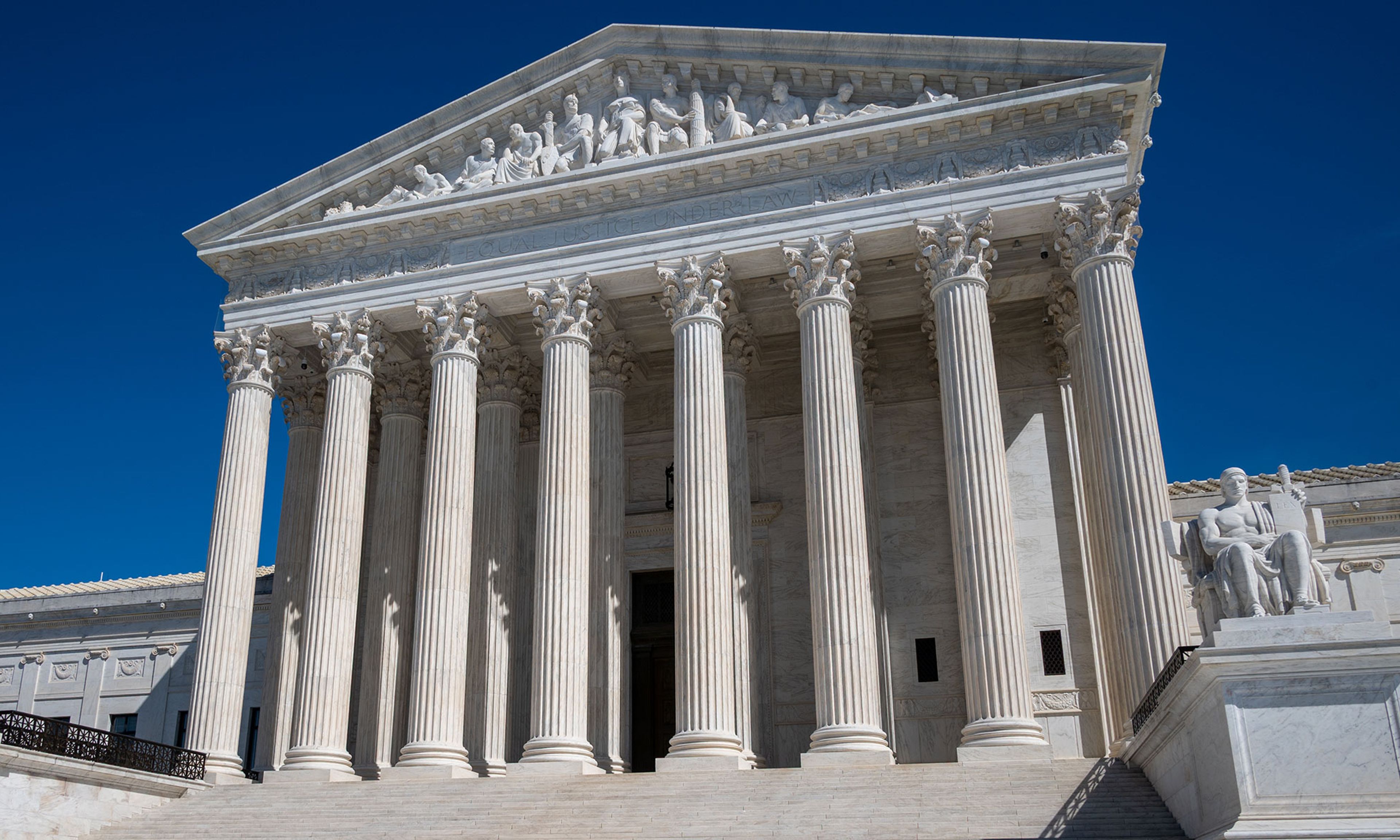
U.S. Supreme Court in Washington, D.C.
The Supreme Court has just accepted an appeal from the Trump administration in an immigration case — one that may result in the Court barring lower federal court judges from interfering in the president’s termination of “Temporary Protected Status” (TPS) for aliens from various countries, many of whom seem to have abused the temporary status to take up permanent residence in the United States.
The Court agreed to hear the cases, Noem v. Doe and Trump v. Miot, on March 16 and set up an accelerated schedule of oral arguments during the second week of April. The expedited process may be a sign of the Court’s impatience with lower court judges who are ignoring clear, unambiguous federal law, as well as the Supreme Court’s own prior orders.
The administration is likely to prevail in the case. Congress gave the president (through the Secretary of Homeland Security) authority under 8 U.S.C. § 1254a to temporarily provide lawful status — TPS — to aliens in the U.S. under certain circumstances. Those circumstances are that the aliens cannot safely return to their native countries due to an “ongoing armed conflict”; “an earthquake, flood, drought, epidemic, or other environmental disaster . . . resulting in a substantial, but temporary, disruption of living conditions”; or other “extraordinary and temporary disruption of living conditions” — unless allowing those aliens to stay would be “contrary to the national interest.”
The Trump administration has sought to end TPS for aliens from Venezuela, Syria, Haiti, Nepal, Honduras, Burma, South Sudan, and Nicaragua. As Solicitor General John Sauer outlines in the government’s petition, Syrians were granted TPS in 2012 when Bashar al-Assad was dictator; his regime fell in December 2024. Haitians were granted TPS by President Barack Obama in January 2010 when an earthquake hit the island; they are still in the country 16 years later.
In jurisdictions ranging from California and the District of Columbia to Massachusetts and Illinois, multiple federal district courts have issued injunctions blocking the administration’s termination of TPS. Their “reasoning” has varied from disagreeing with the administration’s evaluation of what is in the country’s “national interest” and claiming that the administration failed to “disclose the true basis” for the termination to asserting the administration’s supposed failure to “consult with appropriate agencies.”
The problem is that none of these judges have the legal authority to even consider the claims filed by various groups in their courtrooms. Their questioning of the motives of the administration, the circumstances of aliens, or what is in the country’s best interests is completely irrelevant.
Why? Because the TPS statute specifically provides that “[t]here is no judicial review of any determination of the [DHS secretary] with respect to the designation, or termination or extension of a designation, of a foreign state under this” statute. Thus, aliens whose TPS is revoked have no due process rights to contest that revocation. Furthermore, no federal judge has the right to entertain such claims, despite many judges’ erroneous belief that the Administrative Procedure Act gives them the right to review the Homeland Security secretary’s decisions. While some statutes are indeed ambiguous, “no judicial review of any determination” is about as clear as it gets.
As Sauer points out, this is the third time the government has had to file an appeal on this issue with the Supreme Court. In both prior cases, the Supreme Court stayed the injunctions and two appeals courts — the Ninth and Fourth Circuits — hewed to the Supreme Court’s holdings and issued stays in other TPS cases.
But the Second Circuit ignored the Court and the law, refusing to stay an injunction barring the government from terminating TPS for Syrians. Other district courts have similarly continued to issue injunctions in favor of various nationalities challenging the secretary’s decision to revoke their “temporary” status.
The Trump administration asked the Supreme Court to review the case “given the lower courts’ persistent disregard for this Court’s stay orders,” arguing that unless the Court intervenes, “lower courts will continue to impermissibly bypass an unambiguous judicial-review bar and displace the Secretary’s judgment on matters committed to her unreviewable discretion.” The purpose, Sauer says, seems clear: Tie up the decisions to end TPS “in protracted litigation with no end in sight,” in a blatant attempt to run out the clock on the Trump administration’s immigration policies with which these litigants and activist judges disagree.
Fortunately, the Supreme Court has decided to intervene. The law here is so clear that this should be an easy case for the Court to decide. Let’s hope that the justices see it that way and issue a no-holds-barred decision that gives the lower courts no more wiggle room to defy the law and the Supreme Court.

About the Author
Hans A. von Spakovsky is a Senior Legal Fellow at Advancing American Freedom.
Featured Tags
Advertisement
Advertisement


Comments