The Three Callings of Benedict XVI
Written by Nicholas Frankovich
The late pope blessed the church and the world with his intellect and holiness. Like his successor and recent predecessors, he struggled at governance.
Share this story
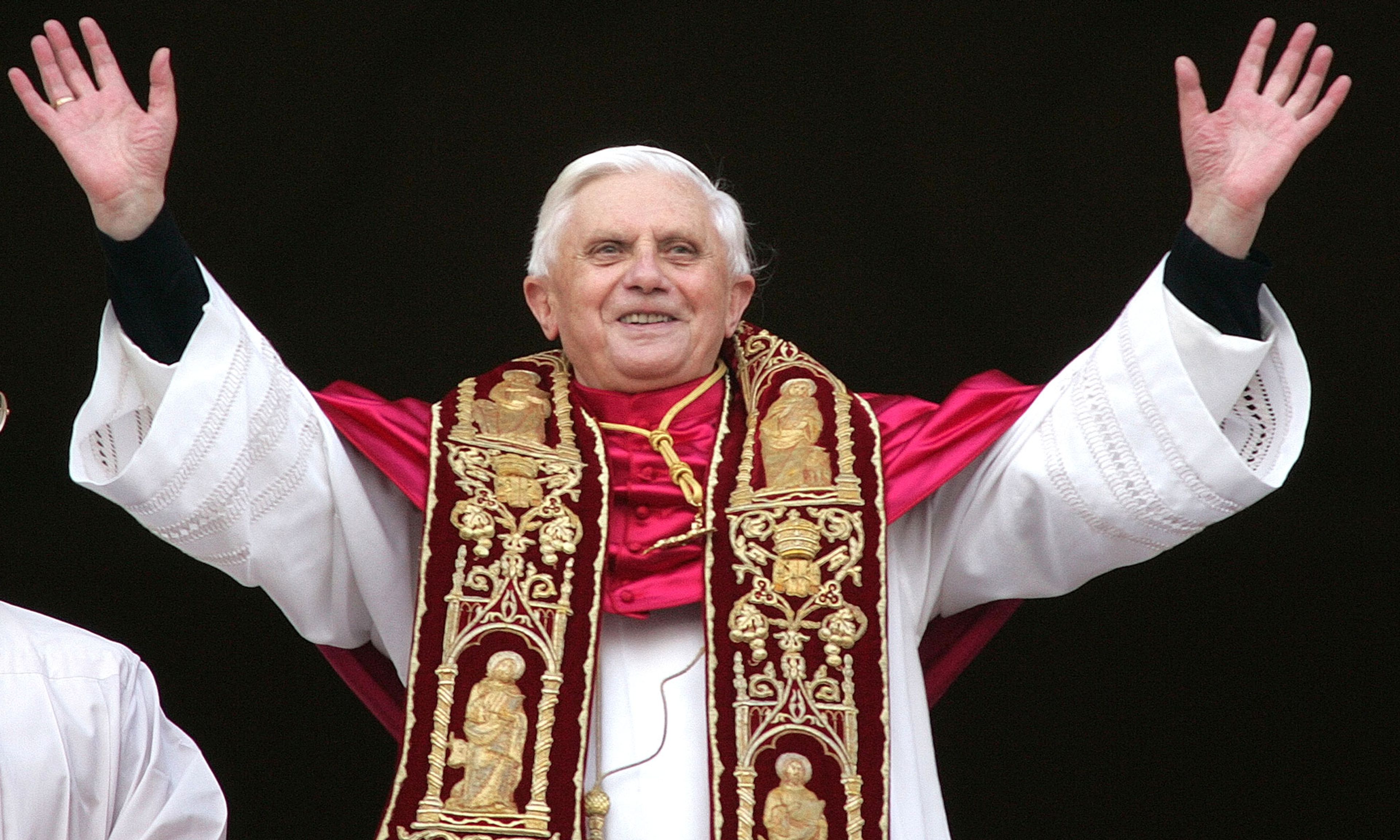
Pope Benedict XVI waves from a balcony of St. Peter's Basilica in the Vatican after being elected by the conclave of cardinals, April 19, 2005.
Teach, sanctify, govern: The three verbs define the work of a bishop, according to tradition and the Catechism of the Catholic Church. As the bishop of Rome and therefore as the vicar of Christ, the head of the mystical body that is the church, Pope Benedict XVI shone and accomplished incalculable good in those first two categories. The church is smarter and holier for his efforts.
Like recent predecessors and now his successor, he struggled in the third category, governance, beset by the fights that Catholics continue to pick with one another over interpretations of the Second Vatican Council. Added to his burden were ongoing revelations of sexual abuse by Catholic clergy and of its cover-up and mishandling by bishops, including him when he led the Archdiocese of Munich and Freising in 1977–82, investigators commissioned by the local chancery reported last year. His record on the issue later in his career was not spotless, but it improved. He led groundbreaking efforts at the Vatican to protect minors and hold abusers accountable throughout the church.
In retrospect, the remarkable 27-year papacy of his immediate predecessor, John Paul II, is also shadowed by the collective Catholic sex-abuse scandal. It has involved so many victims, perpetrators, and clerical apologists and even accomplices across so much terrain over such a long period that the dreaded adjective “systemic” begins to suggest itself. The scale of the problem was still emerging in the public eye when, on the evening of April 13, 2005, Cardinal Joseph Ratzinger was ushered onto the balcony of St. Peter’s Basilica and introduced, urbi et orbi, as Benedictus Decimus Sextus.
“Probably the greatest scholar to rule the church since Innocent III, the brilliant jurist who served from 1198 to 1216,” historian Anthony Grafton called Benedict five years into his pontificate. “No one has studied the development and meaning of the Catholic liturgy with more care and precision.” In The Spirit of the Liturgy (2000), whose title is an allusion to a book by an earlier German priest and thinker, Romano Guardini (1885–1968), Ratzinger mixed historical analysis with a gentle cascade of images and analogies to produce a thing of great beauty, scholarship brimmed with insight and poetry:
We might say that in 1918, the year that Guardini published his book, the liturgy was rather like a fresco. It had been preserved from damage, but it had been almost completely overlaid with whitewash by later generations. In the Missal from which the priest celebrated, the form of the liturgy that had grown from its earliest beginnings was still present, but, as far as the faithful were concerned, it was largely concealed beneath instructions for and forms of private prayer. The fresco was laid bare by the Liturgical Movement and, in a definitive way, by the Second Vatican Council. For a moment its colors and figures fascinated us. But since then the fresco has been endangered by climatic conditions as well as by various restorations and reconstructions. . . . Of course, there must be no question of its being covered with whitewash again, but what is imperative is a new reverence in the way we treat it, a new understanding of its message and its reality, so that rediscovery does not become the first stage of irreparable loss. [Emphasis added]
Benedict in his first Christmas address to the Roman Curia acknowledged that liturgical reform and implementation of the Second Vatican Council in general had been difficult. It still is. He described a tug-of-war between two camps: Advocates of a “hermeneutic of discontinuity and rupture,” as he called it, and those who insist on a “hermeneutic of reform” have been contending to establish as definitive their respective positions on the question of how deep in communion the church after the council should be with the church before it.
His detractors would object that his formulation of the conflict was tendentious: It’s they who are the champions of ressourcement, the project of recovering the thought and practices of the early church. The whitewash may be old and therefore venerable, but the fresco underneath it is ancient. They see Benedict as defending a misguided attachment to the whitewash, to layers of medieval, largely Western European accretions to the church’s genius, whose essence, despite its Near Eastern origin, is universal.
Call it a clash, or call it creative tension. Critics of his promotion of the traditional Latin Mass forget that the Catholic Church has, all told, about two dozen rites and “uses,” or sub-rites. The Roman rite is the most prevalent by far — fewer than 2 percent of the world’s 1.3 billion Catholics worship in any other. As if the Latin church aspired to be more byzantine than the Byzantines, the category “Roman rite” includes a few subcategories:
the Zaire use (a variant celebrated in sub-Saharan Africa),
the Anglican use (for former members of the Anglican communion and others who love its liturgy),
the ordinary form (also known as the Novus Ordo Missae and as the Mass of Paul VI, who promulgated it in 1969), and
the extraordinary form (also known as the usus antiquior, the Tridentine Mass, the traditional Latin Mass, and the Mass of John XXIII, who promulgated the last edition of the missal for this form of the Roman rite in 1962).
The ordinary form, whose name indicates its status as first among equals, is based on the older, so-called extraordinary form, the traditional Latin Mass. When Benedict in 2007 relaxed restrictions on celebration of the latter, he hoped that it and the ordinary form would be “mutually enriching.” He stressed the continuity between them:
There is no contradiction between the two editions of the Roman Missal. In the history of the liturgy there is growth and progress, but no rupture. What earlier generations held as sacred, remains sacred and great for us too, and it cannot be all of a sudden entirely forbidden or even considered harmful. It behooves all of us to preserve the riches which have developed in the Church’s faith and prayer, and to give them their proper place. [Emphasis added]
Benedict was more small-c catholic in his liturgical tastes than were his adversaries who accused him of thwarting the spirit of Vatican II. He took obvious delight in the texts and rubrics prescribed in different editions of the Roman missal. In his enthusiasm for it all, he underestimated the role of externalities in the liturgy wars. About the compatibility of the two forms of the Roman rite, he was correct in theory. In practice, alas, many of those who favor one rite over the other regard the other one, and those who prefer it, with wariness bordering on hostility. The bad vibes are reciprocal.
Even in the United States, with probably the largest, most active traditionalist community in the world, only about 1 percent of Catholics who attend Mass on a given Sunday opt for the extraordinary form. It looks and sounds different in the expected ways. The language of the prayers is Latin. (The scripture readings are read twice, in Latin and then in English. The priest’s homily is in English.) Much of the time the priest prays sotte voce. He and the congregation face the same direction, with the result that what he’s praying over or holding at the altar is partially obscured.
Nothing in the older, 1962 missal requires congregants at the extraordinary form of Mass to dress and act differently from their coreligionists at the ordinary form, but on the whole they do, and the differences are conspicuous. Reviving a tradition that lapsed with the introduction of the ordinary form in 1970, most women at the extraordinary form wear a “veil,” which covers the top and sides of their head though in most cases not their face. They tend to dress modestly. Hemlines are low. Men are more likely to wear suits and ties than are their peers at ordinary-form Mass. Families at the extraordinary form tend to be larger, crying babies more common. The traditional Latin Mass is a liturgy that lends itself to praying from a book, and so adults are buried in their missals — moving ribbons, flipping pages, scanning facing-page translations — when they’re not silencing or correcting their fidgeting kids.
You get the picture. Congregations at the traditional Latin Mass are to “mainstream,” ordinary-form Catholics approximately what Orthodox Jews are to Reform. An ordinary-form Catholic who resents traditionalists is apt to describe them as holier-than-thou, look-at-me humblebraggarts. Conversely, a traditionalist who resents ordinary-form Catholics knows that many of them look down on him. He thinks they’re milquetoast in their faith.
So much for comity and mutual enrichment.
Catholic traditionalists care about more than antique liturgy, although the extraordinary form of the Roman rite is at the heart of the movement or (if “movement” is too strong a word) tendency that they represent in the church. In the Vatican II document Dignitatis Humanae, the church declares its commitment to religious liberty. Few Catholics demur from the teaching, but those who do seem to be disproportionately attached to extraordinary-form congregations, where sympathy for integralism and other post-liberal political possibilities on the New Right runs high.
Archbishop Marcel Lefebvre, the founder of the Society of Saint Pius X, a traditionalist religious order whose communion with Rome has been disputed since its formation in the 1970s, dissented from the church’s postconciliar teachings on ecumenism as well as on religious liberty. Archbishop Carlo Maria Viganò, who in the past four years has emerged as a leading spokesman for an apocalyptic worldview in which Donald Trump figures as an anointed stronghold against Pope Francis and other “globalists,” extols the power of the traditional Latin Mass to spread graces but finds that “the same thing does not happen, it seems to me, with the reformed rite.”
“That’ll be enough,” you can almost hear Pope Francis say with a shake of his head. Last summer he reversed Benedict’s laissez-faire policy on celebration of the traditional Latin Mass. Any bishop whose diocese includes congregations dedicated to Mass in the extraordinary form must accommodate them but “take care not to authorize the establishment of new groups.” The tone of the document, Traditionis Custodes, is not encouraging to traditionalists.
It reinforces the temptation for them to see themselves as singled out and persecuted for their zeal and observance and to view as backslid the pope and the bishops who obey him. Benedict, too, recognized “exaggerations and at times social aspects unduly linked to the attitude of the faithful attached to the ancient Latin liturgical tradition,” but he sidestepped the problem, as if to confront it would have been to elevate and dignify the intemperance that mars traditionalist culture and discourse, much of which is nuanced, even uplifting. He was a connoisseur of liturgy and prized the ancient form, whereas Francis, to judge from his pronouncements on the subject, isn’t and doesn’t, true to his Jesuit stripes. (The Society of Jesus can claim, besides long lines of distinguished scholars and missionaries, a reputation for indifference to liturgical intricacies.)
Francis’s inclination to curb traditionalist excess is understandable even if the method he chose was heavy-handed and may prove counterproductive. Benedict faced similar criticism for actions he took against proponents of liberation theology when, as Cardinal Ratzinger, he was prefect of the Congregation for the Doctrine of the Faith (CDF) in 1982–2005, a period that adds up to almost a quarter of his life. While sharing his concern to prevent the faith from being reduced to a political philosophy or social program, one can also wonder whether he went too far and stifled theological inquiry and debate, which he relished.
“He was a real academic,” the theologian Cathleen Kaveny recounted, years after attending a conference with him in New York. At home “in the world illumined by his beloved texts, which conveyed a reality that seemed to be more vivid to him than the reality conveyed by his own senses,” he had been appointed to a professorship in theology in his early thirties. He had served as a peritus, or consultant, at the Second Vatican Council, where he was seen as a young reformer and moderate liberal. Even late in his career he wrote in appreciation of Teilhard de Chardin, a French Jesuit whose theological application of Darwinian evolution had led church authorities to issue warnings about his work and to typecast him as a controversial, possibly heterodox freethinker.
PHOTOS: Pope Benedict XVI
From his perch in the renowned theology faculty at the University of Tübingen, Ratzinger watched the student strikes there and across Europe in May 1968 and disliked what he saw: a liberalism with too little Adenauer, a little too much Robespierre. Ratzinger didn’t lurch, but he began to lean, away from the spirit of rebellion that marked the age. Like the American literary critic Lionel Trilling, who preceded him on a parallel trajectory a decade or two earlier, Ratzinger cultivated a skepticism of postmodern attitudes. “A dictatorship of relativism,” he later called it. (Trilling, a witness to the student uprising at Columbia in 1968 and to the American counterculture of the day, called it “modernism in the streets.”)
If the German academician was disappointed to be transferred from his ivory tower to the chancery in Munich, he kept it to himself. In 1994 he did tell Thomas Reese, a Jesuit writer who later served as editor in chief of America magazine, that he declined the first two offers by John Paul II to move to Rome to head up the CDF. “I do not have charism about structural problems,” Ratzinger explained.
Translation: “I have no great aptitude for governance or administration.”
The day jobs of a bishop, a Vatican official, and the pope are demanding enough. Serving in those posts, Ratzinger continued to write on the side, in his private capacity, compiling a long bibliography of books and articles pitched to the theologian, the general reader, and both. His Introduction to Christianity (1968) has attained the status of a classic. He had a talent for making familiar information sound new. His prose is limpid and relaxed; the thought behind it, taut.
“What might have been!” he said to himself at night as he nodded off in the papal apartments in the Apostolic Palace, dreaming of libraries, lecture halls, and seminar rooms where he and his students and colleagues would talk Plato, Augustine, and the latest issue of Communio late into the afternoon. So I sometimes imagined. The papacy weighed on Benedict almost visibly. From his demeanor, or was it his aura, I sensed that some premonition of hardship had pressed him to expect a constant hailstorm of vituperation beating down on his head.
His announcement in February 2013 that he would relinquish the papacy surprised perhaps everyone but himself. It angered traditionalists who felt that he was giving up the fight and abandoning them to “Novus Ordo Catholics.” His rationale was reasonable enough. He had “come to the certainty” that his “strengths” were, owing to his advanced age, “no longer suited to an adequate exercise of the Petrine ministry.” The tradition that the pope remains in office for life has become less feasible now that so many people live so long and fade so gradually instead of dying abruptly while still active in what now counts as late middle age.
Benedict made himself the “pope emeritus,” a novel title, and retired from the business of governing the church. He retreated to a monastery in the Vatican Gardens. There, like a monk, he dedicated himself to prayer, sanctifying the world, just as he had once dedicated himself to the life of the mind, making those who read and listened to him a little less ignorant.
He served as pope emeritus longer than he served as pope. In reinventing himself, he invented the possibility of a new office, that of a shadow pope, introspective and dedicated to his priestly function, a vertical relationship with God, with whom he intercedes on behalf of urbis et orbis, of Rome and the world, of the church and all creation.
Benedict flourished in his prophetic function, teaching, preaching, and imparting wisdom. In his kingly function, that of governing, he floundered. In living memory, who in his position has not? The figure of pope as monarch is unsuited to our democratic age and, for that matter, to this whole side of kingdom come: “It is better to trust in the Lord than to put confidence in man; it is better to trust in the Lord than to put confidence in princes” (Psalm 118:8–9). Requiescat in pace Benedictus, servus bonus et fidelis.
About the Author
Nicholas Frankovich was the deputy managing editor of National Review.
Featured Tags
Advertisement
Advertisement
Comments