The Trouble with Trump’s Maritime Action Plan
Written by Caleb Petitt
Two of the plan's proposals, when taken together, show the Trump administration’s hostility to free trade, as well as a general naïveté.
Share this story
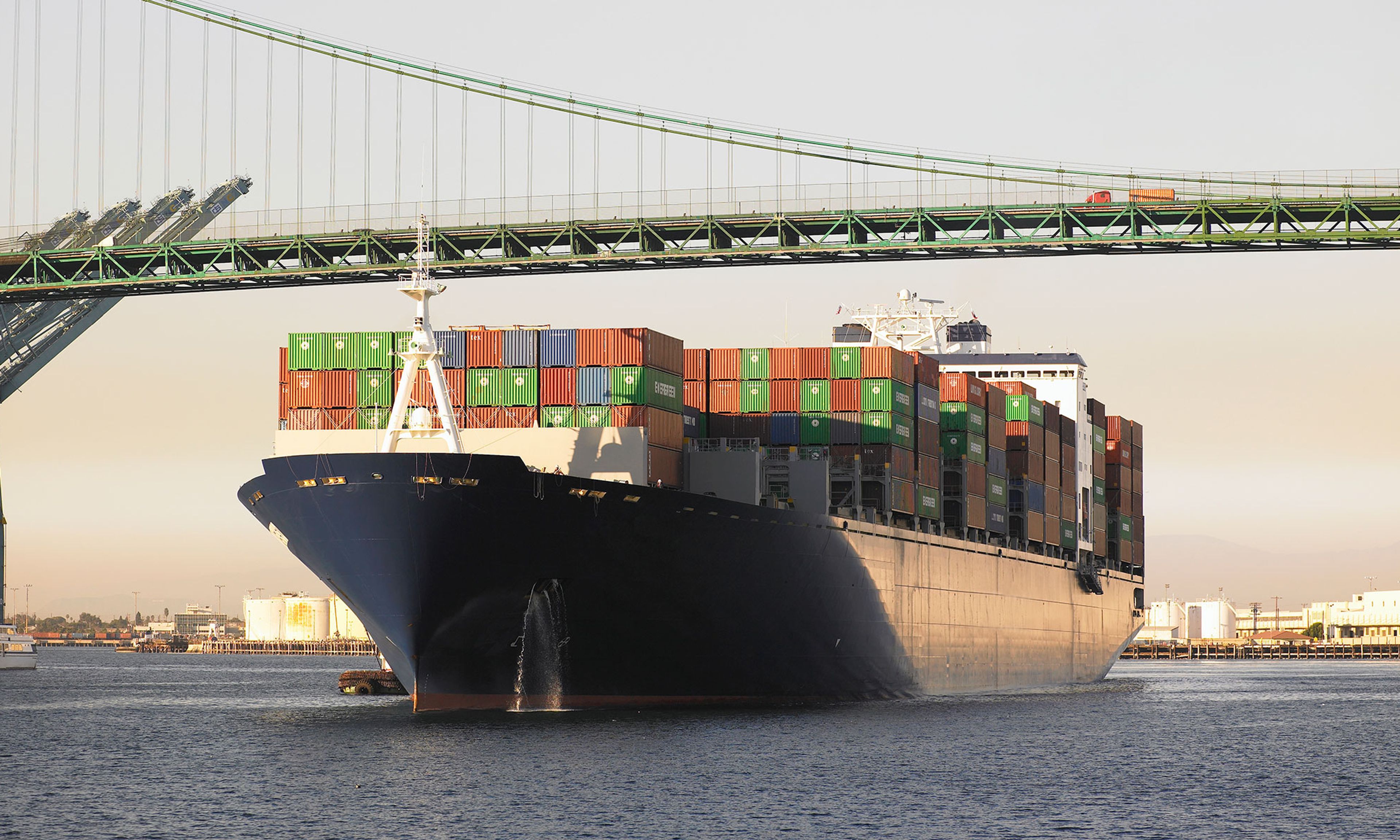
Cargo container ship at the Port of Los Angeles, 2007
The White House recently released America’s Maritime Action Plan (MAP) to revitalize America’s maritime industry. It proposes a variety of regulatory modifications, subsidies, government financing options, and fees to encourage domestic shipbuilding. Although it includes a wide variety of proposals, two of them, when taken together, show the Trump administration’s hostility to free trade, as well as a general naïveté about the plan.
The first is the proposed “universal fee” on foreign-built ships; the second is the proposed regulatory change to the definition of a “U.S.-built” ship.
The universal fee is laughable in its imprecision. The MAP suggests a fee of anywhere from one to 25 cents per kilogram of imports brought on foreign-built ships. The MAP authors expect the fee to generate anywhere from $66 billion to $1.5 trillion over the next decade.
Essentially, this would be a tax by weight on all foreign commerce, as less than 2 percent of imports are carried on U.S.-flagged vessels, and even those vessels are foreign-built. The Jones Act restricts shipping between ports to U.S.-built, U.S.-owned, U.S.-flagged, and U.S.-crewed ships. On the high end of the proposed range, the fee would be a considerable barrier to trade. The tariffs put in place under the International Emergency Economic Powers Act (IEEPA) are projected to generate $1.4 trillion to $2 trillion over the next decade, so the upper estimate of the universal fee ($1.5 trillion) could come close to those tariffs in terms of both trade barriers and revenue.
The universal fee is supposed to encourage shipowners to buy U.S.-built ships for foreign commerce, but that is exceedingly unlikely. U.S.-built ships cost four to five times the price of comparable foreign-built ships. The fee would have to be quite large and impede a considerable amount of America’s commerce before it would incentivize anyone to use U.S.-built ships for foreign commerce.
Even if the fee did incentivize some carriers to buy U.S.-built ships, American shipbuilding is not likely to become great. America’s share of global shipbuilding has steadily declined since the passage of the Jones Act, with the exception of the shipbuilding surge in America during World War II. The American shipbuilding industry is nearly nonexistent. In terms of gross tonnage, the United States accounted for just 0.04 percent of global shipbuilding. America thus ranked 19th globally, just behind Malaysia and Taiwan and just ahead of Norway and Romania.
The proposed change in the definition of “U.S.-built” makes the prospect of using U.S.-built ships in foreign commerce even more remote. U.S.-built ships are constructed in America but frequently use foreign parts. The MAP proposes, as “regulatory relief,” “strengthening the ‘U.S.-built’ definition over time to grow supplier capacity that would further require ship materials to be American Made.” Requiring ship materials to be built in the United States is no trivial proposal and would make already expensive ships even more so.
Strengthening the requirements for a ship to qualify as U.S.-built would only make such ships more expensive and more difficult to build. According to data provided by the American Bureau of Shipping, the last U.S.-built ship to have an engine made by an American company was built in 2000; for American-made anchors, the year is 1998. There are no U.S.-built ships with generators made by an American company. Requiring U.S.-built ships to use American parts will do nothing to help American shipbuilders if they cannot build affordable ships.
American shipbuilders and the Jones Act fleet are coddled by the Jones Act, and the non-Jones Act fleet is protected with cargo preference laws and subsidies, yet our imports are almost entirely carried on foreign-built ships. America is the world's largest importer and second-largest exporter despite its outdated maritime industry and regulations.
The proposals examined here will do little to nothing to revive the dying American maritime industry and, coming on top of the Trump tariffs, will inflict yet more damage to this country’s trading relationships while increasing the price of consumer goods.
About the Author
Caleb Petitt is a research associate at the Independent Institute in Oakland, Calif.
Featured Tags
Advertisement
Advertisement

Comments