The Trump Administration’s Mis-Anthropic Approach to AI
Written by Andrew C. McCarthy
When the priorities of national security, property, and privacy collide
Share this story
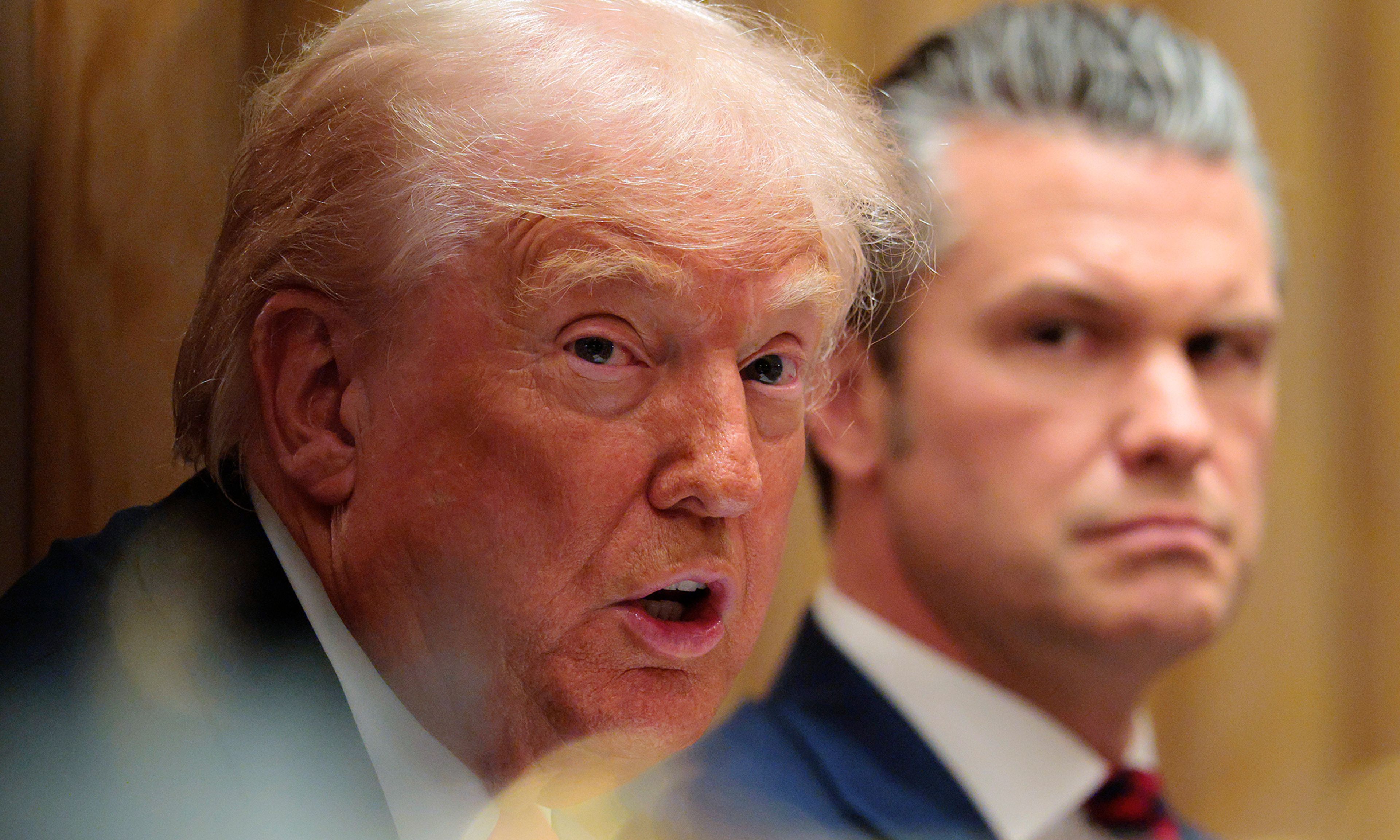
President Donald Trump speaks during a meeting as Defense Secretary Pete Hegseth looks on, in the Cabinet Room of the White House, in Washington, D.C., December 2, 2025.
‘The circumstances that endanger the safety of nations are infinite.” Alexander Hamilton stated this incontestable premise nearly a quarter millennium ago, in Federalist No. 23. Hence, he concluded, “no constitutional shackles can wisely be imposed on the power” to safeguard national security.
The Framers were men of great foresight, but today’s threat environment -- a global environment thanks to technological advances that have made America a superpower -- is beyond the 18th-century imagination.
What will never change is human nature. A government of the people reflects our flawed timber. If that government is sufficiently powerful to secure the nation, then such power, if abused, could eradicate the people’s liberties -- the preservation of which was the rationale for establishing America’s government in the first place. There will always be, then, tension between Hamilton’s postulate and the admonition of James Madison, in Federalist No. 51: “In framing a government which is to be administered by men over men, the great difficulty lies in this: you must first enable the government to control the governed; and in the next place oblige it to control itself.”
The Trump administration is not controlling itself. That is manifest in many ways, but the most consequential may involve artificial intelligence.
AI has life-altering potential for our security, economy, and social relations. It is evolving so rapidly that we can barely take stock of where we stand before the ground shifts again.
The administration is determined to control the development of AI. What hubris. Government consistently proves itself incapable of mastering its own processes. These are naturally clunky: legislation and regulation move at a snail’s pace; the lightning tempo of technological change renders them obsolescent, or at least impractical, in short order. Thus, for example, are commodities and securities governed by early-20th-century statutory schemes that today’s bureaucrats strain to apply to such novel assets as cryptocurrencies, which didn’t exist until decades later. Thus is the 1986 Electronic Communications Privacy Act -- which itself was intended to address the inability of 1968 federal wiretapping law to keep up with the times -- used to police a digital world of email, text, and social media platforms unknown to the lawmakers of the time.
Yet Trump officials nevertheless seek to shape the course of AI, a phenomenon conceived by and sprung from private ingenuity, methods, and capital. What’s more, the “Department of War” (the president’s tough-guy rebranding of what remains in statute the Department of Defense) has threatened to seize control of AI assets if the private companies that created them resist acceding to government demands.
To merge Hamilton and Madison, the question is: What shackles can wisely be placed on government to protect the American people themselves without undermining the government’s proficiency at thwarting hostile foreign powers? Powers such as China: a totalitarian geopolitical rival that is unburdened by scruples about liberty and popular sovereignty as it races to exploit AI’s potential, which could be as ferocious as it is glorious.
There is no satisfying, one-size-fits-all answer. There is the abiding tension between national defense, on the one hand, and freedom and private property, on the other. Trade-offs have always been necessary to manage that tension as technology changes conditions and assumptions. There is, moreover, the knowledge problem: unknowns of the present as well as the future hover over questions of whether and how to regulate.
In late February, just hours (it turned out) before American and Israeli armed forces began the aerial invasion of Iran, a Pentagon dispute with the tech giant Anthropic exploded into recriminations and dubious legal sanctions.
Though one wouldn’t know it from the unhinged rhetoric to which Trump and his minions resort upon meeting resistance, Anthropic has made material national security contributions since 2024. That’s when its AI tool, the commercially popular “Claude,” was incorporated into the classified systems of the Defense Department and U.S. intelligence agencies. Both sides sought to continue this beneficial collaboration. In speed and comprehensiveness, the AI-driven prowess in mapping battlefields, identifying targets, protecting vulnerabilities, and increasing the efficiency and lethality of weapons systems is breathtaking. From the start, however, Anthropic prescribed restrictions on the government’s use of Claude.
First, Anthropic forbade fully autonomous AI control of weapons. This is a fraught topic, so novel, owing to accelerating breakthroughs in technology, that there might not have been such a capability to argue about as little as 18 months ago. Increasingly, though, AI is able, for instance, to manage and target swarms of drones and missiles and to identify likely hostile enemy fire that could hit American targets before military personnel could detect and react to the threat.
To be sure, AI operations are based on human inputs; from that foundation, though, there are limits to the human understanding of how AI reasons. For now, in the military context, those operations proceed with a human agent in the loop, theoretically capable of directing matters and shutting them down if things go awry. As AI becomes more capable, however, human agency can be minimized. And such agents could become an impediment to exploiting AI’s computing power on the battlefield if, for example, agency-dependent American AI is pitted against enemies who lack ethical qualms about the risks to their own forces and civilians if autonomous operations run amok.
These risks could be profound. In the lawsuit it ultimately filed against the Defense Department, Anthropic -- which has a unique grasp of its AI tool’s controls and limitations -- says it lacks confidence “that Claude would function reliably or safely if used to support lethal autonomous warfare.” Trump officials, in their habit of reducing even reasonable concerns to “woke” obsessions, deride Anthropic CEO Dario Amodei’s paeans to “effective altruism” (a commodification of corporate giving fashionable on the center-left). But Anthropic’s stance on autonomous weapons is not progressive preening; it is a hardheaded calculation about legal liability and corporate reputation if a disaster were to occur.
The second restriction involves mass domestic surveillance. In the information age, with its stress on personalized advertising, it is a commonplace for businesses to sell or purchase personal information in bulk: geolocation information generated by cellphones and data culled from web-browsing histories, consumer purchases, financial transactions, and so on. With as little fanfare as possible, arms of government, including the Defense Department and intelligence agencies, have begun purchasing these data, rather than obtaining them by warrant or other legal process as is typically done in government investigations.
Officials theorize that the Fourth Amendment does not apply because there is no expectation of privacy: People who use digital services know the service provider can monitor their activity. While some precedent supports this view, it is dated; there’s real doubt about whether it would survive scrutiny under the Supreme Court’s 2018 decision in Carpenter v. United States (which granted Fourth Amendment protection against “cell-site” tracking of people’s locations by monitoring the movement of their phones).
For our purposes, the surveillance issue is twofold: (1) U.S. defense and intelligence operations are directed at foreign threats and have no business surveilling Americans in the homeland; and (2) Claude has what Anthropic describes as “unprecedented ability to accelerate and automate analysis of massive amounts of data,” enabling government agencies to develop a comprehensive profile of almost any American.
Despite the success of its collaboration with Anthropic, the Defense Department began to object to these restrictions. As the controversy unfolded, Trump devotees lambasted the company for presuming to dictate to national security officials how weapons systems are used -- as if this were analogous to, hypothetically, Boeing selling the government F-15s and then trying to veto their use against particular countries or targets. That misconstrues what happened.
A skewed argument from principle is being made by the government -- essentially, “Who are they to tell us what to do?” Anthropic, however, was not obliged to contract with the government, which accepted its AI on the restricted terms Anthropic offered. The government then decreed that, because national security was at stake (isn’t it always?), decisions about autonomous targeting and surveillance were policy issues to be decided by government officials politically accountable (through the president) to the people, not by the private company that developed and owns the technology -- and that had contracted to provide it with usage restrictions. The administration demanded leeway to exploit Claude for “any lawful use.”
When Anthropic balked, the administration resorted, as is its habit, to lawfare -- the extortionate use of legal processes to punish political enemies and scapegoats. “War” Secretary Pete Hegseth first threatened to seize Anthropic’s business under the Defense Production Act. Generally invoked only in true emergencies, the DPA triggers extensive due process and private-property protections, and requires establishing that a good or service is vital to national defense. In the end, Hegseth pulled up short of that extreme measure but did punitively designate Anthropic as a “supply chain risk” -- the action that prompted Anthropic’s ongoing lawsuit.
Both measures were absurd. In his haste to outdo Hegseth’s public excoriation of the company, Trump pronounced that the government neither needed nor wanted Claude anymore; if that were true, then Anthropic’s AI could not have been vital for DPA purposes. And it’s not only that Anthropic does not fit the statutory definition of a “supply chain risk.” (Congress was concerned about foreign “adversaries” that might undermine systems that affect national security, not about American companies.) The Defense Department is still using Claude in ongoing operations, which it would stop doing if there were risk.
We’ll see what happens with the litigation, and with the government’s new deal, transitioning over the next six months from Anthropic’s Claude to the ChatGPT tool developed by OpenAI. For now, let’s focus on transcendent concerns for our constitutional republic.
What do we owe the government? To whom does private property, including the means of commercial production, belong?
By the Prohibition era, the government had developed crude techniques to intercept telegraph and telephone communications. When that was challenged, the Supreme Court held (in the 1928 Olmstead case) that the Fourth Amendment was essentially a safeguard against trespass -- protecting only one’s person, home, papers, and effects, not communications that the police intercepted by tapping into wires a distance away from the home or office. That was minimal protection, but at least no one was suggesting that early telecoms were obliged to make their services tappable.
As sensibilities changed, along with fears about government exploitation of technological innovations, the Court, in 1967, changed its Fourth Amendment theory from trespass to the woollier expectation of privacy test. More protection for the individual? Perhaps . . . but by then law enforcement was pressing AT&T to facilitate wiretaps and to refrain from notifying customers. Congress went along, theorizing that the phone giant -- the monopoly successor of Bell Telephone -- was a utility, in the nature of a common carrier, profiting from public rights-of-way and therefore duty-bound to assist the government.
With the communications revolution, when digital technology left the analog world behind, the public demanded privacy from government prying (even as it shared personal details on social media). Big Tech developed passwords, remote deletion, and scrambling technology. Government, citing national security as is its wont, has taken to pressuring telecoms to manufacture “back doors” into their communications services, “just in case” its investigators need to monitor or retrieve conversations. Agents want tech companies to design master keys to defeat passwords and passcodes that lock communications devices -- as if the government were empowered to make such demands, as if technological science were required to evolve no faster than the capability of government investigators to defeat technological advance, and as if the public did not have a right to purchase privacy protection -- and options to purchase it elsewhere if American companies can’t or won’t supply it.
Meanwhile, whither the Constitution? The narrow protection against trespassing at the dawn of wiretapping at least required the government to show probable cause of a crime before search or seizure. Now, with its modern capacity to capture oceans of digital data, government complains that showing individualized probable cause before seizing would be impractical; it would have us let agents seize everything and maybe ask for permission to search later -- after all, national security is at stake.
Of course, sometimes it really is.
These are excruciating issues, pitting our veneration of property and privacy against security in a dangerous world. Yet AI is a frontier where the challenge is greater. We don’t fully understand it, and if we regulate it prematurely we will stunt its growth, robbing ourselves of future prosperity and undermining the security it could offer -- particularly against China, a hostile competitor that will press against us every advantage AI can provide.

About the Author
Andrew C. McCarthy is a senior fellow at National Review Institute, an NR contributing editor, and author of Ball of Collusion: The Plot to Rig an Election and Destroy a Presidency.
Featured Tags
Advertisement
Advertisement



Comments