The Trump Effect: On the Universities
Written by Rachel Lu
The administration may be overreaching, but the fact remains that the academy has been overrun by ideologues and rent-seekers
Share this story
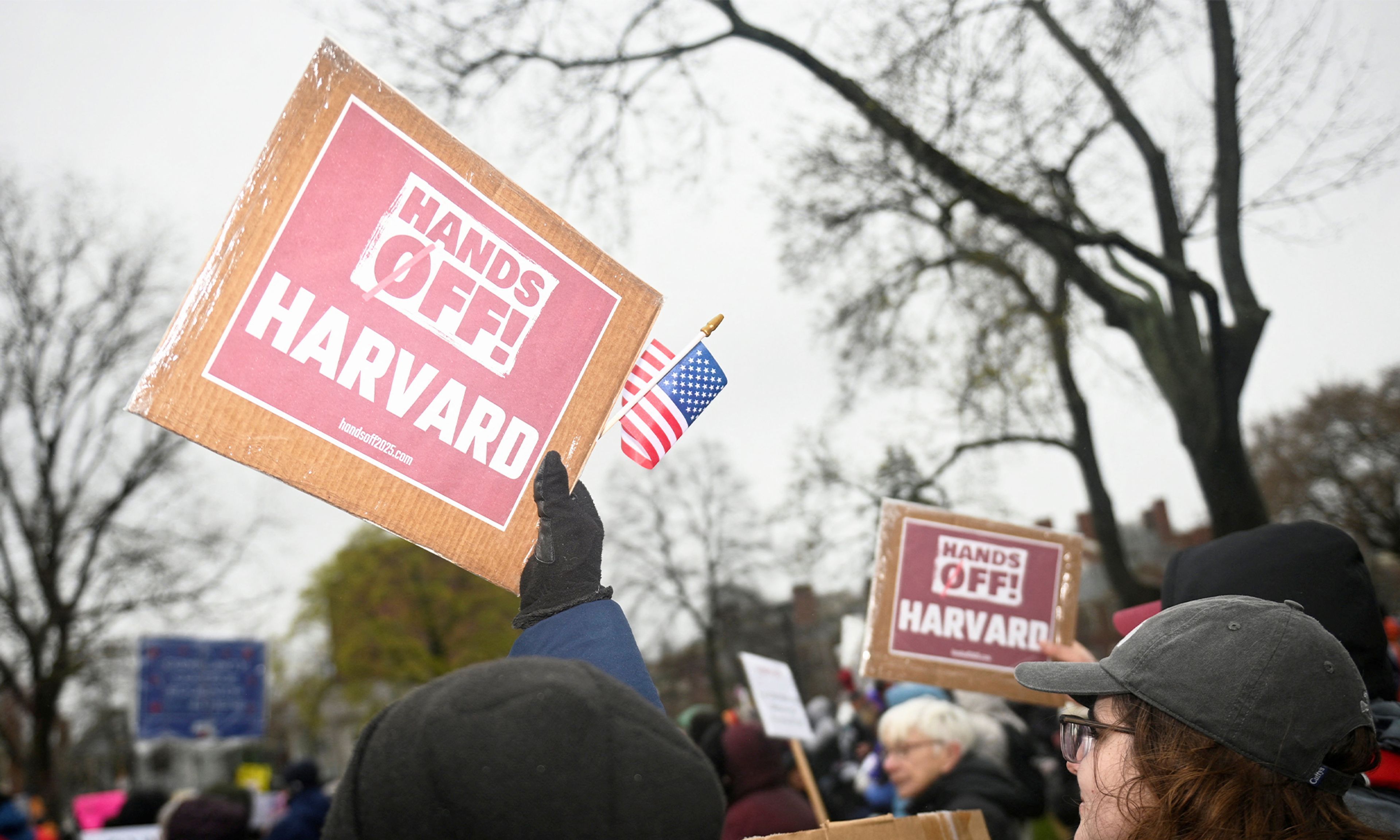
Demonstrators rally on Cambridge Common to protest Trump administration interference at Harvard University in Cambridge, Mass., April 12, 2025.
Whatever else one thinks about the state of higher education, this much is clear. There has been a vibe shift. The approach Trump has taken to university reform has him pulling every lever within reach to force the academy to respond. It has responded, which has been fun to watch. But will the long-term consequences be equally satisfying? That’s harder to say.
Over the past eight months, we have witnessed incredible things at America’s top universities. The DEI offices are closing. Every day, one hears new rumors that a Women’s Studies or LGBTQ Studies program might be shuttered. Several schools, including Brown and the University of Pennsylvania, have rolled back “gender-inclusive” policies that have enabled biological males to compete in women’s sports. University presidents have apologized -- under duress -- for allowing antisemitism to fester on their campuses, and Harvard is now calling for more “viewpoint diversity.” It’s a heady moment for the academy’s beleaguered conservatives. Who thought we would live to see the day?
Some of these changes were already underway, especially in red states like Texas that had already passed legislation to curb DEI or respond to campus antisemitism. It’s clear enough, though, that the Trump administration is the main causal agent here.
Conservatives face a depressing dilemma when it comes to higher ed. The administration’s actions raise obvious and sometimes glaring concerns about executive overreach. That’s bad in itself, but also worrisome insofar as it invites retaliation the next time the electoral wheel turns. Conservatives are still a tiny minority within academia. The small sparks of hope we’ve seen in recent years (such as the liberal-arts-oriented civics centers that have been established in many state universities) could easily be snuffed out by a Democratic administration thirsty for vengeance. At the same time, the problems are so severe that it’s hard to make the case for incremental reform. Higher ed needs open-heart surgery, not just a facelift. How can we hope to achieve that without significant disruption?
To be sure, some of Trump’s actions are thoroughly defensible on their own merits. For instance, he has directed the Department of Education to collect more-extensive admissions data from colleges and universities, as a transparency measure. That seems perfectly fair. Taxpayers support university education on a large scale; aren’t they entitled to a clear picture of who is benefiting from that aid?
Even more encouraging are the modifications to the federal student loan program under the One Big Beautiful Bill Act. Beginning next year, there will be tighter limits on borrowing, especially for parents and graduate students, along with a more streamlined set of repayment options. Federal aid will be given only to students in programs with a demonstrated capacity to boost individuals’ future earning power, meaning that graduates’ median incomes must be higher than those of working adults with lesser credentials. Meanwhile, new Workforce Pell Grants will offer support to students looking to complete briefer training programs, learning skilled trades, or earning credentials in health care, IT, or other in-demand jobs. That’s a welcome and long overdue measure, which recognizes that college isn’t the best option for everyone.
The details can be adjusted as necessary, but the broader trajectory is clear. Under the new system, institutions will be more accountable for student outcomes, while students will be discouraged from taking on enormous debt with no foreseeable payoff. Liberal arts apologists may bristle at the fixation on earning power: Are we simply assuming now that higher education is nothing more than job training? There’s a worthwhile conversation to be had about that. But the truth is that tighter loan restrictions and greater accountability may end up helping the liberal arts most of all. Under the present system, humanities departments too often get converted into soft landing places for failed engineering or premed students whose tuition dollars the university wants to keep. Perhaps those students would be better off with some shorter-term vocational training, while the students who want to study literature or philosophy stand to benefit from more-rigorous programs that may in fact boost individuals’ longer-term earning power.
Those are the bright spots. Then there are the warts. Trump’s adversarial style has won some short-term concessions. And it’s hard to feel sorry for panicked progressives who have spent years luxuriating in rivers of taxpayer money, comfortably pursuing their pet projects and molding young minds in their image as they chased their ideological enemies to the margins. Still, one must ask: Is there a long game here? Conservatives cannot realistically hope either to conquer America’s top universities or to replace them. If Republicans treat our most vaunted institutions as progressive strongholds to be vanquished, and wage an extended war on higher ed, the costs will be felt by the entire country, not just privileged administrators.
Consider, for instance, Trump’s ready willingness to treat research funding as a spigot that he can turn one way or another in accord with his own agenda. One could argue that this is the price universities pay for accepting that money in the first place. It’s true as well that taxpayers fund a lot of nonsense studies and that “overhead” can pad the bill. Even so, it remains true that a sizable share (almost half) of America’s scientific research is done in universities, some of it unquestionably valuable. For both economic and geopolitical reasons, we need cutting-edge research to continue in the United States, which should be an attractive destination for top researchers from around the globe. Trump’s reckless politicization of funding streams could further jeopardize one of the West’s traditional advantages over more repressive societies like China: the power of brain drain. Both nations have historically made efforts to attract talent, but most people would rather live here. Nevertheless, as America’s research climate becomes more uncertain, China is predictably eager to capitalize. One way or another, human knowledge will continue to expand, but it won’t necessarily happen in the United States.
Universities are much more than just research centers, however. They are some of our oldest and most vaunted institutions, which have supported American thriving since before our nation’s founding. Americans have always been an educated people, with a high respect for wisdom, innovation, and discovery. It is utterly abhorrent to imagine a future in which university policy increasingly emanates from the White House. But Trump’s strategy inevitably raises this prospect. Using federal grants as leverage to coerce groveling statements from high-profile administrators is a clear abuse of power, even if they deserve it. Looping in the Department of Justice, with probes that are simultaneously broad and vague in their mandates, is an obvious intimidation tactic. And the ongoing effort to revoke Harvard’s right to enroll foreign students is simply outrageous. This is not how free societies work.
Of course, one must still reckon with the other side of the devilish dilemma. The administration’s tactics may be ugly, but the fact remains that our universities have been overrun by ideologues and rent-seekers. Far from championing free inquiry, higher ed has become infamous for its crusading illiberalism and oppressive groupthink. Conservatives and Christians, long minorities among university faculty, have become an endangered species. Academic standards have fallen through the floor. Administrators proliferate while the trivial business of teaching is foisted onto starving adjuncts. And yet, when the campuses are grappling with squalid antisemitic protests and harassment of Jewish students, no one seems to know what to do. Was there a nice way to turn this corner? One way or another, something had to give.
There are unfortunately quite a lot of ways that the present standoff between Republicans and elite universities could end badly. Nevertheless, it’s worth reflecting on a more interesting question. Is there any plausible way it could end well?
In fact, there may be. The key here is to recognize that our universities were already careening down a steep hill even before Trump took them on. They’ve alienated a large share of the American public. Higher ed is already contracting, and the pace will surely accelerate as enrollment numbers continue to fall. Large language models have hit the already sclerotic system with a slate of bewildering new problems. As our labor markets shift, undergraduate education may diminish in the American imagination as the presumptive ladder to prosperity and respectability. In such a climate, the Trump administration’s overt aggression could indeed serve a useful purpose by opening a space in which reasonable reform becomes possible. Survival-minded institutions could use the administration as a foil to fend off their own radicals, while working with conservatives and moderates to build a healthier and more balanced university climate. Those schools would then have a competitive advantage over more intransigent institutions that simply fixate on “resistance” and pray for courts or Democrats to save them.
Instead of cheering or jeering, therefore, reform-minded conservatives should try to keep our heads, calling balls and strikes as fairly as we can. It’s possible that the panic Trump has induced in the academy will have a chastening effect, motivating moderates to work together in cultivating a healthier campus climate. That possibility can only be realized, though, if conservatives are able to focus their energies constructively. Initiatives like the new civics centers (popping up now at many state schools) have given conservative intellectuals new hope and opened new options to undergraduates who are seeking a serious education in the liberal arts. They also show fair-minded observers how much conservatives have to contribute. But the centers were established by state legislatures, not by Trump. Their flourishing will require steady nurturing across years and decades. A take-no-prisoners battle for institutional control would never bear that kind of fruit, but it could destroy it.
If there is a viable path out of our present predicament, it will involve strategic efforts to channel the winds of change along productive corridors. Foster productive, vibrant centers of intellectual life, and allow useless ideology factories to sink under their own unsustainable weight. A leaner and more effective university system could be a great blessing, but no one stands to benefit from a drawn-out war of attrition between the academy and the American right.
In truth, most conservative scholars don’t want to raze the universities or salt the ground. They want to do the kind of work that drew them to those institutions in the first place. Realizing that dream will take patience, prudence, and some good-faith cooperation from nonconservatives who also want the academy to thrive. Vibes can be fun, but the path to wisdom is a harder climb.

About the Author
Rachel Lu is an associate editor of Law & Liberty and a contributing writer at America magazine.
Featured Tags
Advertisement
Advertisement


Comments