The Tulsa Honors College: A Cautionary Tale
Written by Kayla Bartsch
A revival of classical education, interrupted
Share this story
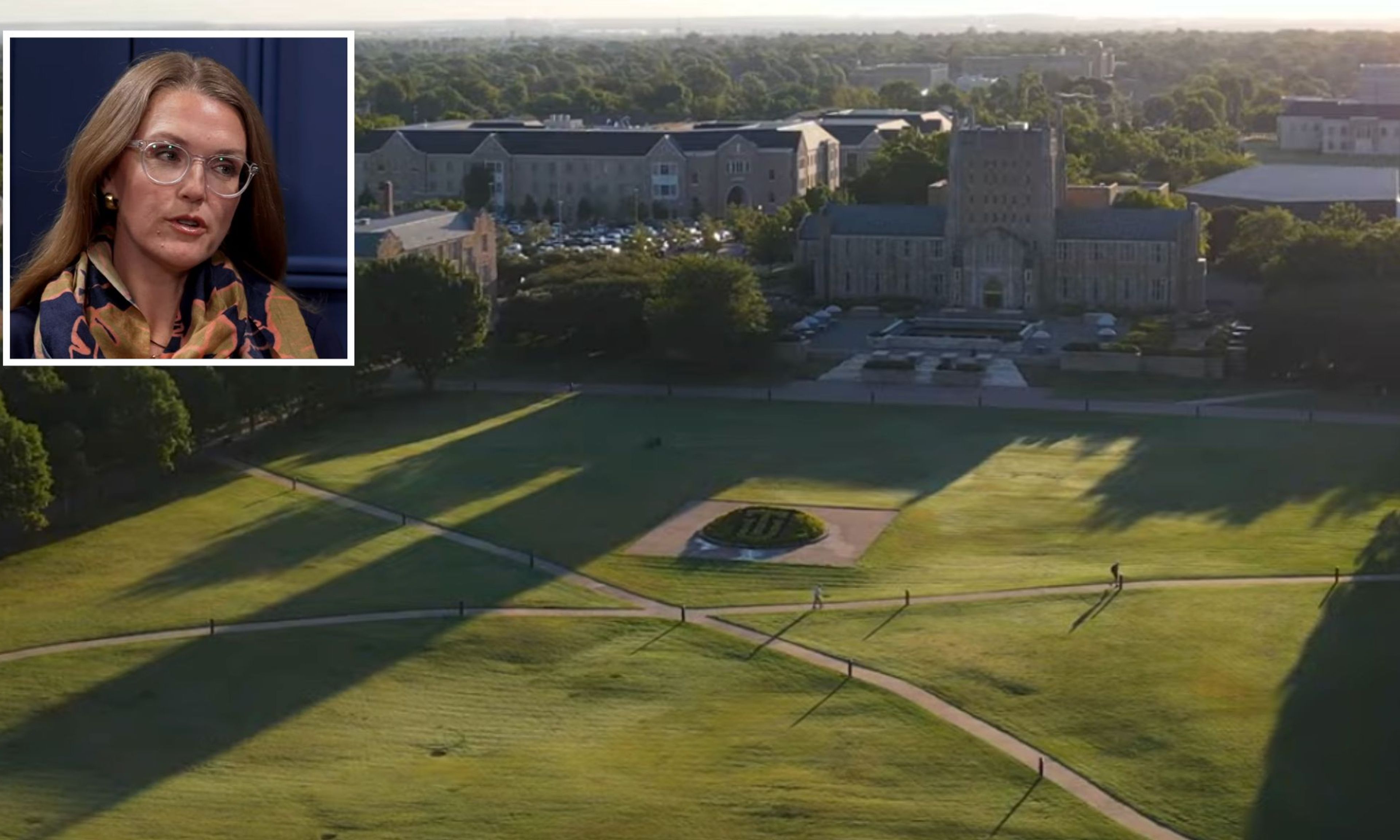
The campus of the University of Tulsa. Inset: Jennifer Frey
‘The Honors College is gone.”
These words, sent in a campus discussion app, flashed across the screens of students at the University of Tulsa (TU), the top-ranked private university in Oklahoma. Alex, a committed student at the Honors College, wondered: What does that even mean? Alex texted other friends in the program, searching for answers. “No one really knows what’s happening,” Alex (a pseudonym, like the other names of students mentioned here) told National Review.
Piece by piece, Alex learned that the administration had “restructured” the leadership of the Honors College, the university’s promising new institution dedicated to classical liberal arts education, in a move akin to an overnight raid. Jennifer Frey -- a prominent Catholic philosopher and advocate of the liberal arts, who had designed the Honors College and led it as its dean -- had been unceremoniously dismissed from that post (although she remains on faculty in the Department of Philosophy and Religion). The operating budget of the college had been slashed by 90 percent. The positions of almost all of Frey’s staff had been eliminated. Of the original faculty dedicated to the Honors College, fewer than half remained.
Frey’s dismissal attracted national attention. Her own description of events landed in the pages of the New York Times. Robert P. George, an influential Princeton professor and author, posted on X about the university’s firing of Frey: “You’ve heard of someone ‘shooting himself in the foot.’ This move could be characterized as ‘shooting yourself in the head.’” And it’s no wonder. Under her leadership, the Honors College flourished. In the summer of 2023, with her husband and six children, Frey moved to Tulsa to serve as its founding dean. The college increased enrollment by over 500 percent compared with the previous honors program, raised retention rates, brought in several major grants and gifts, revived the study of ancient Greek and Latin on campus, standardized the honors curriculum for all students, and nourished a vibrant student life through the establishment of an honors residence for freshmen. No one could understand why a program with such promise would draw the ax. So what happened? A philistine board, a power vacuum, and an antagonistic administrator created the perfect storm for the Honors College at TU.
When freshmen arrive at the Honors College, they are met with “huge boxes of books” -- according to Sam, a rising junior -- filled with titles such as Homer’s Iliad, Ovid’s Metamorphoses, and Dante’s Divine Comedy. Throughout their first two years on campus, Honors students make their way through the most influential texts of the Western tradition. Freshmen begin in ancient Greece and end in the Reformation, while sophomores enter the Enlightenment and arrive at the present day. The program culminates in a senior capstone project. Crucially, all Honors students read the same texts at the same time, and all freshmen live in community together. The intimate Honors seminars, sometimes ten students or fewer, were designed to cultivate community and the civil exchange of ideas.
“I’ve certainly been in seminars where I was shocked to learn some of the things that my friends believed, and we were combative about it,” Sam told National Review. “You would think that conversations like this, where people disagree so vehemently, would drive people apart, but if anything, I found that it brings people much closer together.” In the Honors College, Sam found a true forum for ideological disagreement. “I personally am not conservative. Many of my professors were not, although some, of course, were, and many of my friends are not. And I found in the [Honors] student body a fairly even split that I think reflects the student body of the university.” For Alex, also a rising junior, the Honors College Living Community was “phenomenal.” Ultimately, the Honors College “altered the way I think and the way I speak,” Alex said. “It’s made me a much more critical thinker.”
In a short time, the faculty and staff of the Honors College fostered a vibrant student life. A new program, called Night Owls, brought students together to watch influential movies -- from The Seventh Seal to The Princess Bride -- and discuss them with faculty and their peers. The college hosted events for the Ides of March, Pi Day, and an Honors student formal. The revival of theater at TU was made possible through the Honors College, which sponsored the staging of Greek tragedies on campus.
The intellectual and social life of the college -- the integrated living and learning, the shared curriculum, the supplemental programming -- all stemmed from Dean Frey’s founding mission: to offer “a vibrant intellectual community that fosters friendship, growth in excellent habits of mind and character, and service to the common good.” Frey was handpicked for the project by the former president of TU, Brad Carson. Without her, the college’s future remains uncertain.
In the fall 2025 semester at TU, most of the core faculty members of the Honors College are gone. Frey is on sabbatical. Oliver Traldi, a philosopher (and contributor to this issue of National Review) who served as a core member of the Honors faculty, has resigned. The former assistant dean of the Honors College and another teacher in the program, Matt Post, also resigned after Frey’s termination. Post is currently the interim director of the program, but he’ll leave once the administrative transition is complete. Only two Honors faculty members remain, and their contracts may not be renewed at the end of the school year. With fewer faculty available to teach, class size has increased from 15 to 20 students. This strikes at the very heart of the Honors College project: the intimate, Socratic seminar. For Sam, an upperclassman, the faculty turnover is especially disheartening. “I know who I want to be my faculty adviser, but I don’t know if he’ll be here these next few years. . . . The instability is very concerning.” Honors students launched a petition, which has since received over 800 signatures, to oppose the college’s “restructuring.”
In early August, TU announced that Blaine Greteman, the dean of TU’s Kendall College of Arts & Sciences, would oversee the Honors College. Greteman’s title, however, conflicts with the original communication from the university, which had announced that the dean would be replaced with a director. Greteman will maintain the title of dean but will neither be paid extra nor handle the day-to-day operations of the Honors College, according to sources familiar with the transition. The administrative burden of the college will fall on an associate dean, who has yet to be hired, and on administrative staff at the Kendall College of Arts & Sciences. When asked why the university had terminated Frey but maintained the position of dean of the Honors College, a representative for TU told National Review: “The university does not comment on personnel matters.”
This is not the first time the University of Tulsa has “restructured” its academic programs to disastrous ends. In 2019, the administration gutted the humanities across the university. A 50-page document titled “True Commitment: An Academic Strategy for the University of Tulsa,” obtained by National Review, sought to mold the university into a “STEM-heavy” institution “with a professional, practical focus.” The plan was put together by the Provost’s Program Review Committee, a group composed of faculty members, faculty senate representatives, and senior members of the administration. The provost at the time, Janet Levit, said, “This is who we are.”
Among other “bold” changes, the new strategy entailed the elimination of nearly half of the degree offerings in the Kendall College, including the entire Department of Philosophy and Religion. Minors in ancient Greek, classics, and Latin were also eliminated, along with minors in medieval and early modern studies and classical studies. Remaining humanities departments (e.g., history, English, and comparative literature) were merged into an interdisciplinary studies division dubbed “Humanities & Social Justice.”
The 2019 academic restructuring plan was, on the face of it, a response to TU’s financial struggles. By the end of 2017, it had become clear that the university was running a $16 million structural deficit, despite its more than $1 billion endowment. Athletics accounted for some $9 million of the loss. Expanded administrative staff, TU’s law school, and Tulsa’s Gilcrease Museum -- which the university co-manages with the city -- constituted much of the rest. (Marcia MacLeod, the chairwoman of TU’s board, also serves on the museum’s board.) Rather than address the sources of the deficit, the board sought to cut expenses in the classroom. In the fall of 2019, Levit and then-President Gerard Clancy received a vote of no confidence from the faculty. In January 2020, Clancy resigned. Levit served as interim president until Brad Carson took over in the summer of 2021.
Carson, a former congressman and undersecretary of the Army, took the helm to turn the ship around. His mission was clear: rectify TU’s finances and reinvigorate the liberal arts in the face of the university’s “professionalization.” Under his leadership, S&P gave the university’s credit rating an A, retirement benefits were restored, faculty and staff salaries were raised, and TU received the first clean report from its accreditors in more than 20 years. Carson also reinstated the Department of Philosophy and Religion and several other degree programs that had been eliminated under “True Commitment.” The establishment of the Honors College was Carson’s crowning achievement.
Nonetheless, Carson faced a board that still embraced the core principles of the 2019 “True Commitment” strategy -- and served as a bulwark against his vision for the university’s rejuvenation. Current TU board Chairwoman MacLeod served on the board when the “True Commitment” plan was approved, as did a handful of other senior trustees.
In early May of this year, Carson announced his resignation to run two organizations dedicated to AI policy, as he said in a post on X. This isn’t quite the whole story, however. “He resigned out of disagreement with the board on the future direction of the university,” said a source familiar with the matter. “There was a pretty deep philosophical disagreement about priorities and values and what the university needed to do to succeed.” TU has maintained its own narrative -- the university described Carson’s resignation as a “retirement.”
With Carson out, the board soon relieved the Carson-appointed provost, George Justice, of his position. An English professor and Jane Austen scholar, Justice was a supporter of (and teacher in) Frey’s Honors College. In his stead, the board appointed Jennifer Airey. It was Airey, an English professor whose research concentrates “on depictions of gender and sexuality,” who would deal the fatal blow to Dean Frey’s Honors College.
Airey has spent most of her career at TU. She has received numerous awards from the university for teaching and mentoring. She has served on dozens of committees -- including the Tulsa Curriculum Review Committee, a group formed in 2018 by then-Provost Janet Levit. While she’s primarily a scholar of 18th-century literature, Airey’s curriculum vitae includes courses titled “Early Modern Sexualities,” “Masculinities,” “Sexual Violence in Popular Culture,” and “Directed Study on Queer Theory.” She is also a co-director of TITAN, the Institute of Trauma, Adversity, and Injustice at TU. Airey used to teach in the Honors Program at TU -- the unstandardized coalition of honors classes available to students before Frey built the present college. Frey asked Airey to teach a course from the Honors College’s “Classics Texts Core.” Airey refused: “I will not teach the Bible.” Barely a week into her tenure as provost, Airey terminated Frey’s position. It was she who told Frey that the Honors College had to go “in a different direction.” Sam told National Review that Airey assured Honors students in a private meeting that the termination of Frey’s position was not a political move. Airey did not respond to National Review’s request for comment.
According to Sam, “Provost Airey put out an official statement saying that Dean Frey was ‘stepping down’ from her position as the dean”; but Sam remained unconvinced that Frey would leave voluntarily. “It was very clear to all of us that she was very involved, that she loved the students so much, and that she cared so much for the college.” If the liberal arts cannot survive at a private university with an endowment exceeding $1 billion in one of the most conservative states in America, the future of classical learning on campus looks grim.

About the Author
Kayla Bartsch is a former William F. Buckley Jr. Fellow in Political Journalism at National Review.
Featured Tags
Advertisement
Advertisement


Comments