The Vatican Is Not Where the Magic Is
Written by Michael Brendan Dougherty
Catholicism needs a smaller papacy to clear room for worship and wonder
Share this story
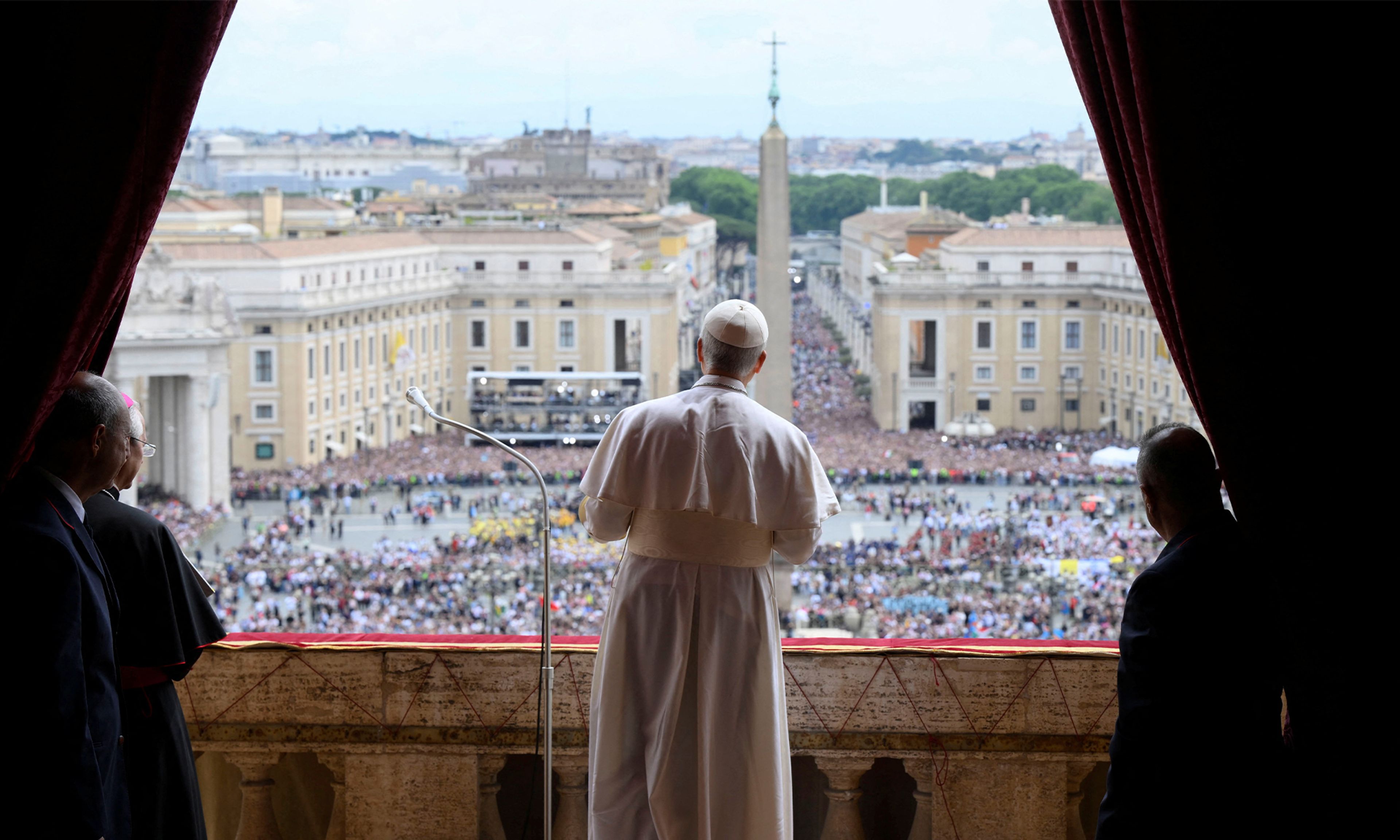
Pope Leo XIV leads a Regina Caeli prayer from the central balcony of St. Peter's Basilica, at the Vatican, May 11, 2025.
The College of Cardinals has elected an American, Robert Prevost, to the papacy. He becomes the head of a church that is in recovery from the whiplash of moving from the tradition-minded and intellectual Benedict XVI to the progressive and emotive Pope Francis. He undertakes the job at a difficult time. Francis has left undone many of the reforms his cardinal electors chose him to implement. Those include the needed imposition of a final and consistent practice for handling priestly-abuse cases. And a cleanup of the Vatican’s finances, which are not just in a parlous state from an accounting perspective but are much diminished, leading to an ecclesiastical pension crisis. These aren’t exciting jobs but necessary administrative ones that only the pope with the help of his curia can do.
But there is another urgent, and perhaps unwelcome, task for the new pontiff. The greatest service he can give the church, and to restore true Catholic faith, is to take it upon himself to begin dismantling some of the accretions on the cult of the papacy. In many ways, the attempts of popes to use their powerful authority to change the church are already draining away the mystique and power of the office.
As we saw in even the breathless tone of secular news coverage of the conclave, it is very easy to get caught up in the sheer majesty of the papacy and the court around the Holy Father in Rome. If you believe in the Catholic Church’s claims, the papacy is the oldest continuous monarchical institution on earth. It is an office that is sanctified by the blood of its martyrs -- Peter, Fabian, Sixtus II; honored in legend-like history from the snows of Canossa to the imprisonment of Pius VII; uplifted by its statesmen -- Clement VII, Leo XIII, John Paul II; and crowned by its great theologians -- Saint Gregory the Great, Benedict XVI. That this great parade is filled out by a few poltroons, nogoodniks, rapists, and plain wastrels is less well known but serves only to add to the drama. Finally, the papacy is the last judge of controversy in the Christian body, the one who adjudicates disputes. Roma locuta, causa finita est. Rome has spoken, the case is finished.
As absolutism in politics gave way to revolution in the 19th century, the church boldly declared the pope’s infallibility in matters of faith and morals. This claim and the collapse of traditional Christian empires worked in tandem to free the church from some of the high-level interference of statesmen in its internal affairs, including papal elections.
The conclave itself remains an absorbing drama, where a far-flung and highly exclusive electorate comes together in the great Renaissance-era structures of the Vatican to elect the pope in secrecy. The rest of the world is banished, and then military-grade anti-bugging devices are deployed. Black smoke, black smoke, and black smoke until, finally, it comes out white. Then we know a man has entered the Room of Tears and is choosing his new name. The global and Catholic media will search through his biography and speculate about the direction in which he might captain the barque of Peter. His persona becomes a kind of symbol of where Western religion’s imagination is today. The newest successor to Peter is greeted by throngs of Romans and tourists waving flags from across the whole world, enthused to be caught up in the drama.
Radio and television brought the pope into the homes of Catholics. What had been a distant monarch, issuing obscure orders to his inferiors in letters, became a kind of religious celebrity, with homilies as fireside chats. Catholic media became something like British tabloid media, reliant entirely on interest in its native monarchy.
Although the Second Vatican Council was intended in many ways to balance the church’s claims of papal authority with a strong restatement of the mission of individual bishops, priests, and laypeople, the practical effect of the Council was to further enhance the cult of the papacy. First, by action alone, the pope had, with the advice of his commissions, completely reordered the Roman Rite of worship. This made him seem more like the master of tradition than its guardian and custodian. Second, the post-Council confusion about traditional moral teaching tended to enhance the authority of Rome as an adjudicator of disputes. For many Catholics, the fidelity of John Paul II and Benedict XVI was the main proof of the church’s claim to indefectibility from the Gospel truth.
The Council’s reforms worked to elevate the papacy in another unexpected way. The almost complete revision of the Mass, the almost universal relaxation of rules against using Protestant hymns, and the revision of nearly every religious order’s constitutions “in light of the Council” worked to demystify and politicize many elements of church life. The liturgy no longer connected you in the same way to the centuries of saints who had prayed it in more or less the same way; it connected you to Pope Paul VI, who instituted it. In many places the practices of Lent were weakened, the customary processions abandoned. By leveling tradition, a papacy that merely retained its status now towered over the church universal.
Suddenly much of Catholic spiritual and intellectual life seemed to revolve around the bishop of Rome in a way that would have been novel to Catholics living in any other century. Would the pope continue to use his powers to open up more areas for reform in the spirit of the Council? Or would he be the primary actor on behalf of Tradition and further bind the church to its historic doctrines and practice?
In effect, the papacy seemed by default to be “where the magic was” in Catholicism. It was almost as if an unspoken transformation had happened, and now the pope’s persona, his preoccupations, his pontificate’s themes were the primary theater in which divine grace revealed itself in the modern world. Consequently, an influential bloc of lay Catholics have been devoted, ever since the Second Vatican Council, to finding out and praying for the pope’s monthly intention, or reading the latest papal encyclical, treating what had been a tool of governance as if it were a basis for lay intellectual devotion. Instead of being the bishop of bishops, and a universal judge, he became the universal pastor, against which all local pastors probably felt insignificant. Under the successive papacies of Benedict and Francis, this dynamic was obviously poisonous. Some traditionalists and liberals in turn felt themselves to be the true custodians of the faith, or in some ways unwanted and abandoned children.
But in fact “the magic” in Catholicism is a lot closer to home. Even in the dingiest, most denuded parish, the Holy Mass itself is at the center of Catholic faith. The Catholic Church teaches that, in its seven sacraments, grace is ex opere operato (from the work worked). That is to say, God Himself effects the results -- not some quality of the priest or the parishioner on whom it is operating: whether the remission of sins in baptism or confession, or the transubstantiation of the Eucharist that makes each Mass a re-presentation of the one sacrifice of Calvary, instantly transporting believers both to first-century Jerusalem and to the heavenly temple in which Christ offers Himself to the Father.
Catholic bishops are true successors to the apostles, not mere franchise representatives of the papal brand. Laymen are nowhere in the Bible or Tradition taught to be preoccupied with the bishop of Rome but instead are assigned the task of working out their salvation in fear and trembling. Just as the “magic” in Catholicism is happening on the altar, it is also happening in each human heart. And in that project, we are more reliably served by searching out wisdom and inspiration from the Scriptures and the writings of the saints and other spiritual masters, like Thomas à Kempis, than in dwelling on whether the bishops ever followed through on Ex corde Ecclesiae, John Paul II’s encyclical on Catholic higher education. Just two of 37 “doctors of the church,” Gregory the Great and Leo I, were popes. Instead of trying to discern a spiritual message to us in the pope’s choices, we might even turn to our own pastors for spiritual guidance.
Leo XIV is a necessary man in Catholicism. As a successor of Peter, he is the symbol of our unity, and he has powers and duties proper to maintaining unity in the church. He should properly begin reforming the Roman Curia and fixing the Vatican’s finances. He may have to discipline his German bishops for their moral capitulations to the spirit of the age. But there is nothing essential to our faith that must be revealed to us by him. Most popes have not been saints, or even great men. That in itself is a testament to a church that operates on God’s grace.

About the Author
Michael Brendan Dougherty is a senior writer at National Review Online.
Featured Tags
Advertisement
Advertisement
Comments