Share this story
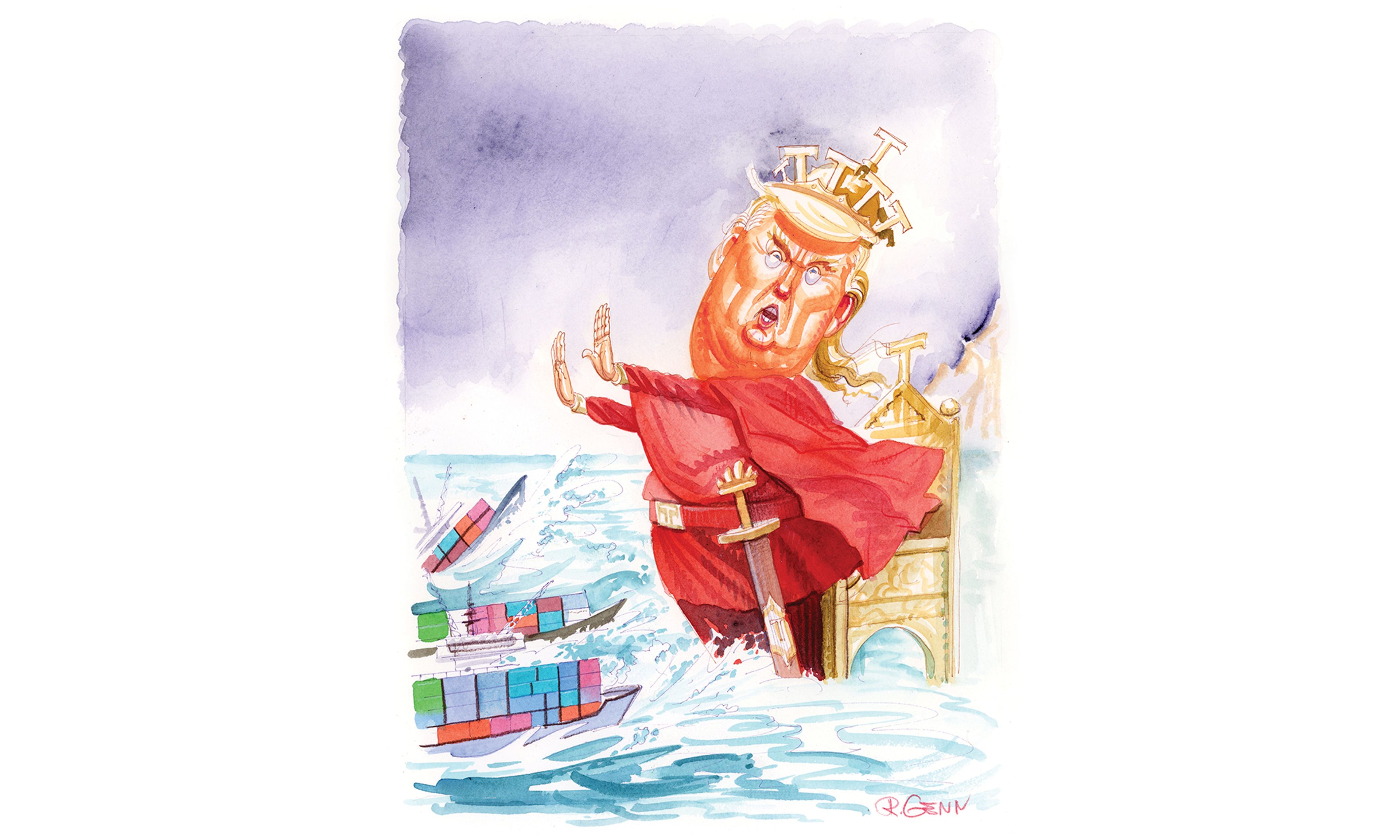
Roman Genn
• Just to clarify, Mr. President: When we said we wanted lower prices, we weren’t talking about stocks.
• The Supreme Court unanimously ruled that the Trump administration must facilitate the return of Kilmar Abrego Garcia to the United States for further court proceedings. He is a Salvadoran who lived here illegally from 2011 until the administration deported him to a notoriously brutal prison in El Salvador. The Justice Department claims but has never proven he is a member of MS-13 (a vicious gang it has designated a terrorist organization) and has admitted that his deportation was illegal because, under a 2019 immigration court ruling, he could be deported anywhere except El Salvador. Yet the administration refuses to seek his return, which would admit by implication that it retains control over all 261 (mostly Venezuelan) aliens it deported -- with the Supreme Court now having similarly ruled that they, too, are entitled to challenge deportation. To acknowledge this legal right is to champion not terrorists, as the administration claims, but due process of law -- which the president is bound by oath to uphold. The administration has continued to stonewall the judge on Abrego Garcia’s case even after the justices ruled. It also pressed El Salvador’s President Nayib Bukele into service: At a White House meeting, with Trump nodding approvingly, Bukele absurdly announced that he would not return Abrego Garcia because he cannot “smuggle” a “terrorist” into the U.S. The Court’s directive was to the American government. The administration’s flouting of it is ominous.
• An immigration judge concluded that the Trump administration may deport Mahmoud Khalil, a former Columbia student prominent in the campus unrest after Hamas’s October 7 atrocities. Until his green card was revoked, Khalil was living in university-owned housing with his American-citizen wife, who was expecting their first child. He entered on a student visa, and his status was upgraded to lawful permanent resident alien (a “U.S. person” for many purposes under federal law). But a decades-old immigration statute provides that even legal aliens on track for citizenship may be expelled if the secretary of state personally concludes that their activities pose harm to American foreign policy interests, even if those activities -- such as speech and association -- would be constitutionally protected if engaged in by a citizen. Khalil’s activities were not protected speech in any event: He was an agitator who sought to extort concessions from Columbia administrators as others occupied buildings, set up an illegal encampment, and harassed Jewish students. He was also a leader of Columbia University Apartheid Divest, a pro-Palestinian group that has supported Hamas. Given these circumstances, the government would arguably be within its rights to do more than deport him.
• House and Senate Republicans fought over a resolution that will serve as the vehicle to extend President Trump’s tax cuts before they expire at the end of the year. A contingent of House Republicans, concerned about mounting debt, was reluctant to go along with a Senate-passed resolution that stipulated a floor of only $4 billion in spending cuts over ten years even as Congress plans trillions of dollars in tax cuts. Only after House Speaker Mike Johnson and Senate Majority Leader John Thune announced their aspiration to cut at least $1.5 trillion in spending did the resolution squeak through, 216 to 214. The House holdouts were right to resist. The federal debt held by the public is expected to reach 100 percent of the economy this year, the highest level since World War II, according to the Congressional Budget Office, and it is on track to surpass that all-time record four years from now. By taking reforms to Social Security and Medicare off the table, President Trump has made it highly unlikely that we will see any significant deficit reduction in his administration (DOGE is not changing the trajectory of the federal spending). But House Republicans should continue to insist on responsible budgeting where they can.
• Republican talk of a red map has given way to special-election blues. Republicans got thumped by a double-digit margin in a race for a Wisconsin Supreme Court seat that cements progressive control of the court for years to come. Democrats flipped a Pennsylvania State Senate seat they haven’t held since 1889. In Iowa, Republicans held a state house seat necessary to keep their supermajority but lost a state senate seat in a district Trump had carried by 21 points. Low-turnout special elections can be unpredictable, but they tend to favor the party out of power (which is fired up) and to favor the party with more educated professionals, settled homeowners, and other traditionally high-turnout groups. Both tendencies favor the Democrats right now. The GOP did hold onto its House majority by winning special elections to replace Matt Gaetz and Mike Waltz in Florida, but by disappointing margins. Fear of losing one or both of these seats probably motivated Trump to lean on Elise Stefanik to withdraw from consideration as U.N. ambassador rather than put her deep-red district at stake in a special election that New York Governor Kathy Hochul might delay for months. Republicans did better in a voter-ID ballot initiative in Wisconsin, but Louisiana voters decisively rejected a package of small-government reforms proposed by Governor Jeff Landry. There are always local factors, but the overall trend ought to focus the minds of Republicans on the midterm electorate -- lest further blues ensue.
• Trump enjoys trolling his opponents by musing about seeking a third term, no matter what the 22nd Amendment says. “I’m not joking,” he told Kristen Welker of NBC News on Meet the Press. “There are methods which you could do it.” There are not. But that hasn’t stopped Trump before. We’d be more willing to think that he is just having fun if we hadn’t seen what he did in seriousness after losing an election. The least worrisome justification Trump might have for this speculation is that he wants to ensure he is not treated like a lame duck. And even if he does not pursue the option seriously, if he is popular and still hale at 83 in 2029, he could remain de facto the power behind a successor. If the voters choose that with their eyes open, no legal structure can stop them. But the American system of transitions of power rests not only on laws but on mutual trust and, yes, norms. It is corrosive of those norms to encourage Trump’s supporters to think that he might get around the rules, and to stoke the fears of his opponents that he could discard them.
• Through a series of executive orders, President Trump has brought the weight of the federal government down on several of the nation’s largest law firms, one at a time. While some of his objectives are laudable, the weapons he has deployed are overkill. His coercive tactics include barring entire firms from federal courthouses and agency buildings and blacklisting even their most junior attorneys and staff from seeking federal jobs. The big law firms -- often under pressure from government and clients -- have collectively created a climate of ideological groupthink that ill serves their profession, hampering the administration of justice. There’s a case for the federal government’s pressuring of firms to stop discriminating on the basis of race, gender, and sexuality -- in short, dismantling the whole “diversity, equity, and inclusion” (DEI) complex -- and even for withdrawing privileges such as security clearances from individual lawyers who abused their positions to conduct lawfare. But firmwide punishments are excessive, and targeting firms that represent Democrats and left-wing causes in activist litigation oversteps how government should respond to legitimate advocacy -- mirroring the excesses of punishing John Eastman for frivolous legal arguments. For firms to pledge more evenhanded pro bono representation is good, but in a climate with a more diverse array of firms, there should be no reason why some firms can’t have partisan loyalties or ideological points of view. No one man should have the power to threaten a business with extinction. We should not wish to live under such a government run by our enemies; nobody should look past it simply because it is temporarily run by their friends.
• Business in the House ground to a halt for a week over whether to allow proxy voting for new parents. Representative Anna Paulina Luna (R., Fla.), who gave birth to her first child in 2023, led a bipartisan push for new moms and dads to vote without being present. This is not a new issue: Under then-Speaker Nancy Pelosi, the House allowed proxy voting as a Covid emergency measure into fall 2022. That was a defensible choice early in the pandemic, but the practice was widely abused by members. One member was spotted partying on the French Riviera while casting 17 proxy votes. President Trump backed Luna: “You’re having a baby, you should be able to call in and vote. I’m in favor of that.” But several Republicans contended that it was unconstitutional. “I signed up for the job!” Chip Roy (R., Texas) argued. “We’re supposed to be here.” Trump then said he would go along with Speaker Mike Johnson -- who, in the end, struck a deal with Luna to allow “vote pairing,” whereby an absent member could agree with a member on the other side to sit out the vote. That solution relies on the survival of some residual collegiality but exposes the absent members to criticism for poor attendance records, disincentivizing abuse. It’s refreshing to see members so invested in ensuring that their colleagues are present. Perhaps as their next step, they can actually debate legislation while they’re there.
• Defying the clearly expressed mandates of a statute passed recently with wide bipartisan support in Congress, Trump is delaying a ban on TikTok for another 75 days. His first 75-day extension of the ban also violated the law, which allows for a single extension up to 90 days provided that the president certifies that a serious deal is on the table. His TikTok extensions belong in the same category of executive lawlessness as former President Biden’s actions to wipe out student loan debt and President Obama’s nonenforcement of immigration law. A deal looks less likely than ever, given the ongoing trade war. The duly enacted U.S. statute is supposed to be the law of the land, not a suggestion to be heeded or ignored depending on how the president of the United States feels about TikTok.
• William F. Buckley Jr. warned in God and Man at Yale against the taking of public money by private universities. The consequences he foresaw have come to pass. The Trump administration, in leveraging universities’ receipt of federal funding to impose terms on them, is not writing on a blank slate but instead, in Trumpian fashion, making loud and explicit what was previously done with subtlety. The Obama and Biden administrations were relentless in using federal law to influence or outright dictate how universities were managed. Trump’s counteroffensive started with Columbia and has advanced to Harvard. We share many of the administration’s concerns and cheer its lawful actions to correct them. But the overall impact of these demands would be pervasive federal monitoring of how the university is governed. The federal government simply should not have this power. Progressives eager to preserve the same powers when they return to the White House will doubtless seek to curb Trump’s authority in this area by attacking his motives, procedures, and factual predicates rather than by going to the root of the issue. But that root, as Buckley observed, is the money itself.
• They knew it was a disaster before it was a disaster. When Ron Klain, President Biden’s chief of staff from 2021 to 2023 and director of debate prep for his June 2024 face-off with Donald Trump, went to Camp David to coach him, the president was “exhausted and out of it. Biden was unaware of what was happening in his own campaign. Halfway through the session, the president excused himself and went off to sit by the pool.” Two mock debates had to be cut short because Biden “was fatigued, befuddled, and disengaged. . . . Klain feared the debate with Trump would be a nationally televised disaster.” These details are excerpted from a new book by Chris Whipple, Uncharted: How Trump Beat Biden, Harris, and the Odds in the Wildest Campaign in History, and Klain has already tried to walk them back, saying that he did not mean to tell Whipple that Biden lacked mental acuity, only that he had been “sidelined” by White House staff -- i.e., kept from understanding his own campaign or the state of domestic politics. That explanation is just another indictment. Only now do members of Biden’s inner circle admit what was evident to anyone with eyes and ears, that the old man was like a cracked piece of china, carried from day to day by anxious handlers. They wanted to keep Trump out of office, and themselves in. Their reward was defeat.
• “No longer will shower heads be weak and worthless,” the White House thundered in a press release accompanying an executive order that rolled back regulatory limits on the amount of water that consumers can expect to flow from their showerheads. The New York Times scoffed: “How big of an issue is this, really?” But Trump is just rinsing away prior bad rules. Congress imposed a 2.5-gallon-per-minute flow-rate maximum on showerheads in the early 1990s, and Barack Obama extended that limit to multi-head units in 2013. In late 2020, Trump merely applied a more commonsense framework to the issue by counting each showerhead on multi-head units as a single conduit. Joe Biden restored Obama’s framework, and Trump countered by returning to his own formula. Trump is on the right side of the issue, and of public opinion. Consumer surveys have long found that low-flow shower users “want more flow and force” and report lower “overall satisfaction” with governed showerheads over high-flow showers. That’s to say nothing of the other low-flow plumbing products -- toilets, dishwashers, washing machines, etc. -- that also consistently underwhelm. Voters aren’t purchasing consumer appliances solely to feel better about their water use. They want their things to work as advertised. The left can scoff all it wants, but helping voters to feel marginally less miserable isn’t a terrible political strategy.
• The House passed, 220–208, the Safeguard American Voter Eligibility Act, which would require those registering to vote to produce proof of citizenship. It is already illegal under federal law to claim falsely to be a U.S. citizen. A commonsense legislative step to make the U.S. Code more enforceable should be uncontroversial. And it is, among the American public: About two-thirds of likely U.S. voters surveyed in April by Rasmussen Reports favor the SAVE Act. The controversy is concentrated in the media and among Democratic lawmakers. Only four House Democrats joined Republicans to pass the bill, one fewer than the five who had done so during the previous Congress. Opponents note that many Americans don’t have passports, and they panic on behalf of married women whose IDs list names different from those on their birth certificates. But U.S. citizens who care to vote can make easy fixes, as the 36 states that have passed voter-ID requirements have already proven.
• Trump signed memoranda ordering the attorney general, the director of national intelligence, and others to investigate two men: Chris Krebs and Miles Taylor. The former was the head of the Cybersecurity and Infrastructure Security Agency at the Department of Homeland Security; the latter was chief of staff in the same department. Their offenses? In the relevant memo, Trump said that Krebs had “falsely and baselessly denied that the 2020 election was rigged and stolen.” Taylor, meanwhile, might be guilty of no less than treason (according to the president). In 2018, Taylor published an op-ed anonymously, warning that the chief executive -- namely, Trump -- was lawless. He followed that up with a book, also published anonymously, titled A Warning. Neither Krebs nor Taylor has been charged with any crime. President Trump ought to be careful, lest he prove Taylor’s point.
• Kathleen Sgamma, who leads the Western Energy Alliance, was President Trump’s nominee to direct the Bureau of Land Management. On the day of her confirmation hearing, her nomination was withdrawn. Earlier in the week, a memo had been unearthed -- one that Sgamma had written on January 7, 2021. It was headed “Hope for a Resurgence of Sanity.” Wrote Sgamma, “I am disgusted by the violence witnessed yesterday and President Trump’s role in spreading misinformation that incited it.” That was a sensible thing to say, but disqualifying four years later.
• The “Make America Healthy Again” crusade, associated with Secretary of Health and Human Services Robert F. Kennedy Jr., has some merit (see this issue’s “The MAHA Brouhaha”). But Kennedy’s putative leadership of it can sometimes be an obstacle to taking it seriously. Already during his tenure atop HHS, his consistent preoccupation with tying vaccines to autism has led to some dubious actions. To a commission investigating that putative link, for example, he appointed a nondoctor who in the search for a potential autism “cure” used hormones to experiment on children. But if you believe Kennedy, such decisions will lead to an incredible outcome. At a recent cabinet meeting, he claimed that, thanks to his efforts, “by September we will know what has caused the autism epidemic and we’ll be able to eliminate those exposures.” His extravagant aspiration is similar to Joe Biden’s promise to cure cancer. But the medical situations of cancer and autism are quite different. As our friend David Harsanyi pointed out earlier this year, there was no widespread and coordinated effort made to track autism until 2000; only in 2006 did the American Academy of Pediatrics begin to recommend that pediatricians screen children for autism during their first two years of life. And there is still no objective diagnostic measure of it equivalent to a blood test. No one should be surprised if Kennedy’s promise ends up sharing with Biden’s the key attribute of not being realized.
• Laura Loomer is a “right-wing influencer” who has the ear of the president. She believes that the terror attacks of 9/11 were “an inside job.” There is an interesting video of her with Nick Fuentes, one of the most appalling of the “influencers.” As they clink glasses, Loomer offers a toast: “To the hostile takeover of the Republican Party.” Last year, Trump told an audience at Mar-a-Lago, “You don’t want to be Loomered. If you’re Loomered, you’re in deep trouble. That’s the end of your career, in a sense.” Yes. After a recent meeting with Loomer in the Oval Office, Trump fired six officials of the National Security Council. He also fired the director of the National Security Agency, General Timothy Haugh, and his deputy, Wendy Noble. All of these people were on Loomer’s “bad list.” Senator Mitch McConnell said out loud what others thought: “If decades of experience in uniform isn’t enough to lead the NSA but amateur isolationists can hold senior policy jobs at the Pentagon, then what exactly are the criteria for working on this administration’s national security staff?”
• Having been soundly defeated in the court of public opinion, the proponents of “gender-affirming” care for kids have taken their efforts underground. Health care providers are now concealing their mutilation of children when applying to have the procedures covered by insurers -- so, rather than admit to performing a double mastectomy on a teen girl for purely cosmetic reasons, the responsible physician will file to have the procedure covered as a medically necessary “breast reduction.” We know about this latest, hidden front in the long-running fight against gender madness thanks to Eithan Haim, the surgeon who was prosecuted by the Biden Department of Justice for blowing the whistle on gender-transition procedures at Texas Children’s Hospital. Haim, who had all charges related to his whistleblower efforts dropped in January, recently testified before the House Judiciary Committee and explained how the Campaign for Southern Equality, an LGBTQ nonprofit, trains doctors to conceal their efforts. Dr. Haim may have to take up whistleblowing as a career.
• A federal judge granted a Department of Justice motion to dismiss the corruption indictment against New York City Mayor Eric Adams. But Judge Dale Ho denied the DOJ’s attempt to preserve the possibility of reinstating the charges at some later time. As the prosecutors who resigned over the DOJ’s order to drop the charges contended, that sword of Damocles made the deal even more redolent of a quid pro quo. To save his neck, Adams would enforce Trump immigration policies that are unpopular among his heavily Democratic constituents; and to ensure Adams’s continued compliance, Trump would keep the threat of revived prosecution in place. Judge Ho, a Biden appointee who drafted former George W. Bush solicitor general Paul Clement as an amicus to advise him, recognized that dismissal should be granted because courts lack authority to order the DOJ to continue a prosecution, but forbade future prosecution of the charges. Ho also rejected insinuations by DOJ leadership that the Adams prosecution was “improperly motivated” because of Adams’s mild complaints about Biden’s border policies, which inundated the city with illegal aliens. Adams will soon face the voters -- he is now running as an independent -- who are apt to be harsher judges.
• Adams is triply handicapped among Ds now: Biden’s Department of Justice prosecuted him for favors shown to Turkey, going back to 2014; Trump’s Department of Justice dropped the prosecution, as a seeming favor for Adams’s cooperation with it on immigration; and Adams talks a good game on crime, begging Albany to rescind bail reforms that amount to get-out-of-jail-free cards. The front-runner among Democrats is former Governor Andrew Cuomo, a liberal with a tough persona; he is hampered by the charges of sexual harassment that caused him to resign the governorship in 2021, and by his decision to lock Covid sufferers in nursing homes, cheek by jowl with the most vulnerable. Guardian Angels founder Curtis Sliwa will be the GOP’s sacrificial lamb. That leaves the midgets of the Democratic left, one of whom is worse than all the others: Zohran Mamdani, member of the Democratic Socialists of America and enemy of Israel (in 2023 he joined a hunger strike calling for a cease-fire in Gaza). The nightmare scenario would be a split in the normal vote allowing Mamdani to slip in on the Working Families line.
• Colorado Democrats are on a mission to wrest the “most extreme” title from their fellow progressives in the Pacific Northwest. In the past few months, progressives in Denver have introduced legislation to force taxpayers to fund abortions for women on Medicaid, to punish parents engaged in custody disputes for “deadnaming” their children, and to fine gas station owners $20,000 if they fail to post on their pumps a notice informing customers that burning fossil fuels contributes to climate change. “A birth is more expensive than an abortion,” Colorado House Speaker Julie McCluskie said at a committee hearing last month. “Ultimately, we do achieve a cost savings because of the averted births that will not take place.” Democrats have for years flirted with this fiscal justification for abortion but -- at least in Colorado -- they’re now just coming right out with it. In an interview with NR, State Representative Junie Joseph, the sponsor of the gas-pump bill, said that the labels would encourage people to “ride bicycles and walk to places as well.” These bills should come with warning labels of their own.
• U.S. special envoy Steve Witkoff met with Vladimir Putin in St. Petersburg on April 11 to talk about the Ukraine war. Two days later, on Palm Sunday, the Russians fired two ballistic missiles at the Ukrainian city of Sumy, killing over 30 civilians and injuring more than 100. A few points are evident. Witkoff is out of his depth. If every meeting with Putin is followed by such results, he had better simply stay home. But he serves a president who seems mainly to want a quick cease-fire so that he can be applauded and applaud himself as a peacemaker. To this end, Trump directs his ire most frequently at Ukraine, which to date has acceded to many of his terms, though it will not accept false blame for starting the war. Trump occasionally shows impatience with Russia, telling it on Truth Social, the same day that Witkoff met Putin, to “get moving.” But that is language far milder than he directs at Canada or Denmark, or Republicans who disagree with him, none of whom slaughter churchgoers. Ukraine’s President Volodymyr Zelensky had a better reaction to the Palm Sunday strike: “Only bastards do this.” In 40 years of real estate, and four in the White House, Trump has met many. Why does he not recognize with whom he is now dealing?
• In Turkey, the principal opponent of Recep Tayyip Erdoğan, the country’s strongman, is Ekrem İmamoğlu. Was? İmamoğlu is the mayor of Istanbul. Was? Erdoğan has had him arrested and imprisoned. This is what dictators do, when their power is threatened. In Washington, President Trump said, “I have great relations with a man named Erdoğan. Have you heard of him? I happen to like him, and he likes me. I know the press will get very angry -- ‘He likes Erdoğan.’ But I do, and he likes me.” An American president can do a little better than that.
• In Gaza, Palestinians took to the streets to protest -- to protest Hamas, which has ruled that tormented strip for 18 years. This is not the first such protest. In 2019, Palestinians demonstrated for several days, in what was known as the “We Want to Live” movement. Hamas put this down mercilessly. They did the same to the more recent protest. Palestinians had shouted, “Hamas, get out!” and “Hamas are terrorists!” One of the protesters was Oday al-Rubay, age 22. According to his family, he was murdered for his trouble, his body dumped at their doorstep. When people say they are “pro-Palestinian,” what do they mean? One thing they should mean is that a terror group should not rule Gaza, or any other territory.
• Apparently learning nothing from Democrats’ experience with Donald Trump, France is using lawfare to go after Marine Le Pen, the leader of the right-wing party National Rally. She has been sentenced to prison and prohibited from seeking public office for five years because her party had, beginning 20 years earlier, misused EU funds for political purposes. Leaders of other parties that have committed that infraction have either been given slaps on the wrist or not punished at all. But with National Rally leading in the polls and a presidential election coming in 2027, it seems the French government wanted to get out ahead of Le Pen’s possible victory. It’s especially strange given that Le Pen has run for president three times before and gotten crushed each time. Her party is more popular now because one key process of democracy, campaigning toward the median voter, was working: She has moderated the party and repudiated much of the odious legacy of her Holocaust-denying father, Jean-Marie. Democracy is not defended by depriving voters of popular choices.
• Men continue to invade women’s sports both mainstream and niche, prompting some courageous female competitors to stand up even if they stand alone. In March, female fencer Stephanie Turner refused to compete against her male opponent at the Cherry Blossom Open in Maryland. USA Fencing responded to her protest by disqualifying her. In England, a women’s pool tournament featured two male players in the championship. In Tennessee, Abigail Wilson walked off the disc golf course at the Music City Open rather than face a male player, who defeated the world’s top-ranked female competitor in 2022. That thing that never happens, in short, keeps happening.
• “Just asking questions” is a tired routine by faux-sophisticated thinkers who pretend to be transgressive while giving their audiences exactly what they want. If you want a steady diet of isolationist criticisms of U.S. foreign policy hardly different from those made during the Vietnam era or the Iraq War, there are plenty of “online right” influencers from whom you can get it. One of them is Joe Rogan, who has one of the most popular podcasts in the world. Another is comedian Dave Smith, whose online presence is dominated by his opposition to Israel more than by anything resembling comedy. Douglas Murray is also popular among the online right, for his opposition to cancel culture and his defense of the West against Islamism. But he chose to confront Rogan and Smith on the former’s podcast, for almost three hours, to ask some real questions: Why are Rogan’s guests so frequently anti-Israel and anti-Ukraine? Why does Smith talk nonstop about a conflict he knows little about? Why give a platform to people who are, at the very least, playing with Hitler revisionism and Holocaust denial? Murray could have easily done fan service if he wanted, but he chose to stand up for values he believes in, values we share, knowing full well he would be savaged on social media by right-wing influencer accounts afterward. There’s exercising free speech, and then there’s exercising it well. Murray did the latter.
• Nothing has more besmirched the Catholic Church in recent history than the scandal of priestly sexual abuse. Neither has anything in recent decades driven more faithful from the pews. It adds scandal upon scandal that Theodore McCarrick was the face of the church’s initial response. At the time, McCarrick, ordained in 1958, was mostly regarded as a trustworthy and influential figure in the leadership of the church in the United States. The archbishop of Newark, N.J., and then of Washington, D.C., he was created a cardinal in 2001. Throughout his long career, rumors had circulated about his extensive sexual transgressions involving minors, seminarians, and priests. The rumors gained a ghastly credence in 2018 following an investigation by the Archdiocese of New York, which opened the floodgates for further sordid revelations. Those involving misconduct at a New Jersey beach house that a diocese had purchased at McCarrick’s request would put even the most corrupt and dissolute Renaissance-era Vatican prelates to shame. Allegations of abuse in the priestly confessional shock the conscience. McCarrick resigned from the College of Cardinals at the request of Pope Francis; a year later, he became the highest-ranking official in the church ever to be defrocked. He spent the last years of his life in a succession of unexplained residences, further scandalizing the church and raising questions about how much, and when, high-ranking officials, including several popes, knew about his diabolical activities. The man who was once a symbol of the church’s response to its gravest modern scandal became a scandal unto himself. Whether McCarrick ever expressed genuine contrition for what he did is unclear. His soul and his judgment are in God’s hands. Dead at 94.
• Everyone recognizes giants in the past, but there are such figures in the present as well. Early on, Mario Vargas Llosa made a splash, with The Time of the Hero, The Green House, and other novels. He also made splashes with political essays. After spending his youth on the left, he became a determined classical liberal. In his native Peru, he founded a political party, Movimiento Libertad. He ran for president in 1990, losing to Alberto Fujimori. In 2018, he published an intellectual memoir, The Call of the Tribe. He chronicled and hailed his influences, including Adam Smith, Friedrich Hayek, and Raymond Aron. His Nobel Prize in Literature, awarded in 2010, was thoroughly fitting. His novels will be read and marveled at for generations. Mario Vargas Llosa is now a giant of the past, having died at 89. R.I.P.
• It’s an apt demonstration of Val Kilmer’s acting talent that, in his first movie role, at age 24, he credibly portrayed an Elvis-like musician who somehow gets tied up in an anti-communist plot against the government of East Germany. If you haven’t seen 1984’s Top Secret!, a joke-a-second spoof by the team that brought us Airplane!, then you’ve missed the debut of one of his generation’s most impressive actors. You probably have seen him in Top Gun, in which his macho alpha Iceman goes toe to toe with Tom Cruise’s Maverick. Or in Tombstone, the Wyatt Earp film in which he stands out from an impeccable cast with his louche yet genteel portrayal of Doc Holliday. Or maybe you caught him in The Doors, in which he more embodied than portrayed the band’s front man, Jim Morrison. It wasn’t all hits for Kilmer; his shots at superstardom as the titular characters in Batman Forever and The Saint did not quite achieve their desired aim. And in making such films as the misbegotten The Island of Dr. Moreau, he displayed the actorly ego and distemper that got him a reputation (not entirely unearned) as difficult. But at his best, Kilmer brought to his roles a unique commitment, and a thoughtfulness also evidenced in his own self-reflections. His career waned in recent years; throat cancer made even speaking a challenge. The exception -- and, it turned out, his career epitaph -- was a brief yet powerful appearance in Top Gun: Maverick, the surprisingly excellent, decades-later sequel to the schlocky original. We learn that Cruise’s Maverick and Kilmer’s Iceman became close friends in the intervening decades, but also that Iceman, suffering from a malady similar to Kilmer’s, could hardly talk. An eccentric man but an electric performer, he deserves to be remembered among his profession’s greats. Dead at 65. R.I.P., Huckleberry.
Public Policy
Trading Down
President Trump, declaring a national emergency, inflicted an economic one. He has launched a trade war with the entire globe, imposing, pausing, and modifying tariffs faster than the tax collectors can implement his decisions. He and his aides have offered multiple shifting and sometimes conflicting accounts of what they are doing. The effects include pummeled stocks, raised bond yields, and a weakened dollar; reduced projections for economic growth; retaliatory tariffs from many countries, and anger from countries that had considered themselves, and that the U.S. government had considered, longtime allies. Even some people who have devoted much of their careers to advocating protective tariffs are raising objections to Trump’s policies.
On the other side of the ledger, administration officials say that scores of countries are willing to make concessions to escape the new tariffs and the threat of future ones. But officials also refuse to speak with one voice about what concessions would be sufficient and which of the new tariffs are on the table. Negotiations may founder also because Trump has in multiple ways reduced U.S. credibility. Making deals with the U.S. -- under the previous Trump administration! -- did not spare Canada, Mexico, or South Korea from tariffs. Trump has also abandoned and weakened some of his tariffs in advance of any negotiations.
[slideshow slideshow="1819689" /]
Individual companies are negotiating, too, seeking tariff exemptions for themselves. This lobbying activity, though understandable, serves no national interest -- even if it makes Trump the master of every supplicant’s fate. But Trump is not special in this regard: Increases in protectionism are also increases in the power of the political class as a rule, and not infrequently in its corruption.
The proffered rationales for this trade war do not stand up. We are told that our persistent trade deficit has had a debilitating effect on manufacturing employment and wages. But every advanced economy has seen declines in manufacturing employment, mostly because improved productivity has reduced the need for it. The overall economy has nonetheless seen wages and employment rise over the decades. The story of stagnation that protectionists tell is a myth. Rising trade deficits have been associated with positive economic outcomes, as during most of Trump’s first term.
Tariffs do not necessarily help the manufacturing sector or shrink the trade deficit, anyway -- especially when, as in the case of Trump’s tariffs, they raise the cost of goods that manufacturers use. That’s one reason, economists have found, that Trump’s first-term tariffs backfired.
Trump complains that most countries have been “cheating” the U.S. He sometimes suggests that merely running a trade surplus with us counts as cheating. But his tariffs have applied to countries that have lower tariffs than we have -- sometimes lower nontariff barriers too -- and to countries with which we have a surplus ourselves. For most of the past century, we have managed to get trading partners to reduce their barriers to U.S. exports through negotiations without leading investors around the world to doubt our stability and rationality. But those negotiations have come to a halt as Trump’s sentiments about trade have gained influence.
Nor can the tariffs be defended as a means of weakening China in geopolitical competition. If that were our goal, we would be trying to build an international coalition to advance our economic aims in that competition, instead of seeming to try to convince current and prospective allies that China is a more reliable ally than we are. We would also probably be imposing barriers on their advanced manufactures rather than on their cheap plastic toys. At the moment, Trump’s policies are doing the reverse.
The U.S. Constitution vests authority over trade policy in Congress, not the president. While Congress has delegated too much of this authority to the president, it is not at all clear that it has given Trump the powers he is chaotically exercising. Court challenges are underway, as they should be. All too few Republicans in Congress are demonstrating any interest in improving policy or even insisting on their constitutional prerogatives. The markets will continue to teach the president a lesson he refuses to learn.
Correction: In the May issue, we wrote that Robert F. Kennedy Jr. advocates the use of vitamin D against measles infections. In fact, he recommends vitamin A, which works just as poorly.
The Stat
25 percent -- United States trade intensity in 2023, according to the World Bank.
Trade intensity is calculated by adding together a country’s imports and exports, then dividing that sum by the country’s gross domestic product. It’s a straightforward way of measuring how exposed a country is to international trade. Despite constant talk about how the U.S. has been overrun by imports in the age of globalization, its trade intensity of 25 percent is one of the lowest in the world. In fact, of countries for which data are available, only two -- Ethiopia and Sudan -- have lower trade intensities than that of the U.S. Australia and New Zealand, highly developed island countries rich in natural resources and far removed from most of the rest of the world, have trade intensities roughly twice as high as that of the U.S. The world average is 59 percent. The United Kingdom’s trade intensity is 64 percent; Canada’s is 67 percent; Germany’s is 83 percent; Sweden’s is 106 percent; the Netherlands’ is 166 percent; Singapore’s is 311 percent. Just because U.S. trade intensity is so low doesn’t mean trade issues are unimportant, though. U.S. GDP in 2023 was about $28 trillion, which makes the total value of U.S. international trade about $7 trillion. A country with a $7 trillion economy would have the third-largest economy in the world, exceeding the entire German economy by about $2.5 trillion. Populists greatly exaggerate the extent to which the U.S. has been exposed to international trade, but their prescriptions would still do great damage because the U.S. is so rich.
by Dominic Pino

About the Author
NR Editors includes members of the editorial staff of the National Review magazine and website.
Featured Tags
Advertisement
Advertisement
Comments