Share this story
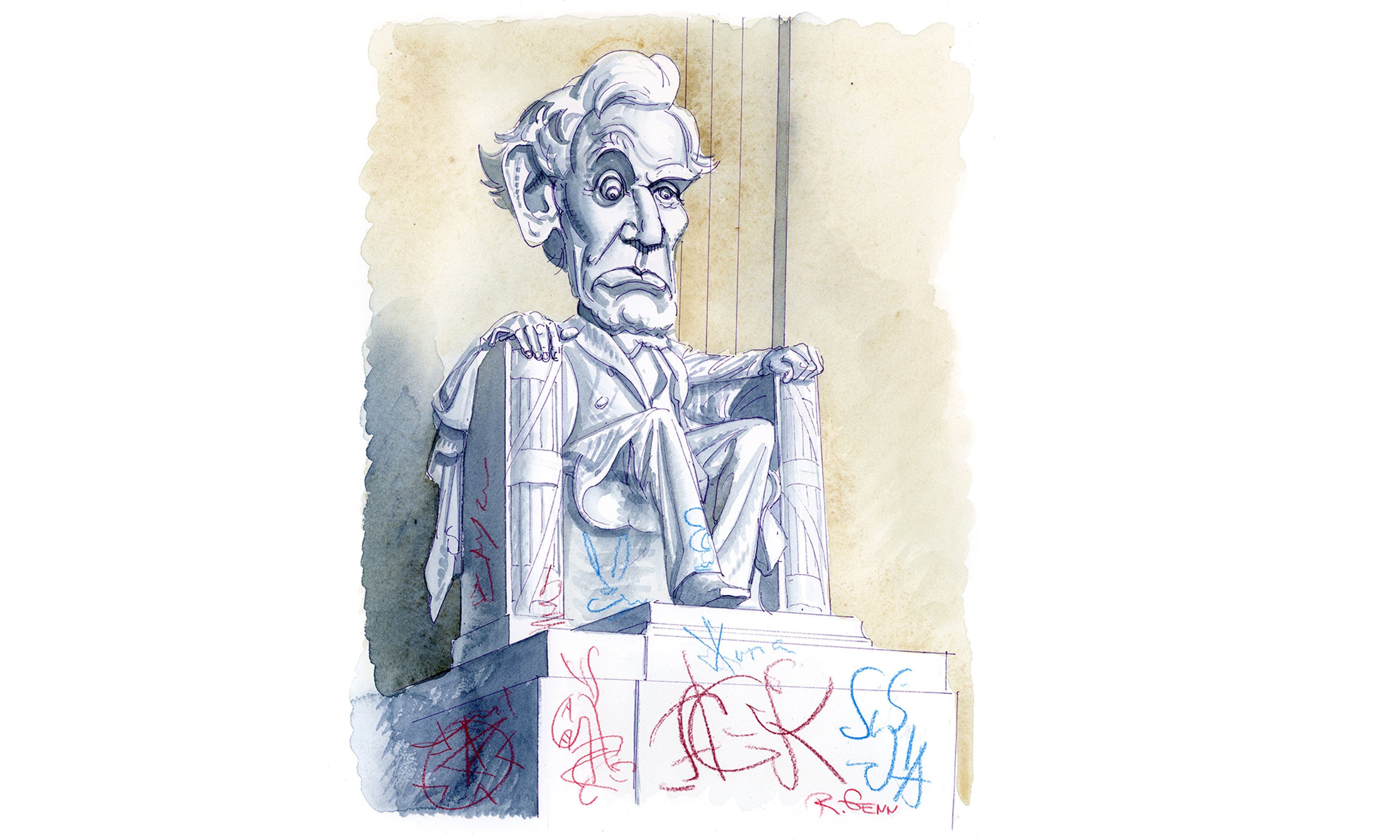
Roman Genn
• Of course all those European leaders came to the White House. How else can they enjoy air-conditioning?
• President Trump sat down with Vladimir Putin in a don’t-call-it-a-summit meeting in Alaska. Holding it at all was a major concession to Putin, who had been diplomatically isolated by the West. After three and a half years of war, Trump thought direct negotiations were worth trying. The Russian dictator hoped that weapons-grade presidential flattery and economic inducements could move the United States into neutrality. Trump wants a cease-fire, both for humanitarian reasons and his legacy. The Ukrainians and our European allies were clearly concerned that Kyiv could be cut out of negotiations that would decide its fate. As we go to press, nothing concrete has come of the talks. Putin proposed hard-to-swallow “land swaps” -- unrequited concessions from Ukraine. Trump spoke tantalizingly of security guarantees for a postwar Ukraine, albeit ones that would involve no formal membership in NATO or U.S. troop commitments. Much depends on what happens next and the details of any agreement. Trump described the situation best: “There’s no deal until there’s a deal.”
[slideshow slideshow="1867898" /]
• Trump vowed on social media to “get rid of MAIL-IN BALLOTS” and voting machines by executive order. He contends that “the States are merely an ‘agent’ for the Federal Government in counting and tabulating the votes,” but the Constitution recognizes that states are sovereign entities with primary responsibility for both state and federal elections. The Supreme Court has recognized this fact since 1890. As Justice Clarence Thomas wrote in 1995, “When the people of Georgia pick their representatives in Congress, they are acting as the people of Georgia, not as the corporate agents for the undifferentiated people of the Nation as a whole.” A distributed system of 50 state elections has served the nation well, and conservatives have long defended it, most recently against Joe Biden; it would be foolish for Trump to throw it away. Moreover, to the extent that the Constitution provides a federal override of state election laws, it gives that power to Congress -- not the president. Trump is also wrong about the policy. While mail-in ballots and some types of voting machines may present security issues, states with proper safeguards have made them work, and it would be costly and impractical to get rid of all forms of machine counting of ballots so long as paper trails of ballots are retained when needed for recounts. Republicans should stand for honest elections. But presidential executive orders are not the way to ensure them.
• Pushed by Trump, Texas Republicans are inching closer to redrawing the congressional map for 2026. This is hardball, and Democrats such as California Governor Gavin Newsom and Illinois Governor JB Pritzker are pledging to retaliate. But Democrats are the last people who should complain. Entering 2024, Republicans controlled the governorship and the state legislature in 23 states. Across those states, they won 59.3 percent of the popular House vote and 132 of the 176 House seats: 75 percent of the seats, a 16-point advantage over purely proportional representation. In the 10 states with divided government, Republicans won 52.3 percent of the popular House vote and 47 of the 75 House seats: 62.7 percent of the seats, a 10.4-point advantage. In the 17 states run entirely by Democrats, the Dems won 56.7 percent of the popular House vote but 143 of the 185 House seats: 77.7 percent of the seats, a 21-point advantage. California delivered a 43–9 Democratic delegation from winning 58.4 percent of the vote; Illinois has a 14 to 3 Democratic edge from winning 52.8 percent. Democrats can do little to retaliate because their own states are already gerrymandered to the hilt.
• Speaking of gerrymandering, the Supreme Court last term put off one case on its docket, Louisiana v. Callais, to be reconsidered this fall. The state added a second majority-black congressional district drawn on explicitly racial grounds after the courts threw out a map that had only one such district. Justice Clarence Thomas dissented from the decision to delay the case, but he might get what he has long argued for: a ruling on whether the Court’s Voting Rights Act precedents are pushing states to segregate voters by race in ways that are unconstitutional. Justice Brett Kavanaugh will be the man to watch. He has balked at reconsidering how the Court reads Section 2 of the VRA, enacted in 1982. But he also wrote in 2023 that “even if Congress in 1982 could constitutionally authorize race-based redistricting under §2 for some period of time, the authority to conduct race-based redistricting cannot extend indefinitely into the future.” Is 43 years of racial gerrymandering enough?
• President Trump says that he wants a new Census done before 2030, and that it should not count illegal immigrants. It’s true that the 2020 Census -- conducted by Trump’s own first-term Commerce Department -- disadvantaged Republican states, overcounting New York and Minnesota and undercounting Florida, Texas, and Tennessee. That was partly due to Covid and partly to blue states working harder to get a complete count. But Trump’s current commerce secretary, Howard Lutnick, has acknowledged that the president lacks the power to order a mid-decade reapportionment. Moreover, the 14th Amendment requires that House districts be based on “the whole number of persons in each State, excluding Indians not taxed” -- meaning that everybody else must be counted, even people here illegally. Legality aside, this would be an expensive undertaking for nakedly partisan purposes. Yet it could easily hurt red border states such as Texas and Florida. If Republicans hold together their current coalition, they could gain significantly in the House and the Electoral College from the 2030 Census. But that will have to wait.
• Democratic lawmakers in some of America’s most populous cities are fit to be tied over the tendency of Immigration and Customs Enforcement (ICE) agents to mask up when conducting official business. They are “operating like masked militias,” said New York State Senator Patricia Fahy. Masking is “abhorrent” and “dangerous,” said Pennsylvania State Senator Nikil Saval. ICE’s tactics are redolent of the KKK and Augusto Pinochet’s secret police, the Reverend Robert Montgomery wrote. The sight of masked law enforcement is unfamiliar to us. But ICE, Customs and Border Protection (CBP), and other federal law enforcement agents face growing threats. In July, the Department of Homeland Security warned that attacks on ICE personnel are up by 700 percent. Some of those attacks were quite unnerving -- among them, a July attack on a CBP outpost in Texas in which one officer took a bullet in the knee. Elsewhere in Texas, on July 4, an officer was shot in the throat amid a “coordinated attack” involving ten suspects who deployed complex tactics in an effort to kill federal agents. Any effort to unmask ICE agents must seriously contend with the threat to officers. So far, we’ve seen precious little of that.
• The White House has launched an AI Action Plan. It prohibits the federal government from purchasing any AI product that, in Trump’s words, “has been infused with partisan bias or ideological agendas.” It seeks to “expedite construction of all major AI infrastructure projects” by waiving or reversing Biden-era environmental obstacles and “easing Federal regulatory burdens.” And it encourages the export of American hardware and software “to preserve and extend American leadership in AI and decrease international dependence on AI technologies developed by our adversaries.” These policies are all within the federal government’s remit, and all are welcome on the merits. Trump said that he had come “to declare that America is going to win” the global AI race. It’s because that goal is in doubt that the plan is necessary.
• Robert F. Kennedy Jr. announced that the Department of Health and Human Services has cancelled $500 million in grants to develop vaccines made with mRNA technology to combat future pandemics, redirecting those funds to more traditional vaccine platforms. Often misunderstood, mRNA vaccines instruct human cells to produce harmless fragments of a virus, training one’s immune system to fight off a real infection. This technology, though in its early stages, could revolutionize the treatment and prevention of innumerable diseases. Many scientists believe that the next generation of cancer treatments will be mRNA-based, as such drugs may be able to attack a patient’s specific cancer cells. Kennedy’s case against the vaccines is weak at best. He claims they aren’t effective against upper respiratory viruses like Covid-19, but the mRNA-based Covid vaccines were better at preventing infection, symptoms, and hospitalization than their non-mRNA competitors. Kennedy also says mRNA vaccines cannot cope with viral mutations because they’re so narrowly targeted, but, once again, the mRNA Covid shots were more potent against variants like Omicron than the alternative platforms that Kennedy prefers. More important, unlike traditional immunizations, mRNA vaccines can be rapidly updated to target new variants as they emerge. Fortunately, half a billion dollars in spending cuts won’t eradicate the promising mRNA industry -- so long as they are not the prelude to a regulatory strangulation.
• Lee Zeldin, the head of the Environmental Protection Agency, has rescinded the 2009 “Endangerment Finding” that allowed the agency to regulate fossil fuel emissions under the Clean Air Act. He hailed this move as “the largest deregulatory action in the history of the United States.” If it sticks, it will be a major blow against intrusive regulation of the energy, automotive, and manufacturing sectors. The EPA was thrust into this area when the Supreme Court, in a dubious 5–4 decision in Massachusetts v. EPA (2007), ruled that Congress in 1970 meant to classify carbon dioxide as an “air pollutant” notwithstanding the fact that it is naturally present in the atmosphere and is exhaled by humans and animals. The Court required the EPA to regulate greenhouse gases or provide a “reasoned explanation” for its failure. The Obama and Biden administrations each rushed to impose new regulations, especially on carmakers. Zeldin is challenging the legal basis of that decision (only three justices remain from the 2007 Court, all of whom dissented), but he’s also aiming to exercise the regulatory discretion to determine that such emissions do not “endanger public health or welfare.” The Court should uphold his decision -- and reconsider its own.
• There is a solid case to be made that the Federal Communications Commission does not need to exist. The arrival of cable, and then the internet, solved the limited-resource problem that had been posed by radio and terrestrial television, and insofar as our modern media need regulation, that regulation could easily be enforced elsewhere. But if it is going to stick around nevertheless, it could at least refrain from using its powers to undermine the First Amendment. Alas, the new chairman of the FCC, Brendan Carr, has developed an inflated view of his own authority that extends to threatening media companies whose choices do not line up with his politics. You will hear no argument from us against the proposition that DEI is a blight on the landscape -- or, indeed, against the claim that much of the news is pure “distortion.” But, under our constitutional order, these are not problems to be solved by the FCC director -- and certainly not as the price of admission to the public square. Once upon a time, Carr opposed the idea that the FCC ought to “operate as the nation’s speech police.” He would do well to return to that view.
• American Federation of Government Employees President Everett Kelley called his union’s 2023 contract with the Department of Veterans Affairs “the very best union contract in the entire federal government.” About 80 percent of VA employees are unionized, and the department’s workforce has ballooned even as the population of veterans has gradually declined. Now, the Trump administration has terminated most of its collective-bargaining agreements with VA employees. And what contracts they were: In 2024, union representatives were paid for more than 750,000 hours of “union time,” the practice by which taxpayers end up subsidizing union activity. Over 187,000 square feet of VA office space was dedicated to union activity, free of charge. The AFGE worked with the Biden administration to reinstate employees who had been fired for misconduct. Success at the VA should be measured by the quality of its care, not the cushiness of its contracts.
• America’s lead in the commercialization of space is generating impressive economic, strategic, and, through allowing NASA to make better use of its resources, scientific returns. There is, however, no reason for complacency. Competitors, notably but not exclusively China, are mounting a formidable challenge. One of the best steps that the government can take to help an industry, especially an early(ish)-stage industry, is to get out of the way. President Trump has signed an executive order that moves in the right direction. It would “eliminate or expedite” environmental reviews for, and other bureaucratic obstacles to, the granting of launch and reentry licenses and permits, a source of delay and thus complaint by SpaceX and other rocket companies. The result will be more launches and more competition, not least as other provisions in the order will make it easier to build more spaceports. On top of this, a new position within the government will be set up to foster “innovation and deregulation in the commercial space transportation industry.” Welcome steps all, and ones that could lead to giant leaps.
• Not long ago, acting NASA Administrator Sean Duffy’s announcement that America plans to put a 100-kilowatt nuclear reactor on the surface of the moon by 2030 would have occasioned sneering condescension from the political class. It is a testament to the revolution in commercial spaceflight, perhaps, that Duffy’s plan received little of the derision that was reserved for Donald Trump’s Space Force. As Duffy observed, the Chinese and Russians, too, seek to put a reactor on the lunar surface, and they “could potentially declare a keep-out zone” around one when they do. In sum, the NASA administrator revealed that earthly geopolitics will soon be exported to the celestial bodies in our solar neighborhood. It’s only a question of when it happens and who will set the rules.
• Soon after Trump’s inauguration, there was a spate of media coverage about how Americans were afraid of air travel. DOGE was gutting air traffic control, they said, and the deadly plane-helicopter collision at Ronald Reagan Washington National Airport was a harbinger of the danger of flying in Trump’s America. Most Americans haven’t thought that at all. The number of air-travel passengers has been at record highs this summer. It is possible to cut government without cutting safety, and most Americans don’t think about Trump as much as the media do.
• For twelve years, the Little Sisters of the Poor, a group of nuns whose sole purpose is to provide care to destitute elderly people, has been dragged through America’s courts by a series of monomaniacal ideologues in the Democratic Party. The nuns’ crime? Objecting to a provision in Obamacare that required nonprofits to offer contraceptives as part of their federally approved health insurance plans. The nuns argued that any participation in the distribution of contraception represented a grave violation of their religious beliefs and that the federal government was obliged to find another means of achieving the same end. The Supreme Court has repeatedly pushed back against federal heavy-handedness toward the nuns, first urging the Obama administration to reach an agreement with religious objectors to the mandate and then turning back a challenge to the Trump administration’s granting of an exemption to them. Now a Pennsylvania district judge has sided with several blue states still suing the sisters, striking down the Trump administration’s broad exemption as “arbitrary and capricious” and therefore a violation of the Administrative Procedure Act. Once again, the Little Sisters of the Poor are being told to choose between their consciences and the law. Given the instincts of the current Supreme Court, it seems likely that the Little Sisters of the Poor’s most recent loss will eventually be overturned. But the instinct that led to their harassment will also remain.
• Electricity bills are rising both in price and in New Jersey’s gubernatorial race. That is due almost entirely to the amount of power consumed by the data centers fueling the AI revolution. The state has responded to residents’ complaints with gimmicks, offering them one-time rebates and leaning on power companies to defer price hikes into the fall, when the strain on the grid will recede along with high temperatures. A welcome though insufficient response has come from New Jersey power provider PSE&G, which plans to expand its operations at the Hope Creek nuclear plant. This problem extends far beyond New Jersey. On average, Americans have seen a 6.5 percent average increase in their utility bills. Wholesale electricity prices are up by 20 percent in some parts of the country. America needs more power, and the Democratic Party’s knee-jerk answer--to shower well-connected renewable-energy producers with taxpayer-backed subsidies and incentives -- just isn’t generating it.
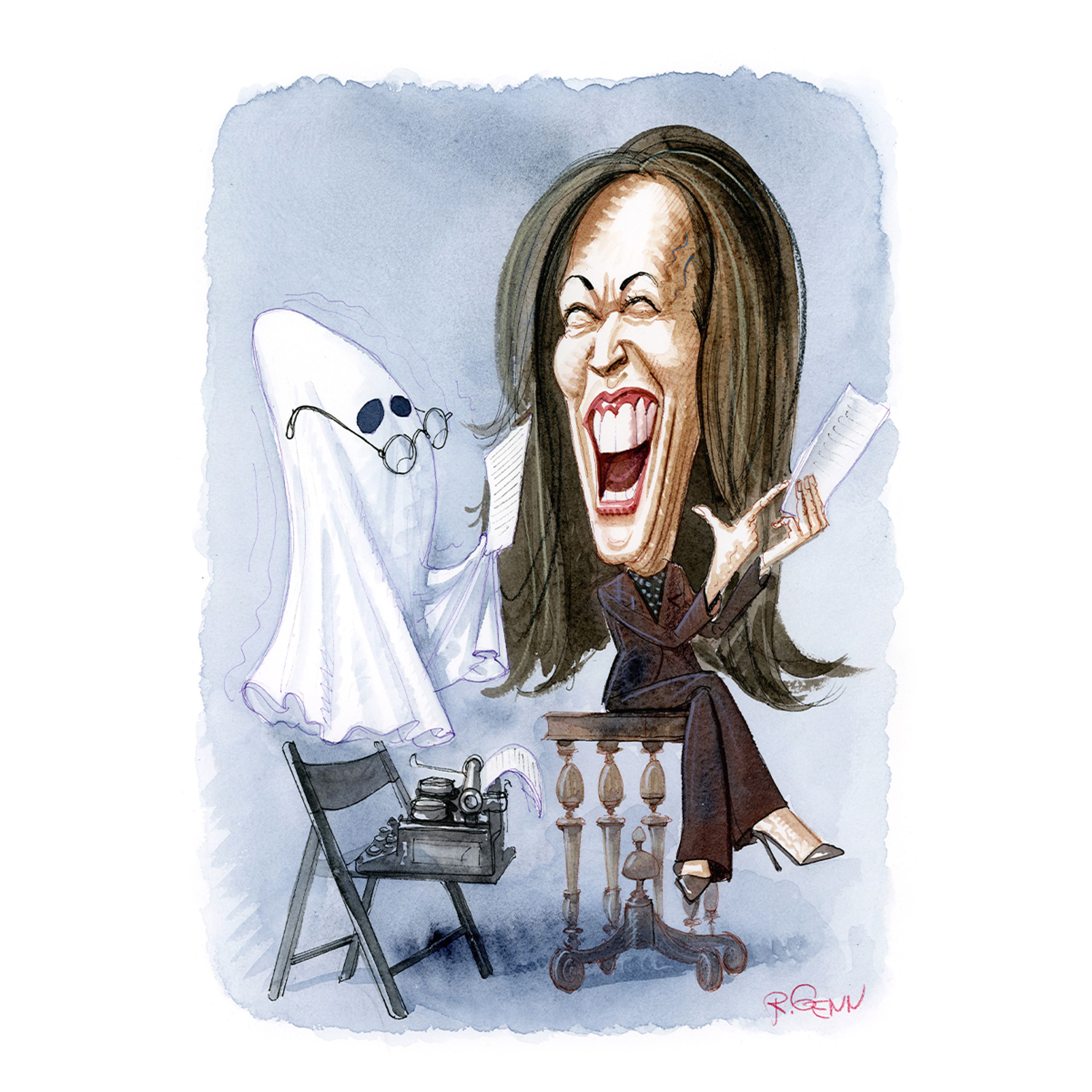
• Kamala Harris announced that she would not run for governor of California in 2026. This is not surprising, as her public comments so far this year -- few and far between -- focused almost exclusively on national issues, not state ones. Harris probably would have been favored to win the Democratic primary and general election just because of name recognition, but as one California reporter put it, “She was tempted to run for governor but ultimately didn’t want to do the job.” (Much like her role as the border czar.) Instead, Harris announced that her campaign memoir, titled 107 Days, will be published by Simon & Schuster on September 23. The title implies an excuse that the abbreviated campaign was the reason for her defeat, although there’s no indication in national polling or any of the swing state polls that she was gaining significant ground against Trump in the campaign’s final days. If anything, it was the opposite in most states. There may be some curiosity about whether Harris’s version of events aligns with or contradicts the other recent high-profile books about the 2024 campaign -- none of which made Harris look or sound like a gifted politician who was tragically impeded by the short campaign. Our review, in advance: 107 days too many.
• A woman in Texas is suing one of the world’s largest abortion pill providers and her former partner after she says he spiked her drink with such pills. Aid Access, a Europe-based nonprofit, uses telemedicine to prescribe and ship abortion pills -- even to Americans who live in states with abortion bans. When this Texas woman discovered she was pregnant, her partner suggested she get an abortion. After she said no, he bought the pills through Aid Access anyway, the lawsuit reads. He pushed the pills on the woman for weeks, until finally succeeding through deceit. The lawsuit alleged that Aid Access and the ex-partner each broke separate laws. First, the 1873 Comstock Act bans the mailing of abortion implements across state lines. Second, the State of Texas has a general ban on abortion and requires that licensed professionals perform any allowed abortions. According to the Washington Post, Aid Access founder Rebecca Gomperts has declared that “it is deeply saddening that the anti-abortion groups are using a woman in very vulnerable circumstances to go after Aid Access.” Allow us to suggest that there is a better source for deep sadness in this case.
• Columbia University announced that it had reached an agreement with the Trump administration to restore $400 million in canceled federal funding. Columbia had already agreed to a series of concessions -- among them a ban on wearing masks on campus, the empowerment of police to make arrests, and putting the Department of Middle East, South Asian, and African Studies under academic receivership. Columbia will now also pay $200 million to settle potential federal antidiscrimination claims and another $21 million to the Equal Employment Opportunity Commission, and appoint a “jointly selected independent monitor” to oversee Columbia’s compliance. Progressive activists are already raising a hue and cry over how Columbia has “bent the knee” to the Trump administration. But Columbia University brought this upon itself with years of racial discrimination and persecution of disfavored minorities. For decades, America’s elite academic institutions have, in fact, generally used their large government research grants as a shield from accountability: “How dare the government tell Harvard how to run itself when Harvard does such important work for the government,” their logic went. The Trump administration deserves credit for defying such arrogantly inverted reasoning.
• By itself, “member of Congress says something crazy” may not seem all that newsworthy. And that’s part of the problem -- because when saying something utterly bonkers no longer generates any significant reaction, pushback, or criticism, there’s less disincentive for elected officials to spout off about any nutty idea or theory that pops into their heads. Anna Paulina Luna, the congresswoman representing Florida’s 13th congressional district since 2023, sat down with Joe Rogan in August and discussed unidentified aerial phenomena, which is the new term for UFOs. Luna said that witnesses kept using the word “interdimensional” to describe the crafts. “Are these things preexisting maybe outside of what we currently know as our own dimension?” She also said: “Look, um, have I seen a portal open? Have I seen a spaceship personally? No. Have I seen evidence of this? Yes. Have I seen photo documentation of aircraft that I believe were not made by mankind? Yes. Is there historical significance to this? Yes. Is there multiple events that go back to, I would argue, maybe even before the time of Christ that have documented this, in text? Yes. So, do I believe that the government has access to certain technology? Yes, to an extent. And I believe that certain contractors potentially have back-engineered this tech.” Do we have hard proof that Luna is crazy? No. Do we have our suspicions? Yes.
• Almost from the outset of the war Hamas inaugurated with the October 7 massacre, international human rights groups and credulous media outlets promoted the notion that Gaza was on the brink of starvation. There was “catastrophic hunger” in Gaza as early as December 2023. By May 2024, it was a “full-blown famine.” Conditions somehow got worse over the next year, culminating in “food-starved” residents resorting to “grinding lentils, pasta and rice for baking bread,” as AFP reported. Over the spring and summer of 2025, international media outlets elevated the plight endured by a handful of children whose skeletal frames were said to represent evidence of Israel’s deliberate starvation campaign. Those children and over a dozen more, according to the Free Press’s reporting, suffered more acutely from genetic ailments like cystic fibrosis, cerebral palsy, and other conditions. Wartime conditions and the depredations of Hamas are doubtless causing serious suffering. Yet it is proving difficult for the media outlets that cover the supposedly engineered famine in Gaza to find evidence of it.
• Western countries are rushing headlong toward recognizing the legal legitimacy of a Palestinian state. Reasonable observers can conclude that this fashion has more to do with Israel than Palestine’s relative fitness for statehood. Still, Ireland, Norway, and Spain recognized Palestine in May. Slovenia followed suit in June. France, Portugal, Malta, Australia, Canada, and even the U.K. say they will do so in September, the last of these making the plan contingent on Israeli behavior. But questions abound. Are these states recognizing one Palestine -- a geographically bifurcated territory with two distinct governments, foreign policies, and economies? Are they going to immediately sanction this new state for having Hamas in government in both Gaza and the West Bank, or for its failure to hold elections since 2006? This is more a temper tantrum than a foreign policy, but it is still, unfortunately, one that Israel must take seriously.
• “Capitalism is the worst enemy of humanity,” Evo Morales, the socialist president of Bolivia from 2006 to 2019, has said. The Bolivian people saw the alternative to capitalism under the government of his Movement for Socialism party for nearly 20 years, and they seem to have decided capitalism isn’t the absolute worst. With price controls causing persistent shortages and inflation at 25 percent, the two top finishers in the first round of Bolivia’s presidential election, Rodrigo Paz Pereira and Jorge Quiroga, both promise to make market reforms. The Movement for Socialism candidate got just 3 percent of the vote. Paz and Quiroga advanced to the runoff in October. No matter who wins, Bolivians can expect a step toward freer markets and away from government control, desperately needed in what has become one of South America’s poorest countries.
• Political patronage of the arts has worked some times in some places -- Justinian building Hagia Sophia, James I encouraging the London theater -- but in the United States it runs a risk. Our arts culture is more from the ground up than high: more rock, jazz, and minstrel show than Aaron Copland (and Copland, recognizing it, appropriated popular forms). President Trump’s determination to take over the board of the Kennedy Center and turn it in a more populist direction is thus both realistic and unnecessary -- vox pop already picks the nation’s winners. His compulsion to inject himself into every cranny of public life risks backfire. “I turned down plenty” of nominees for this year’s Kennedy Center Honors, he said. “They were too woke. I had a couple of wokesters.” He hosted the awards ceremony himself after initially expressing reluctance, once his handpicked board picked him to do it (how they must have twisted his arm). The next Democratic POTUS will be sure to tap rainbow-party stalwarts. But since the arts community breeds such folk spontaneously these days, perhaps the backlash is not such a risk.
• The White House sent a letter to the Smithsonian Institution saying that it would conduct a thorough review of its museums to root out partisan narratives and ideology. Specifically, the Trump administration wants the Smithsonian to recommit to Americanism, or “the people, principles, and progress that define our nation.” If done well, this review can help remove countless progressive distortions of American history that have accumulated on the National Mall. The Smithsonian has, for years, dabbled in a niche progressive worldview that considers oppression to be the defining characteristic of America and the West. Many of its museums have run exhibitions that have reflected a fixation with victimhood: from reducing Latino identity to an endless series of persecutions, to glorifying the Marxist activist Angela Davis, to examining the racist history of sculpture. Rather than keep pounding this same critical note, the Smithsonian should present the full range of American history, including all that makes our country distinctive and wonderful.
• The President’s Test of Physical Fitness had bipartisan sanction until President Obama ended it in 2012. And unlike many such ideas, its fluctuating combination of running, stretching, pull-ups, and other exercises, with a pass/fail element, had some merit. The former kids who have populated mainstream media coverage of Trump’s revival of the test with memories of gym-class horror may disagree. But even these accounts surely self-select for strong antipathy and cannot help but include a few testimonies from people who felt positive about the test. A stronger argument against revival acknowledges the importance of getting kids to be active but denies that the test -- inherently competitive, with a strong possibility of failure -- is the best way to do it. Fitnessgram, the test’s successor, already did away with its predecessor’s high stakes: Most children pass it. But if the fitness test did not prevent the rise of childhood obesity, the post-test landscape has been far worse. Even before Covid, about one in five people in the U.S. ages 2 to 19 were obese; Covid exacerbated the crisis. Time to start moving.
• The actress and model Sydney Sweeney teamed up with the clothing brand American Eagle to make a commercial for jeans. The spot’s strapline featured a play on words: “Sydney Sweeney has good jeans.” Get it? The attractive woman modeling denim has good jeans. Because she’s pretty. Perhaps you don’t care for the pun, but whatever your view, you likely do not react in the same manner as some on the identitarian left, who decided that the advertisement was predicated upon Nazi eugenics. Before long, the commercial had been described as “provocative,” and then “controversial,” and then “white supremacist.” A bunch of TikTokkers made videos. The Washington Post ran an explainer on how everything had “gone wrong.” A host on Good Morning America suggested that, like Hitler, Sweeney had “weaponized the idea of good genes” in order to “justify white supremacy.” Or, perhaps, clothing manufacturers around the world have noticed that displaying attractive people helps to sell their products. Sydney Sweeney is an attractive person. American Eagle wants to sell more clothes. Sometimes, there is nothing more to the matter than that.
• Skibidi (/ˈskɪ.bɪ.di/), adj. (humorous slang): a word that can have different meanings such as “cool” or “bad,” or can be used with no real meaning as a joke. Is this the best the Cambridge Dictionary can do? Merriam-Webster’s the ticket: It doesn’t (yet) list this word at all -- or the other latest Cambridge Dictionary additions, “delulu” and “tradwife.” Change in our vernacular is inevitable, but what’s the rush? Australian Prime Minister Anthony Albanese already embarrassed himself by accusing the Liberal–National Coalition of being “delulu with no solulu.” Don’t encourage him. Political speech is the first to go down the skibidi.
• “I will get back onstage if it f***ing kills me,” Ozzy Osbourne said in 2022, and he made sure of it. The front man of Black Sabbath wasn’t its most talented member. That distinction belonged to the band’s chief composer, guitarist Tony Iommi, who revolutionized music with his magnificently dissonant riffs. But Ozzy was perhaps the greatest talent scout in heavy metal history. He hired 22-year-old guitar wizard Randy Rhoads in 1979, Jake E. Lee in 1982, Zakk Wylde in 1987, bassist Robert Trujillo (who later joined Metallica) in 1996, guitarist Gus G in 2009. He long suffered from mild motor dysfunction. His speech was all stammer and staccato. But as soon as he appeared in front of an audience, he’d be all there: superb stage skill, unmistakable charisma. A diagnosis of Parkinson’s disease in 2019 likely came as confirmation rather than revelation. Dead at 76, a couple of weeks after Black Sabbath’s farewell concert in the band’s hometown of Birmingham, England. R.I.P.
• Born in Cleveland, Jim Lovell built his first rocket at 16. After graduating from the Naval Academy in 1952 and service in the Pacific, he enrolled in a test pilot training course at the Naval Test Center. He finished at the top of his class. His experience made him a natural astronaut candidate; he participated in both the Gemini and Apollo programs. On the Apollo 8 mission, he was part of the first crew to orbit the moon, positioning the craft such that crew member William Anders could capture the iconic “Earthrise” photo of our planet floating above the lunar surface. Lovell preferred Apollo 8 to his harrowing experience on Apollo 13 in 1970. It was Lovell who reported back, upon discovering that the lunar module had been compromised (by an explosion from a damaged oxygen tank, it was later learned), to mission control in Houston that “we’ve had a problem.” The crew of Apollo 13, commanded by Lovell, went about solving it, miraculously returning safely to Earth. In 1973, he retired from the Navy and NASA (he briefly was in charge of Houston), then proceeded to have a fairly down-to-earth life for one of the select few to have left Earth. To provide for his wife, Marilyn (who died in 2023), and their four children, he worked in the telecommunications industry and ran a Chicago-area restaurant. An ordinary life is itself a meaningful accomplishment. But Lovell’s extraordinary deeds shouldn’t -- and won’t -- be forgotten. Dead at 97. Mission complete.
The Economy
Accounting for Taste
There are signs of trouble in the economy that Donald Trump would do well to heed, both for the good of the country and for his own political self-interest. Yet instead of doing so, he has been shooting the messengers.
The most obvious instance of this was his firing of Erika McEntarfer, the commissioner of the Bureau of Labor Statistics. Some have tried to rationalize this decision after the fact by saying the BLS needs to be modernized, which it does. But Trump fired her after a jobs report he didn’t like, and he made clear in a social media post that he believes the jobs report to be “rigged” against Republicans.
Jobs-report errors have gone in both directions under Democrats and Republicans. The pattern of misses comes about as close to truly random statistical error as is possible in real life. And the BLS has consistently performed better than private sector alternatives at estimating the number of jobs in the U.S.
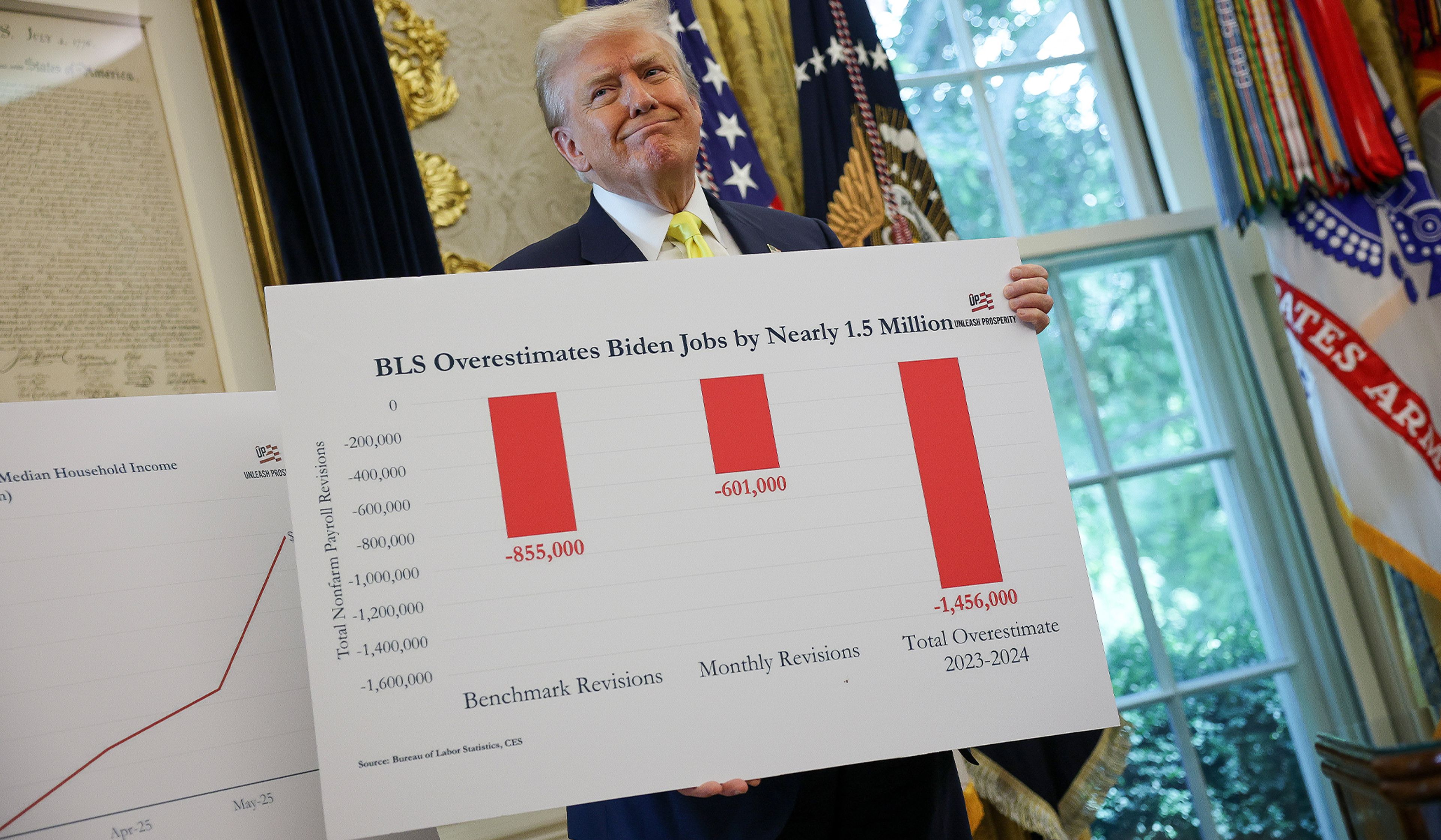
Trump’s replacement for McEntarfer, Heritage Foundation economist E. J. Antoni, has no experience in data collection, but he does have experience writing misleading or simply incorrect social media posts about economic statistics, which was enough for Trump to give him the thumbs up. “Our Economy is booming, and E. J. will ensure that the Numbers released are HONEST and ACCURATE,” Trump wrote in a Truth Social post. As should be needless to say, the accuracy of numbers cannot be judged by whether they show the economy is booming.
Trump is also mad at Federal Reserve Chairman Jerome Powell, and though it may not seem like it at first, he is mad for similar reasons. On the surface, the dispute is about interest rates, which Trump wants to be cut severely, by as much as three percentage points, and which Powell has kept steady, with gradual cuts expected in the future.
Powell doesn’t want those drastic cuts because he is concerned about inflation. He should have been more concerned about inflation in 2021, when the Fed stayed in emergency mode for too long after the pandemic began and helped spur inflation that crested at 9 percent in 2022. But he’s right to be concerned about it now, and Trump should be more concerned than he seems to be.
Inflation never fully went away, having been stuck around 3 percent since mid-2023, above the Fed’s target of 2 percent. That extra percentage point accumulates over time to make a big difference, and the Fed should really be targeting inflation below 2 percent to make up for the excess of recent years.
Powell has been saying over and over that there are still price pressures in the economy. The data confirm this is true. The producer price index came in higher than expected, demonstrating that businesses’ costs are rising. Trump should be especially alarmed by the PPI because, counterintuitively, the upward pressure on prices was not due to tariffs. The PPI uses pre-tax prices, so the tariffs will only make the situation worse for businesses.
Tariffs on business inputs are perhaps the most nonsensical part of Trump’s nonsensical trade policy. About half of all U.S. imports are inputs to domestic production. So, to re-shore domestic production, Trump is taxing inputs to domestic production.
The supposed national security justification for the tariffs is out the window, as Trump is levying higher rates against India than against China because India buys Russian oil -- of which China buys more. Pakistani goods face a lower rate because Pakistan was good at flattery (nominating Trump for the Nobel Peace Prize and making largely empty statements about oil development), even though China has invested tens of billions in its Belt and Road Initiative in Pakistan and is the country’s largest arms supplier. Brazil, a country with which the U.S. runs a trade surplus, is in the crosshairs of Trump’s supposedly trade-deficit-focused executive order because Trump is mad about how the country’s political system is treating former President Jair Bolsonaro.
Leaving so much of the economy to the whims of one man is not a good thing, and the Constitution divides power in part to prevent such damage. One federal court has already ruled Trump’s tariffs imposed under the authority of his national emergency declaration to be illegal, and oral arguments didn’t seem to go well for the administration at the court of appeals. When this case eventually gets to the Supreme Court, the justices should feel no qualms about striking down this abuse of power.
In the meantime, even private economists incur Trump’s wrath for noticing the ill effects of his incoherent economic policy. Trump called for the firing of the chief economist at Goldman Sachs after the investment bank released a report that didn’t paint Trump’s tariffs favorably.
What do all of these people have in common? They work in different branches of government or not in the government at all, they have different training and expertise, and they face different professional incentives when analyzing policy, but they all are saying, in different ways, that Trump’s economic policy isn’t going as well as he thinks. They could all turn out to be wrong, but it’s a warning sign worth paying attention to, rather than dismissing all bad news as fake.
Correction: “Barrett Rules” (September 2025), by Dan McLaughin, misstated Nicole Stelle Garnett’s role at Notre Dame Law School’s religious liberty clinic. She is affiliated with it but is not its head.
The Stat
0.17 percent — the amount of inflation between 2019 and 2024 attributable to “shrinkflation,” according to the Government Accountability Office (GAO).
Joe Biden made a big deal about “shrinkflation,” a practice that some companies use to raise prices by keeping the number on the price tag the same but reducing the size of the product. The president released a video before the Super Bowl in 2024 decrying the shrinkflation of Gatorade and Doritos. In the State of the Union address that year, he said, “Too many corporations raise prices to pad their profits, charging more and more for less and less.” How much of a difference does this practice really make for inflation overall? That’s what the GAO looked at in a report published July 31. Between 2019 and 2024, inflation was 34.45 percent, according to the consumer price index. The GAO found that, over those five years, declining product sizes contributed only 0.06 percentage points, or 0.17 percent of total inflation. Shrinkflation did become more prevalent when the overall inflation rate rose, affecting certain products more than others. Downsizing was most common for paper products, cereal, coffee, and laundry detergent. But it wasn’t enough to make any significant difference in inflation overall. Shrinkflation isn’t even possible for most products included in the consumer price index, which includes shelter, transportation, medical care, education, and utilities. Biden’s shrinkflation obsession was his attempt to shift blame for inflation to the private sector, though ultimately it’s always the result of decisions by the Federal Reserve and the government.
by Dominic Pino

About the Author
NR Editors includes members of the editorial staff of the National Review magazine and website.
Featured Tags
Advertisement
Advertisement

Comments