Share this story
Roman Genn
• Before endorsing Zohran Mamdani, Governor Hochul should have read up on the Mensheviks.
• Struggling to find a winning message against President Trump, Democrats seem to have settled on starting a government shutdown over expanding Obamacare. The national health care law, you may recall, issued a raft of regulations that spiked the cost of insurance. When Democrats gained power in 2021, rather than confront the underlying cause of higher premiums, they used the Covid emergency to make taxpayers pick up the tab by offering more generous subsidies. What was supposed to be a temporary measure during the pandemic was extended again in 2022 through this year. Now Democrats are using the threat of a shutdown as a way to twist Republicans into extending them further. Senate Democratic Leader Chuck Schumer told reporters that “Republicans have to come to meet with us in a true bipartisan negotiation.” A true bipartisan negotiation, however, would involve Democrats’ actually opening themselves up to deregulation and free market reforms, something that they have consistently opposed in lockstep. Instead of caving in, Republicans should call Schumer’s bluff. If he is willing to shut the government down to funnel tens of billions more dollars each year to insurance companies, that’s a fight worth having.
• The Supreme Court has accepted the Trump administration’s request that it take up its lower-court defeat on whether the International Emergency Economic Powers Act of 1977 grants the president unlimited emergency tariff powers. The court has ordered an aggressive schedule under which the first briefs are due September 19, the final briefs are due October 30, and the cases will be set for argument in the first week of the November 2025 argument session. This schedule does not guarantee a quick resolution if the Court is deeply divided, but it suggests that the Court grasps the urgency of the matter and will proceed accordingly. At stake: whether the power of taxation will remain with Congress, where the Constitution puts it.
• Texas Republicans have redrawn the state’s congressional map. The mid-decade redistricting, while not wholly unprecedented, was unusual and largely driven by pure partisan hardball. It gained momentum after President Trump leaned on the state to try to squeeze as many as five new Republican seats out of the state’s delegation, which is currently composed of 25 Republicans and 13 Democrats. But it was also driven by the Trump Justice Department’s pressing the state to stop drawing districts along racial lines -- an issue currently before the Supreme Court. Democrats staged a walkout and seethed with hysterics and threats to retaliate in other states, although the Democratic-run states are, for the most part, already heavily gerrymandered. Republicans in Missouri and Democrats in California are now seeking to follow suit; Louisiana’s map is before the Court. Whether the new Texas seats actually go Republican in 2026 will be a test of GOP strength with Hispanic voters in what is likely to be a difficult midterm environment.
• The president’s executive order on flag-burning is too clever by half. President Trump’s instinct is both correct and widely popular: Burning the flag is both an act of provocation and a statement of enmity to the nation and system it stands for. We don’t think the national conversation would suffer if dissenters were unable to light our flag on fire. But the Supreme Court ruled in Texas v. Johnson (1989) that the First Amendment protects flag-burning, and it seems highly unlikely to revisit that decision. Trump also can’t make a new federal law against flag-burning without Congress. His workaround is to announce that prosecutors should charge flag-burners whenever possible for other offenses they may commit in the course of protests. But this is the very definition of selective prosecution if the charges would not have been brought anyway -- and the federal executive branch is now admitting this in writing. The proper course is to propose a constitutional amendment. Such an amendment last failed in the Senate by one vote in 2006, and it would still be popular -- if more controversial with Democrats when associated with Trump. But a debate on an amendment would be more productive than this executive order.
• Trump’s executive order purporting to ban cashless bail is more flagrantly unconstitutional. He aims to cut off federal funds for jurisdictions that use cashless bail for “crimes that pose a clear threat to public safety and order.” Trump is right that too many states and cities, in the name of criminal justice “reform,” have made it too easy for dangerous offenders and career criminals to get released pending trial. But Congress has not authorized the president to withhold funds on this basis. The federal government is also limited in using coercive means to compel states to change their laws. We rightly object when Democratic administrations do this sort of thing to limit how the citizens of red states can govern themselves. The precedent could easily be used by a future progressive administration to demand the abandonment of cash bail or other forms of pretrial detention. A Republican administration shouldn’t be bailing out those assaults on federalism.
• As the Federal Open Market Committee began its September meeting, Trump was still trying to remove Fed Governor Lisa Cook. A divided panel of the D.C. Circuit had blocked his attempt. Based on digging by Bill Pulte, the loyalist Trump installed at the Federal Housing Finance Agency, the president claims that Cook committed bank fraud in connection with private mortgages she obtained in 2021, two years before Joe Biden named her to the Fed. Cook disputes the claim but has had no forum in which to make a defense. As we go to press, it is unclear whether the Supremes will intervene. The legal issues have gotten tangled, but it bears repeating that Trump’s goal here is a dubious one: a more inflationary Fed policy.
• The Bureau of Labor Statistics released its preliminary revision of the previous year’s jobs numbers and found that the total number of jobs from March 2024 to March 2025 was 911,000 lower than previously reported. That miss of 0.6 percent is larger than the average miss of 0.2 percent over the past ten years. The revision is based on the quarterly census of employers, which has higher-quality data than the monthly survey used in the monthly jobs report. The BLS always revises its estimates on the same schedule each year as better data become available. The monthly employer survey’s response rate declined during Covid and has not recovered, leading to lower-quality monthly data. Improving the accuracy of the monthly survey should be a priority for the government, but it has nothing to do with politics or the competence of BLS statisticians. Trump’s response of budget cuts and a loyalist nominee for commissioner will not fix this problem, to the extent that it matters. Markets expected a larger-than-normal revision this year, reacting to it with a calm that political actors should have emulated.
• President Trump kept insisting that he never sent a note with a doodle to Ghislaine Maxwell in celebration of Jeffrey Epstein’s 50th birthday and even sued the Wall Street Journal over its reporting about the note. Vice President Vance insisted the report was “complete and utter bullsh**.” The Journal “should be ashamed for publishing it,” Vance declared, while demanding, “Where is this letter?” Epstein’s estate turned over a note fitting the Journal’s description to the House Oversight Committee, and when the panel released it, many news organizations published it. The White House continues to insist it is a fake. Meanwhile, House Speaker Mike Johnson admitted he misspoke when he said that Trump had been an undercover FBI informant on Epstein. It’s easy to see why so many Republicans would like the issue of Epstein, Maxwell, their sordid deeds, and his death to disappear.
• A disturbed and evil man killed two children, ages eight and ten, in cold blood and injured 21 more people in Minneapolis in late August. His targets were the students and parishioners of Annunciation Catholic school and church in Minneapolis -- and while the students attended the first all-school Mass of the fall term. Police have identified the murderer -- a 23-year-old man who petitioned the State of Minnesota to legally change his name in 2020 in accordance with his self-proclaimed gender identity. He turned his own weapons on himself in a final bout of homicide. Minneapolis Mayor Jacob Frey typified many progressives in dismissing those offering “thoughts and prayers right now.” When they were attacked, Frey thundered, “these kids were literally praying.” Yes, they were, which is part of what makes this murderer’s crimes so horrific. In fact, the murderer’s video and written manifestos make clear that he targeted the Christian students specifically: “Where Is Your God?” he wrote sardonically in silver paint on one of his magazines. In the immediate aftermath of a horrific event, prayer can address pain in a way that legislation, which at a minimum takes time to debate and pass, cannot. When people pray, they can find strength in the face of helplessness, wisdom at a time when nothing makes any sense, and comfort when the soul is being drawn into the abyss of grief. Prayer is efficacious and ennobling. It was not in vain that the Psalmist declared that the Lord “healeth the broken in heart, and bindeth up their wounds.”
• A judge threw out criminal charges brought by Michigan Attorney General Dana Nessel (D.) against 15 Trump-supporting “fake electors.” Judge Kristen D. Simmons, appointed by Governor Gretchen Whitmer (D., Mich.), thus struck a blow against the weaponization of prosecutorial power targeting political opponents. The electors considered themselves contingent, not fake. Following Biden’s 2020 victory, the Trump campaign sought to reverse the result, targeting Michigan among a handful of states won by Biden but controlled by Republican legislatures. Trump’s baseless fraud allegations were swept aside by several courts in Michigan, which Trump lost by over 150,000 votes. But every state has procedures for challenging elections, and states have occasionally certified multiple slates of electors to cast electoral votes. Congress has a statutory procedure for sorting that out. There is nothing illegal about participating in legal processes. The Trump supporters maintained that they merely agreed to serve as electors in the unlikely event the state’s election was lawfully overturned; if top Trump campaign officials hoped alternative slates would serve as a pretext for Vice President Pence to invalidate election results, that was not the electors’ fault. Judge Simmons found that prosecutors failed to prove criminal intent. Lawfare continues to crumble.
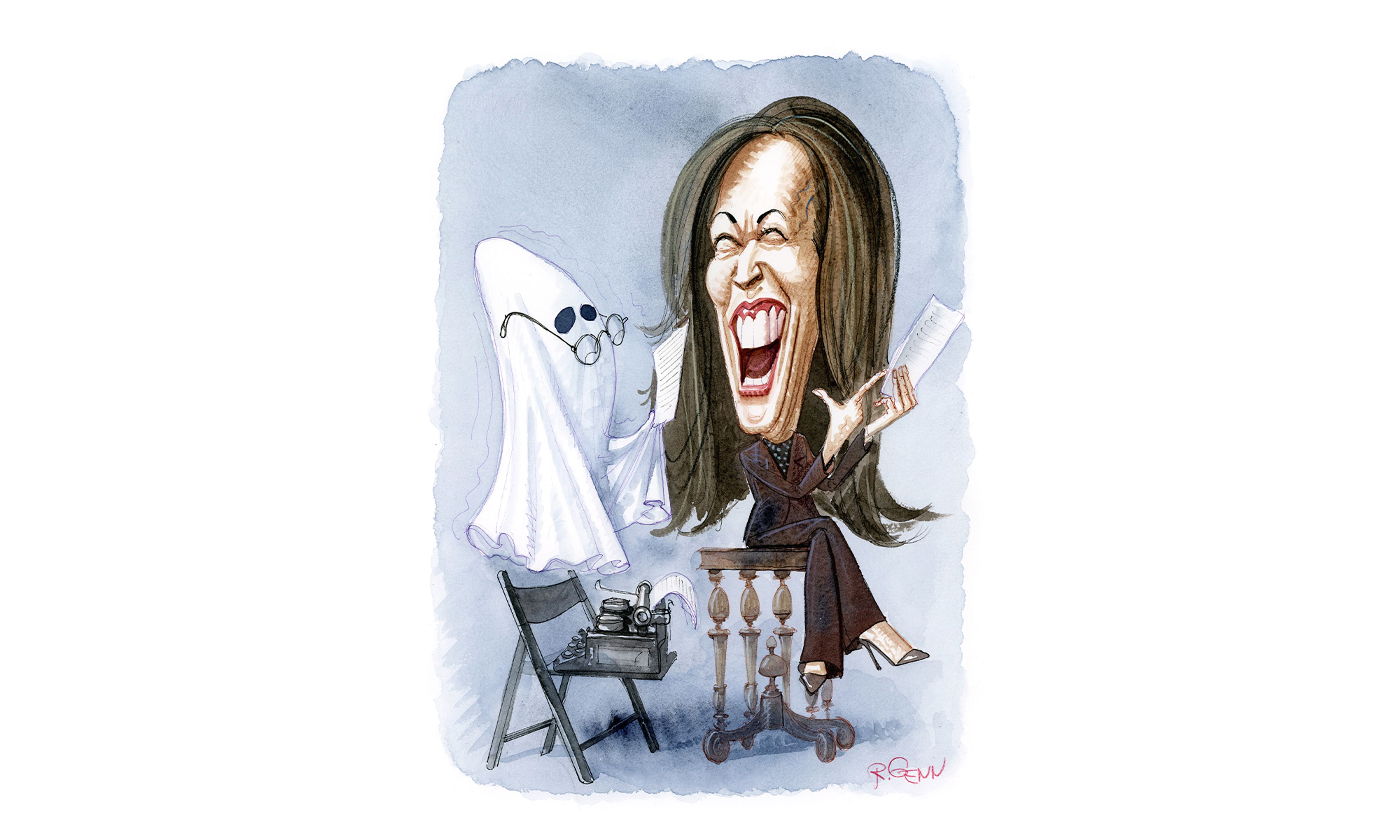
• Kamala Harris’s new campaign memoir 107 Days is heading for publication in late September. Based on the excerpt in The Atlantic, Harris’s upcoming “insider” account of a drama that America lived through in real time last year bears all the hallmarks of being written by a second-rate political ghostwriter slinging focus-grouped buzz phrases around without any proper understanding of what it means to be a human being. (Predictably, Harris blames Joe Biden’s staff for her loss.) Then again, it is a fair impression of the candidate herself, who seems like the kind of woman who would characterize sororities as “engines of uplift” and make solemn observations like “it is often the people with the least who give the most.” Kamala Harris should observe the inverse of that formulation: She was given much and should feel free to give us all a little bit less of herself from now on.
• The supposed justification for putting Robert F. Kennedy Jr. atop the Department of Health and Human Services was to increase public trust in health agencies after Covid reduced it. That is not what he seems to be doing. Indeed, what he’s doing bears a striking resemblance to what he has advocated much of his adult life. Kennedy has purged the CDC’s vaccination advisory committee and staffed it with his fellow vaccine opponents. He dismissed the CDC’s director one month after her confirmation because, her attorneys claim, she would not endorse “unscientific” orders. That may be legal positioning, or it may foreshadow Kennedy’s forthcoming report on autism in America, which is expected to reflect his long-held belief, backed by very little evidence, that unnatural environmental factors -- not increased diagnoses -- are to blame for an uptick in case rates.
• Once again, the Trump administration has announced that there is an imminent deal to resolve the question of TikTok. It’s easy to forget that the ban on TikTok was passed with broad bipartisan support and upheld by the Supreme Court in January, when TikTok challenged it. President Trump has ignored the required enforcement of the law, regularly insisting that a deal that would cut the social media platform’s ties to a Chinese state-connected company was imminent. On September 15, Treasury Secretary Scott Bessent said that Washington and Beijing had struck a “framework for a TikTok deal.” A day later, Trump announced that enforcement of the law would be on hold another three months. Bessent offered few details about the agreement. When asked about who would control TikTok’s algorithm, which dictates what users see on the app, he said: “We’re not going to talk about the commercial terms of the deal. It’s between two private parties, but the commercial terms have been agreed upon.” That vagueness is not reassuring. The one area of “free speech” that the Trump team resolutely defends is your right to keep using a piece of Chinese spyware.
• The federal government has a hard enough time doing the things it should do: securing the border, winning wars, collecting taxes, administering the capital city. It doesn’t need to take on the difficult and nongovernmental task of turning around a struggling semiconductor company. The Trump administration has acquired a roughly 10 percent stake in Intel in exchange for the grants the company is already due to receive under the CHIPS Act. The main Intel project that the CHIPS Act was supposed to support, a facility near Columbus, Ohio, is little more than a hole in the ground. Intel has been in the process of a corporate turnaround strategy since before the CHIPS Act was introduced. It hasn’t gone well. Intel has already announced that it would be cutting thousands more jobs than the CHIPS Act funding was ever supposed to create. Looking at that sad situation, the Trump administration wants a piece of the action. Rather, it wants to use your money to get a piece of the action. If the purpose is to endorse Intel as a “national champion,” the government is picking a likely loser.
• The Securities and Exchange Commission should scrap its rule requiring public companies to report interim results quarterly, Trump says, and instead permit semi-annual reporting. His reasoning appears to rest primarily on the notion that U.S. companies’ thinking is too short-term. Reducing reporting obligations is a signal to corporate managements that they have been paying too much attention to shareholders or, to put it another way, their employers: That is not a message the government should be sending. But shareholders may well send their own contrary signal.
• The bloodcurdling murder in late August of 23-year-old Ukrainian refugee Iryna Zarutska by a complete stranger sitting behind her on public transit in Charlotte, N.C., has brought to light, once again, our nation’s almost literally insane policy regarding the severely mentally ill. The murder drew new attention when the Charlotte Area Transit System released video footage of the crime; a scene from hell could not be more soul-sickening. The petite young woman, head down, calmly reads her cellphone, unaware of the agitated man behind her, who suddenly pulls out a knife, looms over her, and lunges at her neck. Court records show that the man wielding the knife in the video, Decarlos Brown Jr., has had more than a dozen convictions since 2011, including for armed robbery, felony larceny, and assault. But another aspect of Brown’s history deserves attention: his years of untreated mental illness. As his mother, who tried to get him help, has tragically learned -- and as many other mothers with similarly troubled children have also learned -- it is almost impossible to get help for a person with severe mental illness, even when that person has a lengthy record of violence and threatening behavior and has been in and out of mental institutions and prisons over many years. Our country needs many more psychiatric treatment beds, and we need legal reforms that allow mandated treatment and short- or long-term institutionalization. The vast majority of mentally ill people are not dangerous; only about 1.1 percent of Americans are estimated to have schizophrenia, and most of these people will never be violent. But the tiny percentage who are the most troubled deserve more than the “freedom” to wander the streets, trapped in the prison of their own delusions.
• In a discussion of Ukrainian refugee Iryna Zarutska’s murder in Charlotte, N.C., by a demented criminal, the hosts of Fox & Friends wondered what could be done with crazed vagrants who refused help. Lawrence Jones suggested jail. Brian Kilmeade offered “involuntary lethal injection, or something. Just kill ’em” -- words that stood out even in a week marked by celebrations of assassination. Kilmeade, returning to earth or chastened by higher-ups, recanted. “I apologize for that extremely callous remark. I am obviously aware that not all mentally ill, homeless people act as the perpetrator did in North Carolina and that so many homeless people deserve our empathy and compassion.” Yes, but it’s not so obvious when you state the exact opposite. A sabbatical might help Mr. Kilmeade clear his thoughts.
• Riley Barnes, President Trump’s nominee for assistant secretary of state for democracy, human rights, and labor, baffled and alarmed Senator Tim Kaine (D., Va.) by saying that our rights are God-given. Kaine pronounced this a “theocratic” view akin to the Iranian government’s. “Deeply troubling,” he added -- in words better suited to his own ignorance of the views on which our country was founded. Backtracking later, Kaine remembered to mention Thomas Jefferson, noting that our rights are guaranteed in practice because the Constitution and statutes protect them. True enough, but who maintained otherwise? The point is that when governments fail to recognize and protect these rights, they are doing an injustice to us; they are violating “the laws of Nature and of Nature’s God.” Time for the senator to reread the Declaration of Independence, or read it a first time.
• The Trump administration has ushered Americans into the kinetic phase of what is now looking a lot like a literal war on drugs. In early September, the Pentagon ordered the growing fleet of military hardware amassing in the Caribbean Sea to execute a lethal strike on what the administration said was a drug boat emanating from Venezuela and bound, in Secretary of State Marco Rubio’s words, for #*# “Trinidad or some other country in the Caribbean.” Another similar strike on suspected drug traffickers took place on September 15. The strikes are estimated to have resulted in eleven and three fatalities, respectively. They set off a flurry of condemnations from Latin American governments, who object to the summary neutralization of non-combatants in an undeclared military campaign. That logic might also sway some American lawmakers, who are discomfited by both the lack of legal authority for these strikes and the paucity of evidence the administration is producing to support its claims about its targets. If the administration is gearing up for regime change in Venezuela, let it make its case to Congress.
[slideshow slideshow="1876848" /]
• Perhaps the 19 Russian drones that penetrated Polish airspace -- pushing deep into NATO territory, forcing civilian airports as far from the border as Warsaw to close, and compelling the Atlantic Alliance to shoot down hostile Russian assets -- did so accidentally. Maybe it was a deliberate exercise aimed at tracking how NATO responds to an armed incursion. Either way, the Kremlin sought to show resolve. Putin will be waiting to see if aggrieved laments from NATO members contribute to a meaningful shift in the Alliance’s readiness posture both along NATO’s frontier and inside Ukraine, where NATO has a ready-made opportunity to help a partner nation beat back the Russian advance toward NATO’s borders. If the Kremlin does not see that, we should expect more -- and more dangerous -- Russian efforts to challenge NATO with the goal of fracturing it.
• In Washington, the banality of Qatar’s evil is accepted as though it were a fact of life. Sure, Doha plays both sides, Western power brokers admit -- both sides here being the civilized world and the barbaric terrorist sects that attack the foundations of that civilization. President Trump accurately described the regime as “historically . . . a funder of terrorism at a very high level.” So, when Israel launched pinpoint-accurate strikes targeting a safehouse where Hamas’s senior leadership resides inside Qatar -- a haven from which they were supposedly expelled in November of last year -- it was hard to deny the Qataris had it coming. But Qatar is also a useful intermediary with the Iranians, the Taliban, and Hamas, and so the strikes produced substantial public handwringing from the Trump administration. Trump said he was “very unhappy about every aspect” of that strike. Israeli officials are telling another story. “If Trump had wanted to stop it, he could have,” one Jerusalem official told Axios, contradicting the White House’s claim that it was informed only after the strikes were underway. “In practice, he didn’t.” The Qataris aren’t the only ones who can play both sides.
• “Future generations will consider us monsters” for refusing to cast aside “the so-called sanctity of life” in favor of legalized assisted suicide, Churchill biographer Andrew Roberts insisted to his fellow members of the House of Lords. Others, more wisely, warned of the dangers of a Commons-passed bill to the weak and vulnerable. “Private, for-profit providers can become involved in ending an individual’s life, on the inherently unreliable medical prognosis that they have six months or less left to live,” the Times of London pointed out in an editorial that called the bill “sloppily designed and blundering” and “irredeemable.” Critics also pointed out that learning disabilities could become a justification for physician-assisted death. The Lords’ day of debate fell during World Suicide Awareness Week, a fact that former Prime Minister Theresa May mentioned in her speech opposing the bill. One can be merciful and provide comfort to the suffering without declaring them better off dead.
• The Flanders Festival, a classical music festival held in September in the Belgian city of Ghent, invited the Munich Philharmonic, led by conductor Lahav Shani, to give a concert. The festival organizers then disinvited the orchestra because -- and this is the plain, naked truth -- Shani is Israeli. “We are unable to provide sufficient clarity about his attitude to the genocidal regime in Tel Aviv,” the organizers said. Never mind the tendentious use of “Tel Aviv” rather than “Jerusalem,” or the monstrous lie of the “genocide” charge, or the notion that a musician would have to pass an attitude test. Never mind that Shani, the chief conductor of the Israel Philharmonic, “has spoken out in favor of peace and reconciliation several times in the past,” as the Belgians conceded. Merely his nationality was disqualifying. Germans cried foul. “A top German orchestra and its Jewish chief conductor are being disinvited -- this is a disgrace for Europe,” said German culture minister Wolfram Weimer on X. “This is pure anti-Semitism.” Florian Wiegand, executive director of the Munich Philharmonic, expressed shock that such a decision was taken “in the heart of Europe.” Belgium’s prime minister, Bart De Wever, showed decency when he called out his countrymen for their “antisemitic” decision and went to Germany to show his support for Shani in person. An online petition decrying the “morally bankrupt” disinvitation, begun by four leading classical musicians, has attracted 16,000 signatures. The festival organizers, however, made their decision final: The Israeli Jewish conductor, because he is an Israeli Jew, is not welcome in Ghent.
• President Macron’s decision last year to call a snap parliamentary election immediately after his allies had fared badly in EU elections was one of the worst decisions -- no mean feat -- in recent French political history. The result left a hung parliament so divided, and the harder edges of left and right so strong, that he was obliged to turn to a succession of weak minority centrist governments: not exactly what France needed at a time when increasing worries over its fiscal position are forcing up the cost of financing its debt. The country’s budget deficit and government debt are now running at around 5.8 percent and 113 percent of GDP, respectively. France’s previous government, led by Prime Minister François Bayrou, fell after losing a vote of confidence over a package of tax increases and spending cuts designed to gently rein in that deficit. The best chance that Bayrou’s successor, Sébastien Lecornu, a Macron loyalist, will have of legislative success is, alas, by shifting the budget package away from lower spending and toward higher taxing. This won’t end happily.
• Some in the nation’s media and political class spent several weeks furiously arguing whether Cracker Barrel’s rebranding -- which altered its logo to remove both the barrel and the kindly old man sitting next to it -- represented a woke attempt at “cracker erasure.” Now that the company has backed down and retained its old logo, the keyboard warriors of the right are claiming victory: The mighty Barrel has been broken. The triumph is likely to be a Pyrrhic one. However misbegotten Cracker Barrel’s rebranding attempt, it comes after having shed half its market value over the past five years. Food and service quality have slipped; the customer base has aged into senior citizen status or the grave. The chain was on a road to ruin. People have compared Cracker Barrel’s rebrand to New Coke. The difference is that the Coca-Cola Company still had something “classic” to return to that people wanted. Cracker Barrel no longer does.
• Since Taylor Swift’s engagement to Travis Kelce, the Kansas City Chiefs are 0–2. His impending marital happiness is, no doubt, a nice consolation prize for losing the Super Bowl earlier this year to the Philadelphia Eagles, 40 to 22. But credit Kelce; this is the first time he’s won it all without the assistance of an officiating crew. We should also be happy for the bride-to-be, although long-term marital happiness is likely going to end her phenomenally successful run of writing best-selling songs about her ex-boyfriends.
• The United States Postal Service rolled out a stamp honoring our founder, William F. Buckley Jr., in the year of his centennial. A single image cannot convey his wit and warmth. But the one chosen, based on a photo, aptly depicts him with his eyes set to the horizon. A stamp is not only a worthy honor, given his manifold contributions to American public life, but a fitting one: WFB was an indefatigable correspondent. In addition to nonfiction books, novels, magazine editorials, and columns, WFB wrote thousands of letters and postcards to friends, to subscribers, to donors, to activists, to the powerful, and to the humble and anonymous. Lawrence Perelman’s book American Impresario, for example, describes how Perelman’s life was changed by writing to WFB as an 18-year-old and receiving a letter in return. A man of letters indeed. P.S., we still think the Postal Service should be privatized.
• Robert Redford’s impressive career in acting and directing ran, in its heyday, for nearly three decades. It spanned the divides between Old Hollywood, New Hollywood, and modern Hollywood. Redford spent his early career in the Sixties playing blandly handsome supporting characters, as befitted the film industry’s reaction to his prepossessing good looks. Terrified of being typecast as little better than a “male bimbo,” Redford found his niche in 1969’s Butch Cassidy and the Sundance Kid, playing alongside Paul Newman (a slightly older and similarly handsome actor who had fought his own earlier war against typecasting) in a buddy comedy that immediately launched Redford to stardom by featuring his sardonic wit and not just his looks. This launched a career that carried on through several memorable roles in the Seventies -- The Candidate, Three Days of the Condor, All the President’s Men, and especially his reunion with Newman in The Sting. In the Eighties, he starred in such roles as Roy Hobbs in The Natural, and had a superb turn behind the camera with 1980’s Ordinary People. In 1992, he would achieve both simultaneously with A River Runs Through It, a film that brought the young Brad Pitt to national fame. But Redford’s truly standout role perhaps remains his turn as the namesake of 1972’s Jeremiah Johnson, which has barely any dialogue whatsoever. No more proof is needed to explain why Redford was one of the greatest film stars of our era than to watch him dominate the screen -- in near-silence. Dead at 89. R.I.P.
• Family values, GOP primary fights, and corporal punishment: These are James Dobson’s legacy. Born to a religious family in Louisiana, Dobson was a founder or co-founder of several conservative Christian organizations, including the Family Research Council, Focus on the Family, and Alliance Defending Freedom. But he achieved fame first as a psychologist who promoted spanking for misbehaving children. For several presidential election cycles, Republican candidates spent time either courting or distancing themselves from Dobson, whose large radio audience mattered in primary elections. Focus on the Family produced valuable resources for parents, such as reviews of movies and TV shows from a Christian moral perspective, and children’s entertainment such as the Adventures in Odyssey series. It was unjustly branded a “hate group” by the left for its principled opposition to same-sex marriage and abortion. Obergefell happened, but so did Dobbs. James Dobson has died at 89. R.I.P.
Politics
The Shot Heard Round the Political World
First, the shock. The murder of conservative activist Charlie Kirk -- seated, at a mic, before an open-air audience -- was like a Zapruder film in real time. Instant image, instant broadcast. Cameras saw it; the internet flung it to the mediasphere. Commentators would shovel words on the deed, but the eyes had it, making crime and victim even more vivid than they would have been just 20 years ago.
The key to Kirk’s impact and his character is youth. He began pitching to teenagers when he was a teenager. He continued to do so, via his organization Turning Point USA, his video clips, and his campus appearances, where he would sit at a table with an open mic and the challenge, at once bro-bumptious and friendly: Prove Me Wrong. He collected admirers because he never talked down. He treated his youthful interlocutors with the seriousness he had craved since he was their age.
He was a great enthusiast -- for his political views, for his and everyone’s families, for Evangelical Christianity, for all things Trumpian. He joined with MAGA’s last-minute attempts to pressure Congress to redo the electoral vote of the 2020 presidential election, a bad misjudgment, but also won a hearing for, and won converts to, conservative views from a youth audience it seemed, not too long ago, that the Left owned.
What moves his killing from murder to assassination is the evident planning and motive of the gunman. Tyler Robinson, 22 years old, staked out the scene beforehand, seems as of this writing to have shared his plans with some online sympathizers, and expressed to family and friends hatred of Kirk and his views, especially those critical of trans mania. (Robinson lived with a man attempting to move to the other sex.) Among the slogans etched on the murder weapon’s unspent cartridges was the message, “Catch this, fascist.” Post-crime spinners argued that he could not be on the left because his parents were MAGA Republicans or even that he was an ultra-rightist. Better to stick to the facts as they come out.
Dreadful in a different way from the deliberate targeting of Kirk were the reactions of so many to his elimination. His fans obviously, and leaders across the political spectrum, deplored the barbarity and saw it, correctly, as an attack on freedom of expression and the democratic republican political process. Utah Governor Spencer Cox and Vermont Senator Bernie Sanders -- conservative R and socialist D -- were notably thoughtful. Descending the scale of taste and morals, one found the inevitable merch, and worse yet irresponsible talk of the war that is upon us. Many a pol had unwittingly prefigured this -- Senator Chris Murphy (D., Conn.) had declared before the bloodshed in Utah, “We’re in a war right now to save this country. And so you have to be willing to do whatever is necessary.” He was seen and raised after the fact by right pols and talking heads asserting the same thing, often with the modifier “civil” attached. The historic Civil War killed 750,000 American men, which, proportionally, would be over 8 million today. No, we don’t want that. Nor do we want what we had in the late Sixties and early Seventies when over a thousand bombs were set off by the Weathermen and other radical groups, although “leaderless resistance” -- the phrase for independent like-minded cells, first coined by a terror theorist of the racist right -- could bring us there.
Worst of all were the celebrations of Kirk’s destruction, often coupled with wishes to extend it to other prominent figures and even to his widow and children. A Hall of Shame would be stuffed with internet loonies. Dishonorable mentions go to George Conway, who compared Kirk to Nazi brawler Horst Wessel; Stephen King, who said Kirk believed in stoning gays to death (King, when pressured, did retract); antisemites of the natright who said that Kirk, famously pro-Israel, had been killed by the Israelis; and George Abaraonye, incoming president of the Oxford Union who had debated Kirk there only months ago, hailing his death thus: “Charlie Kirk got shot loool.” The number of schoolteachers clapping their hands, occasionally even before their classes, was disturbing. Classrooms should be ghoul-free zones. If teachers’ unions and teachers’ colleges can’t perform some necessary self-cleansing, local school boards and state certifying bodies must.
Is punishing the bloodsuckers a conservative version of cancel culture? No. Excavating old tweets to humiliate and expel is one thing. Flagging educators and military and medical personnel for applauding murder is simple prudence. Do you want your child, your country, or your person to be handled by a homicide fan?
Attorney General Pam Bondi called idiotically for a crusade against hate speech. Calls to regulate the internet may come. It is certainly a fountain of poison. But so were newspapers, and post-Gutenberg books. John Podhoretz of Commentary wrote a thoughtful thread on X about how the internet gives us access to everyone’s most hidden thoughts and impulses. But we began examining those thoughts with Homer. First Amendment law is highly elaborated and carefully balanced, and all the more precious given the behavior of countries -- Canada, Britain, France -- ordinarily thought of as free. Know the dangers, monitor the young, stay clean.
We think, finally, of our country and its character. D. H. Lawrence, in a study of James Fenimore Cooper’s Leatherstocking Tales, decided that “the essential American soul is hard, isolate, stoic and a killer. It has never yet melted.” Founding Fathers killed in duels, and the parade of presidents from John Quincy Adams to Donald Trump shot, shot at, and stalked sustain Lawrence’s grim point -- to say nothing of the lives lost to riots and lynchings.
We are a violent people. We have also a republican form of government, shaken only once, designed to channel disputes into the paths of politics. Many of us -- still more than in any other post-industrial country -- are also, like Charlie Kirk, believers in a God of love and mercy. Love the republic, love your fellow Americans.
The Stat
5.98 percent -- agriculture’s share of GDP in the most agriculture-dependent state economy, according to the Bureau of Economic Analysis (BEA).
The U.S. is an agriculture powerhouse, but the U.S. economy overall is highly diversified, such that agriculture accounts for only 0.83 percent of GDP. Farm states, though, live on in political consciousness as vital economic interests that must be accommodated in policymaking. Some states do have higher shares of their economic output in the agricultural sector, but even there, the percentages are low. The state with the most agriculture-dependent economy is South Dakota, where agriculture’s share of GDP is 5.98 percent. That’s far higher than the second-highest, Arkansas, at 3.85 percent. Iowa, the quintessential farm state that features in politicians’ minds because of its spot on the primary calendar, gets only 1.98 percent of its GDP from agriculture. The BEA’s Plains region (which consists of Iowa, Kansas, Minnesota, Missouri, Nebraska, North Dakota, and South Dakota) gets only 1.66 percent of its total GDP from agriculture. Iowa’s finance and insurance sector, which is seven times larger than its agriculture sector, is the fourth-largest of any state as a share of GDP, trailing only Delaware, New York, and . . . South Dakota. Because agriculture takes up so much physical space and political space, people assume it must take up a lot of economic space as well. But even in the farm states, the U.S. economy is highly diversified and not dependent on any one industry, which is great for the people who live there.
by Dominic Pino

About the Author
NR Editors includes members of the editorial staff of the National Review magazine and website.
Featured Tags
Advertisement
Advertisement



Comments