Thirty Years After Welfare Reform, It’s Time for the Next Generation of State-Led Solutions
Written by Nic Dunn & Clarence H. Carter
The problem with today’s safety net isn’t intent; it’s design. State leadership would help fix it.
Share this story
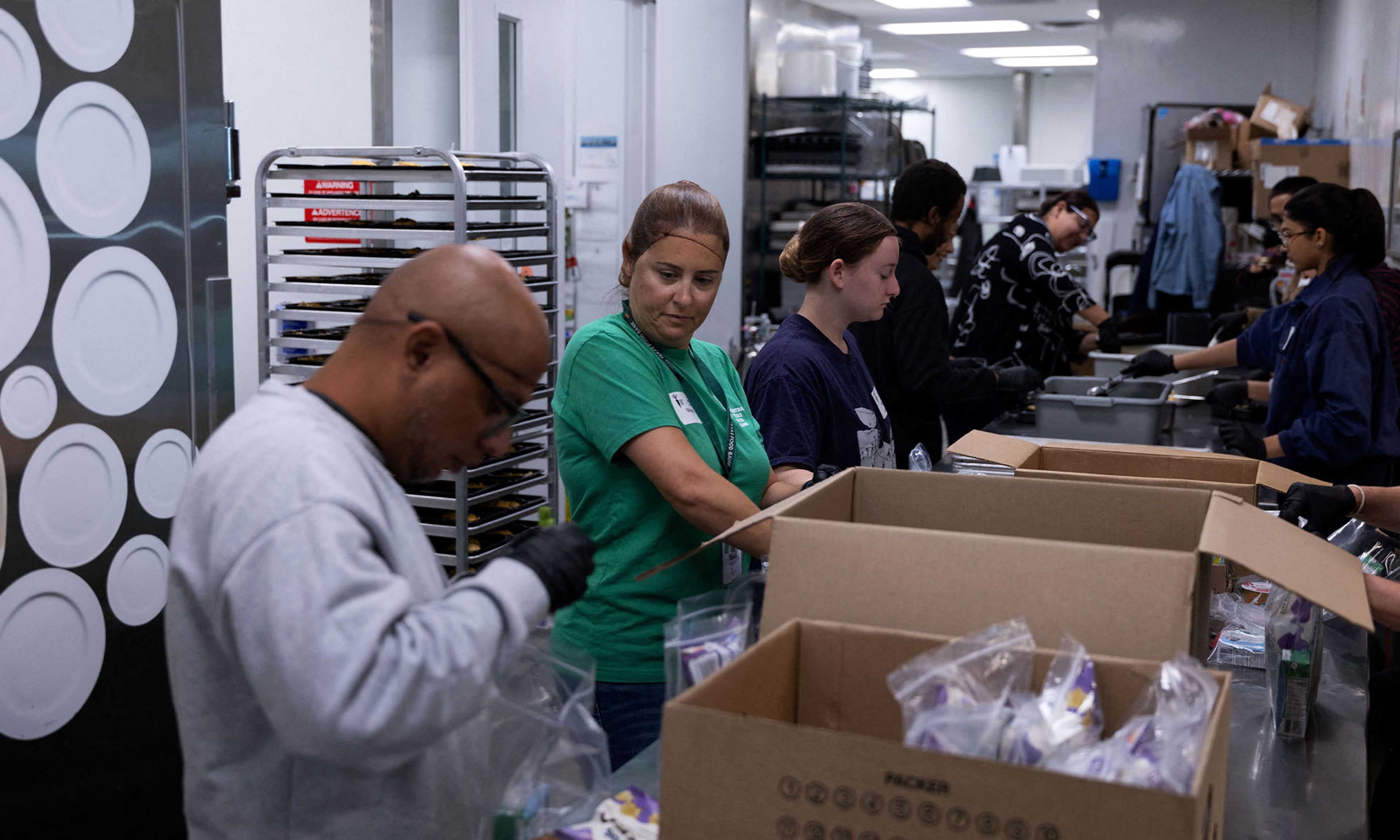
Volunteers pack snack bags and meals at the Central Texas Food Bank warehouse in Austin, Texas, October 30, 2025.
Signed into law 30 years ago, the 1996 welfare-reform law was built on a simple idea: States should lead, and the system should reward work and personal progress. But three decades after welfare reform proved that a properly crafted safety net can reduce dependency and increase work, Washington still operates a fragmented system that too often does the opposite — penalizing progress, discouraging earnings, and obscuring the very goal it was designed to achieve. Congress should act now to ensure that the next phase of reform is once again state-led and work-centered.
Today’s safety net is not a system but rather a patchwork of more than 100 programs, administered across multiple agencies and levels of government, operating with little coordination and no shared vision. Collectively, they spend well over a trillion dollars annually. Yet too often, they fail to produce the one outcome that matters most: helping people build the capacity to achieve independence.
The core problem is not intent. It’s design — or rather the lack thereof.
Why is this? First, there is no unifying goal. Washington built the system program by program, each with its own agency and mandate. The Supplemental Nutrition Assistance Program (SNAP) -- administered by the Department of Agriculture -- was created to focus on nutrition, not employment. Medicaid was designed to provide health coverage, administered by the Department of Health and Human Services. Even when states tried to add work requirements to Medicaid, the Biden administration rescinded prior waiver approvals in 2021. And only this year, the Department of Housing and Urban Development proposed a new rule allowing work requirements for housing assistance. States didn’t build this patchwork; they inherited it. And federal rules make it nearly impossible to reorganize around temporary help oriented toward work and self-reliance.
Second, the system can actively impede progress. “Benefit cliffs” are the clearest example. As individuals earn more, their public assistance can abruptly drop in ways that leave them no better off, or even worse off, financially. Faced with that reality, many rationally limit their earnings to avoid a destabilizing drop in assistance. Research from the Federal Reserve Bank of Atlanta found that a hypothetical single mother in Washington, D.C., would receive no material financial gain if her annual earnings rose from $11,000 to $65,000, because of how benefits phase out along the way. A nationally representative survey found that roughly one in five low-wage workers had taken some action to limit their earnings specifically to avoid triggering a benefit cliff. It’s clear, then: A system that penalizes effort will struggle to deliver long-term success.
Third, the administrative burden of the current patchwork is overwhelming. Navigating multiple programs — each with its own rules, timelines, and reporting requirements — is complex even for professionals. For a working parent trying to build a better life, it can be unmanageable. When accessing support and workforce-development resources alone feels like a second job, the system is not working as it should.
If these challenges sound familiar, it’s because the safety net’s fragmentation and work disincentives today mirror some of its pre-1996 failures. But that also means we can draw from the successes of the 1990s reform movement to fix these problems in 2026.
The 1996 reforms did not originate in Washington. They began in state capitals, where leaders tested new approaches, learned from results, and built an evidence base for national change. That model — state experimentation leading federal reform — worked then. It can work again.
States are already stepping forward. Across the country, leaders are piloting new approaches to address benefit cliffs, streamline services, and support work, while focusing on practical solutions. Utah, for one, has launched a $6 million Temporary Assistance for Needy Families (TANF) pilot program testing financial-planning resources, coaching, and mentoring to help families navigate benefit cliffs and transition to work-based self-reliance. Tennessee has funded a series of TANF pilots focused on upward mobility, including interventions targeting benefit cliffs through coaching, navigation support, and transitional benefits.
These pilots matter. What we learn from them — including what doesn’t work — will be essential to building the evidence base for the next generation of reform. States could do more to innovate and fix the shortcomings in the social safety net, but the barrier is structural.
Most federal programs are tightly controlled, with rules that limit flexibility and discourage integration. States seeking to align food assistance, childcare, housing, and workforce supports into a single, coherent strategy often find themselves constrained by fragmented federal requirements. In many cases, even modest alignment across programs requires navigating complex waivers or is simply not allowed.
That must change. The next generation of reform should start with a clear, shared vision: Public supports should build capacity, not sustain dependency. Every policy, program, and investment should be aligned to help individuals increase earnings, strengthen stability, and move to self-sufficiency.
Achieving that vision requires three shifts. First, the system should move from fragmentation to integration, with services designed around people, not programs. Utah’s “one-door to work” approach is instructive, as it integrates numerous separate programs under a single statewide Department of Workforce Services, giving individuals one point of access -- one office, one website, and one caseworker — connecting their immediate needs to a clear path to work and self-reliance. Integrated, work-based approaches should be the standard, not the exception.
Second, public assistance should shift from rigid benefit structures to dynamic, pro-work pathways. All support should adjust gradually as earnings increase, avoiding cliffs and reinforcing progress. Work should always pay.
And third, the administrative culture in our social welfare and workforce system should evolve from compliance to outcomes. Success should ultimately be measured by results — higher earnings, increased employment, and reduced reliance on assistance — not by process metrics alone.
To enable this shift, Congress should expand state authority to test integrated models at scale. Proposals such as the Upward Mobility Act point in the right direction by allowing a limited number of states to combine funding from multiple programs into a single, flexible stream. This would give states the ability to design systems that reflect local needs and realities aligned with the vision we laid out above.
Flexibility, however, must be paired with accountability. Any new model should include clear performance measures, independent evaluation, and transparency in results. States should be rewarded for achieving better outcomes — especially when those outcomes reduce long-term public costs.
This is not about reducing support or further entrenching government dependency. It is about improving how we help our fellow Americans in poverty get temporary help and move back to work-based self-reliance. This vision of reform recognizes that most people do not want to rely on public assistance — they want a pathway off it. Our experience working directly with these families — and confirmed by research -- is that most people don’t want to stay on public assistance. In a survey of Utah safety net participants, 62 percent said they feel “stuck in a low-income job,” not by choice, but because earning more risks a benefit cliff that would leave them financially worse off. The motivation to move forward is there. The system too often isn’t.
Thirty years ago, we had the courage to rethink a system that was not working. We trusted states to lead, and we focused on outcomes that mattered. The result was transformational. Today, we face a similar moment. We can continue to manage a fragmented system that too often traps people in place. Or we can build the next generation of public supports — one that is aligned, accountable, and focused on helping people move forward.
The path is clear. Let states lead. Define success as increased independence. And design a system that delivers on both.
Clarence H. Carter is the commissioner of the Tennessee Department of Human Services. Nic Dunn is the vice president of strategy and the senior fellow for the Sutherland Institute, and the host of the Defending Ideas podcast.
About the Author
Nic Dunn is the vice president of strategy and communications, and host of the Defending Ideas podcast, for the Sutherland Institute.
About the Author
Clarence H. Carter is the commissioner of the Tennessee Department of Human Services.
Featured Tags
Advertisement
Advertisement



Comments