This Thanksgiving, Heed the Words of George Washington
Written by Lathan Watts
A note about liberty, gratitude, and contentment
Share this story
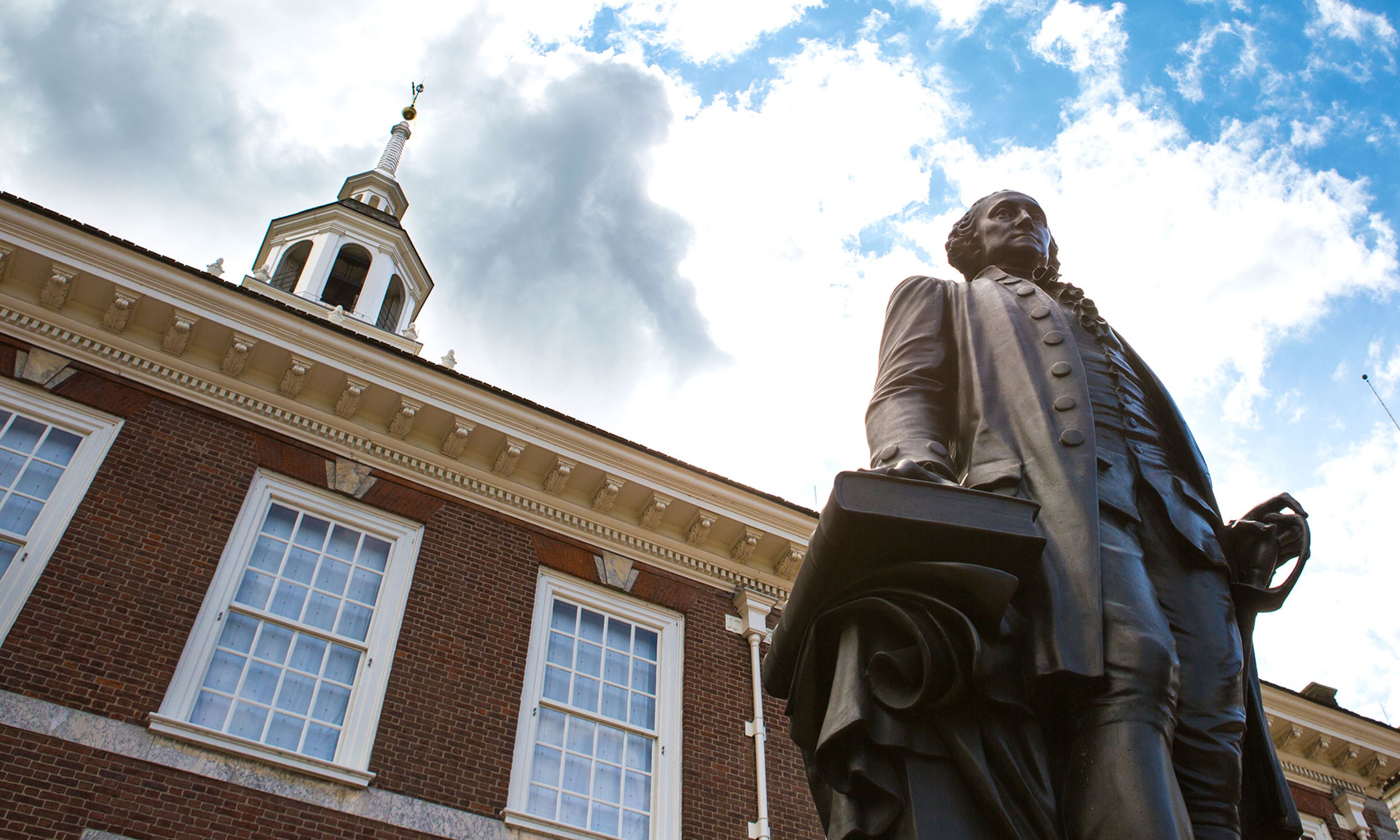
Statue of George Washington outside Independence Hall in Philadelphia
Thanksgiving is my favorite holiday. Everything else is a distant second. I love to cook and to eat. I love college football and the rivalry games that are played at the end of the season as much as the next man, perhaps more.
There is nothing wrong with these traditions per se. Where we go wrong is when these traditions become the focal point of Thanksgiving, displacing the permanent with the temporary, the eternal with the temporal.
The Thanksgiving holiday is a unique American tradition. Other countries have various forms of harvest celebrations that have existed for centuries. But our observance of a day dedicated to offering thanks to God, the giver of all gifts, is rooted in the religious culture that brought the first pilgrims to America’s shores and cultivated a love of liberty.
Liberty, viewed as a sacred gift from the Creator to all mankind as bearers of His image, is the central aspirational tenet that united theologically diverse colonies. It sparked the flame of revolution, birthed a new nation, and to this day draws from all corners of the world those who share our aspiration to be free.
Yet as with many aspects of our history, traditions, and culture, the original intent of Thanksgiving has given way to consumerism and excess. Only in America could one witness people fist-fighting over a flat-screen television the day after they supposedly counted their blessings and gave thanks for all the material and spiritual gifts they enjoy.
G. K. Chesterton once said, “I would maintain that thanks are the highest form of thought, and that gratitude is happiness doubled by wonder.” I wonder if our happiness has been halved by lower forms of thought. C. S. Lewis, whom I hold in near apostolic esteem, said, “Gratitude looks to the past and love to the present; fear, avarice, lust, and ambition look ahead.” So, let us look to the past to inform our love in the present and inspire our future.
In October 1789, George Washington issued a National Day of Thanksgiving Proclamation. His words are worth quoting in full:
Whereas it is the duty of all Nations to acknowledge the providence of Almighty God, to obey his will, to be grateful for his benefits, and humbly to implore his protection and favor—and whereas both Houses of Congress have by their joint Committee requested me to recommend to the People of the United States a day of public thanksgiving and prayer to be observed by acknowledging with grateful hearts the many signal favors of Almighty God especially by affording them an opportunity peaceably to establish a form of government for their safety and happiness.
Now therefore I do recommend and assign Thursday the 26th day of November next to be devoted by the People of these States to the service of that great and glorious Being, who is the beneficent Author of all the good that was, that is, or that will be—That we may then all unite in rendering unto him our sincere and humble thanks—for his kind care and protection of the People of this Country previous to their becoming a Nation—for the signal and manifold mercies, and the favorable interpositions of his Providence which we experienced in the course and conclusion of the late war—for the great degree of tranquility, union, and plenty, which we have since enjoyed--for the peaceable and rational manner, in which we have been enabled to establish constitutions of government for our safety and happiness, and particularly the national One now lately instituted—for the civil and religious liberty with which we are blessed; and the means we have of acquiring and diffusing useful knowledge; and in general for all the great and various favors which he hath been pleased to confer upon us.
And also that we may then unite in most humbly offering our prayers and supplications to the great Lord and Ruler of Nations and beseech him to pardon our national and other transgressions—to enable us all, whether in public or private stations, to perform our several and relative duties properly and punctually—to render our national government a blessing to all the people, by constantly being a Government of wise, just, and constitutional laws, discreetly and faithfully executed and obeyed—to protect and guide all Sovereigns and Nations (especially such as have shewn kindness unto us) and to bless them with good government, peace, and concord—To promote the knowledge and practice of true religion and virtue, and the [i]ncrease of science among them and us—and generally to grant unto all Mankind such a degree of temporal prosperity as he alone knows to be best.
Washington’s words should serve as a stark reminder to all of us that living in freedom is among the greatest gifts ever bestowed upon a people. Our nation is an aspirational exception to the general rule of history. Gratitude should be the hallmark of Christians around the world, but perhaps even more so for those blessed to live in the American republic. Heartfelt gratitude should inspire Americans to preserve this blessing for “ourselves and our posterity.” It should motivate us to lead the world by example, not only to freedom but to its source: the One in whom “we live and move and have our being.”
Gratitude and its kinsman in virtue, contentment, are intertwined. When one is profoundly grateful for what he has, it follows that he would be content with what he has. As the Apostle Paul wrote to the Philippians, contentment “in abundance or in need” strengthens gratitude so that we can “be anxious for nothing; but in everything by prayer and supplication with thanksgiving let your requests be known to God.”
As Thanksgiving arrives, let us all enjoy our turkey, our football, maybe even our shopping. But let us not neglect to set our minds and our hearts on “whatever is true, whatever is honorable, whatever is just, whatever is pure, whatever is lovely, whatever is commendable.” And be truly thankful. Soli Deo gloria.
About the Author
Lathan Watts is the vice president of public affairs for Alliance Defending Freedom (@ADFLegal) and its sister organization ADF Action. He served for three years as the Dallas coordinator for National Review Institute’s Burke to Buckley Fellowship and earned his juris doctor degree from the University of Mississippi.
Featured Tags
Advertisement
Advertisement


Comments