Share this story
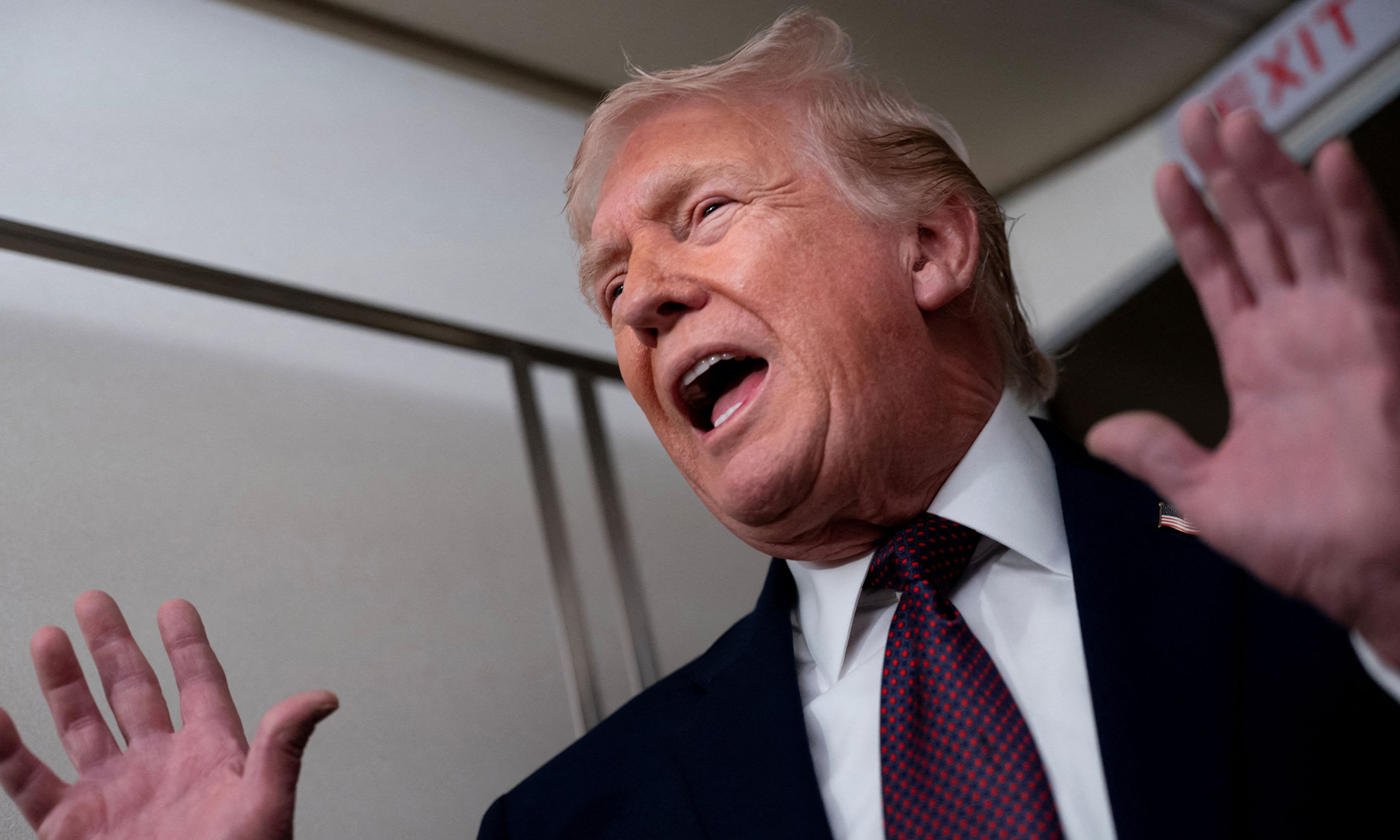
President Donald Trump speaks with members of the media aboard Air Force One, January 11, 2026.
There was a time, not so long ago, when the president of the United States could be counted on to embarrass the republic only through inept decisions or lofty platitudes. Now, presidential disgrace is also linguistic, rhetorical, even psychological. With Donald Trump, the vulgar torrent became the message. The method was bluster, the attitude an amoral indifference to truth, the idiom a kind of gutter demotic that dragged every exchange down to the level of the pro-wrestling ring or the casino floor. For a people once taught to regard the presidency as a moral tribune, this wasn’t just a comedown. It was a national intoxication in which intoxication itself became the new sobriety.
The first and most obvious mark of this coarse dispensation lies in its diction. Political language once at least gestured toward civility of tone. Though its meanings could be evasive, its grammar was usually correct. Trump’s breakthrough was to treat coarseness not as a liability but as a credential of authenticity. The profanity, the name-calling, the brawling with “losers” and “morons,” the yells about “animals” and “vermin” became ritual displays of his supposed proximity to the national id. What would have been a gaffe for any other politician he turned into a virtue by claiming persecution from the “politically correct.” The man who bragged of his genius for “the best words” could rarely manage a paragraph without syntactic collapse. Yet this triumphant incoherence passed as sincerity, the errors and misspellings paraded as badges of manly candor against effete literati who couldn’t “connect with real people.”
The deeper problem isn’t his ignorance of grammar but his debauching of truth itself. Trump, like the totalitarian pamphleteers he dimly resembles, discovered that if you lie often and flamboyantly enough, the issue stops being whether you’re truthful. The only question that remains is whether you’re winning. His presidency turned the lie into spectacle, a stunt in which fact is just a prop. He blurs the line between boast and statement, between dream and daylight, so that the citizenry begins to experience fiction as governance. When a president insists that invisible cabals haunt him, that crowds who stayed home were actually there, that enemies who don’t exist must be crushed, people adjust their expectations. They stop expecting truth from the Oval Office and settle for theater that flatters their feelings and confirms their suspicion that reality is an invention of their foes.
This is the culture of permanent brinkmanship. Trump’s threats, often apocalyptic, aren’t slips of the tongue but provocations meant to normalize constant emergency. Statesmanship, once measured by caution and moral gravity, is now calibrated by volume. In the Trumpian style, the more loudly you shout about “ending a civilization,” the stronger you seem. The more deranged the warning, the more your supporters applaud your “toughness.” That sort of rhetoric shreds the deliberative habits that sustain a democracy. Bluff and dare become routine tools of office, and the expectation that political strength includes restraint dies a quiet death.
One might forgive the occasional exaggeration. Trump has gone further, replacing modesty with megalomania. His boasts — “Nobody knows more than I do,” “I’m a very stable genius” — are so frequent, so unpunctuated by irony, that they’ve become part of the national noise. A civilization that once prized understatement now treats chest-thumping as presidential. The damage is contagious. When the highest office licenses boundless self-praise, the very idea of modest competence turns unheroic. You can already see the future politician who speaks well and dresses modestly being marked as weak by contrast with the showman in chief.
There’s also the matter of linguistic decline, the coarse texture of Trumpese. Here’s a man who boasts of “having all the right words” yet struggles to produce a sentence beyond the vocabulary of a bored adolescent. It would be comic if it weren’t so corrosive. In the Trump era, spelling errors in public communications become emblems of authenticity, proof that the author is too busy “getting things done” to bother with letters. The man who writes “Marine Core” or “unpresidented” isn’t shamed but applauded for “telling it like it is.” We once expected presidents to dignify the language of statecraft. The word statesman itself now seems archaic.
The genius of Trump’s rhetoric lies also in its dog whistles and veiled signals. He denies bigotry even as he nourishes it, allowing partisans to hear in his words whatever hate they please. He plants prejudice while sheltering behind ambiguity. It’s the demagogue’s language reduced to code, a moral encryption meant to please two audiences at once. The bigot nods knowingly, the anxious moderate insists that no racism was “explicitly stated.” In this way Trumpism democratizes insinuation, creating a public language of smirk and wink whose true target is civility itself.
The larger question is contagion. Language, like morality, deteriorates by imitation. There’s already spillover among aspirants who mimic Trump’s lexicon, his gestural patriotism, his pantomime of the tough guy. The vocabulary of American politics has shifted an octave down. Where candidates once strained toward eloquence, they now compete over who can hurl the loudest insults. If the nation’s pulse once raced to the cadence of a Lincoln address or a Roosevelt fireside chat, it now throbs to the tempo of talk radio fury. The idioms of professional wrestling, enthusiastically ushered into the Oval Office, have now oozed into Congress.
Here lies the long-term peril. Once people grow used to being lied to, to being spoken to as if they were a mob rather than an educated electorate, the old expectations die off. The presidency isn’t only an office of policy but of tone. It radiates norms downward. When that tone is aggression wrapped in grievance, when the lie becomes the message and vulgarity a symbol of authenticity, the corrosion seeps into the groundwater. What happens when a whole generation grows up assuming that professional-wrestling hyperbole is the natural idiom of leadership?
Trump didn’t just coarsen our language. He trained us to equate coarseness with sincerity. He didn’t simply lie. He redefined honesty as loyalty to the lie. He didn’t just boast. He persuaded millions that modesty is for losers. He didn’t merely threaten. He made permanent menace a kind of reality-show governance. And he didn’t simply misspell. He convinced a large portion of the public that eloquence is elitist.
So we’re left with a grotesque paradox. The man who claimed to “have all the right words” has left his country nearly speechless, reduced to memes, chants, and jeers. One already hears the echoes in governors, senators, preachers, even reporters who sand down their vocabulary to mimic the vulgarity that now defines “plain speaking.” The world’s most articulate democracy now sputters in monosyllables, every disagreement an apocalypse.
This experiment in linguistic barbarism may have to run its course before Americans rediscover their voice. The residue will remain. The task of repair will fall to those who can still connect word to thought and sentence to conscience. What Trump has wrecked isn’t just political rhetoric but the shared confidence that reasoned speech is possible. Recovering that confidence will demand moral revulsion, spoken plainly, spelled correctly, and honestly felt.
About the Author
Bryan A. Garner is the author of The Chicago Guide to Grammar, Usage, and Punctuation, Garner’s Modern English Usage, and The HBR Guide to Better Business Writing.
Featured Tags
Advertisement
Advertisement
Comments