Trump Administration Notches a Win in Deportation Drive
Written by Andrew C. McCarthy
An appeals court has found a district judge erred in intervening in the case of Mahmoud Khalil.
Share this story
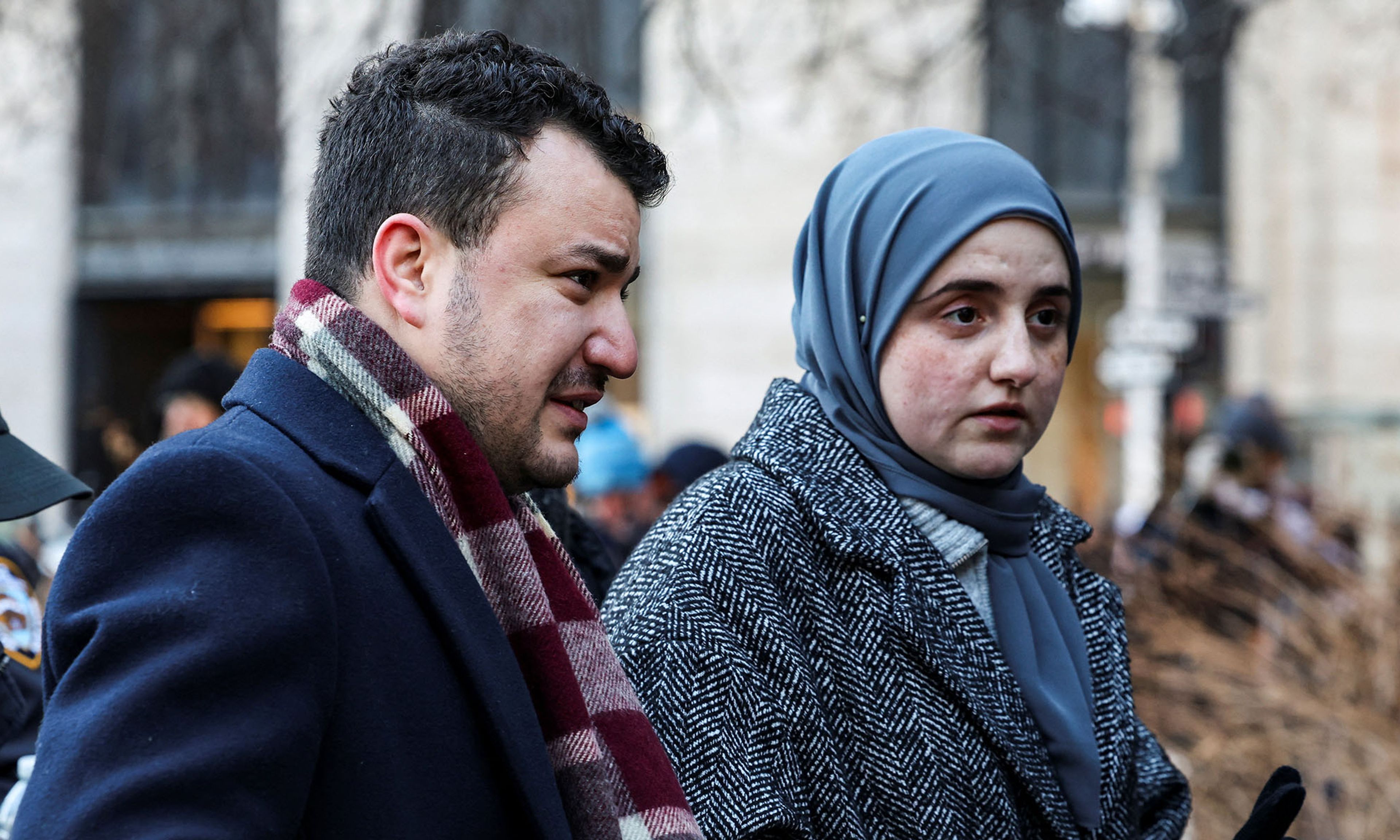
Columbia University graduate Mahmoud Khalil and his wife Noor Abdalla attend the inauguration ceremony for New York City Mayor Zohran Mamdani in New York City, January 1, 2026.
In a victory for the Trump administration in its initiative to oust aliens from the United States over their pro-Hamas agitation, the Third Circuit on Thursday reversed a New Jersey federal judge, who had intervened in the deportation proceedings of Mahmoud Khalil -- the former Columbia graduate student who was a leader in the campus unrest after Hamas’s October 7 atrocities.
As has become customary, the division in the courts’ rulings reflects the partisan divide in the country over the president’s immigration enforcement policies. The district judge who intervened, purporting to bar the government from removing Khalil from our country, was Michael Farbiarz, a Biden appointee. The Third Circuit panel divided 2-1 in reversing Judge Farbiarz, with Judges Thomas Hardiman and Stephanos Bibas, appointees of Presidents Bush-43 and Trump-45 in the majority, and an appointee of President Obama, Judge Arianna Freeman, dissenting.
I’ve covered Khalil’s case extensively. (See, e.g., here, here, here, here, and here; also see posts by Phil Klein, Haley Strack, Dan McLaughlin, Noah Rothman, Brittany Bernstein, David Zimmermann, and Civitas Outlook’s Richard Reinsch). The central issue in the case remains this: In overhauling federal immigration law, Congress undertook to cut federal district judges out of removal proceedings; but in its zeal to afford aliens no due process, the Trump administration has inadvertently brought district judges back into the game, making the deportation of illegal aliens more difficult.
In essence, aliens do not have the same constitutional and statutory entitlements citizens do. Hence, the determination of which non-Americans are permitted to visit, reside in, or immigrate to the United States is principally a political determination, left to the president and Congress, not a judicial one.
Congress did not deprive the courts of all jurisdiction over removal, but it did narrow the judges’ remit in 1996, when it amended the Immigration and Nationality Act (originally enacted in 1952).
An alien the government alleges is deportable gets proceedings before two executive branch tribunals within the Justice Department -- what are confusingly called an “immigration judge” and the “Bureau of Immigration Appeals.” After that process runs its course, a one-time appeal may be taken to the Circuit appeals court -- not the district court -- which covers the place where the DOJ removal proceedings have occurred. The Circuit’s review is narrow: It is restricted to legal questions and essentially must accept the fact-finding of the DOJ immigration tribunals. After that, appeal can be taken to the Supreme Court, but it is rare for the justices to accept a case for review.
Although this process is very favorable to the government, President Trump and his subordinates have complained that allegedly deportable aliens should have no due process rights -- reasoning that since the Biden administration lawlessly let over 12 million illegal aliens into the country, the Trump administration should be able to remove them en masse, without court interference. That may be cosmic justice, but it’s not American law.
The administration has engaged in heavy-handed tactics to try to rig results in its favor. This is illustrated by Khalil’s case: Rather than provide him with notice that the government sought his removal and litigate the matter in Manhattan (which is in the Southern District of New York) where he was living at the time, the administration had him arrested at night and whisked out of the SDNY, not telling his family or his counsel where he’d been taken. As with other allegedly removable aliens in blue cities, immigration agents moved Khalil down south, in an effort to assure that any judicial challenges would have to occur in the Fifth Circuit (where Republican appointees outnumber Democratic appointees 19 to 8: 12 to 5 among active judges and 7 to 3 among senior judges).
The Trump tactics have been self-defeating in that they have invited aliens like Khalil to file habeas corpus proceedings, challenging the lawfulness of their detention and transportation. There is no question that district judges have habeas jurisdiction. Predictably, as happened in Khalil’s case, the district judges -- particularly those appointed by Democrats, who are hostile to aggressive enforcement of immigration law -- have used these habeas challenges as a pretext to weigh in on the removal proceedings. As I observed the last time the Khalil controversy reared its head, “The administration’s tactics . . . have enabled Khalil to seek relief from a federal district court that shouldn’t be involved in the case.”
That is what the Third Circuit majority said in its 40-page ruling. As it summarized the matter:
Because the INA channels “[j]udicial review of all questions of law . . . arising from any action taken or proceeding brought to remove an alien from the United States” into a single petition for review filed with a federal court of appeals, we hold that the District Court lacked jurisdiction over Khalil’s removal proceedings.
To recap, Khalil is an Algerian national although he was born in Syria, in a Palestinian refugee camp. He entered the U.S. legally on a student visa in 2022, enrolling in a master’s program in international relations at Columbia. The following year, he married an American citizen (they now have a child, born last year). The marriage enabled him to seek an upward adjustment of status to permanent resident alien (LPR), which was granted in 2024.
While LPRs are legally deemed “U.S. persons” for some purposes and are on track to apply for citizenship after a few years, they do not have the rights of citizens. Under a provision of immigration law (Section 1227(a)(4)(c)) invoked by the Trump Justice Department they, like other categories of aliens, may be removed if the Secretary of State concludes that their “presence or activities in the United States . . . would have potentially serious adverse foreign policy consequences for the United States.” This provision is constitutionally fraught because, in theory, it permits the apprehension and deportation of aliens whose objectionable activities would be First Amendment–protected if engaged in by American citizens.
Khalil was an agitator in connection with Columbia’s pro-Hamas campus protests. (Hamas, the Palestinian branch of the Muslim Brotherhood, has been designated as a foreign terrorist organization under federal law since 1997 -- even before al-Qaeda.) The protests often resorted to tactics that violated law and school regulations -- e.g., encampments, occupation of buildings, etc. -- although Khalil’s activities as a “leader” were along the lines of trying to leverage the lawlessness for the purpose of squeezing Columbia administrators to make concessions to the pro-Hamas rabble. He was co-president of the Palestinian Working Group at Columbia’s School of International and Public Affairs, and president of the university’s Palestinian Student Society (an oft-time collaborator with the Muslim Students Association, the Muslim Brotherhood’s most influential enterprise in the West). Khalil was a leader in protests maintaining that Israel’s military response to the October 7 attacks led by Hamas was a “genocide” against Palestinians. (When the supposed genocide began with Israel’s independence in 1948, there were about 800,000 Palestinians (not known as such at the time) in what are now the Palestinian territories; today, there are nearly 6 million.)
Ultimately, Judge Farbiarz ruled that (a) the contested foreign policy provision under which Secretary Rubio ordered Khalil’s removal likely violates the First Amendment; (b) Khalil could be released on bail while his removal proceedings went forward; and (c) the government was enjoined from removing him based on Rubio’s determination. Farbiarz rejected the Justice Department's contentions that he should transfer Khalil’s case to the Western District of Louisiana (where Khalil was being held before Farbiarz ordered his release) and that he lacked jurisdiction to intervene in the removal hearings.
In the interim, as I’ve previously recounted, there emerged another ground for removing Khalil: fraudulent misrepresentations (mainly omissions) when he sought the afore-described adjustment of status. Specifically, the government alleges that Khalil failed to disclose that:
(1) he had served as the political affairs officer for the United Nations Relief and Works Agency for Palestinian Refugees (UNRWA), which, to summarize what I’ve previously contended, is functionally an arm of Hamas; and (2) he had worked for the Syria Office in the British Embassy in Beirut, Lebanon. These were material misrepresentations rendering Khalil removable under federal immigration law. (See Sections 1182(a)(6)(C)(i) and 1227(a)(1)(A) of Title 8, U.S. Code.)
Conflicting with Judge Farbiarz, a DOJ immigration judge found that Khalil was removable on both the foreign policy and fraud grounds; she denied his asylum petition and ordered him deported to either Algeria or Syria.
In response, Judge Farbiarz directed the Justice Department to “cause the immigration judge” to reverse her decision finding Khalil removable on the foreign policy ground. Although Farbiarz conceded that Khalil was unlikely to prevail on his challenge to the fraud ground, the judge pushed the government to have the immigration judge consider whether Khalil should be granted a “waiver of removability” regarding that allegation.
In its ruling on Thursday, the Third Circuit majority acknowledged that the habeas claim -- i.e., the challenge to the lawfulness of Khalil’s detention -- was properly before Judge Farbiarz in New Jersey, notwithstanding that the alien was being held in Louisiana until Farbiarz ordered his release on bail back in June. Yet bringing a suit in the correct district is only one part of the jurisdiction equation: A court must also have subject-matter jurisdiction over the basic claims in the suit.
On that score, the majority found, those basic claims are really directed against removal, as to which Congress has denied district judges authority to intervene. The majority rejected Khalil’s attempt to recast his removal claims as habeas detention claims -- noting that his arguments regarding the latter are “identical” to those regarding the former.
The majority reasoned that all of the claims Khalil seeks to raise -- e.g., whether the grounds for his removal violate the Constitution, and whether the Trump administration is proceeding against him in a manner that is unlawfully selective or punitive -- can be effectively raised in the eventual petition for removal to the Circuit at the conclusion of the proceedings before the DOJ immigration tribunals. Congress’s point in the 1996 INA overhaul was to streamline removal proceedings. That’s the antithesis of Khalil’s attempt to have two bites at the apple: the first in a habeas case designed to circumvent the INA’s stripping of removal jurisdiction from the district courts, and later -- i.e., upon losing the habeas case -- in a second under the regular INA process.
The wayward habeas litigation has delayed the removal proceedings -- which, of course, is what Khalil wants as long as he is out on bail. That is unlikely to continue now that the circuit has reversed Judge Farbiarz, and particularly with the DOJ immigration judge having concluded that Khalil should be deported. The next step is Khalil’s appeal to the DOJ’s Bureau of Immigration Appeals (BIA); the BIA had stayed its proceedings while waiting for the Third Circuit to rule on the habeas case. Now, the matter will move expeditiously.
I expect that the BIA will rapidly affirm the DOJ immigration judge’s conclusion that Khalil is removable on both the controversial foreign policy ground and the more straightforward fraud ground. Because those proceedings are in the Fifth Circuit, Khalil would then have to seek review in that circuit, not the third. The fraud ground for removal appears to be an open-and-shut case, even if the judicial courts may be queasy about removing a legal immigrant -- an LPR -- based on activity that would be First Amendment-protected if engaged in by an American citizen. But even LPRs are not American citizens; they do not have the same claim on constitutional safeguards that citizens do, and, as Rubio has urged, it is not logically offensive to kick an alien out of the country over expressive conduct and associations that would have been grounds not to let him in the country in the first place.
Lesson for the Trump administration: The INA grants some due process to removable aliens, but it is weighted -- as it should be -- to enable the government to deport illegal aliens on a fast track. By chafing against the INA’s minimal due process standards and trying to put its thumb on the scale of cases it should win on the merits, the administration is slowing up the works. In Khalil’s case, the administration’s actions invited an unnecessary, drawn-out district court litigation, forcing the Justice Department to expend more than double the effort a positive enforcement outcome should have required.

About the Author
Andrew C. McCarthy is a senior fellow at National Review Institute, an NR contributing editor, and author of Ball of Collusion: The Plot to Rig an Election and Destroy a Presidency.
Featured Tags
Advertisement
Advertisement



Comments