Trump Makes Powell His Piñata
Written by Andrew C. McCarthy
Lawfare against the Fed chairman is meant to bully him into bad economic policy
Share this story
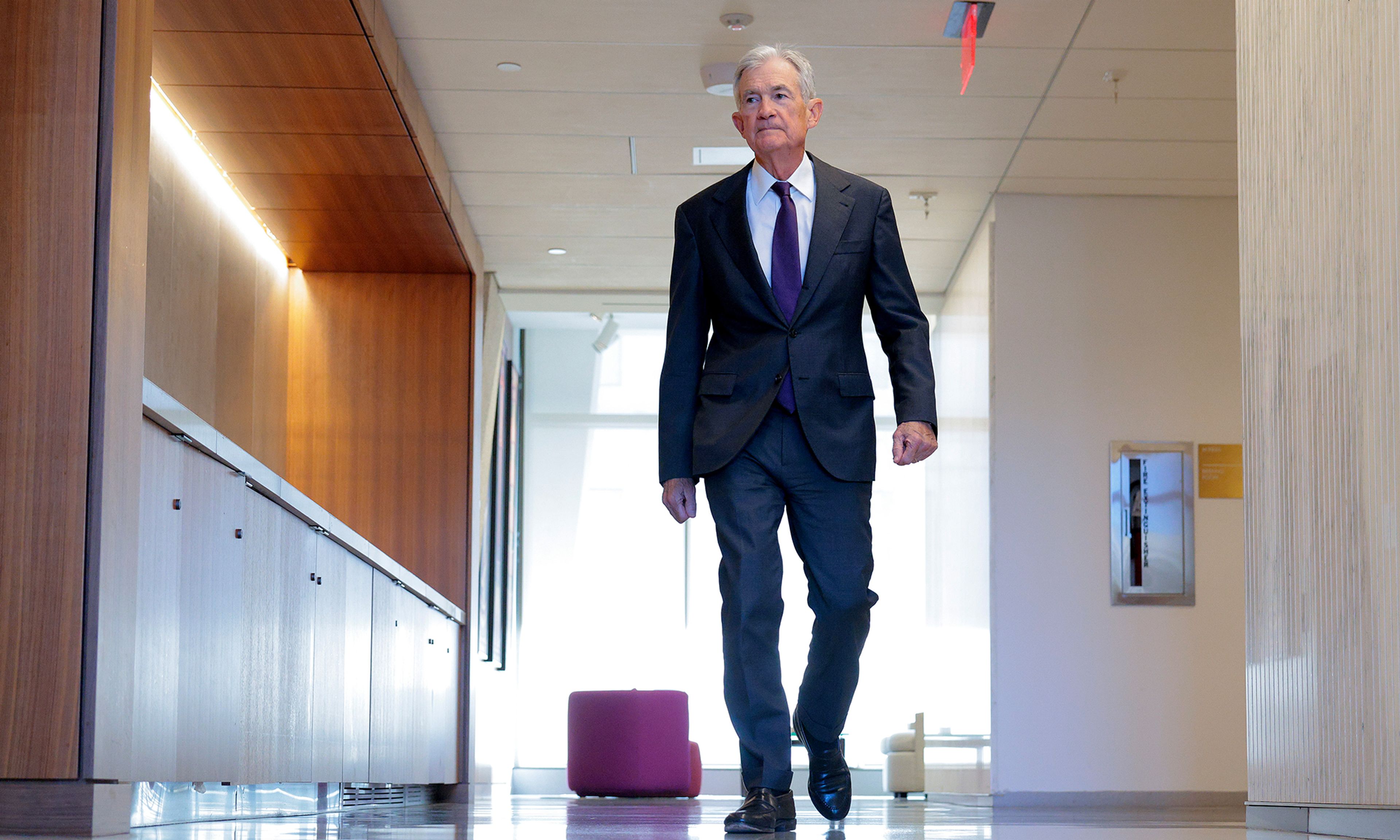
Federal Reserve Chairman Jerome Powell walks between meetings at the Fed in Washington, D.C., January 13, 2026.
The Justice Department’s criminal investigation of Jerome Powell, chairman of the Federal Reserve Board, displays all the Trump administration’s now familiar seaminess.
It is a retributive politicization of law enforcement -- lawfare, through and through. Its motivation is disreputable: an attempt to extort the chairman, a piñata for Trump, into adopting economic illiteracy. And as ever, subordinates pursuing petty but conflicting agendas, in their haste to please the overlord, have ignited a firestorm that defeats the administration’s purported objectives.
In its most lasting consequence, though, the episode illustrates that the framing of a constitutional dispute over the administrative state -- which has heated up since the first weeks of the second Trump term and is careening toward Supreme Court resolution -- has put the cart before the horse. Notwithstanding the administration’s vehemence, the president’s authority to fire the heads of agencies, such as the Fed, without cause is not the critical issue. That is just a corollary of the fundamental flaw: These agencies violate the separation of powers, enabling the president, or his appointees, to superintend legislative functions.
Although Powell was elevated to Fed chairman by Trump in 2017, the two have had a stormy relationship from the get-go. To be sure, there are many legitimate criticisms of Powell’s stewardship, particularly on inflation. Yet Trump’s case against him is strictly political and misconceived: Powell will not give Trump the easy money he desires.
Trump was reelected, despite deep public reservations, with the expectation of a return to the economy of his first term, during which, despite his quotidian tantrums and some tariff foolishness, he took the advice of seasoned subordinates. Alas, the second-term Trump is more self-assured. The relentlessness and capriciousness of the tariff onslaught, coupled with sundry statist misadventures, have not brought the anticipated relief from high, Biden-era prices. The uncertain climate created by Trump’s mercurial machinations undermines business expansion. Moreover, the country is now $38 trillion in debt, such that interest payments, at about $1 trillion per annum (and rising), exceed the defense budget -- while Trump eschews the political risk of addressing entitlements, the primary drivers of debt.
In these straits, the president needs a scapegoat, and Powell is his man. He has branded the Fed chairman “Mr. Too Late” -- always too slow and timid about cutting rates, a “clueless” “numbskull” who “doesn’t know what he’s doing.”
Concurrently, Trump has let it be known that he is unhappy with Attorney General Pam Bondi over what he somehow sees as the slow pace of indictments against his political enemies. The president won’t accept that the conduct he wants probed, particularly the 2016–17 Russiagate hoax, besides being stale under the five-year federal statute of limitations, is of dubious criminality. (As Trump of all people should grasp, abuses of power often do not violate criminal law.) By the president’s lights, since Democratic prosecutors had no problem hounding him, the lack of adequate action by his own prosecutors must signal disloyalty and incompetence. Meanwhile, courts have thrown out the major indictments Bondi has already brought against such Trump nemeses as New York Attorney General Letitia James, who brought a bogus civil fraud case against Trump, and former FBI Director James Comey, of Russiagate infamy.
At a White House photo shoot in early January, the president lambasted district U.S. attorneys for their tremulousness. The next day, federal prosecutors in Washington, D.C., under the direction of Trump-appointed U.S. Attorney Jeanine Pirro, sent grand jury subpoenas to the Fed. The claim was that Powell misled Congress last summer when testifying about the lavish renovations of two Fed buildings.
The probe is an unworthy exercise, especially given the grandiosity and cost overruns of Trump’s own vanity project, the East Wing ballroom. Because the Fed is self-funding, taxpayers are not footing the bill for construction on its buildings. By Washington’s profligacy standards, the surge past initial cost estimates -- to about $2.5 billion from the original $1.9 billion -- is neither remarkable nor difficult to explain: Covid-era supply chain woes and inflation have raised construction expenses everywhere. Transparently, then, the Powell investigation seeks to manufacture a statutory basis -- misfeasance or malfeasance -- for Trump to remove Powell. The objective is inane: Powell’s term as Fed chairman lapses on May 15, so Trump will get to replace him anyway, although Powell’s separate term as a Fed Board governor runs through January 2028.
If press reports are accurate, the driving force behind the Powell probe was Bill Pulte, the director of the Federal Housing Finance Agency. He’d previously pushed dubious mortgage-fraud investigations of the aforementioned Letitia James, Senator Adam Schiff (D., Calif.), an orchestrator of the two first-term impeachments of Trump, and Lisa Cook, a Biden-appointed Fed governor whose seat Trump also hopes to fill with his own appointee.
Pulte, a Trump donor with a degree in journalism, is not a lawyer and has no experience investigating financial crimes. He has the president’s ear but denied any instigator role in the Powell probe, at least after Powell issued a forceful public statement about it, prompting consternation across the board, even from notoriously supine congressional Republicans.
The bank fraud charges that Pulte earlier championed against James had proved so weak that Erik Siebert, the Trump-appointed interim U.S. attorney in Eastern Virginia, declined to bring them. Trump furiously cast Siebert aside, replacing him with a loyalist, Lindsey Halligan -- an insurance lawyer and White House aide who’d never been a prosecutor, and who Bondi has now announced is out. Halligan indicted James, only to have the case first thrown out by a judge (over grand jury irregularities and Halligan’s lack of qualification under controlling statutes) and then rejected by multiple grand juries when Bondi tried to have it reindicted. (Halligan’s indictment of Comey was also thrown out by the court.) Once burned, prosecutors are twice shy, refusing (thus far) to bring against Schiff and Cook any charges that rely on Pulte’s scouring of government mortgage files. Trump has nevertheless tried to fire Cook based on unproven claims of financial shenanigans, but he has been blocked by the Supreme Court. The justices will rule this term on Trump’s authority to remove agency heads and on whether different rules should apply to the Fed.
Trump seems nonplussed by the political blowback. The Justice Department, quite aware that central bank independence is popular, had already conceded to the Supreme Court that presidents should not have the same unreviewable discretion to remove Fed governors as to fire heads of other agencies. It is perhaps no surprise, then, that Pirro was quick to portray the subpoenas as a big misunderstanding, caused by the Fed’s failure to respond (over the Christmas holidays) to an informal inquiry about the renovation -- as though the prospect of an indictment was a figment of Powell’s overheated imagination.
Most frustrated, it appears, is Treasury Secretary Scott Bessent, one of Trump 2.0’s more competent officials. It was Bessent who, at a private September dinner attended by Trump officials and advisers, threatened to punch Pulte in the face for bad-mouthing him to the boss. The secretary had reportedly been working on a plan to maximize Trump’s impact on the Fed: simultaneously paving the way to get an as-yet-unnamed Trump nominee to replace Powell as chairman through Senate confirmation while cajoling Powell to leave the Fed’s board early (i.e., before January 2028). That would enable the president to fill two seats -- maybe three, depending on what the Court ultimately decides in Cook’s case. The Powell probe appears to have blown up the plan. The nomination fight over Powell’s replacement promises be fierce; Powell’s incentive is now to hang on as a governor until after the 2026 midterms, which could empower Democrats to block Trump’s future Fed nominees. The White House lawfare against Powell can’t help the administration with the justices.
That last one is the essential issue. Since the start of his second administration, Trump has agitated to rein in the administrative state by asserting unilateral executive authority to remove agency heads, despite statutory mandates that good cause must be established. At issue is Humphrey’s Executor, a 1935 precedent in which the Court, in a seeming departure from precedent (although the matter is disputed), upheld such restrictions after FDR tried to terminate a member of the Federal Trade Commission.
The spotlight on yet another episode in Trump’s reification of Arthur M. Schlesinger Jr.’s “imperial presidency” misses the main event. The principal defect in Humphrey’s was not limitations on presidential authority to remove officials who wield executive power, which the Constitution vests in the president alone. That was a by-product of the Court’s endorsement of administrative agencies that violate separation of powers principles, consolidating the exercise of executive, legislative, and even judicial powers in single agencies.
As scholars such as Stanford University’s Michael McConnell have explained, the Fed’s most significant activity -- steering monetary policy by buying and selling securities -- is essentially a legislative power. The executive authorities Congress has heaped on the Fed (e.g., bank examinations and enforcement of consumer-protection laws) could easily be assigned to a different agency.
That would make for a better Fed. It would also legitimize Congress’s constraints on executive authority over the board. Then, even this most vindictive of presidents might find better things to do than sic prosecutors on the chairman.
About the Author
Andrew C. McCarthy is a senior fellow at National Review Institute, an NR contributing editor, and author of Ball of Collusion: The Plot to Rig an Election and Destroy a Presidency.
Featured Tags
Advertisement
Advertisement
Comments