Trump’s Executive Order Targeting Perkins Coie Must Be Condemned
Written by Andrew C. McCarthy
The president’s EO is nothing less than a bill of attainder, and a deep constitutional wrong.
Share this story
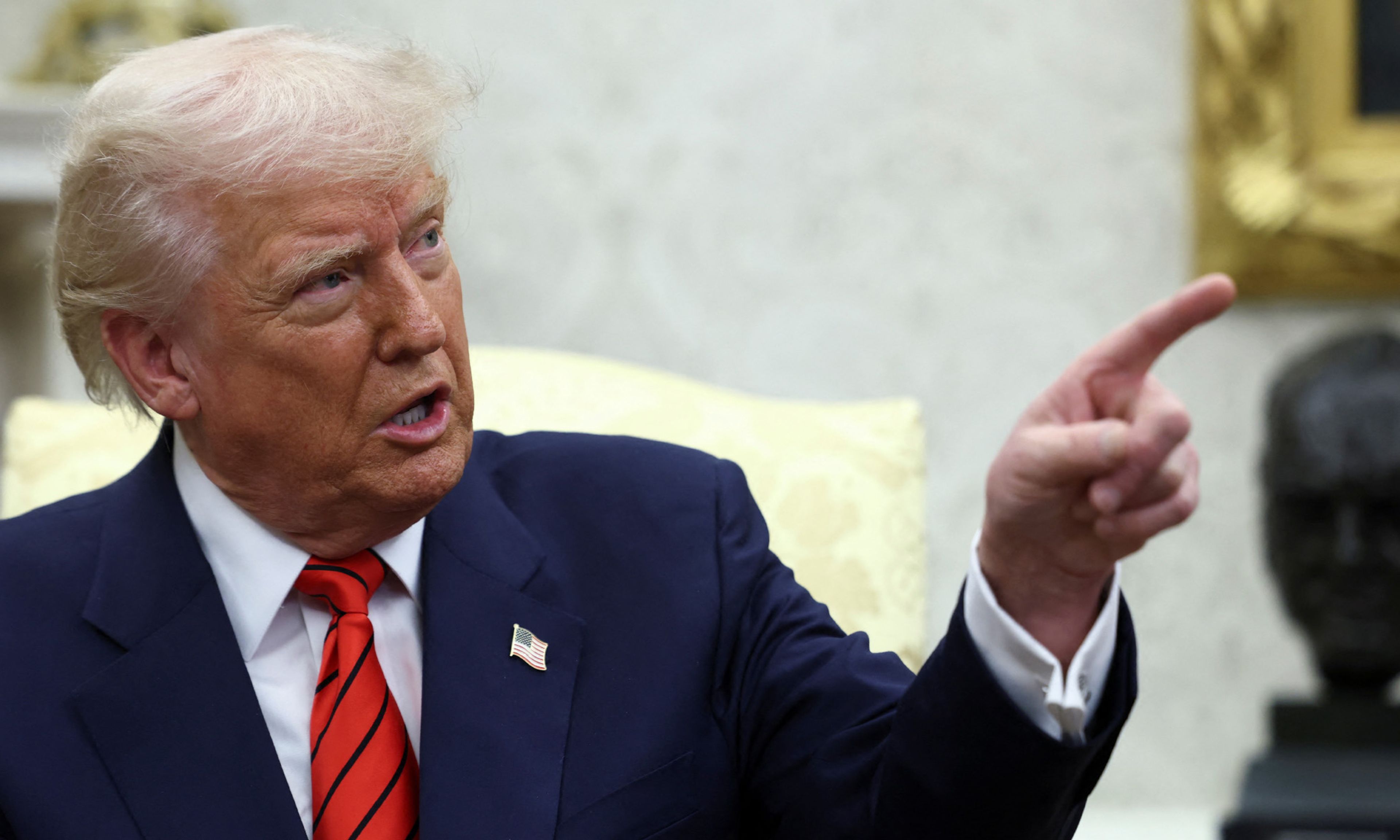
President Donald Trump in the Oval Office at the White House in Washington, D.C., March 13, 2025.
Every fiber in my being makes me want to ignore the Perkins Coie story.
It stems from a March 6 executive order, in which President Trump condemned and sought to punish the law firm that prominently represented the Democratic Party, the Hillary Clinton 2016 presidential campaign, and others implicated in the plot to frame Trump as a clandestine agent of Russia. Two top lawyers deeply involved in that scheme are no longer at the firm, which Trump is evidently trying to put out of business. The Seattle-based organization employs 3,700 people: 1,200 lawyers and the rest support staff, almost none of whom had anything to do with Russiagate.
The executive order -- so subtly titled “Addressing the Risks from Perkins Coie LLP” -- is nothing less than a bill of attainder, as that unconstitutional decree has always been understood in American law.
The Left Doesn’t Make This Easy
I’d prefer to ignore the EO because the Democrats and their base supporters now expressing outrage over it are hypocrites. I know: To put the power of the presidency behind ostracism of this kind -- this professional death sentence and all the financial and reputational harm it entails -- takes things to a new degree of egregiousness. But it’s not a new kind.
Democrats and their Trump-deranged allies in the legal profession did precisely this sort of thing to John Eastman and other Trump lawyers involved in the “stop the steal” soft coup attempt to retain Trump in power after he lost the 2020 presidential election. Eastman is a former law school dean and constitutional law scholar whom I’ve known and considered a friend for many years. Yet I’ve been unsparing in deriding his theory that the vice president had the legal authority to either invalidate state-certified electoral votes or at least remand them to those states for further investigation (i.e., to create an opportunity for Republican-controlled legislatures to supplant the voters’ preference for Joe Biden with their own preference for Trump).
Here's the thing, though: Eastman’s flyer was just that, a theory. Theorizing is what smart lawyers do: They are retained, often in unwinnable cases, to try to win, or at least get the best result for the client within the often vague boundaries of the law -- with some creative lawyers taking this to the edgy point of manufacturing vagueness rather than merely exploiting it.
Eastman had a frivolous legal theory. In fact, it was so out there that he conceded he’d probably lose in a shutout at the Supreme Court. But we don’t indict lawyers for frivolous legal theories, so there was little risk of professional discipline for his floating one.
Defense lawyers are some of the most creative thinkers I’ve ever encountered. Back when I was a prosecutor, if positing a frivolous legal theory was a crime, I could have indicted a dozen of them per week. Thankfully, that’s not how things work. A lawyer who is perceived as a crackpot by fellow practitioners and, especially, judges is by his own making a pariah. That, coupled with the specter of professional discipline, keeps the bar reasonably on the up and up.
But for the Trump-deranged, that wasn’t enough pain for Eastman and company. The profession wanted them destroyed: disbarment, criminal charges -- and if drawing and quartering had been available, we’d have had that, too. And if you were one of these lawyers, good luck finding counsel to represent you. Nearly a quarter century ago, lawyers queued up from Fifth Avenue to Guantanamo Bay to offer their services, gratis, to jihadists who wanted to obliterate the United States and its Constitution. We were told that this was noble -- somehow, it illustrated “our” values and how much “we” venerate the Constitution. But none of that soaring BS for Trump lawyers -- off with their heads.
So it’s hard to take sides with these people: progressive ideologues who can’t spew enough bile about pardons for participants in a three-hour riot at the Capitol, including hundreds who viciously assaulted police officers (and they’re right about that), but who turned a blind eye to -- or even marched in lockstep with -- left-wing radicals who engaged in months of lethal rioting, looting, and arson triggered by the death in police custody of a black man with a substantial criminal record, who had started the fateful confrontation by assaulting the cops. This includes progressive ideologues now trying to turn a Hamas-supporting activist into a free-speech martyr, but who have not a word to say about Hamas’s brutal killing, maiming, and raping of hundreds of people on October 7, or about Edan Alexander, the American citizen who is among the two dozen living hostages the jihadists are still holding in their dungeons after 17 months.
I know none of this is going to change. I’ve been watching for over 60 years as the Left transformed the murderous anti-American radicals of my youth into celebrity academics, influential NGO operatives, and trustees of overflowing progressive funding streams. This is who the Left is. They are masters of the very tactics that they condemn, expecting we’ll believe all the twaddle about how “one man’s terrorist is another man’s freedom fighter.”
But the point isn’t to reform what can’t be reformed. It’s to do what’s right for its own sake and -- if you’re lucky -- to convince the convincible that we can trust each other to do the right thing, regardless of which “side” has done the wrong thing.
The Democrats’ Slander and Trump’s Reprisal
The president’s executive order is a deep constitutional wrong.
There is significant evidence that Marc Elias and Michael Sussmann, the two Perkins Coie lawyers who are no longer associated with the firm, were complicit in the Clinton campaign scheme to smear Trump as a Kremlin plant. Elias was the Clinton campaign’s main lawyer. Sussmann represented the Democratic Party, as well as both the Clinton campaign and Clinton supporters who claimed, based on nonsensical digital analyses, that Trump had a covert communications channel with Vladimir Putin. Elias retained the research firm Fusion GPS which, with the help of former British spy Christopher Steele, fabricated the “dossier” of faux intelligence that made sundry farcical claims about Trump “collusion” with the Russian government -- including that Putin had blackmail material (kompromat) he was leveraging against Trump, and that Putin was positioned to publicize information damaging to Clinton in order to help Trump win the election.
The Perkins Coie lawyers were influential in steering these manufactured allegations against Trump to the Obama administration, its intelligence agencies, the State Department, the Justice Department, and the FBI. As a result, they were used as bases to open foreign counterintelligence and criminal investigations that targeted Trump.
These were the building blocks of the special counsel investigation conducted by Robert Mueller, which cast a pall of suspicion over Trump well into the third year of his first term. Eventually, in March 2019, Mueller’s final report conceded that there was no evidence of a Trump-Putin conspiracy to steal the 2016 election (and studiously ignored immense evidence of a Clinton campaign conspiracy to draft the government’s law enforcement and intelligence apparatus into its slandering of Trump).
The defamatory hardball played by Trump’s political opponents was appalling. I wrote a book about it when it was still unfolding: Ball of Collusion: The Plot to Rig an Election and Destroy a Presidency. Trump is right to believe that it should have been covered and adjudged a scandal of Watergate dimension (rather than casually set aside by the media once the allegations were shown to be a smear).
Trump is stubbornly wrong, however, in refusing to accept that the payback he gets -- extraordinary payback, but the only legitimate payback -- is his stunning political comeback. The Democrats suffered thunderous defeat, in large part because the public saw these and other lawfare abuses as scandalous. That has to be enough. Trump’s retribution is that he won the presidency; it is not turning the presidency into lawfare on steroids.
Participants in the Russiagate farce have been disciplined. The government officials, particularly at the FBI, were the subject of scathing inspector general reports and either fired or pushed out of office. Hillary Clinton is irrevocably damaged political goods.
Whether it is petty or prudent to do so, Trump has all the authority the Constitution gives a president to remove government officials he blames for the lawfare tactics, and he has done that. And most pertinent for present purposes, the Perkins Coie culprits have been separated from the firm for years. Elias has started his own firm, bringing about 40 Perkins Coie lawyers with him to continue specializing in election-law mayhem. Sussmann was indicted by the Trump DOJ-appointed special counsel, John Durham. I thought he was guilty, but it’s not a surprise that he was acquitted by a Washington, D.C., jury in a case presided over by an Obama-appointed judge. Still, the prosecution was a valuable window into the Clinton campaign’s corruption of our erstwhile premier federal investigative agency.
That may not be enough for Donald Trump, who is of the eye-for-an-eye school. Revenge for a more fit man would be to revel in winning the presidency against all odds and try to be a good president for everyone -- thus proving his critics wrong. Trump, by contrast, seems determined to prove his critics right by exploiting the awesome might of the presidency to destroy his enemies, just as they tried to destroy him.
He doesn’t get to do that. Not if the Constitution has anything to say about it.
Bills of Attainder
The Constitution was written by brilliant men who had risked their lives in breaking away from the monarch of what was then the world’s strongest empirical power. Having had authoritarian power and allegations of treason leveraged against them, they were unusually mindful of the imperative to rein in that power and sharply narrow the legitimate reach of treason. The establishment of a republic dedicated to liberty would otherwise have been impossible.
The principal safeguard of liberty is the separation of powers, under which the executive branch is not permitted to exercise legislative or judicial powers. The president has no authority to prescribe crimes. Only Congress can do that. And while the president’s Justice Department may prosecute people it convinces a grand jury to formally accuse of violating Congress’s laws, the president may not unilaterally adjudicate guilt and pronounce sentence. Only the judiciary can do that.
To bolster the separation of powers, the Framers expressly forbade the federal and state governments from decreeing bills of attainder. In common law, these were legislative acts that, without trial in court, condemned a person or category of persons for alleged wrongs sufficiently serious that the death penalty could result. Wrongs calling for lesser penalties were targeted by analogous “bills of pain and penalty.” In American law, however, the prohibitions against bills of attainder cover both categories of wrongs. As The Heritage Guide to the Constitution explains regarding the bill of attainder provisions (in Sections 9 and 10 of Article I), so concerned were the Framers about this abuse of power that “these are the only two individual liberties that the original Constitution protects from both federal and state intrusion.”
Relatedly, the Framers also expressly prohibited ex post facto laws: The government may neither allege in an indictment, nor punish as a crime, activities that were not criminalized in statutory law at the time they were committed. And the Framers took care to define treason (in Article III, Section 3) as traitorous conduct against the United States -- not against the president -- during wartime.
The Executive Order
With these principles in mind, Trump’s executive order, in brazenly singling out the Perkins Coie law firm, is shocking. As condemnable as bills of attainder were in British practice, at least they were parliamentary acts. Apparently, the president not only thinks that Americans can be convicted and sentenced without trial (in blatant violation of the Constitution) but also that he can direct this outcome unilaterally.
Without any indictment, Trump pronounces that Perkins Coie has engaged in “dishonest and dangerous activity” that “has affected this country for decades.” He decrees that the firm conspired “to steal an election,” activity he insists is “part of a pattern” that includes collaborating with “activist donors including George Soros to judicially overturn popular, necessary, and democratically enacted election laws.”
I suppose that last bit is a relief: The president noticed that, to get a claim adjudicated, you need to get judicial intervention. And, indeed, he does elaborate that “a court was forced to sanction Perkins Coie attorneys for an unethical lack of candor before the court.” As best I can tell, this is a reference to a team of lawyers at the firm, led by Elias, that was sanctioned by the Fifth Circuit federal appeals court in 2021 for a “redundant and misleading submission” and for violating the “duty of candor” to the court.
Now, put aside the irony that Trump himself has been sanctioned by judges for violating court orders, has been indicted for obstructing a grand jury investigation (the Mar-a-Lago case that was dropped when Trump won the 2024 election), and has been found liable by a federal jury for sexual assault and defamation (in a civil trial at which he had a full opportunity to contest the allegations but chose not to show up, resulting in a verdict that a federal appeals court affirmed in December). Put aside the hypocrisy: The president would tell you that sanctions against him were politically rigged; when it comes to Elias, though, sanctions are apparently to be credited as if they came down from Mount Sinai.
What’s relevant for present purposes is that, as noted, Elias left Perkins Coie a couple of years ago -- although, as my friend Jonathan Turley has noted, he continues in his new venture to puzzle judges with the audacity of his submissions. And mightn’t it have dawned on the president that the sanctions in question were imposed by a court, in compliance with the due process rights of Elias and his colleagues? The president doesn’t get to pronounce guilt and impose sanctions in our constitutional system -- the very one the president swears an oath to preserve and protect.
But pronouncing guilt and imposing sanctions is exactly what Trump does in the EO. He purports to find, sua sponte, that “in addition to undermining democratic elections, the integrity of our courts, and honest law enforcement,” the law firm “racially discriminates against its own attorneys and staff, and against applicants.” This finding -- we can’t call it merely an “allegation” because Trump asserts it as if it were adjudicated fact and then, as we are about to see, goes on to impose severe penalties -- is based on what the president frames as racial discrimination (mainly quota hiring in the service of “diversity, equity, and inclusion” pieties) in violation of the civil rights laws.
If the president believes the serious accusations he is making, he can authorize a Justice Department civil rights investigation. He can’t do what the EO does.
These allegations were never charged as crimes (except with respect to Sussmann, who was acquitted). Yet the president doesn’t just make allegations without complying with the Constitution’s due process requirements; he usurps Congress’s power to criminalize conduct and usurps the judiciary’s power by unilaterally finding the firm guilty and imposing crushing penalties.
Trump directs the intelligence agencies to yank the firm’s security clearances and access to facilities secured for the review of classified intelligence. He not only undertakes to cancel government contracts with the firm but also to require that third parties who do business with the firm disclose that fact to the government -- the transparent message being that if you want government contracts, you must cut off business with Perkins Coie. He directs his subordinates to cut off the firm’s access to government buildings and, finally, endeavors to make it impossible for people who have worked for the firm to seek government employment.
With these sanctions in place, there is no way Perkins Coie can function as a law firm engaged in the areas of expertise for which it is well known. The penalties are tantamount to a professional death sentence. That, patently, is the president’s objective. If it stands, God help American corporations when the next Democrat wins the White House.
In our system, the president has no such power. Indeed, it is the aim of the Constitution to deny a president such powers by imposing limits on his authority and enforcing separation of powers by arming the other branches with tools to counter executive abuse.
Again, if the president wants Perkins Coie investigated, no government officer has more power to make that happen. As candidate Trump seemed to know for the past four years, and reminded voters ceaselessly, such investigations are not supposed to be premised on the happenstance that the target is a political adversary of the president. Alas, as we’ve also seen over the past four years, if Congress will not rein in lawfare by using its oversight authority, its power of the purse, and, if all else fails, the impeachment remedy, then nothing can stop the executive branch from abusing its investigative and prosecutorial powers.
Nevertheless, it can’t go beyond that. Lawfare against Trump failed because he had access to courts and due process rights, including appellate rights (which enabled him to litigate immunity up to the Supreme Court; it was this protective judicial process that made most of the allegations against him practically impossible to get to trial before his election victory functionally mooted them). The president seems to be trying to cordon his enemies off from the judicial process by, in effect, convicting them and imposing doomsday sentences before they can get to court -- in a way he calculates will frustrate the capacity of judges to grant his targets meaningful relief.
The Lawsuit
Perkins Coie has sued the Trump administration over the executive order. An initial hearing on the matter was held this week before Judge Beryl Howell of the federal district court in Washinton, D.C.
To my mind, Judge Howell should prudentially recuse herself from lawsuits in which the president is the central player. As her court’s chief judge responsible for overseeing grand jury matters, she was an important participant in special-counsel investigations of Trump. Moreover, her contempt for the president is undisguised and, too frequently, given voice in opinions and courtroom commentary. She is undeniably smart, but when it comes to Trump, she lacks objectivity and the detached judicial temperament. Even if her rulings were sound (which I suspect they would be in this instance), they wouldn’t be seen as impartial.
That said, she was not wrong to be offended by the Perkins Coie EO, major provisions of which she has enjoined while the case proceeds. As I write this, the judge has not issued a written opinion, though she says she will do so. But her remarks in court leave no doubt about the outcome. She praised Williams & Connolly, the renowned Washington law firm representing Perkins Coie, for its supposed courage in doing so (she sees them as courting the president’s punitive wrath). As for the EO itself, “This may be amusing in ‘Alice in Wonderland’ where the Queen of Hearts yells, ‘Off with their heads!’ at annoying subjects . . . and announces a sentence before a verdict,” Politico quotes her as saying, “but this cannot be the reality we are living under.”
Touché. It would be nice, though, if she exhibited some recognition that “off with their heads” is no more attractive as the approach to the lawyers who schemed against Trump than to those who schemed on his behalf in 2020.
Judge Howell reportedly suggests that the executive order amounts to viewpoint discrimination in violation of the First Amendment (among other things). I believe it is a bill of attainder. However you look at it through the Constitution’s prism, it cannot stand.
Republicans are evidently too cowed by the president and his base to make a peep about all this. They are currently in control of Congress. They won’t be in control of it for long if they can’t bring themselves to condemn unabashed abuses of executive power.
About the Author
Andrew C. McCarthy is a senior fellow at National Review Institute, an NR contributing editor, and author of Ball of Collusion: The Plot to Rig an Election and Destroy a Presidency.
Featured Tags
Advertisement
Advertisement
Comments