Trump’s Messy Courtroom Drama
Written by Andrew C. McCarthy
‘Judicial insurrection,’ executive overreach, or both?
Share this story
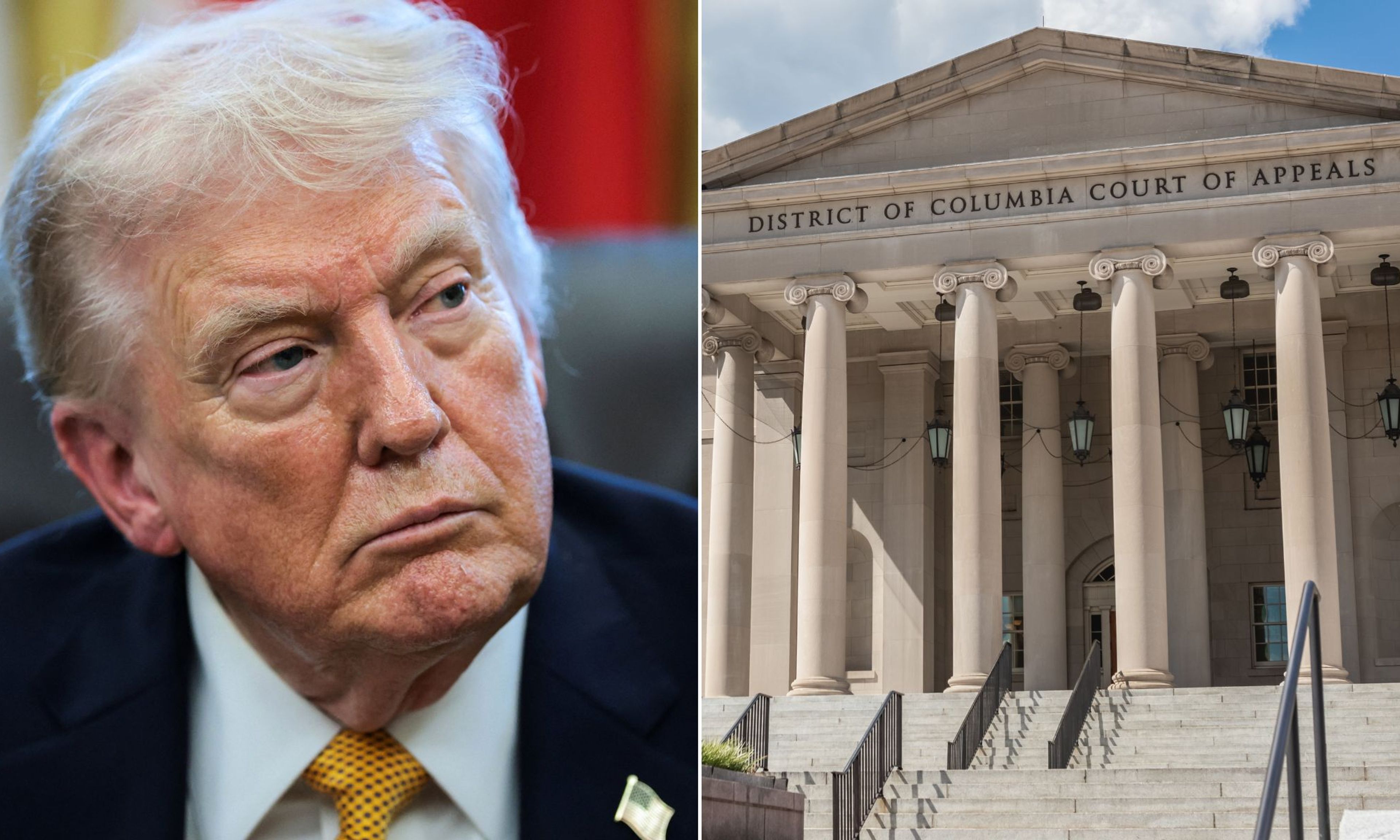
Left: President Donald Trump in the Oval Office at the White House in Washington, D.C., March 16, 2026. Right: District of Columbia Court of Appeals building.
If ever there was a word with bursting baggage in the Trump era, it is “insurrection.” In the wake of the Capitol riot, the House — overwhelmingly Democrats but a few Republicans, too — impeached the president, formally accusing him of “incitement of insurrection.” For Democrats, it connoted insufficient umbrage to label a four-hour uprising a mere “riot.” Trump supporters, they maintained, were “insurrectionists” of the neo-Nazi variety. Although no one was actually charged with insurrection (a federal crime since the Civil War era), Democratic-appointed judges echoed this purple prose while presiding over prosecutions of rioters. The Democratic judge presiding over the Democratic Manhattan district attorney’s criminal “hush money” prosecution against Trump also gratuitously invoked it.
Moreover, when it appeared that Trump not only would capture the Republicans’ 2024 presidential nomination but stood a good chance of winning that November, Democratic state attorneys general and the Democratic-dominated Colorado Supreme Court tried to get Trump removed from the ballot, claiming he was ineligible under the 14th Amendment’s ban against insurrectionists.
Although the U.S. Supreme Court unanimously rejected that gambit, the epithet remains a vexation to the president and his top advisers. Like no administration before them, they hew to the iron rule of politics that what goes around comes around. In that vein, Trump has led his minions in a 15-month chorus bemoaning the “judicial insurrection” against his administration.
Stephen Miller, the president’s top domestic policy adviser, leads the charge, publicly accusing “far-left Democratic judges” of attempts to “nullify” Trump’s election and conduct a de facto “coup,” particularly against the administration’s immigration enforcement. Trump has also been stymied in his efforts to tame the administrative state (by firing Democratic-appointed agency heads), pare the federal workforce, and impose tariffs — the latter being the deepest cut of all since two of his own Supreme Court appointees, Neil Gorsuch and Amy Coney Barrett, joined the 6–3 majority. In a notable outburst, the president excoriated the justices as “very unpatriotic and disloyal to the Constitution,” adding that “they sicken me because they’re bad for our country” and even “an embarrassment to their family.”
Well, then.
It is true that courts have issued hundreds of rulings halting, or at least delaying, various administration policies. In the main, these rulings have been issued by appointees of Presidents Biden and Obama. Of course, they were in the White House for twelve of the last 17 years and appointed about two-thirds of the federal district judges installed during that time (and overall, slightly more than half of the nation’s nearly 700 active federal district judges are Democratic appointees). That’s why Democratic appointees are catching most of the cases. Yet drawing the conclusion that jurists, because of their partisan affiliation, are insurrectionary is foolhardy; so is the common media wisdom that the Supreme Court is in the tank for the president, as the tariff ruling illustrates.
Many of the judges who’ve ruled against the administration are Republican appointees. A ruling that induced one of Miller’s most virulent eruptions — a decision blocking Trump’s National Guard deployment in Portland — was rendered by Judge Karin Immergut, a first-term Trump appointee (albeit one who would not have been confirmed had she not been acceptable to blue Oregon’s two Democratic senators). It was, moreover, another Trump appointee, Judge Thomas T. Cullen in Virginia, who offered this excoriation in throwing out a farcical administration attempt to sue the judges of Maryland’s federal district court (teeming with Democratic appointees) for delaying summary deportations:
Over the past several months, principal officers of the Executive (and their spokespersons) have described federal district judges across the country as “left-wing,” “liberal,” “activists,” “radical,” “politically minded,” “rogue,” “unhinged,” “outrageous, overzealous, [and] unconstitutional,” “crooked,” and worse. Although some tension between the coordinate branches of government is a hallmark of our constitutional system, this concerted effort by the Executive to smear and impugn individual judges who rule against it is both unprecedented and unfortunate.
There is no one-size-fits-all explanation for the administration’s jousts with the federal courts. Partisan affiliation does not explain all of it, but it surely explains some of it.
This implicates a salient difference between progressive and conservative jurists. Critics commonly carp that they each produce outcomes preferred by their tribe, but that’s a misreading. Left-leaning judges do tend to reason backward from the desired result; that is consistent with the progressive bent of elite law schools, which envision the law as a tool of social change, not the stable undergirding of a free, flourishing society. What makes a jurist conservative (most of the breed see themselves as “originalists” and “textualists”) is a focus on the process, not the policy outcome. Hence, decisions such as Dobbs v. Jackson Women’s Health Organization (2022), in which Supreme Court conservatives overturned the Roe v. Wade “right” to abortion, do not dictate a result (Dobbs did not, as the left shrieked, “outlaw” abortion); rather, they ensure that the policy decision is made by the constitutionally appropriate component of government (e.g., state rather than federal, or Congress rather than the executive).
Lower-court judges tend to be ambitious, hoping for elevation to the superior courts. Opposition to Trump’s immigration policies is a progressive cause célèbre. Ditto for resistance to Trump’s campaign to claw administrative agencies back under executive control. As one would expect, then, Democratic appointees on the district courts often scald the administration’s ruthlessness in executing deportations (after having turned a blind eye to Biden’s border collapse), and they write paeans to Humphrey’s Executor v. United States (1935), the Supreme Court’s seminal precedent endorsing a progressive administrative state independent of presidential direction — which Trump is laboring to get today’s justices to overturn.
If these rulings read like auditions for a promotion when the next Democratic administration comes to power, that can’t be an accident. Typical of the genre is a scathing 52-page opinion by Biden-appointee Trina Thompson in San Francisco. Though immigration law gives the administration wide latitude to end temporary protected status for aliens, Judge Thompson theorized that the canceling of TPS for 60,000 (mostly) Hondurans was nonetheless illegal because of Trump’s suspected racism. She opened her 52-page cri de coeur with: “The freedom to live fearlessly, the opportunity of liberty, and the American dream. That is all Plaintiffs seek.” Even if such rulings get reversed higher up the chain, as often happens and as Thompson’s was, the judges reap the desired progressive cred. In Democratic politics, such policy extremism and Trump antagonism get lawyers appointed to and moved up in the judicial branch.
Nevertheless, there is much more to the story.
Trump and his top advisers, including Vice President JD Vance, embrace a vision of the presidency that is unmoored from the Constitution and, in some particulars, from reality. By their lights, Trump won a “landslide” election victory and therefore has a “mandate” from the broad American public to implement the policies that the president unilaterally decides are good for the country — on everything from border security to a recently issued executive order purporting to ban the playing of other college football games while the annual Army vs. Navy contest (“America’s Game,” the EO says) is aired.
Now, the election was the antithesis of a landslide. Trump barely won a popular plurality (by 1.5 percentage points); slightly over 50 percent of voters (around 78 million) cast their ballots for a different candidate; and his Electoral College victory (312–226) stands in the bottom third of such margins historically. More important, it is simply a fact — a remorseless one, but one we should celebrate — that the overarching principle of our system of governance is the separation of powers.
If the Constitution has one purpose, it is to preserve liberty by preventing exactly what Trump wants: the agglomeration of powers, particularly executive and legislative power, in the hands of a single governmental branch. In fact, while it’s a commonplace to speak of “peer branches,” these departments are not designed to be equals; it is Congress, not the executive, that is primus inter pares. The president’s remit is to execute the laws faithfully, not to make them.
The president is heedless of the limits of his power. In part, this is due to his personal constitution — self-centered, in stark contrast to the federal Constitution’s diffusion of authority. It also owes to the happenstance that, while he has cowed congressional Republicans, their majorities are thin — in the House, threadbare. Trump is not wired to be a Lyndon Johnson–style legislative strategist. But even if he were, he lacks the support, in a Congress in which the party bases have hollowed out the mainstream middle, to get his agenda enacted into law. In our system, statutory codification is the only way change can be made stable and enduring. The Constitution is structured to prevent the kind of sweeping reform the president and his base — like their progressive Democratic counterparts — insist the country needs.
Because Congress is indolent as well as paralyzed, it is increasingly left to the courts to rein in an overbearing executive. The president lashes out at the judiciary, but it is a form of transference. The rudimentary problem is that he isn’t popular, he lacks bipartisan congressional support, and, as a result, he can’t get his agenda enacted in a constitutional manner that would immunize it from much judicial interference.
Immigration enforcement, Trump’s top priority, is the most illustrative example. While administration officials twaddle about landslides and mandates — and it’s true that immigration enforcement was Trump’s strongest issue both times he was narrowly elected — the Constitution vests Congress with authority over the terms by which aliens may lawfully enter and be lawfully removed from the United States. The president has a great deal of power, particularly when it comes to border enforcement, but it is only power conferred by Congress.
The administration’s core argument is that it’s irrational to say that Biden could let millions of aliens stream into the country by lax enforcement but it’s now illegal for Trump to summarily stream them out. This has logical and populist appeal. It is easy, then, to paint judges who block removals as anti-Trump obstructionists. But as a matter of law, which is what the courts must uphold, Trump has only the detention and deportation authority that Congress has prescribed. In fact, Congress’s statutes are heavily weighted in favor of removing illegal aliens; still, they require a modicum of due process. The system is overwhelmed by Democratic nonenforcement policies as well as congressional failure to dedicate sufficient resources to detention and removal. That is not the judges’ fault.
As ever, Trump is also his own worst enemy. In the Nineties, Congress undertook to strip district judges of jurisdiction over the removal of illegal aliens. After proceedings in immigration “courts” that are actually run by the Justice Department, the aliens get a narrow appeal in a federal circuit court. The Trump administration, however, gave progressive judges a wider opening for interference by arresting aliens in blue states and whisking them to detention and removal proceedings in red states. The goal was obviously to get these cases before more-accommodating judges and to intimidate illegal immigrants into leaving the U.S., but the effect was to let aliens file petitions alleging illegal arrest and detention. District judges have undeniable jurisdiction over these habeas corpus petitions. Progressive judges are exploiting the opportunity to obstruct the administration, but it was Trump’s tactics that predictably gave it to them.
Analogously, Trump has ordered summary deportations, tariffs, military deployments, and other controversial actions based on an array of emergency powers that Congress has delegated to presidents over decades. The problem: Objectively, the claimed emergencies are fictitious. There was no foreign invasion or predatory incursion triggering wartime powers to mass-deport aliens to a notorious Salvadoran prison previously condemned by the State Department. Trade imbalances (which imply reciprocal surpluses of foreign investment) are a normal economic condition, not an emergency that green-lights capricious tariffs. And while crime is rampant in some blue cities, and there have undeniably been forcible attacks on federal immigration agents and facilities, there is a strong tradition in the United States, codified in such provisions as the posse comitatus law, that the armed forces should be excluded from domestic law enforcement.
It has been inevitable that such edgy actions would result in lawsuits. The administration has won its share of these. Still, because Trump officials have taken dubious, sometimes counterfactual positions, and because they have assumed power that the Constitution assigns to other components of government, the administration has also lost cases decided by judges appointed by both Republican and Democratic presidents — even by Trump himself. That’s not an insurrection. That’s the law.

About the Author
Andrew C. McCarthy is a senior fellow at National Review Institute, an NR contributing editor, and author of Ball of Collusion: The Plot to Rig an Election and Destroy a Presidency.
Featured Tags
Advertisement
Advertisement



Comments