Trump’s Strike on Iran Was Constitutional
Written by John Yoo
The president acted to protect the nation’s security within the powers granted to his office by the Constitution.
Share this story
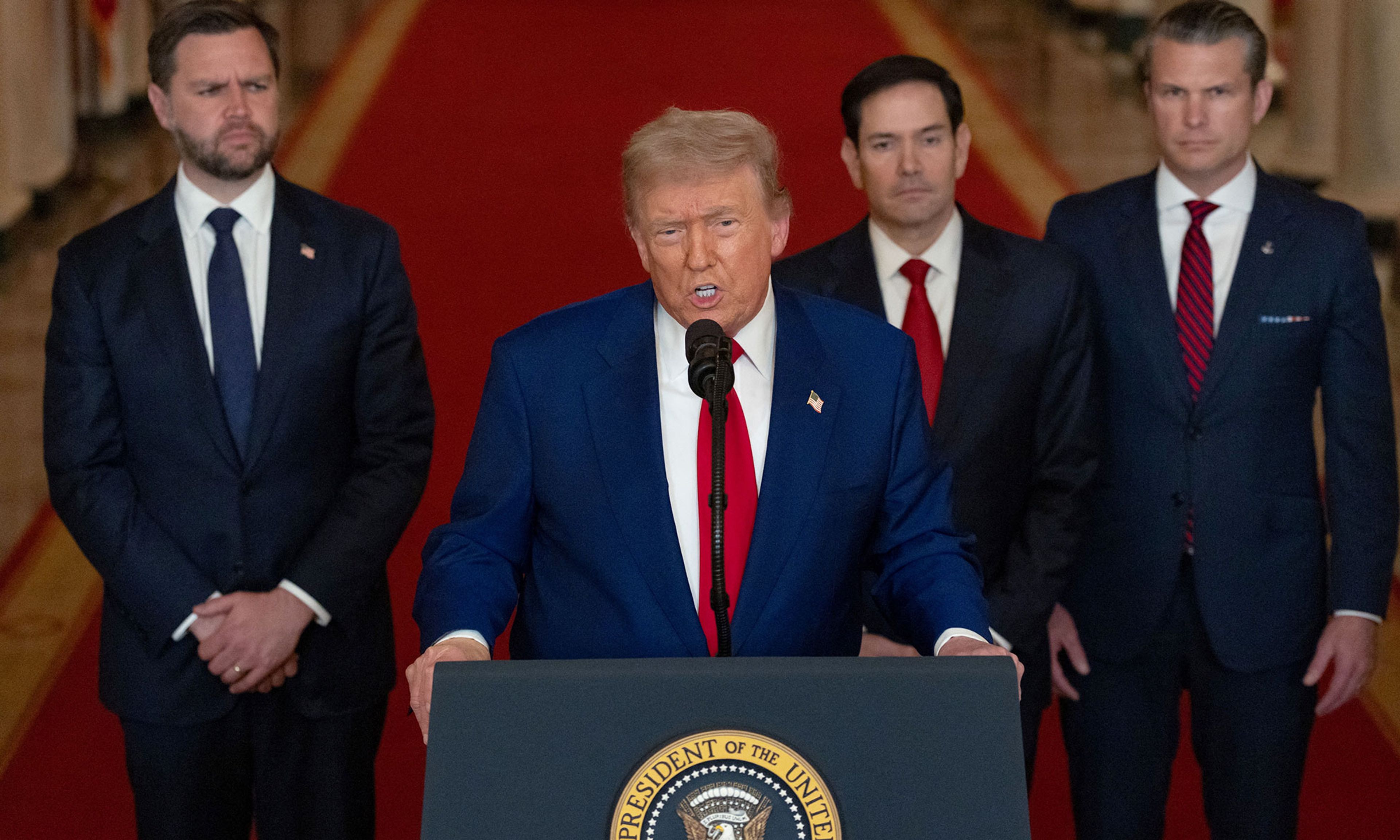
President Donald Trump delivers an address to the nation following U.S. strikes on Iran's nuclear facilities alongside Vice President JD Vance, Secretary of State Marco Rubio and Defense Secretary Pete Hegseth at the White House in Washington, D.C., June 21, 2025.
America’s weekend strikes on Iran’s nuclear facilities met little resistance in the skies above Tehran. But President Donald Trump may meet more serious opposition at home. Many members of the left and right wings of Congress claim that Trump has violated the Constitution and the War Powers Resolution in a way that might warrant impeachment. These critics, however, misrepresent the wartime relationship of the executive and legislative branches and distract from the real congressional check on the president: the power of the purse.
Late on Saturday night, the U.S. Air Force used B-2 stealth bombers to drop massive bunker-busting bombs on the Fordow uranium enrichment plant in Iran, while the U.S. Navy bombarded the nuclear facilities at Isfahan and Natanz with Tomahawk cruise missiles. In a White House address, Trump called the attack “a spectacular military success” that left Iran’s nuclear sites “completely and totally obliterated.”
Success, however, was not good enough for Trump’s critics. Democrats, who appear to question a president’s war powers only if he is a Republican, reacted as expected. Senator Bernie Sanders (I., Vt.) called the attack “grossly unconstitutional.” “All of you know that the only entity that can take this country to war is the U.S. Congress. The president does not have the right,” he declared. Representative Alexandria Ocasio-Cortez (D., N.Y.), of course, called the strikes “grounds for impeachment.” Representative Ro Khanna (D., Calif.) demanded that Congress immediately vote on his newly introduced war powers resolution “to prevent America from being dragged into another endless Middle East war.”
The pacifist left found itself in the company of the isolationist right. “This is not Constitutional,” Representative Thomas Massie (R., Ky.) said on X shortly after Trump announced the strike. Similar remarks came from Representative Warren Davidson (R., Ohio): “While President Trump’s decision may prove just, it’s hard to conceive a rationale that’s Constitutional,” he said on X before Trump’s speech. And Representative Marjorie Taylor Greene (R., Ga.), an ardent MAGA loyalist, posted that this “is not our fight.” They may be joined by the few non-isolationists who also believe that the president should have sought congressional permission, though the question remains why they think so regarding an Iranian strike but not regarding other presidential uses of force, such as drone attacks on terrorists or rogue states such as Syria and Libya.
Regardless of their political priors, these critics fundamentally misunderstand the Constitution. The Constitution vests the president with the executive power and the role of commander in chief, which, as Alexander Hamilton explained in Federalist No. 70, gives him the primary constitutional duty of “protection of the community against foreign attacks.” The Founders vested these powers in the president precisely because only a single man could act with sufficient “energy in the executive” to respond to the challenges of foreign policy and national security. “Decision, activity, secrecy, and despatch, will generally characterize the proceedings of one man,” Hamilton wrote, while large bodies such as Congress could become divided, which would “impede or frustrate the most important measures of the government, in the most critical emergencies of the state.” In Federalist No. 74, Hamilton was even more explicit: “Of all the cares or concerns of government, the direction of war most peculiarly demands those qualities which distinguish the exercise of power by a single hand.” Hamilton believed that the power of “directing and employing the common strength” of society in war “forms an usual and essential part in the definition of the executive authority.”
Hamilton’s defense of executive power in war has held sway for more than two centuries. With little variation, constitutional practice has seen the president take the lead in deciding whether to initiate armed conflict, with Congress exercising a check through its sole power of the purse. This practice extends at least as far back as the Korean War; in cases of smaller conflicts, the practice can be traced to the very first administrations. George Washington conducted the Indian Wars without a declaration; Thomas Jefferson fought the Barbary pirates on his own authority; Abraham Lincoln raised an army and navy and launched them against the South without calling Congress into session; FDR ordered escorts for British convoys, aid to the Allies, and attacks on German submarines in the face of Congress’s Neutrality Acts. Congress has declared war only five times, while presidents have committed military forces to combat abroad more than 130 times.
But, in the wake of the Vietnam War, political leaders adopted a radical academic theory that only Congress could authorize war. In 1973, Congress enacted the War Powers Resolution over the veto of a weakened Nixon. It requires presidents to receive congressional approval for any use of military force abroad and, if they do not get it, to pull troops out after 60 days. Leading Democratic politicians, such as Senators Ted Kennedy and Joe Biden, claimed that the Constitution’s war powers clause forbade Republican presidents from waging war without congressional permission. Then, of course, Democrats furiously attacked George W. Bush for the wars in Afghanistan and Iraq, even though they had voted to authorize them, on the ground that he had somehow violated the Constitution. This led presidential candidate Barack Obama in 2008 to declare, “The president does not have power under the Constitution to unilaterally authorize a military attack in a situation that does not involve stopping an actual or imminent threat to the nation.” Candidate Hillary Clinton affirmed: “The Constitution requires Congress to authorize war. I do not believe that the president can take military action — including any kind of strategic bombing — against Iran without congressional authorization.”
Presidents, however, have refused to accept the legality of the War Powers Resolution of 1973, and neither Congress nor the courts have shown any interest in enforcing it. Presidents Ford, Carter, and Reagan, for example, engaged in several military actions without congressional assent. Publicly declaring that he had the constitutional authority to initiate war unilaterally, President George H. W. Bush committed half a million soldiers to Operation Desert Storm for a period of time that violated the War Powers Resolution. President Clinton followed with interventions in Somalia, Haiti, Bosnia, the Middle East, and, most significantly, Kosovo, none of which were authorized by Congress. While President George W. Bush sought and received approval of the wars in Afghanistan and Iraq, President Obama’s wars in Libya and Syria went ahead in violation of the War Powers Resolution’s time limits.
Trump’s critics err in their beliefs that Congress can seize the president’s war powers through a simple statute and that Congress’s power to “declare war” mandates that it must preapprove all wars. If this reading were correct, we should expect the Constitution to consistently repeat the phrase when addressing war-making. It does not. Take Article I, Section 10:
No State shall, without the Consent of Congress, lay any Duty of Tonnage, keep Troops, or Ships of War in time of Peace, enter into any Agreement or Compact with another State, or with a foreign Power, or engage in War, unless actually invaded, or in such imminent Danger as will not admit of delay.
If we take seriously the idea of a written Constitution, then uses of the same word in the Constitution must have the same meaning, and different words must have different meanings. If Trump’s critics were correct, the Framers should have included a provision in the Constitution that “the President may not, without the Consent of Congress, engage in War, unless the United States are actually invaded, or in such imminent Danger as will not admit of delay.” Instead, the Constitution gives Congress only the power to declare war, and it gives the president the executive power, without setting out how those powers interact. The Constitution does not establish any specific procedure for going to war but expects the executive and legislative branches to use their powers to either cooperate or fight over war.
When considering the meaning of “declare war,” the Framers’ thoughts would have turned to their most significant national legal act, the Declaration of Independence. The declaration did not “authorize” military resistance to Great Britain. At the time that the Continental Congress met at Philadelphia in the summer of 1776, hostilities had been underway for more than a year, and Congress had been exercising sovereignty — negotiating with Britain, sending ambassadors, seeking aid — for at least two years. The importance of the Declaration of Independence was not in authorizing combat but in transforming the legal status of the hostilities between Great Britain and her colonies from an insurrection to a war between sovereigns.
Trump’s critics implicitly believe that war must follow the same rules as do domestic affairs, whereby Congress authorizes and the president faithfully executes. As a result, they argue that the Constitution must establish a strict procedure that requires Congress to declare war before the president, as commander in chief, can prosecute it. But the Constitution nowhere describes such a process, nor does it explain how the power to declare war and the power of the commander in chief must interact. Suppose that Congress had ordered President Franklin Roosevelt to ignore the Pacific theater entirely, to leave Italy alone, or to avoid a direct invasion of France. It seems obvious that the Constitution allows the president, as commander in chief, to block congressional wartime decisions (including its decision to declare war), just as Congress can block the president through the use of its funding power. The president can refuse to carry out congressional orders to implement a particular wartime strategy or tactic, or even to conduct hostilities against another nation. But under the critics’ reading of the Constitution, a president would have to act on Congress’s declaration of war, just as he would execute any other statute.
Constitutional structure requires the opposite. In fact, any ambiguities in the allocation of a power that is executive in nature, such as the power to conduct military activities, must be resolved in favor of the president. Article II, Section 1 provides that the “executive Power shall be vested in a President of the United States.” By contrast, the vesting clause of Article I gives Congress only the powers “herein granted.” This difference in language indicates that the Constitution limits Congress's legislative powers to the enumeration in Article I, Section 8, while the president's powers include inherent executive powers that the Constitution does not explicitly list. As Hamilton famously argued in defending Washington’s 1793 Neutrality Proclamation, “the general doctrine of our Constitution, then is, that the executive power of the nation is vested in the President; subject only to the exceptions and qualifications which are expressed in the instrument.” To the extent that the constitutional text does not explicitly allocate the power to initiate military hostilities (just as it doesn’t explicitly allocate the power to conduct foreign relations), the constitutional structure requires that it remain among the president's unenumerated powers.
Congress has only too happily cooperated with the rise of presidential authority in wartime. It can cut off funds for any conflict: modern warfare has become so expensive that presidents need congressional agreement to open the purse strings. Congress could structure the military to make presidential adventurism less likely, such as by reducing expeditionary forces and focusing on the deployment of systems to defend the homeland. But the members of Congress who are decrying Trump’s strike in Iran will not risk their political standing by blocking funds for the troops (just as they criticized Trump’s killing of Islamic Revolutionary Guard Corps commander Qasem Soleimani and attacks on the Assad regime in Syria, during Trump’s first term, but did not cut off funds afterward). These critics, instead, take the cynical path: they leave the president out on a limb with the political responsibility should the war turn badly and take credit for funding the troops if the conflict turns out well.
This two-faced political strategy of the far left and far right is not just cynical but also dangerous. The United States is not waging a war of conquest; it is acting in self-defense. Once upon a time, the doctrine of self-defense required that an enemy’s attack be “imminent” before a nation could justifiably use force. But that temporal requirement makes less sense when enemies can acquire nuclear weapons and when the window of opportunity to stop them may be open months, if not years, before any attack. President Kennedy, for example, perhaps stretched the doctrine of anticipatory self-defense to its limits when he imposed a naval blockade during the 1962 Cuban Missile Crisis. Nevertheless, his decision to prevent Soviet deployment of nuclear missiles on an island just 100 miles from Florida met widespread approval.
Iran is another case of preventive self-defense in the nuclear age. The Islamic republic was perhaps weeks away from assembling enough nuclear material to build a weapon. Tehran has already mastered the technology for medium-range ballistic missiles; it was only a matter of time before it advanced to intercontinental weapons capable of reaching the United States, to which it is clearly hostile. Iran has long supported attacks on U.S. personnel — it covertly supplied the IEDs that killed 1,000 U.S. soldiers during the occupation of Iraq. Its leaders have openly wished “death to America.” With access to extensive electronic and human intelligence, the Trump administration could conclude that Iran represented a clear and present danger to the United States. President Trump acted to protect the nation’s security within the powers granted to his office by the Constitution.

About the Author
John Yoo is Heller Professor of Law at the University of California, Berkeley; distinguished visiting scholar at the School of Civic Leadership and a senior research fellow at the Civitas Institute at the University of Texas at Austin; and a nonresident senior fellow at the American Enterprise Institute.
Featured Tags
Advertisement
Advertisement

Comments