Trump’s Tariff Climbdown Will Make China More Confrontational
Written by Thérèse Shaheen
Whatever the flaws of Trump’s trade moves, capitulating early is terrible for the U.S. and for Trump himself.
Share this story
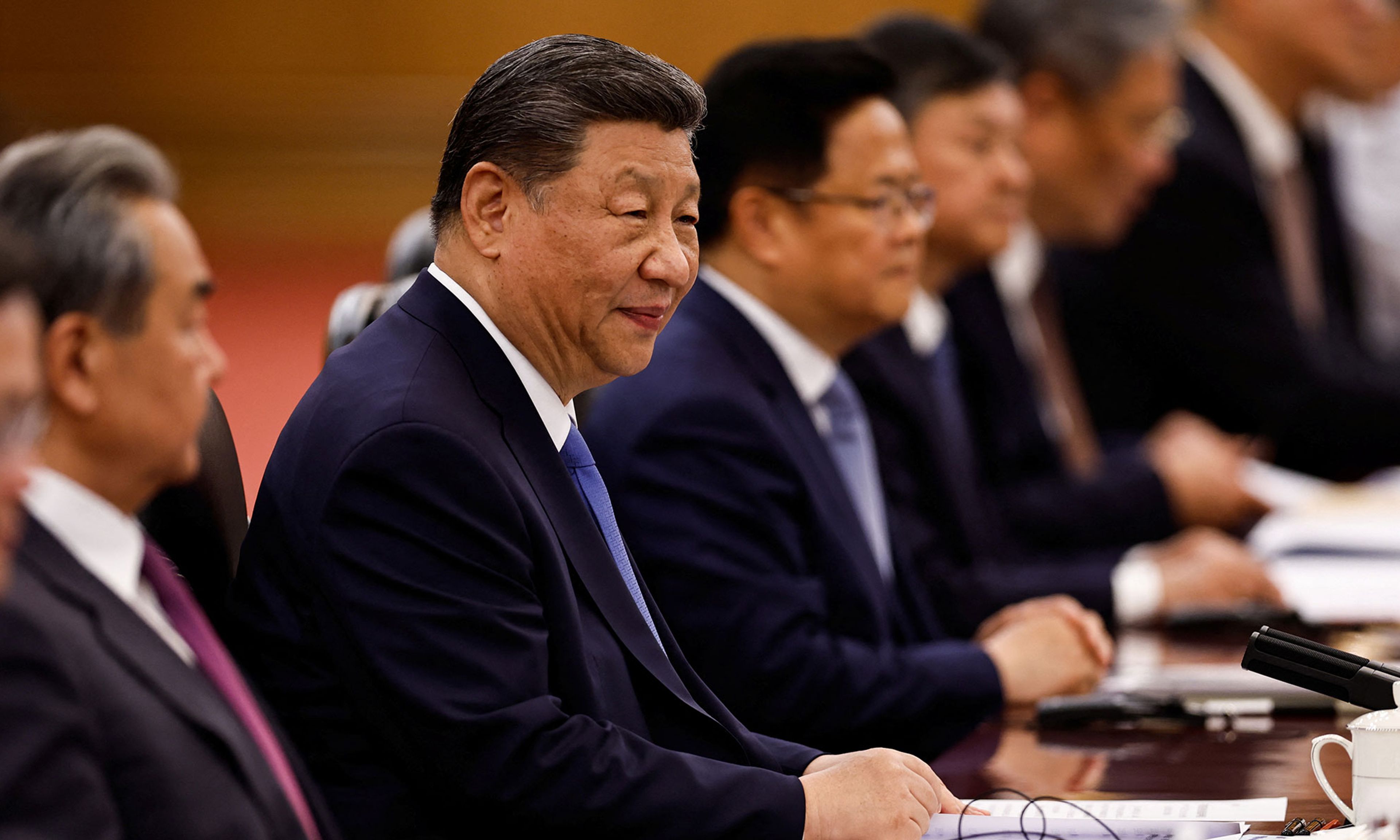
Chinese President Xi Jinping attends a meeting with Brazil's President Luiz Inacio Lula da Silva at the Great Hall of the People in Beijing, China, May 13, 2025.
The Trump administration regrouped after the wild reaction to its April 2 trade “liberation day” by teasing the possibility of multiple trade agreements with allies and friendly trading partners in the near term and suggesting a longer term, more intense focus on China. Now, instead, the administration has gone for an early “deal” with China. After a series of escalations on both sides that put real pressure on the Chinese economy, the U.S. capitulated. Treasury Secretary Scott Bessent and U.S. Trade Representative Jamieson Greer in Geneva agreed to a 90-day negotiation period after reducing tariffs on China by more than 100 percentage points. Whatever the initial plan may have been, and however it seems to be developing, let’s just say that the PRC was always the most relevant target, since everyone agrees that China is an egregious abuser of the global trading system.
Even after all the fits and starts, it seems clear that the administration did not intend the outcome that developed prior to the Geneva U-turn. The U.S. had launched a campaign of maximum pressure on China, which is experiencing serious negative effects from the tariffs given the underlying fragility of its economy. After the reversal in Geneva, President Trump and Secretary Bessent were clear that they did not intend to squeeze China that hard. Even so, China wants the world to believe that it can tolerate more pain than the U.S. That’s what we were supposed to believe during Covid, which turned out to be a disaster for the Chinese people. The truth is that China’s economy is in very serious danger, and serious U.S tariff pressure would quite likely have exposed that. All the inefficiencies, distortions, and collateral damage of tariffs aside, the best approach for the administration would have been to hold out until China relented. Capitulating short of that, out of fear of empty shelves at Walmart and other economic dislocations, creates a crisis of credibility for the U.S. and for Trump himself. Trump’s — thus America’s — credibility already is under assault given lack of consistency and principle. An early U.S. climbdown will embolden China to generate continued geopolitical challenges in the Indo-Pacific, and U.S ability to mediate in the Middle East and Ukraine will be further hampered. If Trump is seen as having insufficient resolve in his core trade issue, it will further weaken his ability to affect geopolitical matters that go beyond trade, in the bilateral relationship with China and in other parts of the world.
However we got here, it’s okay to acknowledge the many problems with Team Trump’s views on trade. Tariffs are an inefficient tool to use across the board because they distort market signals by raising prices beyond the natural level set by the forces of supply and demand. Tariffs also undermine the beneficial effects of comparative advantage in the production of goods and services, which leads to more inefficiency and poor allocation of capital, thus stymieing innovation and competitiveness. Tariffs also invite retaliation, and consumers across the economy lose out more than what is gained by labor and business owners in the protected sectors.
The liberation day announcement had many unintended or unwelcome effects. Markets were disrupted as people across the economic spectrum watched the value of their savings and investments plummet. Friendly trading partners — who Trump and his team say have been “screwing” us for years — are facing the effects of China’s retaliation themselves, even though they could perhaps have been enlisted to be partners in a more coordinated U.S. effort, had such a strategy been laid out.
The frustration and anger by friendly trading partners is made all the worse by the fact that most of them share the U.S. concern that China has taken advantage of the global trading system for too long. China’s admission to the World Trade Organization in 2001, after a decade and a half of negotiations, gave it unrestricted access to the U.S. and European consumer markets, the most lucrative in the world. Those advocating China’s entry into the WTO saw the many barriers to free and fair trade that remained in China and argued that bringing China in was needed to help Beijing merge into the global commons. The argument was that trade would make China “more like us,” although there was plenty of indication even then that the Chinese Communist Party had no such plan in mind.
Instead, the party and government retained control of the economy, and of industries in every sector, and limited foreign companies’ access to the Chinese market. Intense barriers to entry and draconian conditions — data localization, capital repatriation restrictions, forced technology transfers, theft of intellectual property, local joint venture partner requirements — hit especially hard the technology, finance, and media sectors. In manufacturing, foreign entrants faced competition from local champions that received generous below-market prices for property, energy subsidies, tax breaks, and outright operating subsidies. To encourage exports and raise further barriers to market entry, China artificially suppressed the yuan’s value to make goods cheaper and built massive trade surpluses. The government encouraged overbuilt capacity, which has led to the overproduction and dumping of cheap goods on foreign markets around the world. This combination of policies resulted in the protection of key industries in China and increased foreign markets’ dependency on heavily subsidized Chinese exports.
Certainly, this is a tenuous time for the global economy because of the implications of U.S. tariff policies. The economic and market risks are obvious and potentially devastating. Just the same, though, the stakes are now even higher with the U.S. having conceded without deriving meaningful benefits from the brinksmanship. Preemptive U.S. concessions may have caused markets to rally and many to breathe a sigh of relief, but they also sow the seeds of future challenge if China is seen having outlasted U.S. resolve.
China’s economy is groaning under the weight of crises that have accumulated over many years, and the tariff pressure was a substantial addition at just the most crucial time. It would have been difficult for the PRC to wriggle free from under these layers of deadweight burden on the economy. The most proximate are the one-two punches of Covid and the real estate crisis. The country emerged from Covid lockdowns well after much of the rest of the world. The “zero-Covid” policy was formally ended only in December 2022, after the party leaders became concerned that the social unrest engendered by the shutdown would become widespread. The next year was one of uneven economic response — an immediate “sugar high” from pent-up demand before the economy slumped again. Things only really began to stabilize in 2024, with Trump’s election and the ensuing trade war pulling the rug out again soon thereafter.
Beneath the Covid-related crisis are the ongoing effects of the real estate collapse that reverberate across China’s economy and society. While the depth and extent of the real estate crisis began to become obvious prior to Covid, it was exacerbated during the shutdown and in August 2020, when the so-called three red lines policy was introduced to interrupt rampant speculation by putting more limits on the debt-fueled activities of real estate developers. The false sense of wealth that ever-increasing housing values had created and is now gone, compounded by the collapse in value of the associated structured wealth management products in which so many of China’s middle class had invested their savings, has created significant additional consumer drag on the economy. The Chinese government has been attempting to stimulate household consumption, which, at about 38 percent, is a far less meaningful driver of Chinese GDP than it is — at nearly 70 percent — of the U.S. economy.
China ostensibly avoided the great recession of 2009–10 through excessive government investment at home and, outside the country, through the Belt and Road Initiative. The bill has come due. Domestic overinvestment in real estate led to a property crisis that is many times larger than what the U.S. faced in the mortgage crisis. There is no resolution in sight and ghost cities and foreclosures of empty properties everywhere. The country’s banks are badly overleveraged and undercapitalized and depend on significant government injections of capital. Provinces and municipalities depended on land sales to developers for construction — much of it residential — as a primary source of revenue, and this has added the burden on China’s central government of bailing out local governments.
Dig a little deeper, and beneath these more recent drags on the Chinese economy are the festering social and demographic crises stemming from the one-child policy. The die for today’s structural economic fissures was cast in 1979, when the policy was put into place. The result is an aging, declining population. There is no meaningful social safety net as there is in the advanced economies of the world. Too few current workers must support too many older people, and that fuels many of the other problems we’re seeing. Consumers don’t consume because they’re saving to support their aging parents. With the bust of the real estate market, in which so many had placed their hopes for wealth accumulation before the music finally stopped, there is nowhere to invest excess consumer savings.
Chinese economic growth is a chimera — the government claims greater than 5 percent annual growth, but the only way it can sustain that fiction is through massive government spending and by maintaining trade surpluses and dumping excess production onto global markets. To keep the economy going, the government props up the banks, and the banks make loans they know won’t be paid back, so that state-owned enterprises can keep producing. But there are too many airports, trains, dams, roads, and apartments that are of no use. Command and control economics doesn’t work, and China has not invented a new form of capitalism.
The relative positions of the U.S. and Chinese economies are such that President Trump, wittingly or not, created the conditions to exert real leverage over China to modify this behavior, and to expand that leverage to other areas. It will be an unfortunate waste of this situation if a much vaunted final “deal” with the PRC were limited to front-loaded purchase agreements for more soybeans, or some such headline-makers, that don’t address the real issues of tariff and nontariff restrictions to fair trade. U.S. leverage also creates other opportunities, for instance to curtail China’s military adventurism in the South China Sea. The challenges to China’s economy and society that existed prior to the trade war will be greatly intensified if the U.S. can marshal like-minded partners and allies under a coherent strategy and at least attempt to address the many problems China causes for the world.
The Trump administration’s holding firm on its current trade policy, while it would have reverberating effects here, would create far more challenge for China. The circumstances in which we find ourselves are not dissimilar to the U.S.-Soviet relations of the 1980s, although the Reagan administration was far more systematic and coherent in its policies than the Trump administration has been thus far. Reagan’s conception of the Strategic Defense Initiative came at a time when the USSR was already reeling from its own military and economic inconsistencies. The Soviet Union, by the early- to mid-1980s, was structurally brittle because of decades of bad government and policymaking. Reagan held firm despite pressure in the U.S. and from allies around the world to make concessions in exchange for Soviet promises of further arms reductions. By holding firm on his defense investment strategy, Reagan put pressure on the Soviet regime, which led to the emergence of a more accommodating government and, eventually, Western victory in the Cold War.
President Trump needs to show the world that U.S. pronouncements matter and that we can show resolve. By appearing to reverse course so quickly, it is the U.S. that seems to lack confidence and resolve. By contrast, holding the line with regard to China would expose the PRC’s underlying weakness, not just economically but strategically. U.S. conviction could arrest Beijing’s descent into totalitarian one-man rule by Xi Jinping. There have been episodic indications that the CCP Politburo is concerned with Xi’s judgment and accumulation of power and authority. The U.S. does not necessarily seek “regime change” in Beijing, but a more realistic and less belligerent CCP would be an achievable outcome. More than that, the U.S. needs the world to see that America is not a blowhard, to be duped and avoided, but a force to be reckoned with and respected.
The case against tariffs has been borne out by many years of data analysis that demonstrates how harmful they are, even to economic actors in sectors that are supposedly the beneficiaries of protectionism. There is little doubt that the stated reasons for the tariffs — to replace the income tax, to return a meaningful number of manufacturing jobs to the U.S., or even to eliminate U.S. trade deficits — have about zero chance of being satisfied. But, given time to work, rather than the scant weeks since we backed into it, a pressure campaign would expose the cracks in the Chinese façade of confidence and strength. The U.S. about-face, if it holds, would be an unwise decision leading to something far worse than empty shelves at Christmas: In the illusory pursuit of a “solution” to the faux crisis of trade deficits, we risk creating a very real crisis of a strategic-credibility deficit.

About the Author
Thérèse Shaheen is a businesswoman and CEO of US Asia International. She was the chairman of the State Department’s American Institute in Taiwan from 2002 to 2004.
Featured Tags
Advertisement
Advertisement
Comments