Twenty Films Worth Leaving the House for in 2026
Written by Giancarlo Sopo
This looks like the strongest year for cinema since before the plague.
Share this story
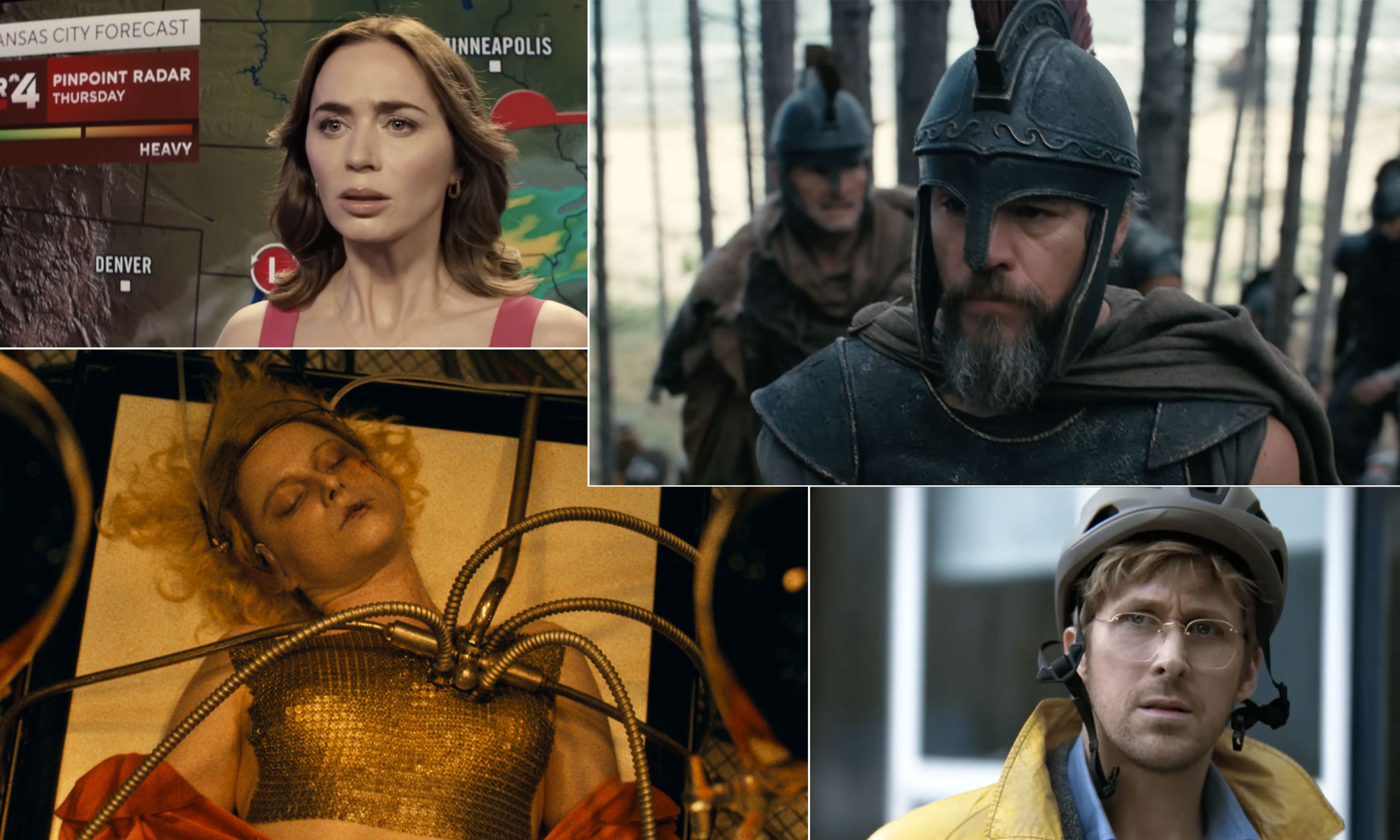
Clockwise from top left: Emily Blunt in <i>Disclosure Day</i>, Matt Damon in <i>The Odyssey</i>, Ryan Gosling in <i>Project Hail Mary</i>, and Jessie Buckley in <i>The Bride!</i>
I don't have a best-movies-of-2025 list for you — new dad, sleep deprivation, the works. But from what I did see, I can bury the myth that 2025 was a bad year for cinema. It wasn't 2023, the decade's best so far, but it wasn't a wasteland either. Not many homers they'll be playing at Cooperstown, but plenty of singles, doubles, and a few triples.
Joseph Kosinski's F1 hit 220 and stayed there — you could practically smell the burnt rubber through the screen. Carson Lund's Eephus was the slow-burn elegy we needed for the civic life we had before the internet atomized us into content-consuming particles. Ana de Armas carried the underrated John Wick spin-off Ballerina with brutal elegance. The first 25 and final 75 minutes of Spike Lee's Highest 2 Lowest, starring Denzel Washington as a hip-hop mogul, might be the movie that left me grinning widest all year. (In this house we don't talk about the middle 40.) Hamnet's third act will drain your tear ducts. And Marty Supreme settled any remaining debate about Timothée Chalamet: the kid can act.
The closest thing to decade-defining work was Ari Aster's Covid-era black comedy Eddington, which has zero awards-season heat. Why is that? Well, Hollywood tastemakers misread it as a jab — no pun intended — at their political compadres. Once the fever breaks, it'll be recognized as the year's most important film.
The film barreling toward a Best Picture Oscar is Paul Thomas Anderson's Pynchon adaptation, One Battle After Another. I suspect that's partially because the predominantly progressive awards bodies — and many conservatives — are reading more politics into it than its 35mm celluloid holds. Sure, it pillories neo-fascistic paramilitaries, but useless hippies don't fare much better. Politics is neither the point nor the problem in what's ultimately a father–daughter story wearing radical chic as a costume. Where it stumbles is Anderson's decision to afford Teyana Taylor's Perfidia Beverly Hills, the revolutionary opposite of Leo DiCaprio's Bob Ferguson, an unearned sentimental coda even after she murders a security guard in cold blood. You can admire Anderson’s craftsmanship — that white-knuckle car chase had me gripping my armrest like it owed me money — and still walk out unsettled by what he asks you to look past.
None of that will cost it the gold. The more interesting question is what else gets nominated at month's end. (If the industry had any sense, it would reserve the "fan favorite" slot for F1, not the Wicked follow-up.) Then it's on to 2026, which on paper looks like the strongest year for cinema since before the plague.
The following are the 20 films I'm most anticipating — ranked loosely by the hard-to-name quality of making me want a ticket before I've seen a single frame.
20. October (Jeremy Saulnier, TBD): Saulnier's first film since Rebel Ridge: a Halloween-set fugitive thriller for A24 with Jodie Comer, who stole every scene in The Bikeriders. The Safdies are exec producing. Saulnier makes lean, mean, genre machines. Blue Ruin and Green Room are modern classics that coil in your gut and refuse to let go. The man doesn't know how to flinch.
19. Jack of Spades (Joel Coen, TBD): Solo Joel goes Gothic. Frances McDormand, Josh O'Connor, and, on score, Carter Burwell. After The Tragedy of Macbeth proved that Coen could strip cinema to the bone and still make it sing, he's back with what early word suggests is Blood Simple territory. The framing, the control, the ice in the shot. If you've missed that sensibility, this is as close as we're likely to get.
18. The Christophers (Steven Soderbergh, TBD): Soderbergh releases films the way offices do Secret Santas. Once a year. Sometimes you unwrap a candle that still has a Pier 1 sticker on it. Lately, though, he's been pulling out the good stuff. This one's a chamber piece: Michaela Coel as a forger hired to finish a dying artist's paintings, Ian McKellen as the cantankerous old master. Neon's distributing. It should crackle.
17. Paper Tiger (James Gray, Cannes 2026 likely): Early word says Adam Driver and Scarlett Johansson deliver career-best work. Gray reunites with Joaquín Baca-Asay, his DP on Two Lovers, after 18 years. Two brothers chasing the American dream get tangled with the Russian mob. The director has spent three decades making quietly devastating films about ambition's price. Early buzz from the edit bay is this could be his best. Cannes will tell.
16. Artificial (Luca Guadagnino, TBD): The OpenAI boardroom psychodrama, dramatized. Andrew Garfield as Sam Altman, Ike Barinholtz as Elon Musk. Guadagnino is an odd fit for Silicon Valley ego warfare. That's exactly why it might work.
15. The Social Reckoning (Aaron Sorkin, October 9): Nobody asked for a sequel to The Social Network. But maybe we need one. Jeremy Strong inherits Zuckerberg, Mikey Madison plays whistleblower Frances Haugen, and we watch Facebook metastasize into Meta. Sorkin prefers crystallizing arguments to detonating them. Perhaps this time he lands an uppercut. The first film was a prophecy. This one should be an autopsy.
14. The Bride! (Maggie Gyllenhaal, March 6): Gyllenhaal's second feature pivots hard from The Lost Daughter. A Bride of Frankenstein reimagining set in 1930s Chicago. Jessie Buckley as the Bride, Christian Bale as the Monster, plus murder, mayhem, class warfare, and — reportedly — dance numbers. Mary Shelley is having a moment.
13. Archangel (William Eubank, November 6): Eubank's Land of Bad was the kind of action flick you'd rent at Blockbuster on a Friday night, watch with your dad, and "forget" to return. Now he's got Jim Caviezel in a military thriller scripted by Randall Wallace (Braveheart, We Were Soldiers). Veterans Day counterprogramming. Mid-budget, adult-skewing, cape-free. Someone's still making movies for us. God bless.
12. Dune: Part Three (Denis Villeneuve, December 18): Villeneuve closes the saga with Dune Messiah, the book Frank Herbert wrote specifically to kneecap anyone who mistook Paul Atreides for a hero. The Canadian director says he intends to honor Herbert's intentions, which means everyone who cheered Paul's rise is in for a reckoning. If he sticks the landing, this joins Star Wars and The Lord of the Rings in the vanishingly small club of epic trilogies that actually delivered.
11. Ebenezer (Ti West, November 13): Paramount's billing this as a "thrilling ghost story" with Johnny Depp as Scrooge, Rupert Grint as Cratchit, and Ian McKellen in an undisclosed role. Entre nous, I have a fondness for West's work (his MaXXXine trilogy is deliriously sleazy in the best way) that reminds me of little Giancarlo watching MTV's The Grind back in ’94. If my mom walked in, I'd swear I was only there for the music before lunging for the remote and flipping to SportsCenter. Bah, humbug? Not from me.
10. Project Hail Mary (Phil Lord & Christopher Miller, March 20): Lord (305 represent!) and Miller finally return to live-action directing after a decade in animation and producer purgatory. Ryan Gosling wakes up alone on an interstellar ship with no memory and one job: save humanity. Drew Goddard, who adapted The Martian, wrote the screenplay. Word is it's smart, funny, and has a friendship at its center. I'm there opening weekend.
9. All of a Sudden (Ryusuke Hamaguchi, Cannes 2026): Hamaguchi ventures outside Asia for the first time. Shot in Paris, in French, three hours long. The history of directors switching languages isn't encouraging, but the Drive My Car auteur has workshopped this material for years. Expect conversations that unfold like slow-motion detonations.
8. The Dog Stars (Ridley Scott, August 28): Yes, Napoleon was bizarre. The director's cut improved on a theatrical release that spent way too much time on Bonaparte's bedroom proclivities. And Gladiator II was no masterpiece, but it was better than you heard. Set all that aside. Ridley Scott, at 87, still working at this scale, is a gift we shouldn't take for granted. Here he adapts Peter Heller's postapocalyptic novel. Jacob Elordi as a widowed pilot surviving after plague, Josh Brolin as the hardened gunman he partners with. We've all thought about what we'd save if it all went sideways.
7. Werwulf (Robert Eggers, December 25): Eggers finally rescues cinema's most neglected monster. Werewolves in 13th-century England, Middle English dialogue, most of his Nosferatu cast reunited. He understands that horror only works when it's about something. Here, it’s the beast within and the membrane between civilization and savagery. His films carry Christian undertones, so it’s fitting for this one to open on Christmas Day.
6. Narnia: The Magician's Nephew (Greta Gerwig, November 26): Gerwig has caught flak from the online right, much of it unearned. No, Barbie was not the "woke" catastrophe we were promised. (Michael Knowles had a "Ken-servative" take, if you're curious.) Little Women was hardly subversive. And Lady Bird's arc — a young woman learning to appreciate her mother, her church, her hometown, after thinking herself above them — was, if anything, traditionalist. But C. S. Lewis is a different beast. The choice to start with The Magician's Nephew, the creation narrative, means Gerwig must grapple with Aslan singing Narnia into existence. Will she preserve Lewis's theological weight and mythic clarity? The most respected filmmaker of her generation has earned the chance to try.
5. Digger (Alejandro González Iñárritu, October 2): Tom Cruise, who has spent the past decade making insurance actuaries weep into their spreadsheets, returns to auteur territory in what Iñárritu calls "a comedy of catastrophic proportions." The teaser showed Cruise dancing with a shovel to Gorillaz. I don't know what this is, but I need to see it immediately.
4. Disclosure Day (Steven Spielberg, June 12): It's 2026 and we still have a Spielberg movie coming. That alone is a cultural win. The once-wunderkind returns to original science fiction for the first time since War of the Worlds: with a UFO film, his own idea, scripted by David Koepp, and scored by John Williams coming out of retirement. At 79, Spielberg has nothing left to prove — The Fabelmans and West Side Story showed a master rejuvenated. When he tilts the camera skyward, he remains one of the few filmmakers who seem to believe that something might actually answer back.
3. The Adventures of Cliff Booth (David Fincher, Summer 2026): I want to rank this No. 1, but two things give me pause. Fincher isn't explicitly political, yet his films — The Game, The Social Network, The Killer — sometimes invite readings that wouldn’t quite fit Cliff Booth, the stuntman Quentin Tarantino built in Once Upon a Time in Hollywood as a monument to men who don't apologize for what they are. The other worry is Netflix, which I fear will give this a theatrical release the way Ralphie ate his meatloaf in A Christmas Story: technically, but begrudgingly. The upside: Brad Pitt returning to the titular role, an original Tarantino script, Fincher behind the camera. Three giants of their generation, finally in the same room. A cinematic fever dream.
2. The Odyssey (Christopher Nolan, July 17): Getting worked up about Nolan dressing Odysseus "wrong" is like accusing Caravaggio of botching Supper at Emmaus because he gave the apostles 16th-century doublets. Art doesn’t have to be security footage; it just needs to translate myth into compelling visual language. This one is shot entirely on IMAX 70mm. Matt Damon as Odysseus. Practical effects wherever possible, including a six-meter-tall mechanical cyclops puppet built inside a real Greek cave. That's the voltage we've been starving for: craftsmanship that makes the impossible feel dangerous, tactile, alive.
1. The Way of the Wind (Terrence Malick, TBD): Malick shot his Jesus film in 2019, reportedly amassed over 3,000 hours of footage, and has been editing it for six years. That's not a typo. Whether it ever sees release is anyone's guess. But if it arrives — and that's a cathedral-sized if — it might be the film of the decade for anyone who believes cinema can aspire to the transcendent. The most important living Christian filmmaker reaching for the Gospels at 82. Pray it happens. If it does, count it as a blessing.
Honorable Mentions
The Super Mario Galaxy Movie (April 3): The first one was like lemonade on a hot day — not particularly nutritious, but refreshing. More importantly, it'll fill seats, which is itself a win for the culture.
Toy Story 5 (June 19): Pixar needs to regain some theatrical relevance after streaming exile nearly killed it. Andrew Stanton directing. The premise — toys versus tablets — is at least thematically interesting and relates to childhood, attention, and presence in an age that has none.
Wuthering Heights (February 13): Margot Robbie as Catherine, Jacob Elordi as Heathcliff. A Dumpuary release isn't exactly a vote of confidence. But Saltburn proved that Emerald Fennell doesn't know how to be boring. Whether this amounts to a daring reinterpretation or stylish vandalism, it won't put you to sleep.

About the Author
A veteran of political campaigns, Giancarlo Sopo is a cultural writer exploring the intersection of cinema, politics, and the conservative imagination. In addition to National Review, his commentary on culture, aesthetics, and public life has been featured in IndieWire, the New York Times, and CNN. Follow him on X (@giancarlosopo) and Letterboxd.
Featured Tags
Advertisement
Advertisement
Comments