Two Bad Apples Threaten to Spoil the Gaza Board of Peace
Written by Natalie Ecanow & Sinan Ciddi
The inclusion of Qatar and Turkey puts the body’s peacemaking mission at risk.
Share this story
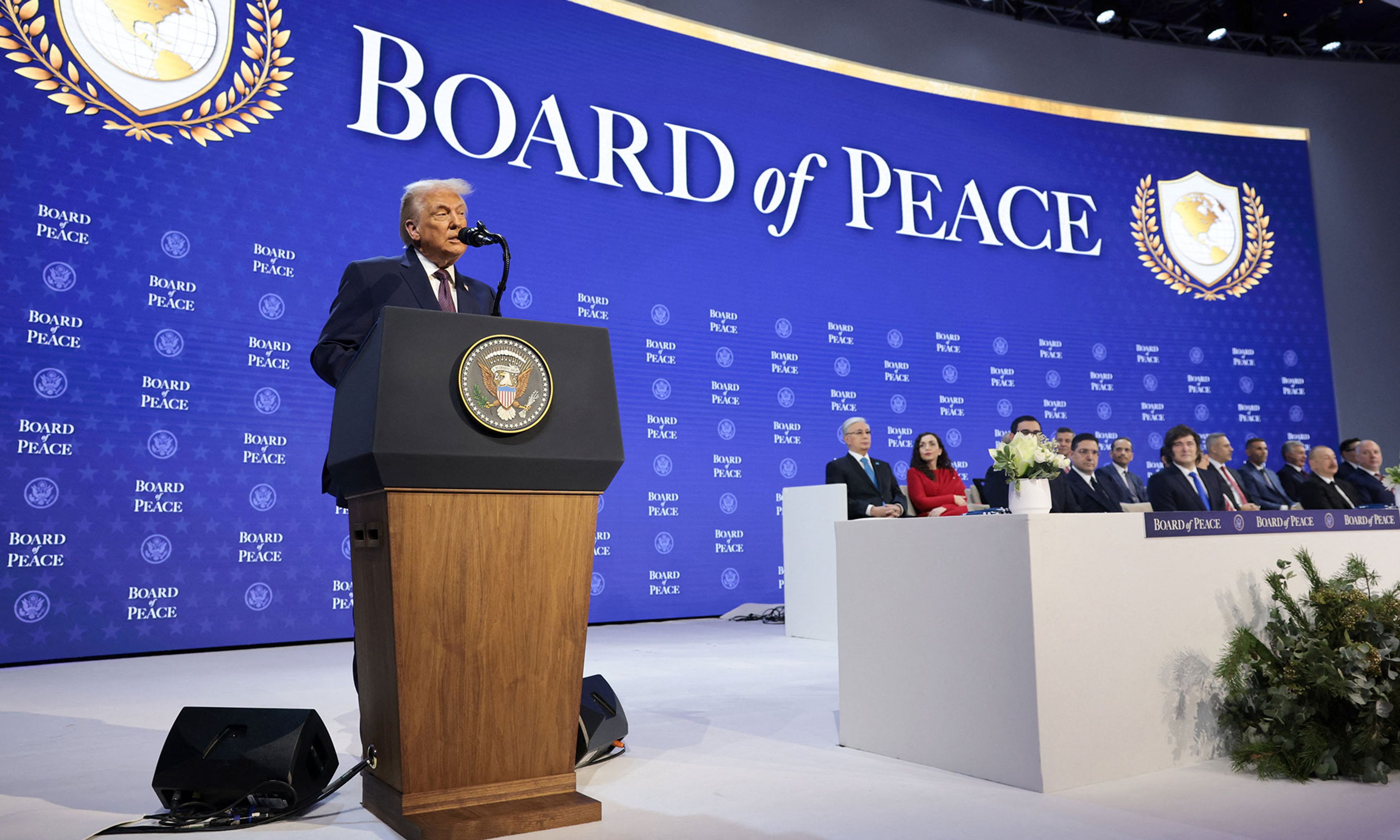
President Donald Trump speaks during a charter announcement for his Board of Peace initiative at the World Economic Forum in Davos, Switzerland, January 22, 2026.
In the Middle East, President Donald Trump is known for breaking the status quo. He moved the U.S. Embassy in Israel from Tel Aviv to Jerusalem. He brokered the Abraham Accords, shattering the traditional belief that progress hinges on Palestinian statehood. And he deployed B-2 bombers to strike Iran’s nuclear program. But in Gaza, the administration’s approach will not break the status quo like it should.
On Monday, the Israel Defense Forces received the body of the last hostage who had been captive in Gaza since October 7, 2023. The second phase of Trump’s 20-point plan for Gaza can now commence in earnest. The Gaza Board of Peace, which the White House announced on January 16, “will play an essential role” overseeing Gaza’s transition “from conflict to peace and development.” The problem is that Turkey and Qatar may have a seat at the table.
Among the individuals appointed to serve on the Gaza executive board are Turkish Minister of Foreign Affairs Hakan Fidan and Qatari Minister Ali Al-Thawadi. Both men represent countries that spent years nourishing Hamas politically and financially. Their inclusion on the Board of Peace puts the body’s peacemaking mission at risk.
Turkey and Qatar are entering post-war Gaza as longtime sponsors of Hamas. Qatar, in particular, played a significant role in propping up the terrorist group prior to the October 7 slaughter. In 2018, Doha began delivering millions of dollars per month in cash to Gaza to help Hamas subsidize government salaries. Israel approved the arrangement in a bid to stabilize Gaza and protect surrounding Israeli communities. Any assumption Israeli officials had about reaching into Qatar’s purse to prevent future wars evaporated on October 7.
Israeli troops have since recovered documents indicating that “Qatari grants” were “Hamas’s main artery” for fundraising, and that Doha had established a “discreet” financing channel for Hamas’s terrorist activity. Israel’s Shin Bet internal security service now assesses that “the flow of money from Qatar to Gaza and its delivery to Hamas’s military wing” enabled Hamas to strike.
The October 7 war has done little to drive a wedge between Doha and its Hamas clients, who continue to operate inside Qatar’s borders. Qatari Prime Minister Sheikh Mohammed bin Abdulrahman Al Thani appeared to tacitly approve Hamas’s return to power when he said last year that Gaza’s government “is a decision for the Palestinians to take.”
Meanwhile, Qatar’s emir told the World Economic Forum in Davos last week that Doha is “working together very closely” with the U.S., Turkey, and Egypt to help the newly established technocratic government in Gaza “deliver a better life” for Palestinians in the strip. Qatar has only buttressed Hamas at the expense of Palestinian well-being, and it’s a mistake to assume that anything has changed. If the Board of Peace is to usher Gaza into “peace, stability and prosperity,” Qatar should be sidelined.
Turkey is no better.
Ever since the Gaza ceasefire deal was signed, Turkish President Recep Tayyip Erdoğan has insisted on deploying 2,000 Turkish troops to Gaza as a constituent part of the International Stabilization Force (ISF). This is firmly opposed by Israel, as Jerusalem doesn’t believe Ankara’s motives are born out of its humanitarian concern for the plight of Palestinians. Instead, Israel’s perception is that Turkey wants to place its military in Gaza to facilitate provisional military assistance to Hamas.
Doing so would be wholly consistent with Turkey’s position toward Hamas until now. Hakan Fidan’s appointment to the Board of Peace is not accidental, nor is it because he is Turkey’s top diplomat. In his previous role as Turkey’s intelligence chief, Fidan presided over a Turkey that hosted Hamas officials, defended their cause politically, and resisted international efforts to isolate the terrorist group. In fact, it is in large part Fidan’s diplomatic efforts in 2011 that allowed Hamas to establish a permanent presence in Turkey, as well as raise funds, recruit, and begin coordinating terror attacks against Israel.
Beyond Hamas, Fidan has been a strong advocate for the Muslim Brotherhood throughout the Middle East, allowing Egyptian elements of the movement to establish an institutional presence in Ankara prior to the removal of Egypt’s Brotherhood affiliated leader, Mohamed Morsi, in 2014. Since October 7, Fidan has echoed Erdoğan’s core policy that Hamas is a resistance movement, rather than a terrorist group. Besides Turkey, no other country inside NATO has actively courted Hamas’ leadership, provided them sanctuary, passports, and the ability to recruit, fundraise, and plan and coordinate terrorist attacks. Fidan’s inclusion on the Gaza Board of Peace signals that support for Hamas carries no diplomatic cost. Instead, it is rewarded.
Peace in Gaza will not be advanced by empowering officials who have spent years legitimizing the very actors responsible for its devastation. Including Hakan Fidan would not bridge divides — it would cement them.
Enmeshing Doha and Ankara into Gaza’s post-war architecture risks breathing new life into Hamas and institutionalizing its brand of political Islam. This isn’t lost on Israeli Prime Minister Benjamin Netanyahu, who remains adamant about locking Qatari and Turkish troops out of Gaza.
The Trump administration has a historic opportunity to reset Gaza and chart out a path of prosperity for the Palestinian people, but that won’t happen if Qatar and Turkey continue to have a hand in post-war planning. Washington should seriously consider removing Fidan and Al-Thawadi from the Gaza Board of Peace and leave Doha and Ankara at the door.
Sinan Ciddi is a senior fellow at the Foundation for Defense of Democracies, where Natalie Ecanow is a senior research analyst. Follow Sinan on X @SinanCiddi. Follow Natalie on X @NatalieEcanow. Follow FDD on X @FDD.

About the Author
Natalie Ecanow is a research analyst for the Foundation for the Defense of Democracies. Her work focuses on the Middle East.

About the Author
Sinan Ciddi is a senior fellow at the Foundation for Defense of Democracies.
Featured Tags
Advertisement
Advertisement

Comments