Unite the Rails
Written by Jordan McGillis
A new merger proposal is on the table to make the country’s rail network truly transcontinental at last.
Share this story
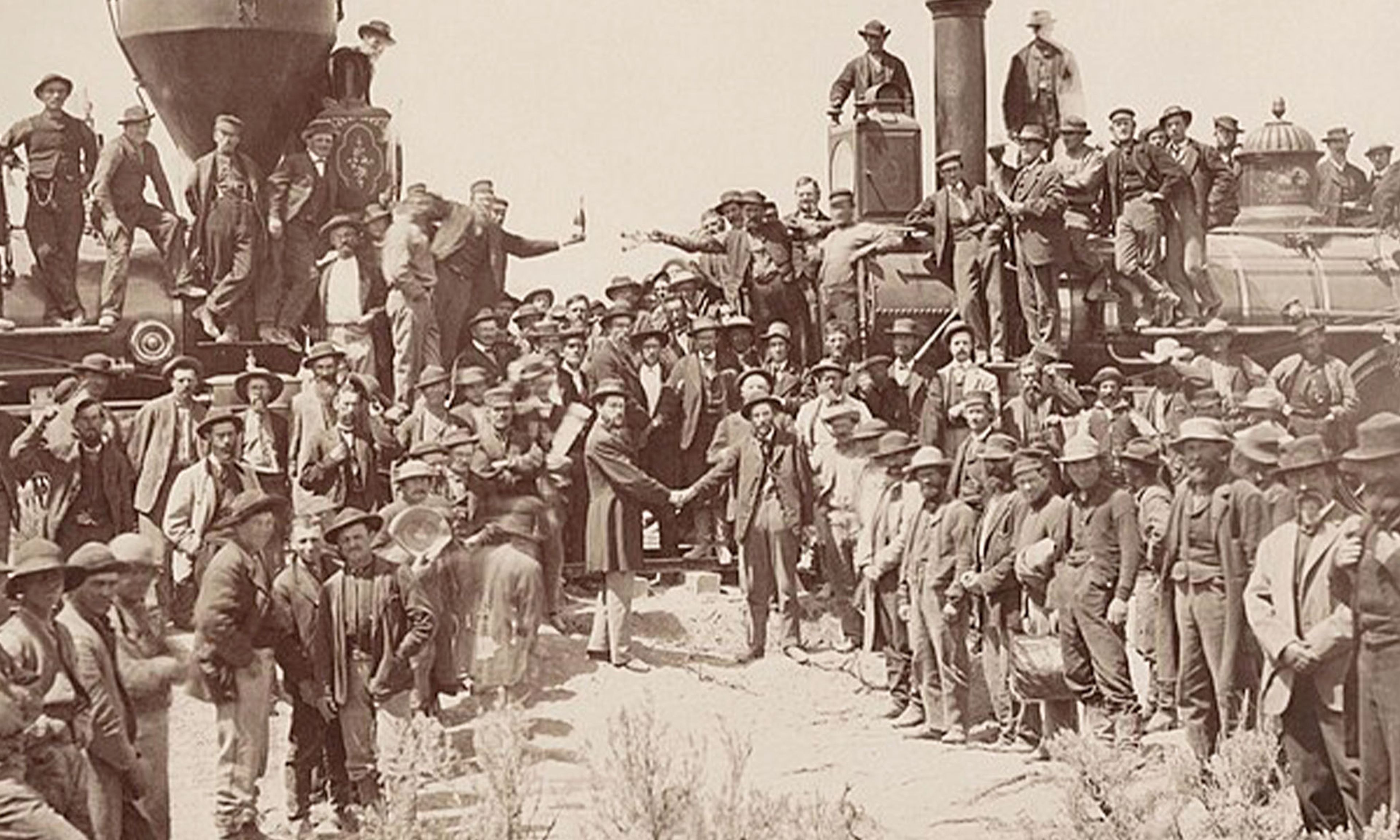
The ceremony for the driving of the Golden Spike at Promontory Summit, Utah, May 10, 1869, marking the completion of the First Transcontinental Railroad.
When Leland Stanford hammered in the golden spike at Promontory Summit, Utah, connecting the Central Pacific Railroad and Union Pacific Railroad tracks in 1869, he linked America east to west by rail for the first time. While its color was symbolic, the spike that completed the Transcontinental Railroad tied the country into one giant market, catalyzed unprecedented economic gains, and genuinely ushered in a new golden age.
A century and a half on, Americans who remember that fabled spike from history class might be surprised to learn that the country does not have a functional transcontinental railroad today. As a result of antitrust legislation and litigation dating back to the Progressive era, America’s eastern and western railroads were never permitted to consolidate into larger national companies, forcing them instead to meet at various interchange points. Laws such as the Interstate Commerce Act and Supreme Court cases such as Northern Securities instituted price controls and regional rail fiefdoms that prevented firms from ever resembling the Taggart Transcontinental of novelist Ayn Rand’s imagination.
Among the numerous unintended consequences of Progressive-era hostility are that, by forbidding scale, government also limited the upside of innovation and inadvertently redirected freight onto what would become the interstate highway system, despite the fact that trucking is much less safe. The bifurcation of rail that remains in place today slows down freight traffic by requiring freight to switch railroads in the middle of the country, raising costs for businesses and their customers across the land. Imagine, for comparison, if every air passenger had to stop for a layover at Chicago O’Hare or Dallas-Fort Worth to switch airlines when flying cross-country.
A new merger proposal, however, is on the table to make the country’s rail network truly transcontinental at last. In July, the major railroads Union Pacific and Norfolk Southern drew up terms that are now before the Surface Transportation Board (STB), the federal agency that regulates rail transport, to join as one. Presently, Union Pacific operates in the western United States, whereas Norfolk Southern covers the eastern U.S.
This proposed merger would eliminate interchange delays, cut transport times, and improve rail-system reliability. According to the two companies, their railroads currently exchange about a million shipments a year at their various connecting points. The friction between their systems produces a delay of 24 to 48 hours for each exchange — an exorbitant cumulative waste.
Yet approval for this merger is no sure thing. Although President Trump generally favors grand enterprises and said the merger “sounds good” in September, his vice president, JD Vance, has been a leading critic of the Republican Party’s historic coziness with Big Business, and of railroads in particular.
Vance and his fellow travelers, such as Missouri Senator Josh Hawley and MAGA influencer Steve Bannon, have lived up to the “Khanservative” moniker that alludes to their cross-partisan admiration for Lina Khan, the progressive Biden-era Federal Trade Commission chairwoman. Khan, a Millennial graduate of Yale Law, like Vance, took a hard line against corporate mergers and acquisitions, often on grounds not so far removed from MAGA territory. Moreover, as a senator from Ohio, Vance inveighed against Norfolk Southern in 2023 when one of its trains, transporting toxic chemicals, derailed near the Ohio town of East Palestine. Vance argued then that companies like Norfolk Southern have endangered the public in their quest to squeeze out more profits since shipping rates were deregulated in the 1980s.
While holding companies legally accountable for their safety errors is essential for any rule-of-law society, Vance and Surface Transportation Board Chairman Patrick Fuchs should evaluate Union Pacific and Norfolk Southern’s merger through a separate lens — that of national industrial strength.
America has a wealth of inherent industrial advantages relative to China, its natural geographic endowment chief among them. But the same vastness that grants America rich soil and plentiful mineral deposits also scatters our productive clusters across a 3,000-mile landscape. China’s economy, on the other hand, is heavily concentrated along its eastern seaboard and has made cutting-edge physical infrastructure its calling card. If the many high-output regions of this country remain unconnected by efficient transportation, achieving economic resilience through the renewed interest in industrial policy on both sides of the aisle will prove difficult.
Connecting America’s farms, mines, factories, and harbors by rail — the safest land transport method around and the fastest for heavy goods — is an essential task for boosting the nation’s productivity and realizing its industrial potential. Contrary to the Khanservatives, bigger quite often is better. It’s time the United States gets a unified railroad and ushers in another golden age.

About the Author
Jordan McGillis is a fellow at the Economic Innovation Group and a 2025-2026 Novak Journalism Fellow with the Fund for American Studies.
Featured Tags
Advertisement
Advertisement


Comments