Want to End Shutdowns? Remember the Past and Proceed with Caution
Written by Joshua Rowley
After last year’s government shutdown, it’s not surprising to see a number of proposals to prevent future shutdowns.
Share this story
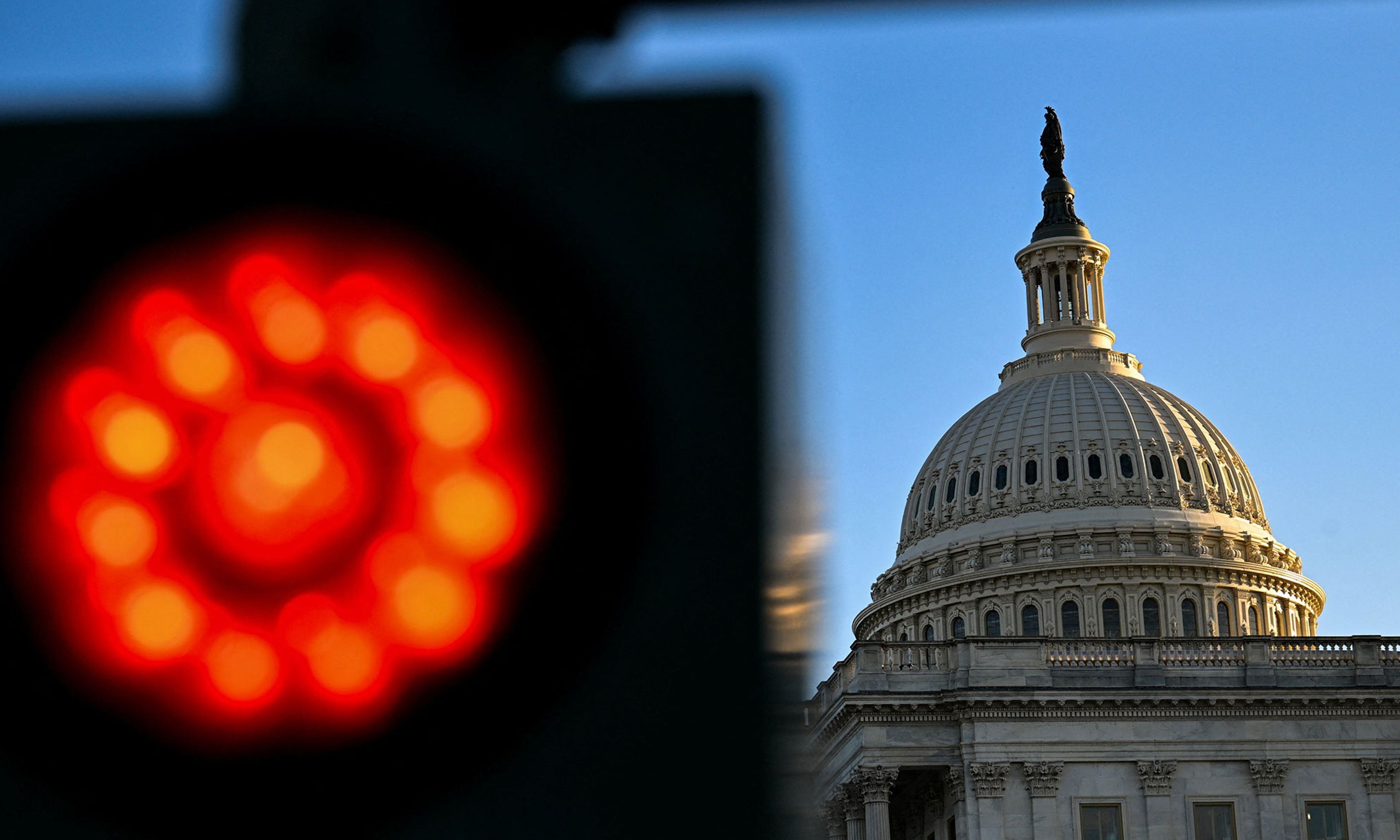
A signal at a parking lot displays a red light in front of the U.S. Capitol during the first day of a partial government shutdown in Washington, D.C., October 1, 2025.
After last year’s government shutdown, the longest in U.S. history, it is not surprising to see a number of proposals to prevent future shutdowns. The frustration is more than justified, but many of the ideas amount to little more than feel-good fixes that address the symptoms of fiscal disorder rather than the causes.
Before policymakers rush to legislate away their problems, they should remember the mostly failed sets of budget reforms of their predecessors. Here are four.
First is the Congressional Budget and Impoundment Control Act, known simply as the 1974 Budget Act. It established the modern budget and appropriations process, organized the House and Senate Budget Committees, and created the Congressional Budget Office.
Yet despite its sweeping and, in many ways, helpful reforms, Congress has routinely ignored the law’s core requirements. As Drew DeSilver of the Pew Research Center recently noted, Congress has failed to adopt a budget resolution on time in 45 of the 51 years since. Likewise, it has completed all appropriations bills on time on only four occasions since the act, most recently in 1997.
The act included what then seemed like an obscure provision: the creation of the budget-reconciliation procedure. Between 1980 and 1997, reconciliation was used 14 times, almost exclusively for deficit reduction; the sole exception was a relatively minor tax cut signed into law on August 5, 1997.
Since then, reconciliation has become a vehicle for increasing deficits. Of the ten reconciliation packages enacted after 1997, six have been deficit increases. Even the dubiously named Inflation Reduction Act of 2022 would likely be reclassified today as a deficit increase.
The second occurred in 1978, when Congress amended the Bretton Woods Agreement Act and expanded the government’s involvement with the International Monetary Fund. Tucked into that legislation was a balanced-budget requirement: “Beginning with fiscal year 1981, the total budget outlays of the Federal Government shall not exceed its receipts.”
Of course, Congress ignored this mandate. The deficit rose from $59 billion in 1978 to $79 billion in 1981, remaining roughly 2.5 percent of GDP. In 1980, it watered down the requirement to merely “reaffirm” its commitment to balance the budget in 1981. It weakened the provision again two years later.
The language still on the books today reads: “Congress reaffirms its commitment that budget outlays of the United States Government for a fiscal year may not be more than the receipts of the Government for that year.” In other words, what began as a statutory requirement was reduced to a symbolic gesture.
Third is the Balanced Budget and Emergency Deficit Control Act of 1985, known as Gramm-Rudman-Hollings. This legislation sought to eliminate the deficit within six years by gradually tightening deficit limits. If those targets weren’t met, automatic spending cuts -- “sequestration” -- would take effect.
After the Supreme Court struck down parts of the sequestration process in Bowsher v. Synar, Congress revised the law in 1987 and delayed the balanced-budget target to 1993. But only three years later, sequestration was fundamentally reshaped under the Budget Enforcement Act (BEA) of 1990.
The BEA replaced deficit limits with discretionary-spending caps and a new pay-as-you-go (PAYGO) rule requiring that any new spending or tax cuts be offset. Instead of hard deficit targets, sequestration would now be triggered if Congress violated the new rules.
While Gramm-Rudman-Hollings failed to eliminate deficits, the BEA framework did temporarily prove remarkably effective in restraining discretionary spending. From 1991 to 1999, discretionary spending grew just 7.3 percent -- a period of relative fiscal discipline. But at the turn of the century, discipline faded. Between 1999 and 2002, discretionary spending jumped nearly 30 percent, despite the caps still being technically in place.
Fourth is Congress’s response to the explosion of spending during the 2000s. It reinstated PAYGO in 2010, then reimposed discretionary-spending caps in 2011. Those reforms initially worked: Discretionary spending fell for five consecutive years.
But by 2018, Congress had once again largely abandoned those caps, approving bipartisan deals that blew through them repeatedly until the framework expired in 2021. In practice, the PAYGO scorecard has become a whiteboard that Congress frequently erases.
These lessons illustrate how legislative rules -- even those that are designed well -- are certain to fail without the proper institutional constraints, such as secure legislative norms or constitutional requirements that cannot be easily overridden by weak-willed legislators.
The 1990s and early 2010s stand out as periods in which Congress effectively paired legislation with sufficient fiscal norms. Unfortunately, those norms appear to be long gone. Effective future constraints will likely need to be of a constitutional nature.
About the Author
Joshua Rowley is a Gibbs Scholar and research fellow with the Mercatus Center at George Mason University and former economist for the U.S. House Committee on the Budget.
Featured Tags
Advertisement
Advertisement


Comments