Watching <I>The Leopard</I>
Written by Jay Nordlinger
Observations and musings on a new adaptation of Lampedusa's classic novel
Share this story
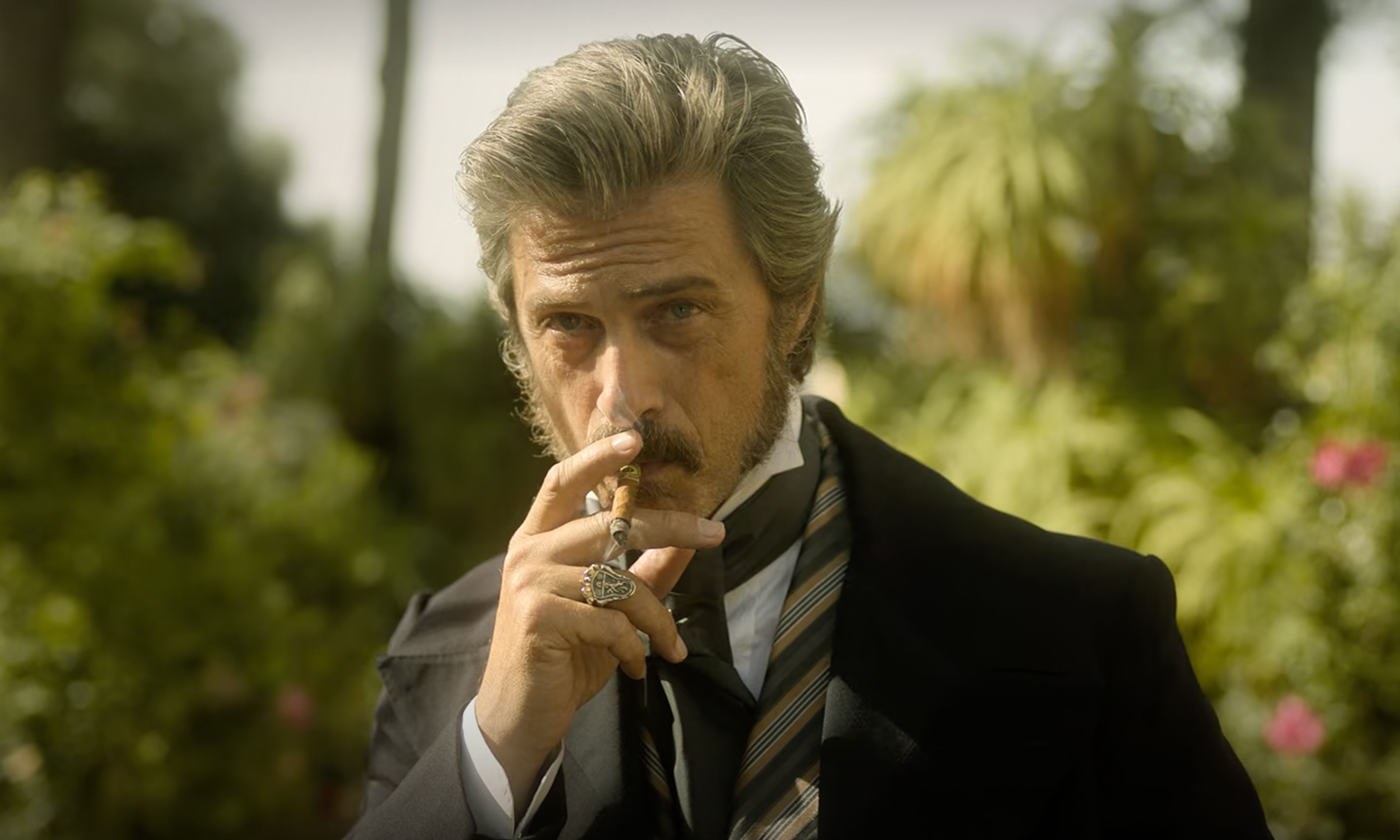
Kim Rossi Stuart as Don Fabrizio Corbera, Prince of Salina, in <i>The Leopard</i>
On Netflix, there is a series, a mini-series: The Leopard. I think of it as a grand, long movie, in six parts. It is based on a marvelous piece of literary art. And the mini-series -- it’s hard to settle on a right term -- is a genuine work of art itself.
Giuseppe Tomasi di Lampedusa wrote his novel, The Leopard, in the mid-1950s. I wrote about it three years ago, because it had been turned into an opera: music by Michael Dellaira, libretto by J. D. McClatchy.
The Leopard is Lampedusa’s only novel “and he wrote little else.” I am quoting from my 2022 piece -- and will keep doing so:
Lampedusa is one of the great one-book authors, along with Boris Pasternak, Ralph Ellison, and others we could name.
A little biographical information:
He was born in 1896 into the decaying Bourbon aristocracy. His father was the prince of Lampedusa (an island off Sicily). The author-to-be would inherit the title in 1934, when his father died. Our Lampedusa was the last of the line -- the last of the princes.
A little more:
He had a melancholy life, to a large degree, and he spent a lot of time reading: reading and reading and reading. He was smitten with literature. All the while, a book was brewing within him -- a book based on his family, and his great-grandfather in particular.
He produced The Leopard in the last years of his life. The book was published posthumously. Would that he could know it was almost instantly a classic!
What explains the novel’s title? Again I will quote from my 2022 piece:
The novel’s prince -- the prince of Salina (rather than Lampedusa) -- is called “The Leopard” because that animal is featured on the family’s crest. In Italian, the title is “Il Gattopardo,” and if you want to get seriously zoological, gattopardo equates to our “serval” or “ocelot.” But “The Leopard” works so much better.
What is the novel about exactly -- or inexactly?
The book is about society and politics: the passing of one world and the birth of the next. But it is no sociological or political tract. It is personal too -- about relationships, and individual lives. For example, Concetta loves her cousin Tancredi, but he thinks of her as more like a sister. He loves Angelica, whom he marries. This shatters Concetta.
You will want to know about the setting, too:
The Leopard takes place during the Risorgimento (mid–19th century), when Garibaldi, Mazzini, and their people were trying to unite Italy, casting aside the old kingdoms and fiefdoms.
Moreover,
there is a famous line in The Leopard, which goes, “If we want everything to stay the same, everything needs to change.” What does that mean? It is subject to interpretation. What I get from it is, “The old guard has to accept some liberal reforms, so as not to be smashed by revolutionaries, as in Robespierre’s France.”
A number of questions arise:
Lampedusa’s novel, you could say, explores the questions “What is conservatism? What is liberalism? What is reaction? What is revolution?” There is also the matter of the particular versus the broad, or a tribe versus a grander state.
Have a swatch of J. D. McClatchy’s libretto, for the opera composed by Dellaira:
Sicily does not speak as the others do --
Piedmontese, Milanese, Tuscans and Romans,
They are all different,
Each the tribe of its own territory,
Made of the very earth
They cultivate and defend.
Did there have to be an Italy? Should there have been an Italy? What was wrong with an assortment of kingdoms, fiefdoms, and tribes? The same question has been asked of India as well. But here we are getting into deep waters . . .
I read The Leopard, and studied it, when I was in college with a marvelous professor: Maria Rosaria Vitti-Alexander. I wrote about her, and another great professor of mine, in a 2022 piece called “Back to School.” (I had gone back to school, via Zoom, during the pandemic, with both of them.)
After all these paragraphs, I have not yet mentioned the movie -- not the new Netflix series but Luchino Visconti’s treatment of The Leopard in 1963. I touched on it in my 2021 piece:
Like the book, the movie is a classic. It stars Burt Lancaster, Alain Delon, and Claudia Cardinale. But hang on, wasn’t Lancaster an American and Delon a Frenchman? Yes -- their lines were dubbed.
The cast of the Netflix series is all-Italian. As I understand from press reports, the cast was originally going to be international, but the decision was made to keep it all in the family, so to speak. The viewer can watch the series in Italian -- there are subtitles in several languages -- or in a version with English dubbing. (I watched one of the six parts in English, and the dubbing was very well done.)
Amid all this Italianness, the director is English -- Tom Shankland. But he is not without Italian connections. His father was a scholar of Italian and the family traveled around Italy. Later, Tom married an Italian -- a Sicilian, no less.
The Netflix Leopard is sexed up. That is, it takes liberties with Lampedusa’s novel, in an effort to make the story more “modern.” Dare I use the neologism “relatable”? In any event, Shankland and his team are candid, using the words “based on”: their movie, their series, is based on the novel. Still, in my eyes, it is very Leopard-like.
And those looking for fidelity should simply read the book -- a great experience.
The new series is in the grand tradition, with all the cinematic bells and whistles (no matter that I watched it on my laptop). Wikipedia says this:
Principal photography began in April 2023. Filming took place over 105 days and required the use of 5,000 extras; 130 carriages, carts and boats; 100 animals; and 12 animal trainers.
A friend of mine (Italian) said, “The real star of the show is Sicily.” She makes a good point. I’m not sure that Sicily has ever been more beautiful or alluring than in this show. The Netflix Leopard is a feast for the eyes. Almost indecently sumptuous. The flowers, the lemon groves, the palazzos -- the food!
And, of course, the people: the principal actors and actresses. Gorgeous people, on a gorgeous island, gorgeously shot. That is a commendation already.
The title character -- the prince, the Leopard, also known as Don Fabrizio -- is portrayed by Kim Rossi Stuart. (One of his grandparents was Scottish. He was named for Kipling’s title character.) Stuart’s prince is suave, worldly, world-weary, charismatic -- every inch a prince, really.
Tancredi, that Garibaldian rascal, is played by Saul Nanni, born in 1999. I came to detest the character -- not because the actor does anything wrong but because I wanted Tancredi to do right by Concetta and Angelica (and he does right by neither).
Do you ever try to “edit” a movie, so as to make it come out right, by your lights? Life can be frustrating, onscreen as off . . .
Concetta is Benedetta Porcaroli, who reminds me of Lady Di, as we knew her, before she became a princess. Angelica is Deva Cassel, born in 2004. Signorina, or Mademoiselle, Cassel is the daughter of Vincent Cassel (the French actor) and Monica Bellucci (the Italian model and actress). How ugly can she be, I ask you? Angelica in this series is sex on wheels -- a danger to young men, old men, and, you could say, herself.
Don Calogero is portrayed by Francesco Colella. The character is supposed to be a villain of the piece, and in a way he is: he behaves badly. But many do. And he is a man born poor who is trying to rise in the world: trying to have some of the money, influence, and power that the likes of Don Fabrizio have dropped into their laps at birth.
It is interesting to watch Colella’s Don Calogero go from subservience -- a wily subservience -- to open defiance. I almost can’t fault him for the tricks he pulls. “It’s our turn,” he seems to say. “The lords and ladies have ruled the roost, and hogged the goods, for long enough.”
Not to be overlooked is Bendicò, the Salinas’ dog, their Great Dane -- present in the novel, and present in this adaptation.
As I mentioned above, a great theme of Lampedusa’s story is change: “If we want everything to stay the same, everything needs to change.” There are accommodators in the story: accommodators of power. People who bend with the wind, go with the flow. People who know what side their bread is buttered on. People who pledge their allegiance to one poobah one day and to another the next -- depending.
Are they bad? They are human.
I think of a well-known line from The Simpsons -- when the anchorman says, “And I, for one, welcome our new insect overlords. Like to remind them that, as a trusted TV personality, I can be helpful in rounding up others to toil in their underground sugar caves.”
The Leopard -- the prince of Salina, Don Fabrizio -- is noble, admirable, likable. (He has a hooker in town, which causes great distress to his wife and family, but leave that aside for now.) He is maybe the “good guy” of the story.
But is it easy to be the good guy when you’re born a prince? Born to rule and to be served and obeyed? Do you know what I mean?
It is possible to romanticize this royal family. They live so beautifully. They are so beautiful. They are in a position to practice noblesse oblige. We sympathize with them. It’s so romantic -- even the tragedy.
(Let us remind ourselves that a novel, in Italian, is a romanzo. And in French, a roman. Etc.)
It must have been good to be on top, in those days. Good to be bowed and scraped to. But would you have liked to do the bowing and scraping? And to have done back-breaking work in broiling sun, to supply the top dogs’ tables with bounty?
Who ate better? You or Bendicò?
The prince is indeed a good guy -- a high and thoughtful example of his breed -- and he knows his place: his position and its responsibilities. But he knows everyone else’s place too -- beneath him. And he reminds them of it.
Sure, the newcomers in The Leopard -- the Don Calogeros -- are corrupt. But who isn’t, including the nobles? Personally, I have no use for aristocracy or gangsterism. (You might call aristocracy an elegant gangsterism.) Thank God for liberal democracy: ordered liberty.
Maybe I could end my scribbles with a couple of sidenotes -- endnotes. In the Netflix series, we see, in a graphic, that one scene takes place in April 1861. I am an American, and you know where my mind went. When I was a kid, there was a well-known novel for youngsters -- a Civil War novel, Across Five Aprils (Irene Hunt).
In another scene, the prince and his family host a visitor from the north -- from Turin. Everyone dresses very formally at dinner. Hell, for breakfast, too. And in the Sicilian summer, it is very hot. The visitor is clearly uncomfortable. Don Fabrizio’s wife, if I remember correctly, invites the visitor to take off his jacket. One of the children (if I remember correctly) says something like this: “That is a privilege my mother grants only to people from the north. She would never allow us to do it!”
I thought of Pat Buckley -- Mrs. William F. Buckley Jr. At most dinners (not all), men were expected to wear jackets. In the hot summer, when the air conditioning could not quite keep up, Pat would say, “Gentlemen, please remove your jackets.” What a relief . . .
The music in the Netflix Leopard is apt and good. Its chief composer is Paolo Buonvino. More than once, I think, we hear “Va, pensiero,” the Chorus of the Hebrew Slaves, from Verdi’s opera Nabucco. According to some historians, this was an anthem -- a musical rallying cry -- of the Risorgimento. Since that time, it has been an unofficial national anthem of Italy.
A beautiful, inspired thing, political associations aside.
Let me restate what I said at the beginning: This new Leopard is a genuine work of art. I inhaled it, watching one episode after the other, sorry to see it end. I was immersed in that world, mentally, for days after. For most of his life, the author, Giuseppe Tomasi di Lampedusa, thought about this story and finally got it down, just in time. He did us all a great a favor.
He belongs to Italy, yes -- Italians know this novel as a kind of birthright -- but he belongs to the entire world, too, for what he depicts, though particular, is also human. Wonderfully, awfully, human.

About the Author
Jay Nordlinger was a senior editor of National Review and a book fellow at National Review Institute.
Featured Tags
Advertisement
Advertisement


Comments