Share this story
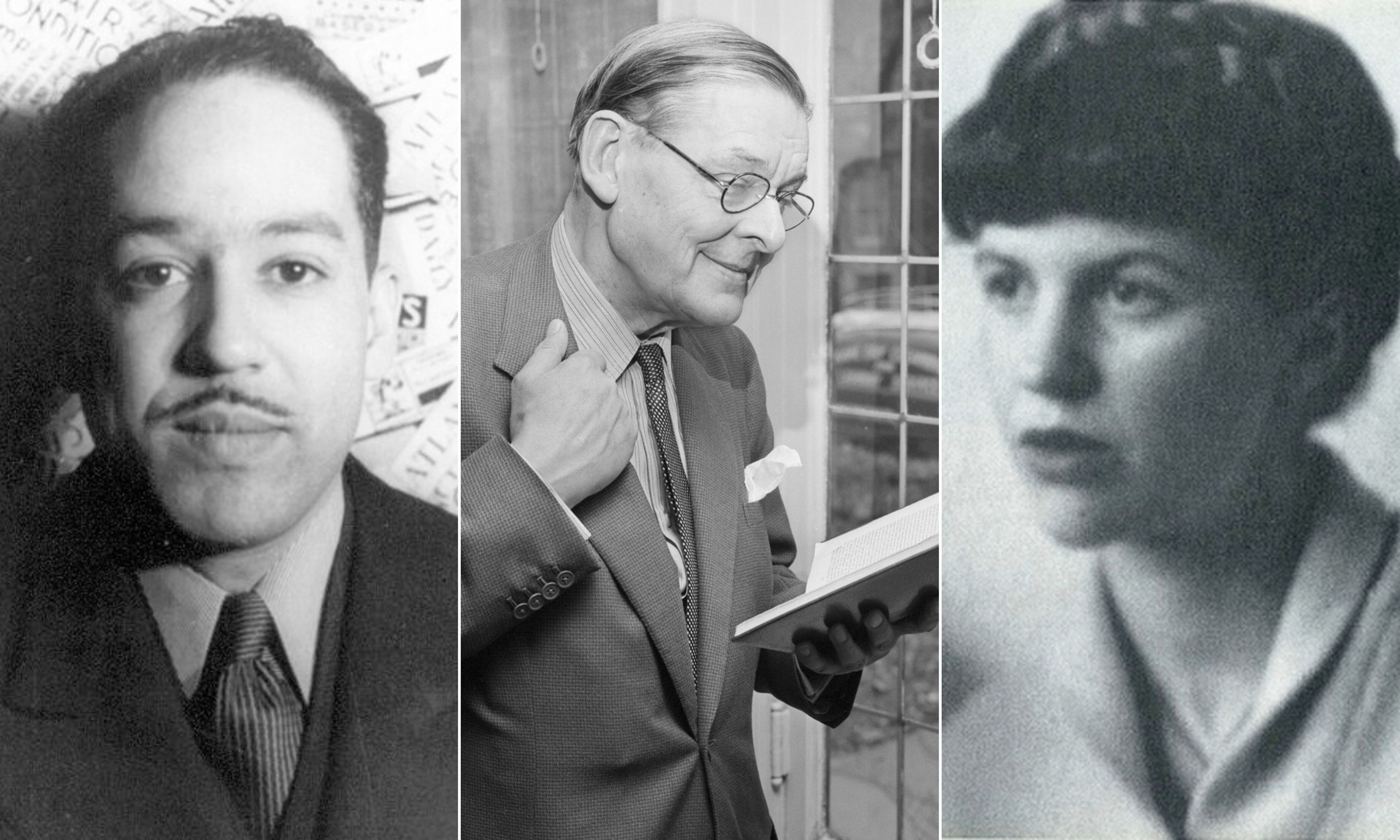
From left: Langston Hughes, T. S. Eliot, and Sylvia Plath
Ifeel blessed to have lived in a golden era of poetry. My mother read poetry to me, mostly A. A. Milne and Dr. Seuss, in our yard. All my elementary school teachers taught poetry, and my third- and fifth-grade teachers assigned poetry writing. My third-grade poem appeared in the local newspaper -- an ode to Arbor Day that is, fortunately, lost to posterity.
The great Anglo-American poets T. S. Eliot and W. H. Auden were alive, as was the Harlem Renaissance’s great poet, Langston Hughes; the deaths of Robert Frost and Sylvia Plath were recent. Poets invested in the tradition of Edgar Allan Poe, Henry Wadsworth Longfellow, and E. A. Robinson were coming into their own, including Richard Wilbur, Elizabeth Bishop, Wallace Stevens, and Gwendolyn Brooks. Poets in the free verse tradition of Walt Whitman, such as Allen Ginsberg and Anne Sexton, were attracting large audiences. Each Sunday the New York Times Book Review came alive with debates over the merits of these poets.
Some were pop celebrities; light-verse poet Ogden Nash was a game show panelist, and Dante translator John Ciardi made two appearances on The Tonight Show with Johnny Carson. Magazines often included poetry, and the so-called women’s magazines, such as McCall’s and Good Housekeeping, paid their poets well and helped to launch the literary careers of Sylvia Plath, Maxine Kumin, and Rhina Espaillat.
The American poetry world started failing in the 1970s. The first corrosive force was modernism. The same people who brought you unlistenable atonal music and Brutalism’s bleak, concrete, prisonlike buildings stripped poetry of craft, music, spiritual content, and other qualities that people have always loved. The second corrosive force was the woke ideology of this century, which blesses unintelligible poems that check the politically correct boxes.
The academy’s flight from traditional prosody and craft expanded its influence and improved its finances; the number of creative-writing programs increased from about 15 in 1965 to over 250 today. During the boom years, these master of fine arts programs operated like a Ponzi scheme; recent graduates often could find work teaching in new MFA programs. Today, MFA students learn what the poetry establishment vaguely wants to see, obtain a credential that might slip them past a screener on the way to publication in a little-read literary journal, and gain a few helpful contacts in a stunningly inbred culture -- not much value for two years of tuition.
Surprisingly, huge amounts of money have solidified this literary establishment that produces reams of unreadable politicized poetry, praise for which is surely cynical and self-serving. A $200 million bequest from the philanthropist Ruth Lilly eventually stimulated a nasty woke takeover of Poetry magazine, founded in 1912 and long regarded as one of the most coveted places to publish, and its influential Poetry Foundation. Moreover, The Atlantic recently documented how Elizabeth Alexander, the Obama-inauguration poet, has channeled huge sums from the $8 billion Mellon Foundation endowment into “social justice” in the humanities. Almost all of the past century’s greatest poetry would flunk the Mellon Foundation’s social justice standard.
Academics have also smothered the few initiatives within the academy that support traditional poetic techniques. Pennsylvania’s West Chester University for many years sponsored a conference on formal and narrative poetry. This Woodstock of New Formalism became the country’s largest conference dedicated solely to poetry. Shortly after one of the co-founders retired, the university transformed it into exactly the sort of conference its English department always wanted: laden with identity politics and stripped of rhythm, rhyme, and poetry that could move a broad audience. Almost no one came, so WCU shut it down.
Unfortunately, few academic institutions would support a poetry counterrevolution. Houston’s University of St. Thomas has a terrific MFA program that stresses prosody and Great Books, but the numbers make working within higher education a doomed crusade.
Progress must come from outside academia, so here’s a start: (1) Demand accessible poetry in newspapers, magazines, and journals. (2) Since our thin-skinned literary establishment kills off poetry criticism, build more online venues devoted to it. (3) Excite the public with more social media recitations of the great works of our greatest poets.
Let’s hope it is not too late for American poetry.
About the Author
A. M. Juster has published poems and translations widely. He is the author of a children’s book, Girlatee, and a new translation of Petrarch’s Canzoniere.
Featured Tags
Advertisement
Advertisement


Comments