What It Will Take to Fight Campus Antisemitism
Written by Tal Fortgang & Matthew H. Solomson
Universities’ last-minute promises to uphold free speech aren’t enough
Share this story
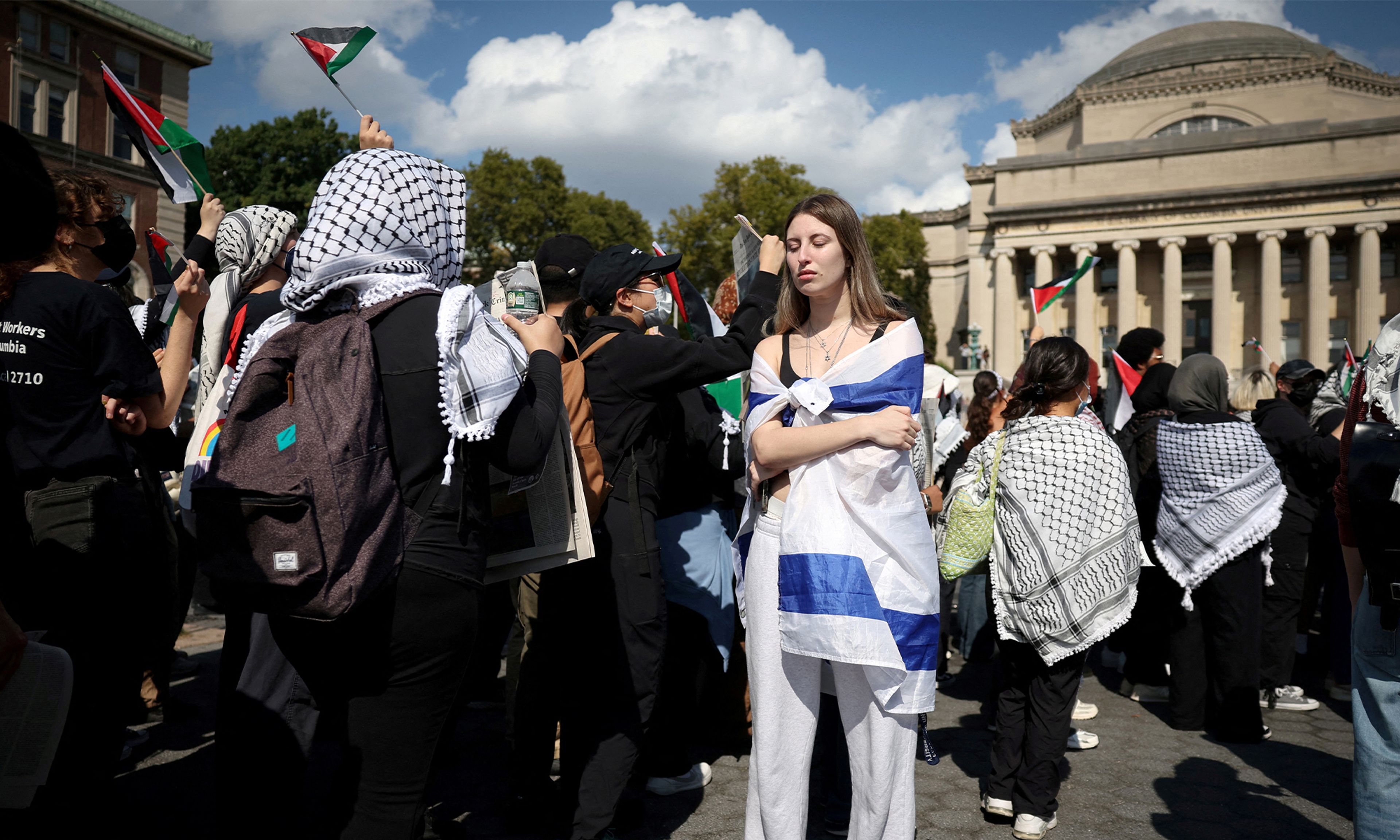
A female student wrapped in Israeli flag stands amid pro-Palestinian demonstrators on the campus of Columbia University in New York City, October 7, 2024.
The nation’s largest association of observant Jews, the Union of Orthodox Jewish Congregations of America, held its first-ever attorneys’ conference in February. The focus, unsurprisingly, was antisemitism -- the worst of which has ravaged American campuses since Hamas attacked Israel on October 7, 2023.
Though the Orthodox Union (OU) is best known for its educational and kosher-certification arms, it serves Orthodox Jews by channeling and representing their interests in other ways, too. Its public policy office in Washington, D.C., has been led, relatively quietly but successfully, for more than 25 years by Nathan Diament, a Harvard Law graduate. Things have been less quiet for the past year and a half for Diament, who has kicked his advocacy for Orthodox Jews into overdrive on the pressing issues that unite the OU’s constituency, chief among them supporting Israel and fighting terrorism and threats to synagogues. As he noted at its outset, Diament organized the attorneys’ conference out of a sense of dire need.
In addition to well-known attorneys from large firms, attendees and speakers included a former solicitor general, a senator, a congressman, three federal judges, and, from top law schools, current students and recent graduates who recounted their experiences on campus. The consensus seemed to be that the situation on campus has improved -- no “Zionist-free” encampments have sprung up yet this year -- but that seems largely due to the threat of litigation, whether from students themselves or from the Trump administration. And the situation still isn’t great. In a five-day span just before the OU conference, Columbia University issued five different statements regarding antisemitic incidents on campus, including a classroom disruption orchestrated by student activists. Disruptions kept on coming. To its credit, Barnard College, Columbia’s all-women affiliate, expelled two students who had burst into an Israeli-history class to spout anti-Israel bile and push leaflets depicting armed Hamas terrorists, captioned “The Enemy Will Not See Tomorrow,” alongside a boot stomping on a Star of David. Dozens of students occupied a campus building in late February to protest the expulsions, defacing property and assaulting a staff member in the process; Barnard said it would discipline the culprits.
As of this writing, it does not appear that the college has done so. Controversy has only mounted as the Trump administration subsequently announced it would cancel $400 million in grants to Columbia for failing to address antisemitism, and then began deportation proceedings against a Columbia graduate, a green-card holder, who had led campus demonstrations and occupations at the university. What will happen next is anyone’s guess, though Columbia has preliminarily agreed to the administration’s conditions as a prerequisite to restoring the funding. In either event, the various legal disputes will likely highlight, and perhaps clarify, the distinction between protected speech and prohibited actions.
On the need for more legal pushback to hold universities accountable for letting rule-breakers harass and discriminate against Jews and Israelis, the Orthodox Jewish lawyers and students at the conference were nearly united. Clearly schools’ internal mechanisms for protecting all students’ civil rights were flawed, but ongoing and threatened litigation is proving effective in addressing administrators’ shortcomings. If universities continue to coddle terror-sympathizers, they will face more lawsuits.
That is not to say attendees were unanimous on that point. What disagreements there were, moreover, seem to reflect larger cultural debates about how to fight woke ideology, according to which Western civilization is oppressive, Israel is a “settler-colonialist” oppressor state, and Jews are white oppressors. And as these Jewish lawyers are at the forefront of that fight, their conclusions and logic may prefigure the debates’ next phases.
Disagreements on how to approach campus antisemitism surfaced early on. At the very first session, the former dean of a prominent law school cautioned against viewing universities as opponents that need to be brought to heel. He posited that the vast majority of the faculty are supportive of Jewish students but may not know what antisemitism looks like; accordingly, the best way to combat antisemitism and ensure that it is taken seriously is to promote robust free speech norms. He urged his fellow Jews to stick to the sort of free speech principles articulated at the University of Chicago, collectively representing an “overarching commitment to free, robust, and uninhibited debate.”
This is a serious argument, one voiced frequently even by higher education’s harshest critics. At its heart is the belief in the marketplace of ideas: convincing others that their ideas are bad requires exposing them to better ones. Persuading college students that Hamas is evil, and Israel is good, requires free speech. If you want to show the haters that Israel is not, in fact, a settler-colonial project, marshal the evidence and make the argument. If you want administrators to understand that calls to eliminate Israel can constitute threats to Jews and are possibly discriminatory, you have to keep the flow of information and ideas open so that they may correct their misconceptions. In the former dean’s view, so long as speech does not cross into prohibited actions -- expressing violent threats, blocking students from traversing a quad, engaging in the heckler’s veto -- Jews should embrace debate. He implored them to relax and not give up on institutions of higher learning, even the prestigious universities that seem most rife with discrimination against Jews and Israelis.
That view may have drawn the OU crowd’s full support just a few years ago. But in February 2025, it did not find much purchase. Not because Orthodox lawyers don’t believe in the ideals of the First Amendment and free expression -- just the opposite -- but because free speech alone rings decidedly hollow as an answer to the particular brand of campus antisemitism that has swept across America, an anti-Jewish animus so threatening, and indeed so violent, as to have spurred dozens of investigations and lawsuits. The dean’s recommendation, given on behalf of universities he thought deserved one last chance to correct course, smacks not of a sincere desire to change but of a deathbed conversion. Indeed, many private discussions following the former dean’s remarks revolved around a counter-thesis we may be hearing soon from other constituencies that have been targeted for censure on university campuses: It is too late for free speech to save the day, too hypocritical, and, frankly, it just does not address the roots of the intellectual corruption that manifests as campus antisemitism and anti-Americanism.
Freeing the flow of information within ideologically captured institutions cannot repel the ideology that drives them. Universities have aggressively policed speech in recent years precisely because they adhere to a progressive worldview that equates certain words or opinions with literal violence. That is why, over the past decade, students, professors, and visiting speakers who express disfavored ideas (or use forbidden words) have been hounded, canceled, and even punished for being supposedly bigoted and hateful. And within that same ideology, antisemitism is considered a lesser form of bigotry, if it is thought to be one at all. The campus bureaucrats who snap into action at the faintest whiff of “misgendering” or supposedly insensitive costumes aren’t disturbed by calls to “globalize the intifada,” because they consider it legitimate “resistance” against Jews and Israelis as part of the oppressor class. Even if they do recognize antisemitism when they see it, they do not consider it part of their job to do anything about it.
Meanwhile, Zionism, the ostensible ideology hated by the campus radicals -- shouts of “We don’t want no Zionists here!” went over better than “Make our campus Judenfrei!” might have, though the effect was largely the same -- is one of those disfavored ideas. Likening Zionism to racism or sexism made those who advocate it legitimate targets for harassment and canceling. That is how we got to the point of what appears to be the great campus hypocrisy: students who claimed to be harmed by harmless words now claim that open support for genocidal terrorists is not just harmless but virtuous, and administrators and faculty behave as though they agree.
[slideshow slideshow="1636116" /]
As conference attendees discussed the prevalence of that ideology among students and administrators, the question kept coming up: How is it that Columbia, UCLA, and other schools now facing lawsuits for violating Jews’ civil rights managed to admit to their student bodies, consistently, year after year, hundreds if not thousands of individuals inclined to be openly pro-Hamas? Do they look for indications of, and select for, radicalism in admissions? You don’t see such behavior at Notre Dame, Pepperdine, or Hillsdale.
More questions followed: Are parents and students supposed to trust those very same administrators and admissions officers, who admitted and then encouraged the campus mobs, to enforce viewpoint-neutral free speech rules? Have they, or are they willing to, shed their belief that certain disfavored speech is essentially violence? Are they going to stop populating campuses with anti-Israel, antisemitic zealots before announcing that suddenly they are uninterested in policing speech?
Faculty one-sidedness is another systemic problem. As any review of the political donations of tenured faculty will show, viewpoint diversity within the academy is close to nonexistent. Would encouraging free speech on campus actually expose students to a variety of views or refined thinking? It also seems suspiciously convenient for those who defend universities to consider it anti–free speech when critics object to universities’ employment of radical professors who use their position to indoctrinate students in hatred of the West or foment harassment of Jews on campus. The role of many of those professors in organizing campus activism -- including holding classes within anti-Israel encampments and offering extra credit to students who attend Students for Justice in Palestine demonstrations -- has recently come to light. More than ever, prospective students and their parents (and policymakers) understand that such professors are ideologues and partisans, not scholars or educators. They have abused their positions to restrict Jewish students’ campus access, and shame or scold them for their beliefs. Suddenly they believe free speech is sacrosanct? It doesn’t take a cynic to consider this rediscovery of principle disingenuous.
So, to answer that law school dean’s proposal, would the Chicago principles address what ails Jews on campus? The answer is an emphatic no. Just as we Jews had to wander in the desert for 40 years to weed out the generation who, for their faithlessness, could not enter the Promised Land, so too universities must clean house before they can seek refuge in free speech principles. That is particularly true of the managing deans, the DEI bureaucracy, and the admissions staffs -- all must be left in the desert -- and those who take their place must be committed to advancing genuine free speech and debate, not ideology.
If free speech principles are to flourish on campus, as we believe they should, university culture must be rebuilt from the ground up. That goes well beyond discarding the kid-glove treatment of antisemitic harassment, vandalism, and trespassing. No more days off when the faculty doesn’t like the election results or a particular Supreme Court decision. No more proudly touting a school’s record of radicalism, as though that’s what universities exist to promote. Universities must bring balance to course offerings and faculty and stop institutionalizing and promoting radical views -- especially the false and toxic idea that the world is best understood through the warped lens of oppression analysis. When these things happen, we’ll start to believe the academy’s professed commitment to serving as educational institutions instead of progressive seminaries.
Until then, forgive the Orthodox community’s skepticism. Those lawyers at the OU conference are on to something. As universities begin to swear that their deathbed conversion is genuine, Americans who are neither Jews nor lawyers may soon be singing the same tune: We don’t believe them. They have not earned our trust. The principle of free speech cannot be an escape hatch through which to avoid the harsh consequences many universities now face from unhappy donors, parents, alumni, and the students themselves, who have suffered most.
Matthew H. Solomson is a judge serving on the U.S. Court of Federal Claims. Tal Fortgang is a legal policy fellow at the Manhattan Institute.
About the Author
Tal Fortgang is a legal policy fellow at the Manhattan Institute.
About the Author
Matthew H. Solomson serves as chief judge of the U.S. Court of Federal Claims in Washington, D.C.
Featured Tags
Advertisement
Advertisement

Comments