What Trump Still Doesn’t Grasp About Radical Islam — and Iran
Written by Andrew C. McCarthy
His weekend posts about Iran and Israel avoid reality.
Share this story
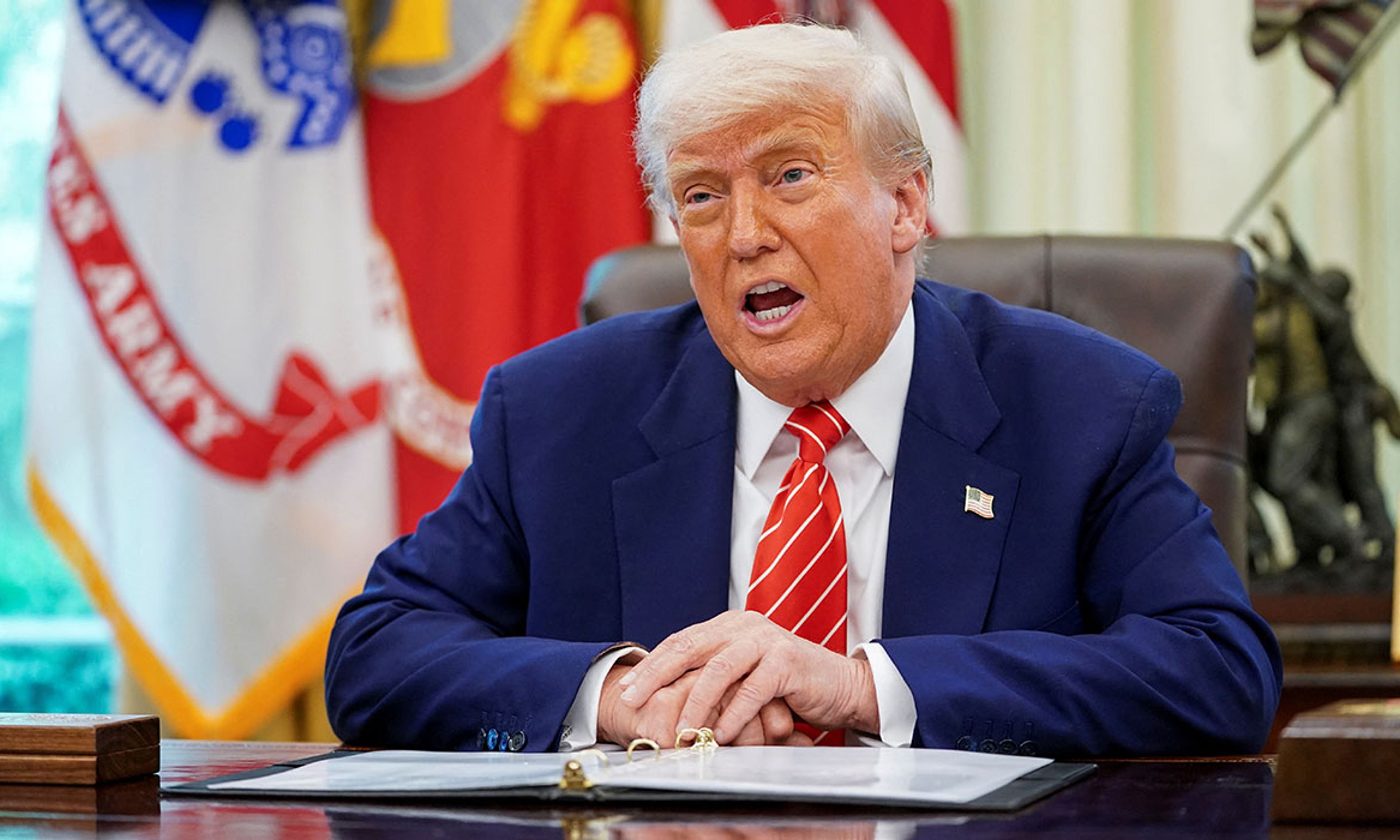
President Donald Trump speaks during a press conference in the Oval Office of the White House in Washington, D.C., May 30, 2025.
I’ve contended a number of times that President Trump does not understand radical Islam (more accurately, sharia supremacism). Indeed, to repeat what I said in the context of Russia’s war of aggression against Ukraine, Trump’s “transactional” view that the key to unlocking all disputes is financial interest is facile and disproved by history recent and remote.
His posts from the weekend illustrate this willful blindness yet again. Yesterday morning, the president said:
Iran and Israel should make a deal, and will make a deal, just like I got India and Pakistan to make, in that case by using TRADE with the United States to bring reason, cohesion, and sanity into the talks with two excellent leaders who were able to quickly make a decision and STOP!
Iran’s government is a millenarian jihadist regime that is committed to the destruction of Israel and the West for reasons easily grasped, unless one consciously avoids reality, by scrutiny of fundamentalist Islamic doctrine. The regime in Tehran has been killing Americans, making war on the Jewish state, and confidently calling for death to both America and Israel since its 1979 inception.
This vision of governance has never been in Iran’s general financial interest, its specific trade interests, or its interest in survival. That hasn’t mattered. Obviously then, accommodations in finance and trade are not going to induce Iran to abandon its vision. The war will not end unless and until the regime is utterly defeated. That is why, right now, Tehran is desperately seeking a strategic pause: hoping both to prevent the destruction of its nuclear program, the strategic gamechanger, and to regroup and rearm for a revived pursuit of its longstanding objectives, the regime’s raison d’être.
As for India and Pakistan, Trump is no more responsible for that cease-fire (it’s not peace, it’s a cease-fire) than he is for the fact that Russia prosecuted a border war against Ukraine for the entirety of Trump’s first term (the continuation of the border war it began during the Obama’s years).
Pakistan, with a population of 252 million people, nearly 100 percent Muslim, has a basket case government in which the defense forces, which keep the institutions of civilian governance under their thumb, have long been partially captured by sharia-supremacist elements. This is especially true of the Inter-Services Intelligence Directorate (ISI) factions, which sponsor jihadist organizations -- in part for ideological reasons, in part as a geopolitical weapon against India, Pakistan’s neighbor and enemy (which is about 80 percent Hindu but actually has one of the world’s largest Muslim populations, making up about 14 percent of its 1.4 billion people). Pakistan’s ISI essentially created the Taliban; it sponsors Lashkar-e-Taiba (LeT) and Jaish-e-Mohammed (JeM), which foment violence in Kashmir (and have carried out attacks further inside India); and it allowed Osama bin Laden -- then the world’s most notorious fugitive terrorist -- to live for years in a compound located less than a mile from the Pakistani Military Academy.
Theatrically, although the ISI abets the jihadist groups, the Pakistani government occasionally arrests some operatives in order to keep up appearances . . . and Western aid. Trump suspended aid to Pakistan in his first term; he also did so at the start of his second term, only to reverse himself -- as he is wont to do.
The flashpoint of the India-Pakistan conflict is the Jammu and Kashmir region, which is part of India’s sovereign territory but claimed by Pakistan. The ISI sponsors an insurgency there, waged by its jihadist factions (much like Russia has sponsored insurgencies in eastern Ukraine and Georgia, waged by its Russian and pro-Russia separatists). Several wars have been fought by India and Pakistan over the disputed territory since the two countries were created by the partition of British India after the World War II; the persistent conflict has become more alarming since the two countries became nuclear powers (India in 1974, Pakistan in 1998).
The most recent round of combat ended because, after Pakistan’s LeT proxies carried out attacks in Jammu and Kashmir in April, killing over two dozen tourists, India retaliated with significant air strikes which, rather than being confined to the disputed territory, hit targets deeper within Pakistan -- striking not only LeT targets but also JeM camps and Pakistani airbases in six different cities. India’s capabilities and willingness to use them induced Pakistani political leaders to seek a cease-fire. Having conveyed its message, India agreed.
The Trump administration was among several governments that mediated. Nevertheless, the shooting stopped -- for now, but certainly not forever -- because India made clear that Pakistan would come out on the short end of more intense fighting. India has vigorously denied that trade discussions with the Trump administration played any role in the cease-fire with Pakistan. Moreover, the Trump administration is making the same error in this conflict as it has in the European war -- claiming to be a disinterested broker between two warring countries rather than unambiguously recognizing, in each conflict, that there is an ally we should be backing (India and Ukraine) and an aggressor that is in the wrong and should be treated as such (Pakistan and Russia).
Most absurd of all is the president’s read-out on his weekend call with Russian dictator and war criminal Vladimir Putin, who Trump said called “to very nicely wish me a Happy Birthday.” Good grief.
According to the president, Putin “feels, as do I, [that] this war in Israel-Iran should also end.” Well, sure, all wars should end, and I don’t doubt that Putin would like to see the war end now because his ally Iran (a) is getting its ass kicked but (b) still -- at the moment -- has enough of its nuclear infrastructure intact to resume weapons development. From the perspective of both American and Israeli national security, however, the only acceptable end of the war should be a decisive Israeli victory (you should read Noah Rothman on that point). At a minimum, victory would mean the eradication of Iran’s offensive military capabilities, including the complete destruction or credible dismantlement of its nuclear program.
While the president is making noises about how the war should end, he doesn’t seem to be pressuring Israel to stop short of its -- and what should be our -- objectives. Let’s hope that continues.
Yet, to the extent Trump contemplates resuming negotiations with Iran about its nuclear program, with Russia as a key player in the mix, that would be indistinguishable from the disastrous Biden policy of resurrecting Obama’s Iran nuclear deal.
In his first term, after well over a year of nudging, the president finally and properly pulled the plug on that deal (the Joint Comprehensive Plan of Action, which had no constitutional standing because Obama end-ran Congress, just as Biden intended to do in resuscitating it). Trump ditched the JCPOA in favor of a maximum pressure campaign that had the anti-American jihadist regime bankrupt, desperate, and perhaps even teetering.
Whatever happened to that guy?

About the Author
Andrew C. McCarthy is a senior fellow at National Review Institute, an NR contributing editor, and author of Ball of Collusion: The Plot to Rig an Election and Destroy a Presidency.
Featured Tags
Advertisement
Advertisement

Comments