Why Does the U.S. Put Up with the U.N.’s Antisemitism?
Written by Brett Schaefer & Danielle Pletka
We have the tools but choose not to use them.
Share this story
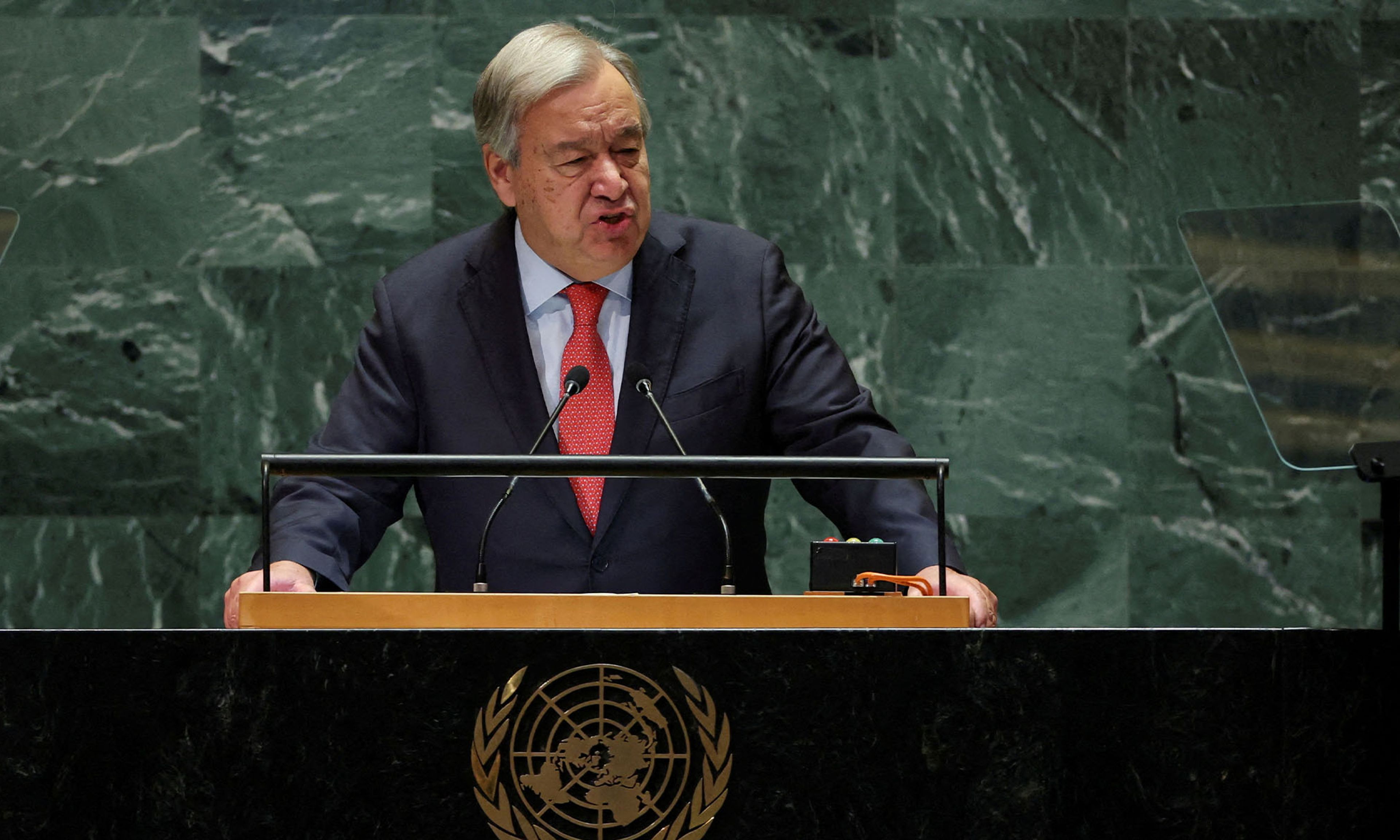
United Nations Secretary-General Antonio Guterres addresses the 79th United Nations General Assembly at U.N. headquarters in New York City, September 24, 2024.
Since the October 7 Hamas terror attack in which more than 1,200 innocents were murdered and hundreds raped, tortured, and kidnapped, the United Nations has been clear and consistent in its messaging: Israel must exercise restraint, cease its anti-terrorism campaigns, facilitate humanitarian aid for Gaza residents, and agree to an immediate cease-fire with Hamas and now Hezbollah.
Like a record skipping, U.N. Secretary General António Guterres has repeated this mantra over and over and over and over again. And with rare exceptions, mostly in the early months following the attack, the Biden-Harris administration has been right behind him.
A myriad of laws dictate how the executive branch manages America’s relationship with and funding of the United Nations and its specialized agencies. Notwithstanding a web of legislative restrictions and instructions, many involving the Palestinians, terrorism, or instability in the Middle East, the State Department and the U.S. Agency for International Development managed in 2023 to shovel $12.97 billion into the U.N. system undeterred by the world body’s single-minded targeting of Israel and de facto support for its adversaries after October 7.
One of the most egregious examples of inaction on the part of both the U.S. and U.N. leadership is the United Nations Relief and Works Agency for Palestine Refugees in the Near East (UNRWA). Despite an agreed framework between the U.S. and UNRWA in which the organization agreed to vet its employees for connections to and support for terrorism, there is voluminous evidence that Hamas has compromised the organization.
Part of the problem is that UNRWA, like the rest of the U.N., does not consider Hamas and Hezbollah to be terrorist organizations. This creates a glaring loophole in vetting that the State Department has not addressed effectively. In fact, Secretary of State Antony Blinken has repeatedly certified that UNRWA is following U.S. legal strictures. State’s disingenuousness is why Congress suspended funding to UNRWA earlier this year.
Israel asserts that hundreds of Hamas members remain employed by UNRWA. Hamas embedded its facilities within or under UNRWA buildings specifically to use them as shields. The practice was so common and overt it could not have been missed by the U.N. or its State Department counterparts.
Indeed, the U.N. itself was forced to admit after an investigation that at least nine UNRWA employees participated in the October 7 attack. An UNRWA teacher’s passport was found on the body of Hamas leader and October 7 mastermind Yahya Sinwar. A recently eliminated leader of Hamas in Lebanon, Fatah Sharif, was simultaneously the capo of the UNRWA teachers’ union.
Yet the United Nations has yet to lift immunity from prosecution for any of those UNRWA employees. In fact, when NGO recipients of U.S. humanitarian assistance flag concerns about U.N. staff connections to or support of terror groups, the organization rarely takes action.
Is it any wonder, then, that the Israeli Knesset overwhelmingly voted to ban UNRWA from operating in Israel? The move was, predictably, criticized by the U.N., the State Department, and other governments. But no other nation would allow an organization with UNRWA’s record to operate with impunity within its borders.
Israel has similarly drawn criticism for its actions in the ongoing conflict even though, as John Spencer, chairman of the urban warfare studies program at West Point’s Modern War Institute, observed, “Israel has taken more steps to avoid harming civilians than any other military in history.” Nonetheless, United Nations officials from Guterres to World Food Program honcho Cindy McCain to U.N. human-rights chief Volker Türk have blamed Israel repeatedly for targeting schools or hospitals. But the U.N. is near silent when evidence shows Hamas and Hezbollah housing their weapons or facilities near, under, or inside those structures.
Similarly, warnings of famine in Gaza by the U.N. in almost all instances focus blame on Israel rather than on the theft and misuse of aid by Hamas — a habit grounded in bias and mirrored by the Biden-Harris administration. USAID director Samantha Power in particular has repeatedly cited Hamas “Health Ministry” fatality figures that inflated the number of women and children casualties, blamed Israel for hunger in Gaza despite Hamas’s aid diversion that is so evident even the Palestinian Authority condemns it, and argued for denying Israel weapons transfers on “humanitarian” grounds by misrepresenting humanitarian law.
It is against the law to provide any U.S. resources to a terrorist entity, but cynical administrators have used humanitarian exceptions as a blanket excuse for supporting terrorism. A regularly used work-around enables aid to bleed over to terrorists via a Treasury Department license that says NGOs carrying out humanitarian assistance are immune to enforcement and prosecution. These exceptions exist for Gaza, the West Bank, Syria, Lebanon, Afghanistan, and Yemen.
And then there’s UNIFIL, the United Nations peacekeeping operation in Lebanon, which is charged under U.N. Security Council Resolution 1701 with keeping arms and militants out of southern Lebanon along the Israeli border. Specifically, it is tasked with “taking steps towards the establishment between the Blue Line [the “line of withdrawal” of Israeli forces in 2000] and the Litani river of an area free of any armed personnel, assets and weapons other than those of the Government of Lebanon and of UNIFIL.” Yet, over the past 15 years, Hezbollah became the “most heavily armed non-state group in the world,” with most of those arms located in the very area overseen by UNIFIL.
UNIFIL reported that it was denied access to sites of interest by the Lebanese Armed Forces and that Hezbollah “civilians” blocked roads and assaulted peacekeepers on patrol. Credible reports allege that Hezbollah may have bribed peacekeepers to use UNIFIL posts and cameras to spy on Israel. Instead of addressing the many violations, the U.N. Security Council simply recycled the UNIFIL mandate year after year — with nodding acquiescence from Washington — while Hezbollah imported arms, dug tunnels into Israel, and stored weapons within sight of UNIFIL bases.
Meanwhile, the U.N. stands idle as Iran breaches the Nuclear Non-Proliferation Treaty, brutalizes its own population, and finances and arms Hamas, Hezbollah, and the Houthi terrorists now dominating Yemen who have been terrorizing shippers in the Red Sea. Iranian proxies have taken over Gaza, Lebanon, and Yemen, turning all into staging grounds to launch attacks on Iranian-designated targets. Iran stands at the threshold of a nuclear weapon that may be used to fulfill its threat to “wipe Israel off the map."
Yet it is Israel, not Iran, that the U.N. urged to practice restraint after Iran’s unprecedented missile attacks in April. Likewise, the call to end “tit-for-tat violence” conveniently came after Iran’s October missile attack but before Israel’s response.
The global body’s passivity has largely been mirrored in the Biden-Harris administration’s non-policy on Iran. Desperate to entice the Islamic Republic to return to President Obama’s failed nuclear agreement, the U.S. loosened sanctions and excused Iran’s steps toward a nuclear weapon. The administration cracked down on several terror-finance networks in the wake of October 7, but the president and his staff seem alarmingly indifferent to Iran’s nuclear advances. Indeed, they seem more intent on preventing Israel from attacking Iranian nuclear sites. Nor has the United States encouraged European members of the Iran nuclear deal to implement the so-called snapback that would restore U.N. sanctions on Tehran.
As if that were not sufficient, the U.N. has also been instrumental in facilitating the global lawfare of the increasingly authoritarian and corrupt Palestinian Authority to bypass a negotiated solution to the Israeli–Palestinian conflict and renege on promises to recognize Israel’s right to live in peace and security. Palestinian leaders in the West Bank and Gaza have rejected peace proposals and frameworks that would have resulted in statehood, yet it is Israel that is characterized as intransigent by the Security Council and General Assembly.
The blatant bias against Israel in Turtle Bay can only be chalked up to one thing. Yet, in the face of this virulent antisemitism, the present administration has been almost supine. Early on, the Biden-Harris administration reversed the prior administration’s decision to end funding for UNRWA and fought for a waiver of U.S. law to resume funding for the United Nations Educational, Scientific and Cultural Organization (UNESCO) even though it had granted full membership to the Palestinians. (U.S. law bars funding to the U.N. or any U.N. specialized agency if it grants the Palestine Liberation Organization the same standing as member states.)
In May, a resolution elevating Palestinian representation in the General Assembly passed 143–9 — a clear sign that the United States declined to fully use its influence to oppose the effort. In September, the U.N. General Assembly overwhelmingly passed a resolution demanding that Israel end its “unlawful” presence in the West Bank. A rumored effort to suspend Israel’s membership in the U.N. General Assembly may be next, unless U.S. officials up their efforts to stem the tide of hate sweeping through that body.
The United States is sending billions annually to the United Nations. The question must be asked: Why does the Biden administration fail to exercise its leverage effectively to fight the U.N.'s institutional antisemitism? We have the tools but choose not to use them.
Danielle Pletka is a distinguished senior fellow at the American Enterprise Institute and the host, with Marc Thiessen, of the podcast What the Hell Is Going On? and the related Substack. Brett Schaefer is the Jay Kingham Fellow in International Regulatory Affairs at the Heritage Foundation.
About the Author
Brett Schaefer is a senior fellow at the American Enterprise Institute focusing on the United Nations and international organizations.
About the Author
Danielle Pletka is a distinguished senior fellow at the American Enterprise Institute and the host, with Marc Thiessen, of the podcast What the Hell Is Going On? and the related Substack.
Featured Tags
Advertisement
Advertisement
Comments