Why the Witkoff Plan for Peace Is Simply a Nonstarter for Ukrainians
Written by Mark Antonio Wright
The scheme would remove the tools that Ukraine needs to defend itself from subsequent Russian aggression.
Share this story
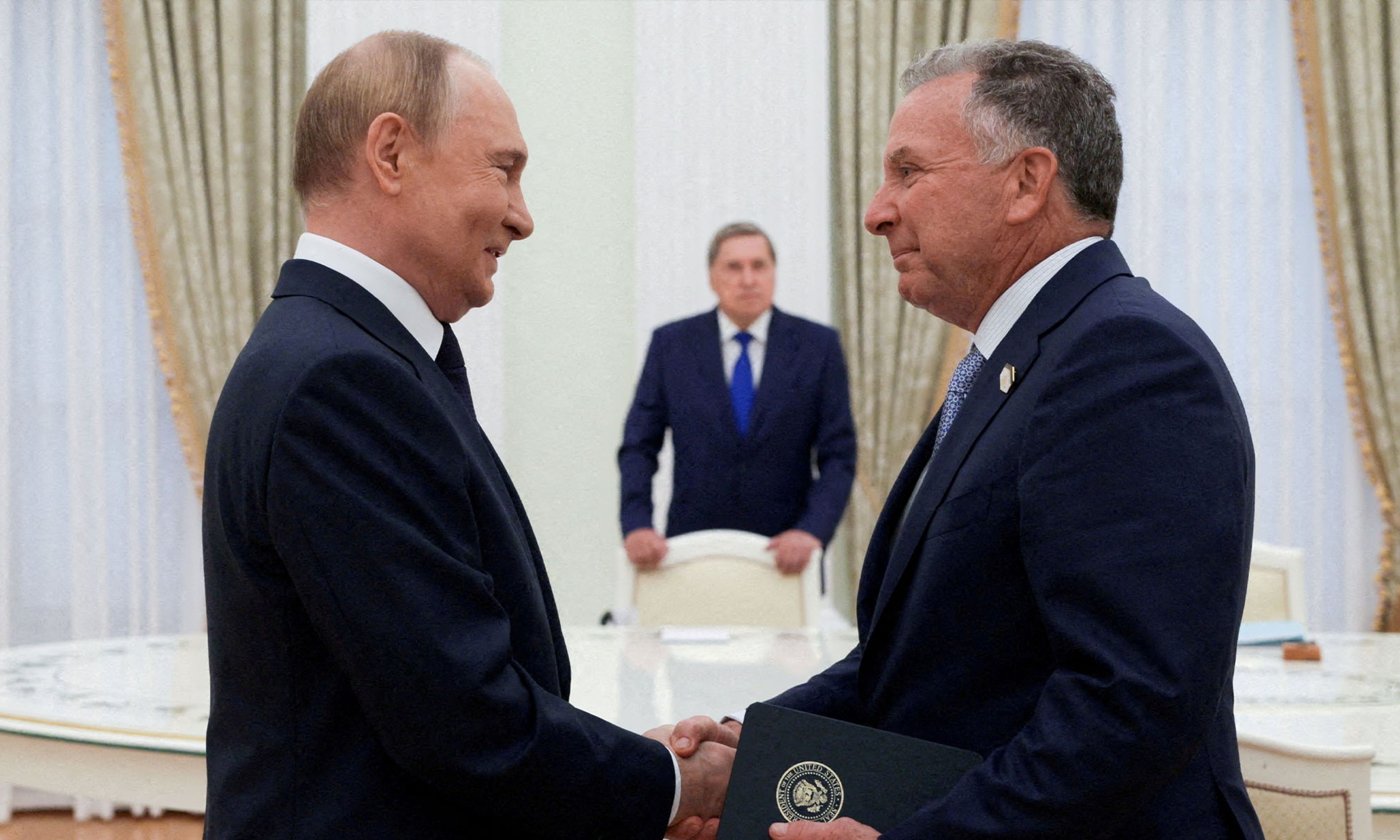
Russian President Vladimir Putin welcomes President Donald Trump's envoy Steve Witkoff during a meeting in Moscow, Russia August 6, 2025.
Kyiv, Ukraine -- The 28-point plan to end Russia’s war against Ukraine that has reportedly been negotiated between Trump envoy Steve Witkoff and Russia’s Kirill Dmitriev has landed with a thud here in Kyiv.
I’ve been in Ukraine nearly a week now, and I haven’t seen anything like the shock and astonishment on the part of the Ukrainians when the details of the proposal started leaking out online.
(Read my report from the eastern city of Dnipro as the Russians attacked here.)
The outlines of the Witkoff plan approach the maximalist goals of any negotiated end to this war that the Kremlin could hope for. Moreover, the plan was drafted by U.S. and Russian officials — Yalta-style — without any involvement from the Ukrainians at all. And it’s a bad deal:
- Ukraine would cede control of Crimea and its eastern provinces of the Donbas to Russia, including territory currently controlled by the Kyiv government and its army.
- Ukraine would be forced to cut the size of its army — by as much as 50 percent.
- Ukraine must give up certain weapons systems, likely to include missiles and drones that could reach into Russia.
- Kyiv must grant official recognition to the Russian language and the Kremlin-controlled Russian Orthodox Church.
- European military security and training deployments to Ukraine would be prohibited.
- And, of course, NATO membership would be off the table.
These are all major Ukrainian concessions — and the first two especially are simply nonstarters to the Ukrainians, if that means evacuating even more territory rather than merely reluctantly recognizing (de facto) that Ukraine is unlikely to eject Russia from, say, the Crimean peninsula in the short or medium term.
Furthermore, it’s hard to see what concessions the Kremlin is making in this plan at all.
I do not at this time have any tremendous insight into whether the Witkoff plan, first reported by Axios, is President Trump’s firm personal view about how to proceed, or merely an opening gambit to begin more public negotiations, or whether Witkoff is freelancing at some level on this.
One read of the situation, that is somewhat positive for the Trump administration, is that Witkoff has actually scored a minor win here by getting the Russians to put down on paper their starting bid in the first place — even if that bid is, from the Ukrainian perspective, an unreasonable and unacceptable start to the negotiations.
Marco Rubio’s cautious tweet about the Witkoff plan can be read multiple ways. In it, the secretary of state says that the administration “will continue to develop a list of potential ideas for ending this war based on input from both sides of this conflict.”
“A list of potential ideas” — well, that is not necessarily a strong endorsement of all the above in their exact particulars. That said, Rubio does say that achieving a “durable peace” will include “difficult but necessary concessions” — which is indeed true — though of course he says that both sides will need to give something up. And, again, it’s unclear that Russia is giving up anything meaningful here at all.
So why is the deal a nonstarter for the Ukrainians?
First, it’s important for Americans to understand that both anecdotal evidence and polling data suggest that the Ukrainians, by and large, understand that a peace deal will require them to give up territory on at least a de facto basis.
The humanitarian aid organization, Razom, which is sponsoring my reporting trip to Ukraine, has released recent polling data showing that only 28.2 percent of Ukrainians would demand a return to the 1991 borders as the “minimum necessary for concluding a peace agreement with Russia.” In fact, a supermajority understand that they’ll have to make “difficult but necessary concessions,” in Rubio’s terminology.
But the Witkoff plan, as reported, goes far beyond this. The ceding of territory to Russia that the Ukrainian army is at this very moment fighting hard for, and dying for, and that it has so far successfully defended would be extremely unpopular in this country — and in my view impossible for any democratic government of Ukraine to accept or sell to its people.
But that’s not — again, in my view — the key sticking point. I’ve talked to dozens and dozens of people, of all walks of life, in the week I’ve been in this country: soldiers, government officials, pastors, priests and rabbis, businessmen, journalists, young people at bars out on a Saturday night, civilians who have just had their homes blown up.
Almost everyone I’ve talked to wants the war to end as quickly as practically possible. (A minority want to fight on until a series of battlefield victories set them up for negotiating success.) Ukrainians know that they will have to make concessions. But I have not talked to a single person who doesn’t think the Russians will try again to take over the whole of Ukraine after some interval. To a man, the Ukrainians think that a peace deal would only result in an interregnum, an intermission, a pause in which both sides will refit and rebuild before Vladimir Putin’s Kremlin decides the time is ripe for attacking again.
Western security guarantees are, in many people’s minds, almost beside the point. Sure, they want NATO admission; the Ukrainians want the U.S., and Britain, and Germany to say that they’ll stand by them if Russia menaces the country at some later point. But after their experience of the last 20 years, most people here (understandably) don’t have a lot of trust in any Western guarantees.
“I don’t care about American guarantees,” one woman told me at lunch. “Sorry, no offense.”
Far more than security guarantees, Ukrainians want to be ready and able to defend themselves.
The Ukrainians — again, by and large — are reluctantly willing to accept territorial concessions because they are determined to use a cease-fire to build up a military so strong and powerful that Ukraine can defend itself from further Russian aggression.
But if Witkoff’s plan demands that Ukraine cede not only its territory but the means and the tools for the Ukrainian people to defend themselves from further aggression that everyone here believes is just down the road — by reducing the size of the army and eliminating key weapons platforms — then Ukraine will never accept it.
The people will demand that the Ukrainian government fight on — even if it means fighting on without the help and support of the United States — instead of surrendering their sovereignty at the negotiating table.
About the Author
Mark Antonio Wright is the executive editor of National Review.
Featured Tags
Advertisement
Advertisement

Comments