Why Trump Must Tread Carefully in Deportation Cases Against Legal Aliens
Written by Andrew C. McCarthy
American law enforcement is supposed to be both energetic and fair.
Share this story
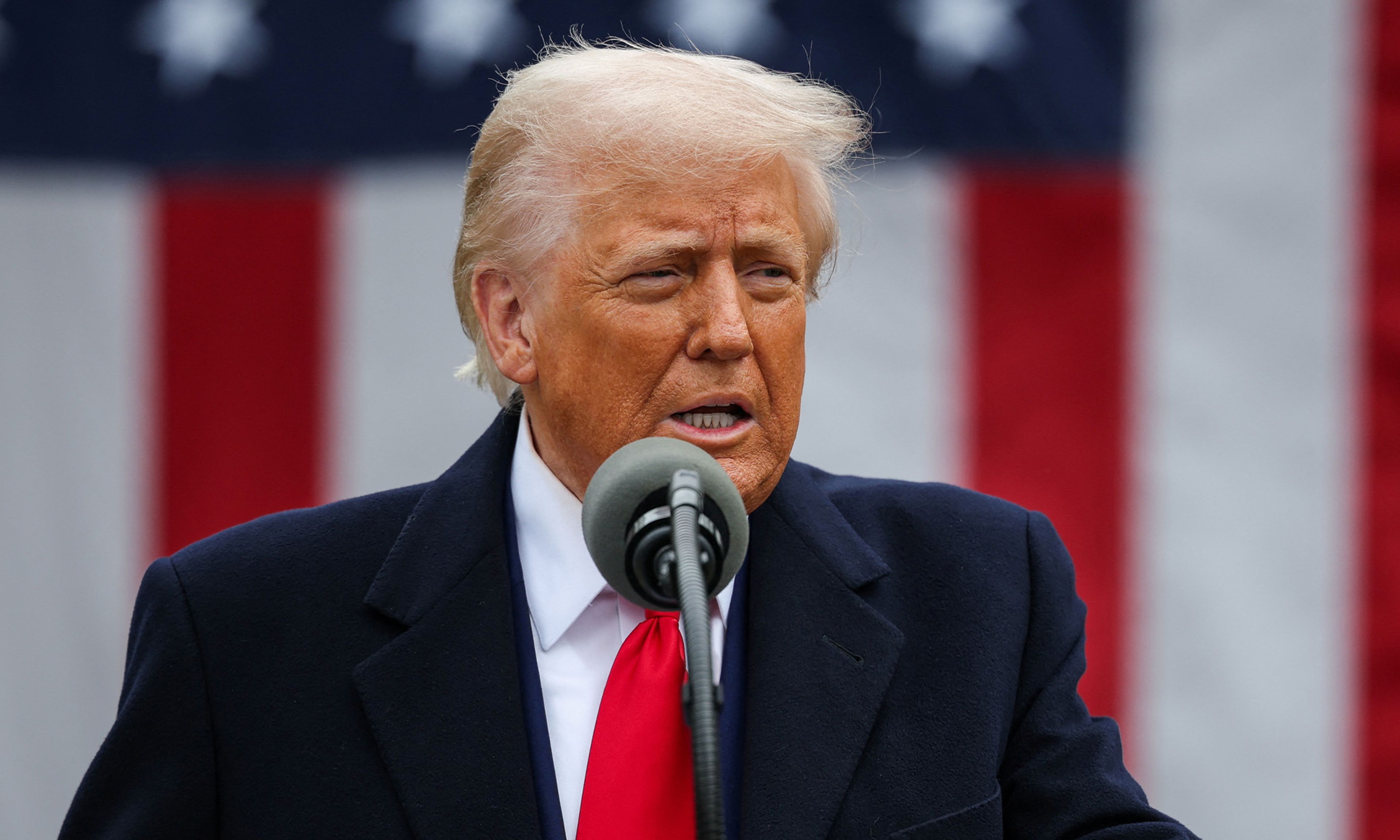
President Donald Trump speaks on the day of his remarks on tariffs in the Rose Garden at the White House in Washington, D.C., April 2, 2025.
Author’s Note: This is the first in a series of articles on the Trump administration’s effort to remove several legal aliens based on a finding by the secretary of state, under Section 1227 of federal immigration law, that their continued presence in the United States “would have potentially serious foreign policy consequences.”
Rich Lowry is right: Rumeysa Ozturk, one of the notable legal aliens arrested by Trump immigration-law enforcers with an eye toward removing her from the United States, was not “disappeared” or “kidnapped.” She was lawfully arrested, in the same manner that Mahmoud Khalil was lawfully arrested.
Alas, there is more to it than that. And we need to get into it.
There are probably going to be many Ozturks and Khalils. Secretary of State Marco Rubio says he has revoked more than 300 visas of students and other aliens, in anticipation of expelling them from the United States. Green cards are being revoked, too -- we know that from the cases of Khalil and another Columbia student, Yunseo Chung (whose case I wrote about last week). NBC News reports on the cases of two academics – Rasha Alawieh, a Lebanese kidney specialist who was teaching at Brown until her recent deportation (she reportedly attended the funeral of Hezbollah honcho Hassan Nasrallah); and Badar Khan Suri, an Indian national who was teaching at Georgetown and living in Virginia with his wife and children for years until his recent arrest in contemplation of removal (the government says he promotes Hamas and has “close connections” to at least one of its “senior advisers”).
Let’s be clear: These are not criminal cases, and they do not involve illegal aliens. These are civil immigration-law proceedings involving people lawfully living and working in the United States. While there is some vague talk of terrorism ties from government officials, the government has not charged these aliens with even minor crimes, much less material support to terrorism or other offenses involving violence. And although there are immigration-law provisions that enable the government to remove aliens based on “terrorist activities” (see Sections 1227(a)(4)(B) and 1182(a)(3), which apply even to aliens who merely “endorse or espouse terrorist activity”), the Trump administration is not invoking these provisions. As we’ll see, it is relying on a Cold War–era law that authorizes the secretary of state to order expulsions, even if the alien has engaged in activities that would be constitutionally protected if an American engaged in them.
I am not saying it is wrong to do this. I don’t think it is. But there are two important aspects of American law enforcement: the legal objective (here, deportation) and the manner in which the objective is supposed to be achieved (due process of law).
Even in criminal matters, the government has discretion not to begin a proceeding by arresting people. Frequently, when dealing with nonviolent offenders who do not present a patent risk of flight, the Justice Department commences proceedings by allowing the person to surrender to the authorities at a set time and place -- even if the person has committed a penal offense for which the government will eventually seek a significant prison sentence.
Yet, in Rumeysa Ozturk’s case -- again, involving a longtime legal resident and no crime -- Trump officials opted to make a sudden arrest on the street. The agents themselves were not in any way abusive. But make no mistake: An arrest is a show of force. In addition to intimidating the arrestee (a necessary part of ensuring compliance), an arrest on the street -- or in a home, or business, or other location where the subject’s family, friends, or associates are apt to be present -- necessarily carries risk for the agents, as well as risk for bystanders. The arresting agents are armed precisely because things can and often do go wrong.
That’s why the government should avoid arrest scenarios when doing so is a viable option -- e.g., when the situation involves a nonviolent noncriminal; the dispute is under the civil law; and the subject is not likely to flee or destroy evidence. With Ozturk, to the contrary, (a) the government was dealing with someone who would surely seek to stay in the country, so flight risk was minimal; (b) since the government seeks her removal based on a judgment Secretary Rubio already made, the relevant evidence is in the government’s possession; and (c) if the government had proof that Ozturk was likely to destroy incriminating evidence, they’d be pursuing a criminal case against her, not an immigration action.
There’s an important distinction to be made: The fact that the arresting agents were not abusive does not mean this administration-directed process is not abusive. The agents were ordered by their chain-of-command to brace Ozturk on the street and take her into custody, and they did so professionally. But their superiors chose this tactic because the Trump administration is seeking to both circumvent due process and forum-shop.
That is, like Khalil and the other legal aliens described above, Ozturk was arrested and whisked out of town, to federal districts far away from her home -- and remember, Massachusetts is her home: She is not an illegal alien trespasser; she has been lawfully here, attending schools, for about eight years. Why is the administration in a hot panic to get a nonviolent noncriminal out of town when, in the usual criminal arrest situation, after taking people into custody, it immediately brings them to the nearest federal court in the home district where the case will be prosecuted?
Answer: Because the Trump administration is trying to avoid habeas corpus lawsuits before judges in federal district court, which it well knows the legal aliens are entitled to bring. And, to hedge its bets, the administration seeks to ensure that any unavoidable habeas proceedings must occur in the Trump-friendly Fifth Circuit (which includes Texas, Louisiana, and Mississippi), rather than what it sees as the Trump-hostile circuits in the northeast -- such as Massachusetts (Ozturk) and New York (Khalil).
To elaborate, as a practical matter, the administration knows that removal proceedings for legal aliens, which feature appellate review, cannot be completed rapidly enough to prevent the alien from filing a habeas corpus petition. Trump officials see this as a problem because, while immigration proceedings are controlled by the executive branch (i.e., the immigration “judge” at the removal hearing and the “judges” who conduct appellate review are Justice Department officials subordinate to the attorney general), an actual, independent Article III judge presides over habeas proceedings.
Here’s the catch: Federal law requires a petitioning alien to file a habeas proceeding in the district in which the alien is being detained at the time the petition is filed. Consequently, since the administration figures that habeas is unavoidable, it is speeding the aliens out of town after arrest, racing to get them to Texas (a convenient transit and detention hub) and Louisiana (which it has strategically set up as the hub for removal proceedings). The hope is that, by the time the alien’s family and friends learn of the arrest and deportation proceedings, they will have to file habeas petitions in the Trump-friendly districts in the South, not the Trump-hostile districts where the alien lives and likely took whatever actions the administration claims warrant deportation.
Manifestly, this is forum-shopping. To be sure, the Democratic and progressive activist lawyers are masters of the dark art, too. And predictably, they are filing their habeas suits in the blue districts anyway. But the Department of Justice is not supposed to forum-shop in so crass a manner.
Bottom line: The Trump administration could direct these legal aliens to appear in immigration court at a specific date and time for a removal hearing -- and then, if the aliens failed to appear, it would have a strong basis to make arrests (and a stronger basis to deport them). Instead, the administration is using its arrest power so it can transport the aliens away from their homes, shifting the inevitable litigation to friendlier climes for the government.
I will come back in subsequent posts to Rumeysa Ozturk and similar legal-alien cases, in which the Trump administration is proceeding at the outer rim of its statutory and constitutional authority. My purpose here, and in the next post, is to establish the context in which this Trump immigration-enforcement initiative is occurring.
In a properly functioning enforcement structure, the Trump administration would be providing these legal aliens with notice that it intends to seek their removal from the United States, and to detain them while that process is taking place (since the government will have voided any visa or green card). This would not be a concession, just a matter-of-fact recognition that the aliens have due process rights. It would enhance, rather than undermine, the government’s position on deportation because it would convey confidence that the government believes that its position, while controversial, is legally sound (which, for what it’s worth, I believe it is).
Would that mean the Justice Department would have to deal with hostile, progressive judges appointed by Presidents Clinton, Obama, and Biden, sitting in the federal courts of the Northeast, the West Coast, and other progressive havens? Sure. But willful judges would have a harder time ruling against a Justice Department that wasn’t acting as if it was afraid to make its case anytime, anyplace.
In any event, on an issue this controversial, the cases are going to have to be won on appeal. That should have a sobering effect on the district-court judges, who know their work is going to be checked. Even if it doesn’t, the appellate courts and the Supreme Court will be more impressed by, and more likely to rule in favor of, a Justice Department that appeared to have taken a careful position, mindful of due process, than one that was gratuitously abusive for no better reason than to forum-shop.
What President Trump is seeking to do is very edgy, but he has a good legal argument. The surest way to blow a close case, though, is to send the judge into orbit at the very beginning, before the tough litigating starts.

About the Author
Andrew C. McCarthy is a senior fellow at National Review Institute, an NR contributing editor, and author of Ball of Collusion: The Plot to Rig an Election and Destroy a Presidency.
Featured Tags
Advertisement
Advertisement




Comments