Will Canada Abandon Its EV Mandate?
Written by Matthew Lau
Liberal politicians like Mark Carney are slowly waking up to voters’ frustration with the expensive climate policies they imposed.
Share this story
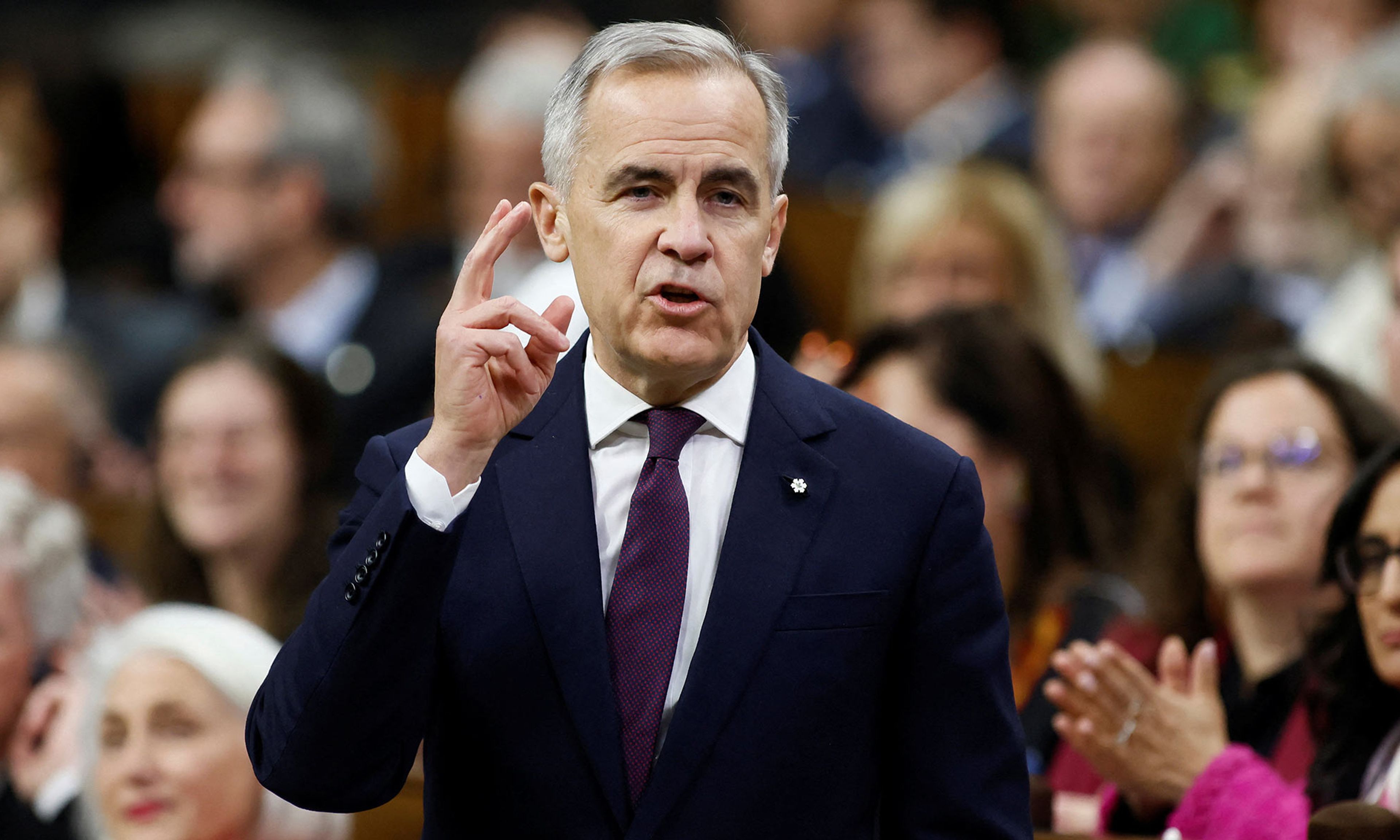
Canada's Prime Minister Mark Carney speaks during Question Period in the House of Commons on Parliament Hill in Ottawa, Ontario, Canada, November 17, 2025.
When even Greta Thunberg has largely turned away from radical climate action to other activities, you know that dread over climate change has fallen out of fashion. To be sure, she has not given childish environmental stunts up completely, but her main focus lately has been anti-Israel troublemaking, evidenced by her recent arrest in London while demonstrating in support of an organization proscribed by the British government as a terrorist group.
Among members of the public not named Greta Thunberg, climate change concern is also in decline. Surveys from the U.S., Europe, and Canada all show the general population significantly downgrading global warming as a top issue in recent years. And along with Greta Thunberg, other true believers of yore seem to be de-emphasizing their commitment to climate activism. Canadian Prime Minister Mark Carney may fall under this heading.
Carney was the United Nations Special Envoy for Climate Action and Finance from December 2019 to January 2025, when he left to run for leadership of Canada’s Liberal Party. His U.N. role mainly involved marshaling as much of the world’s private capital as possible into climate initiatives. Carney boasted in 2021, “We have banks, asset managers, pension funds, insurance companies from around the world — more than 45 countries — and their total resources, totaling $130 trillion” dedicated to transitioning the global economy away from fossil fuels. That fantastical sum was about 32 percent higher than global GDP at the time.
The same year, in an interview with Pivot Magazine, the industry magazine for Canada’s accounting professionals, Carney chastised business leaders whose operations were not aligned with his and Greta Thunberg’s vision of a sustainable economy. “A Swedish teenager can figure out the carbon budget and that we have less than 10 years and you have to get to net-zero to stabilize it and if you’re a company and you have purpose, well, what’s your plan?”
In addition to his United Nations role, beginning in 2020, after leaving his governorship of the Bank of England, Carney advised then-prime minister Trudeau on economic policy. He championed Trudeau’s carbon tax and praised Trudeau’s plan to push the tax to $170 per ton as a “model for others.”
Trudeau’s carbon tax became politically toxic as Canadians experienced its effects, so Carney abandoned it on his way to winning last year’s federal election. Yet he preserved or made worse many other aspects of Trudeau’s environmental agenda. Canada’s industrial carbon tax, which penalizes large emitters, remains in place. Carney’s first federal budget last fall proposed greater subsidies for biofuels. It also promised hundreds of millions of dollars in new environmental spending, including $40 million to create a “Youth Climate Corps” to “benefit young people through additional employment and/or training opportunities in support of climate emergency and recovery response.”
Now, however, there is hope that Carney may back away from additional elements of Trudeau’s environmental agenda. Whereas last year Liberal members of the House of Commons Industry Committee opposed a Conservative motion calling for the government to repeal Canada’s phased-in ban on internal-combustion engine sales, after the EU announced plans to scrap its own electric vehicle (EV) mandate in December, there is now immense pressure on Carney’s Liberal government to do the same. This pressure has been strengthened by the considerable headwinds to Canada’s automobile industry created by Trump’s erratic tariff policies.
Back in September, Carney launched a 60-day review of the EV mandate and paused the government’s 2026 target that would have mandated 20 percent of new vehicle sales be zero-emission. In November, the government said that next steps on EV policy would be announced in the coming weeks. Said announcement is expected to occur early this year.
Meanwhile, Canadians are voting emphatically with their wallets in rejection of any EV mandate. The latest monthly data from Statistics Canada show sales of zero-emission vehicles down 42.3 percent in October 2025 from a year earlier, and accounting for only 8.9 percent of total new motor vehicle sales. Moreover, according to AutoTrader, Canada’s largest online marketplace for automobiles, the proportion of consumers considering an EV purchase fell to 42 percent in 2025 from 68 percent in 2022. Also according to AutoTrader, 78 percent of Canadians believe it is unlikely or very unlikely that the government’s EV mandate can be achieved.
Ordinary people across the Western world are rejecting the expensive, economically harmful climate policies born from years of fanaticism. If they want their cause to become politically palatable again, Prime Minister Carney and other climate-concerned politicians in Canada should take note and continue to turn away from such policies.
About the Author
Matthew Lau is a writer in Toronto.
Featured Tags
Advertisement
Advertisement




Comments