Your Robot Carer Can Help
Written by Jordan McGillis
To stop the cost ratchet from turning inexorably against families that are seeking affordable options for kids and the elderly, we will need to get more comfortable with technology — including robots.
Share this story
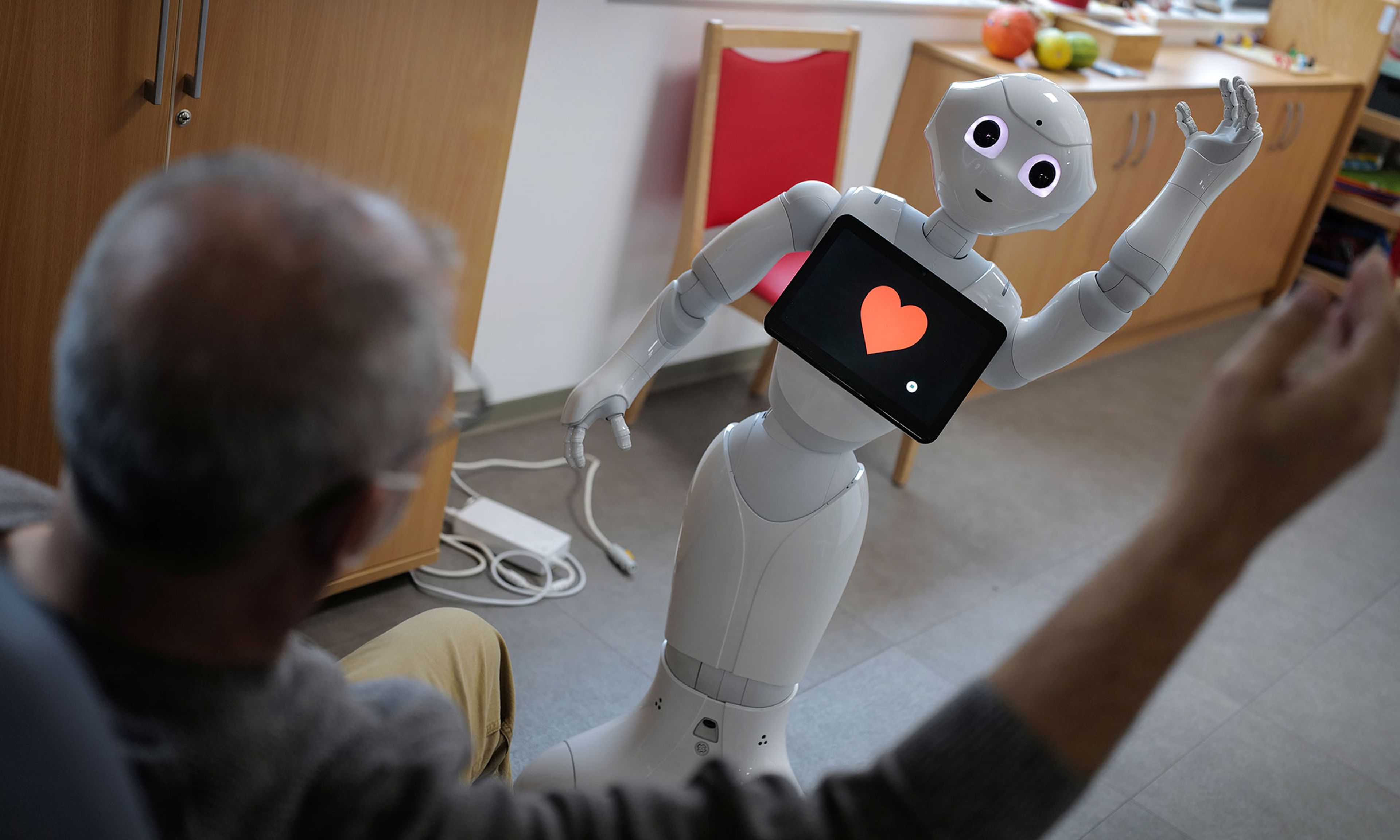
A guest of the day care center of German welfare organization Caritas follows the instructions of humanoid robot "Pepper" for his rehabilitation work during the Covid pandemic in Erlenbach, Germany, in 2020.
America faces a looming care crunch. As the Baby Boomers enter old age and smaller cohorts enter the labor force, the dependency ratio -- that is, the proportion of retirees and children to working-age people -- will likely rise to a level not seen since the Baby Boom itself.
Back then, the demographic challenge was managed mostly by harried mothers and female relatives. But while care for the young and the old has been supplied by kin historically, millions of families now opt to pay for help both inside and outside of the home. Rising wages, as economist Claudia Goldin explains, have pulled women into the formal workforce and away from the family in recent decades; the tradeoff has been forking over a growing chunk of that new income to cover the child and elder caretaking that makes workplace participation possible.
Immigration is one economic strategy to blunt care-related costs. Last year, I proposed a set of solutions to that end in the Washington Post, such as welcoming more au pairs through cultural exchange visas and removing degree qualifications for childcare licenses.
Another strategy is to improve caregiving efficiency through technology. I previously said that most people don’t want futuristic tech too close to their loved ones, and I therefore suggested that immigration was the better route. However, our politics continue to harden against pathways for lower-paid foreign workers. To stop the cost ratchet from turning inexorably against families that are seeking affordable options for kids and the elderly, we will thus need to get more comfortable with technology -- including robots.
In a November interview with Sean Hannity, Vice President JD Vance expressed a perspective on how technology can improve outcomes in blue-collar fields that’s worth applying to the care-related industry as well. “No robot can replace a great blue-collar construction worker,” Vance said. However, he added, “There’s an art there that I don't think a robot's ever going to be able to replace. But a robot maybe makes it easier for a construction worker to put more nails and more walls over a shorter period.”
The insight is just as relevant to the “pink-collar” care fields, where human connection is essential. We want our kids and elders in the trusted hands of a compassionate person, and we can supply caregivers with technologies that enhance their efforts. As the pool of potential caregivers shrinks relative to the pool of those in need of care, the possibility will become a necessity.
Fortunately, opportunities to complement caregivers with AI and robotics abound.
In elder care, one of the greatest risks for workers is the physical challenge of helping adults get up, down, and around. Not only are these moments when a care recipient can fall, but they are also instances of intense strain and potential injury for caregivers whose own bodies are put in compromised positions. Equipping caregivers with robotic assistance for these tasks would improve the well-being of all involved. Lowering the probability of injury, pain, and missed work for the caregiver would result in aggregate cost savings for providers like nursing homes. At the most rudimentary, a rolling machine with a strong, mechanical-assistance bar could help pull elderly people to stand. Likewise, humanoid robots could someday provide a second set of “hands” for more complicated maneuvers.
In the childcare domain, some costs result from duplicative staffing for administrative compliance. One specific rule exemplifies the well-intentioned, but price-ratcheting, nature of childcare regulation. According to the Virginia administrative code for childcare, "resting or sleeping infants shall be individually checked every 15–20 minutes." Moreover, "one staff member shall not supervise more than one room or area during rest time." Other states have similar requirements. While these strict rules were rather sensical, there is a useful alternative today: Cameras enhanced with AI can now track the rise and fall of a baby’s breathing chest, then alert caregivers if anything is amiss. The existing requirements take a caregiver’s attention away from other children; they compound into staffing rules that make infant care cost parents more than $20,000 annually in a place like Fairfax County, Virginia.
As the dependency ratio worsens, the cost of caring for the young and the old will climb unless labor costs are addressed. One mechanism, which is now politically toxic, is to add workers through immigration. However, an alternative viable path politically is to embrace AI and robotics technology. Just as the vice president envisions in the blue-collar fields, technology can enhance caregivers’ labor of love.

About the Author
Jordan McGillis is a fellow at the Economic Innovation Group and a 2025-2026 Novak Journalism Fellow with the Fund for American Studies.
Featured Tags
Advertisement
Advertisement

Comments