Share this story
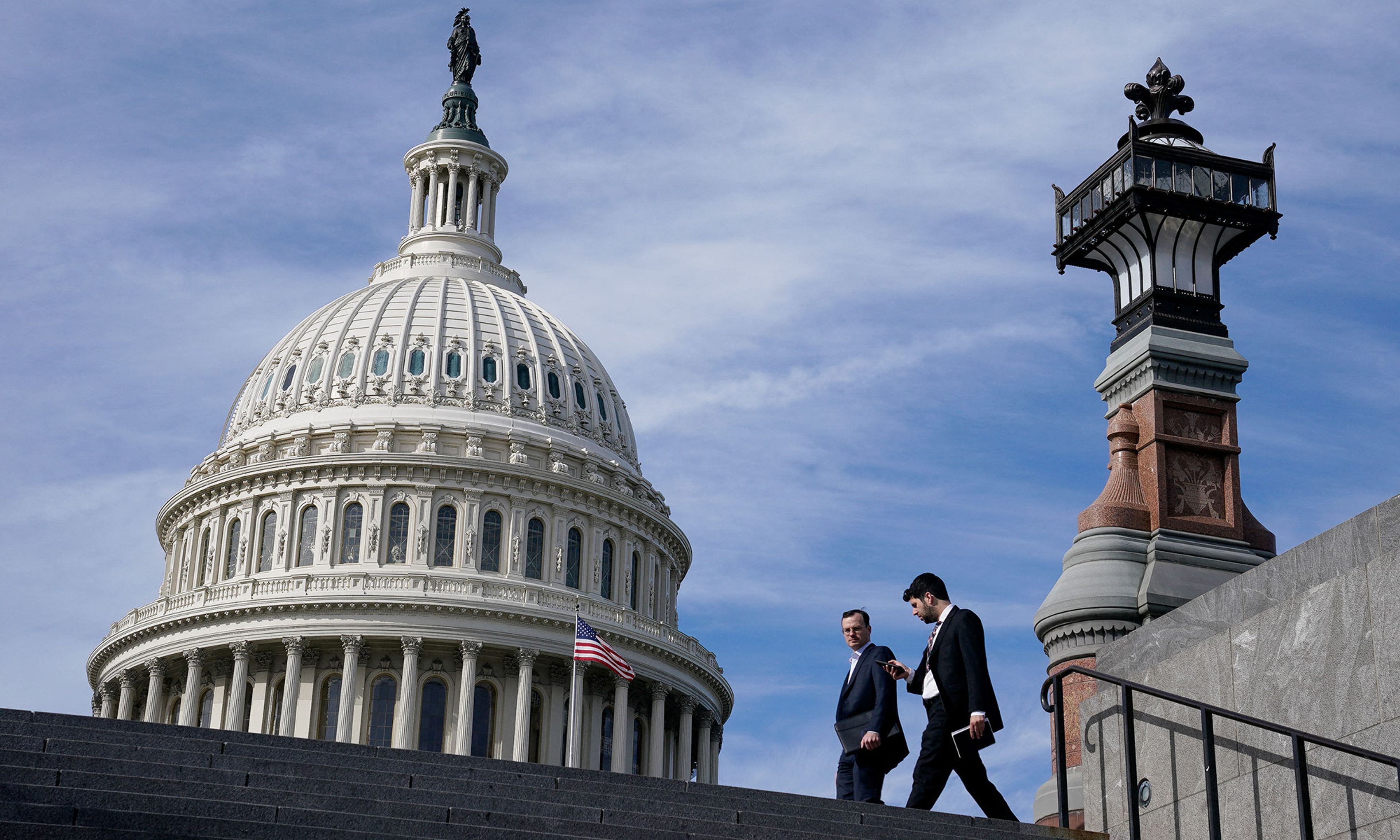
People walk past the U.S. Capitol in Washington, D.C., November 15, 2023.
The Justice Department’s decision this week to eliminate disparate-impact liability from its Title VI regulations marks a critically important correction in our civil rights laws. For the first time since the early 1970s, the Department has realigned its rules with the Constitution and with the original meaning of the Civil Rights Act of 1964, which guarantees that every individual is entitled to equal treatment under the law without regard to race.
This long-overdue administrative action needs to be enshrined in our civil rights laws, and Congress should make doing that a priority.
For decades, disparate-impact theory pushed schools, hospitals, state agencies, nonprofits, and local governments to do exactly the opposite. Institutions were warned that regardless of intent, statistically uneven outcomes among racial or ethnic groups could trigger federal investigations, funding cutoffs, and crushing legal liability. Under this regime, neutrality was not enough. Equality before the law became suspect if it failed to yield proportional results.
The predictable result was a quiet but sweeping distortion of public policy. Institutions learned that the safest course was not to treat people as individuals, but to treat them as members of racial groups. Admissions offices, hiring committees, contracting authorities, and grant administrators increasingly sorted Americans by race — not out of malice, but out of fear. Federal regulators had created a system in which racial decision-making became the path of least resistance.
This pressure warped policy choices across countless domains. School discipline rules were relaxed not because they improved safety or learning, but because they reduced racial disparities in suspension data. Academic standards were lowered or abandoned to achieve demographic parity. Hospitals altered care protocols and resource allocation to avoid uneven outcome statistics. Local governments adopted race-based contracting goals and set-asides, even when those policies conflicted with merit, efficiency, or fairness. In each case, the driving force was not evidence of discrimination, but anxiety over numbers.
This regulatory drift never had a basis in Title VI. Congress prohibited intentional discrimination — nothing more and nothing less. The statute’s text is unambiguous. Yet in 1973, federal bureaucrats added disparate-impact liability through regulation rather than legislation. This misguided innovation transformed a civil rights law meant to secure equal opportunity into a mechanism that demanded racial engineering. It encouraged litigation not against purposeful exclusion, but against neutral policies whose results failed to mirror national or local racial percentages.
Over time, disparate impact inverted the moral logic of civil rights. Instead of asking whether individuals were treated fairly, regulators asked whether groups were represented proportionally. Instead of rooting out discrimination, the doctrine incentivized it. Race became the lens through which every policy decision was evaluated, and deviation from racial balance became prima facie evidence of wrongdoing. The result was a bureaucratic obsession with outcomes that crowded out common sense, institutional autonomy, and individual dignity.
The Supreme Court has been warning about this danger for years. In Alexander v. Sandoval, the Court held that Title VI itself does not authorize disparate-impact claims. In Ricci v. DeStefano, it made clear that fear of disparate-impact liability cannot justify intentional racial discrimination. And in 2023, in Students for Fair Admissions v. Harvard, the Court rejected the notion that benign intentions, sociological theories, or historical narratives can excuse racial classifications by institutions receiving public funds.
The Justice Department’s recent action is greatly welcomed. But administrative reform alone is not enough. The same regulatory pen that created disparate-impact liability fifty years ago could recreate it in the next administration. Civil rights protections should not depend on which party controls the executive branch. They should be stable, principled, and anchored in law.
Congress must therefore finish the job. It should amend Title VI to state explicitly that the statute prohibits intentional discrimination only. Such clarification would foreclose future attempts to impose racial balancing through regulation. It would reaffirm that civil rights belong to individuals, not racial groups. And it would allow government-funded programs to focus on genuine economic or educational disadvantage — without resorting to racial categories, proxies, or quotas.
This legislation would not weaken civil rights. It would restore them. It would honor both the Constitution and the proper vision of the Civil Rights Act, in which the law protects persons as persons, not as representatives of a racial class.
Equal treatment under the law is not merely a legal principle. It is the colorblind covenant that binds together our multi-racial nation. Congress should secure it against bureaucratic overreach and against the shifting winds of politics.
About the Author
Edward Blum is the founder and president of Students for Fair Admissions.
Featured Tags
Advertisement
Advertisement





Comments