Justice Scalia at 90: A Justice for the Ages (Part 3)
Written by Carrie Campbell Severino
Share this story
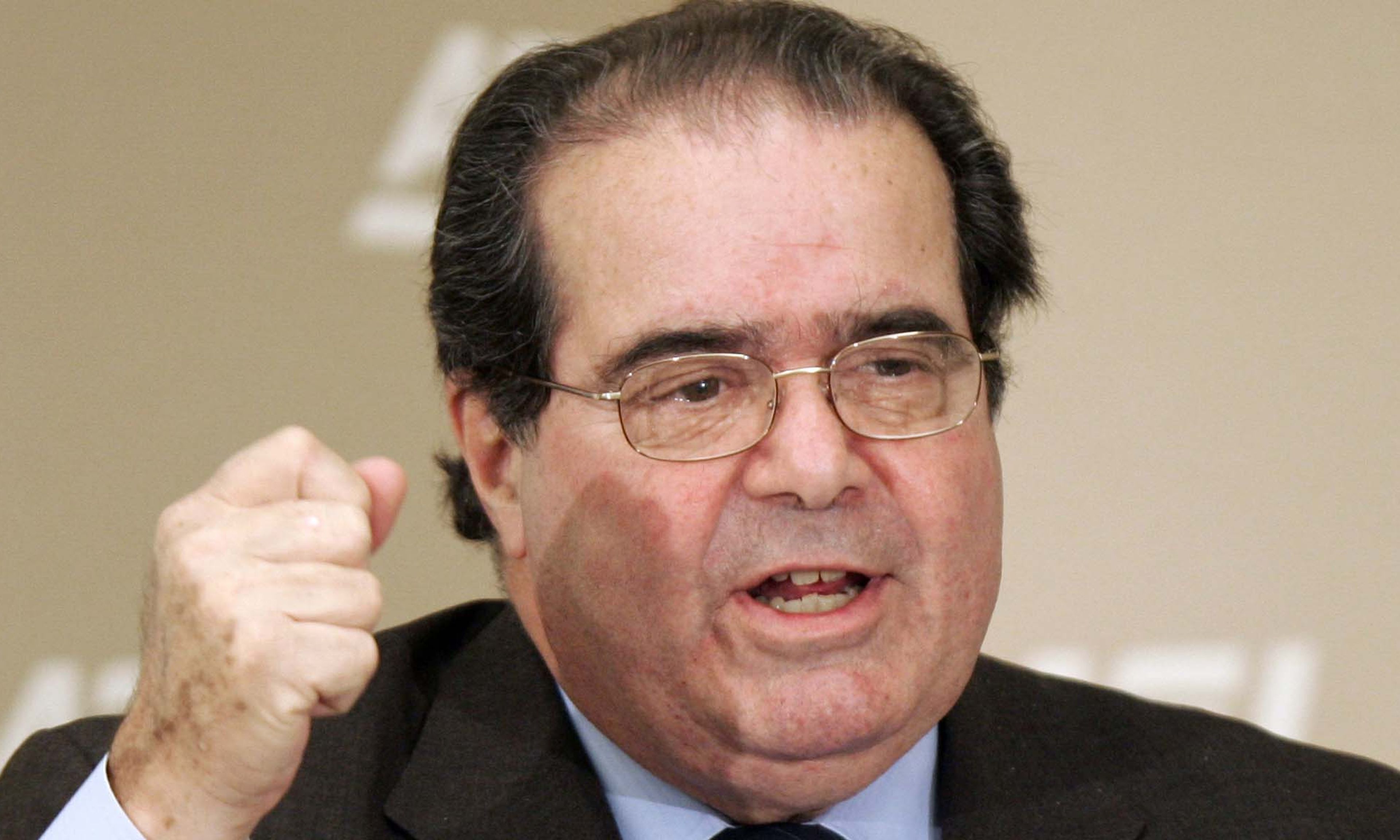
Then-Supreme Court justice Antonin Scalia speaks at the American Enterprise Institute for Public Policy Research in Washington, D.C., February 21, 2006.
How to sum up Justice Scalia’s impact on the law? We can begin with his jurisprudence on the structural Constitution, which I discussed in part 2. Scalia’s warnings about independent agencies and administrative overreach have gained traction in decision after decision. With Scalia’s vote, the Court struck down dual-layer for-cause removal protections that insulated officers from presidential control in Free Enterprise Fund v. Public Company Accounting Oversight Board (2010).
More recently, in Seila Law LLC v. Consumer Financial Protection Bureau (2020), the Court made clear that an official who wields significant executive power—the CFPB’s director—cannot be insulated from the president’s removal authority by a for-cause prerequisite. The Court did not overrule Morrison v. Olson (1988)—or, for that matter, Humphrey’s Executor v. United States (1935), which permitted for-cause removal protections for multi-member independent agencies—but limited the application of both precedents to their respective contexts. Scalia had sharply criticized Humphrey’s Executor in his Morrison dissent, and this term, the likelihood of Humphrey’s Executor being overruled is significant as Trump v. Slaughter directly challenges the ninety-year-old precedent. As John Yoo recently observed, “Were it not for Scalia’s unique contribution to the Court’s approach to the separation of powers, the Roberts Court’s coming decisions this summer that may strike down virtually all independent agencies would not have been possible.”
Scalia also made his mark in his criticism of the three-part test created by the Court for the Establishment Clause in Lemon v. Kurtzman (1971)—a test Scalia believed was both unworkable and untethered from constitutional text and history. For decades, the Court continued citing Lemon even as it routinely ignored the test’s requirements. Scalia memorably wrote in his concurrence in the judgment in Lamb’s Chapel v. Center Moriches Union Free School District (1993): “Like some ghoul in a late-night horror movie that repeatedly sits up in its grave and shuffles abroad, after being repeatedly killed and buried, Lemon stalks our Establishment Clause jurisprudence once again, frightening the little children and school attorneys of Center Moriches Union Free School District.” The Court formally acknowledged in Kennedy v. Bremerton School District (2022) that Lemon no longer controls, so the ghoul was finally laid to rest. And while there are valid originalist criticisms of the free exercise standard Justice Scalia articulated in Employment Division v. Smith (1990), the balance of his religion clause jurisprudence helped end the Court’s hostility to religious expression and usher in a victory streak for religious liberty claims that began during his last years on the Court.
Unlike some areas in which Scalia’s vindication was delayed for decades, in Crawford v. Washington (2004), he was able to win over a majority of the Court to the textualist approach he had urged in his Maryland v. Craig dissent fourteen years earlier. Scalia’s opinion for the Court did not directly overturn that precedent but did overturn another, more foundational interpretive precedent by establishing that the Sixth Amendment’s original meaning and text demanded better than “replacing categorical constitutional guarantees with open-ended balancing tests.” So testimonial statements by witnesses absent from trial could be admitted only where the witness was unavailable and the defendant had a prior opportunity for cross-examination. That decision represented a triumph for originalism in criminal procedure.
Scalia also found a measure of vindication in his own time on the issue of political speech, which he consistently voted to protect from government restriction under the guise of campaign finance regulation. The Court’s decision in Citizens United v. Federal Election Commission (2010) striking down independent spending and broadcast bans by corporations and unions contained numerous citations to Scalia dissents and separate concurrences that had not carried a majority in prior cases. Other campaign finance cases since then have continued the trend of protecting political speech, and a case on the docket this term, National Republican Senatorial Committee v. Federal Election Commission, offers the prospect of overruling a prior decision from which Scalia had dissented, Federal Election Commission v. Colorado Republican Federal Campaign Committee (2001).
On matters of race, Scalia periodically found himself at odds with the majority, as in the Court’s decision upholding racial preferences in law school admissions in Grutter v. Bollinger (2003). “The Constitution proscribes government discrimination on the basis of race,” he wrote in his partial dissent, “and state-provided education is no exception.” Twenty years later, in Students for Fair Admissions v. President and Fellows of Harvard College (2023), the Court adopted the nondiscrimination principle long advocated by Scalia as it ended racial preferences in education.
A monumental vindication of Scalia’s jurisprudence came with the Court’s overturning of Roe v. Wade (1973) in Dobbs v. Jackson Women’s Health Organization (2022). And not just because Scalia had pushed as ardently as he did for that result during his tenure. When Justice Samuel Alito was asked in a recent interview whether his opinion for the Court in Dobbs is “indebted to Antonin Scalia in any meaningful respect,” the justice replied, “Yes, absolutely, because that was my effort to write an originalist’s opinion.” He added, “I flatter myself to think that he wouldn’t have written it very differently. And the language, to a degree, may be influenced by him.” Even apart from the specific context of abortion, Dobbs and other recent cases reflect that the Court is no longer in the business of aggrandizing itself with the concoction of new “rights” that are neither deeply rooted in history and tradition nor supported by constitutional text.
Of course, all of these fronts on which Scalia has been vindicated are components of his overarching triumph, the triumph of originalism. It was a generational project, and Scalia knew it. Plenty of observers during his years on the Court wondered why he devoted so much effort to crafting one dissent after another. Was that really a legacy-building activity? But they need only consider the justice’s own statement that he wrote his dissents for law students. He wanted to teach the next generation how to think about law. And he succeeded. Today’s Supreme Court, today’s federal judiciary, and today’s legal academy have been transformed by the interpretive revolution he led. Originalism went from stigmatization when Scalia arrived on the Court to an originalist majority with the appointment of his former law clerk, Justice Amy Coney Barrett, in 2020. In fact, in recent times, even non-originalist liberal judges can be expected to pay at least lip service to Scalia’s philosophy—see Justice Elena Kagan’s notable remark during her 2010 nomination that “we are all originalists.”
The early years of Justice Scalia’s tenure overlapped with the final years of Justice William Brennan, who in 1986 had served on the Court for thirty years and would ultimately be remembered for (as his New York Times obituary put it) giving the Supreme Court a “liberal vision.” Scalia himself had called Brennan “probably the most influential justice of the [20th] century,” and it says something about the junior justice’s stature that the Scalia-Brennan matchup defined the Court’s ideological battles during the late 1980s. Brennan, who retired in 1990, championed the “living Constitution” while Scalia insisted on original meaning. At the end of Scalia’s nearly thirty-year tenure, his chief jurisprudential rival was seen as Justice Ruth Bader Ginsburg, who during the 2010s had something of a cult following. But Ginsburg’s impact on constitutional jurisprudence did not come close to that of Scalia (even if she would get a postage stamp and he would not) or Brennan. Whether or not it was the case one or two generations ago, Scalia today eclipses Brennan, with originalism having supplanted the once dominant living constitutionalism.
According to Bloomberg Law’s recent analysis, no other former justices have been referenced nearly as often in oral arguments since 2016. Additionally, Adam Feldman’s study of merits briefs over the past two years found that “Scalia is cited across party types and across administrations because his formulations are embedded in the Court’s doctrine. He has become part of the justices’ shared grammar.”
Justice Scalia transformed the high court and changed how Americans think about the law. He demonstrated that interpretation is not a cover for imposing personal predilections, but a discipline that requires fidelity to text, history, and structure. He showed that colorful writing can coexist with rigorous reasoning. He proved that dissents today can become majorities tomorrow if the arguments made are powerful.
It is easy in the present era of an originalist Supreme Court to forget the struggles it took to make that possible. As we mark his 90th birthday, we can say about the protracted fight for originalism to which he was indispensable: Justice Antonin Scalia won.
This is the final item in a three-part series. You can read the first part here and the second part here.

About the Author
Carrie Severino is the president of JCN.
Featured Tags
Advertisement
Advertisement

Comments