What to Watch for in the Supreme Court’s Most Consequential Campaign Finance Case Since <em>Citizens United</em>
Written by Matthew Petersen
Share this story
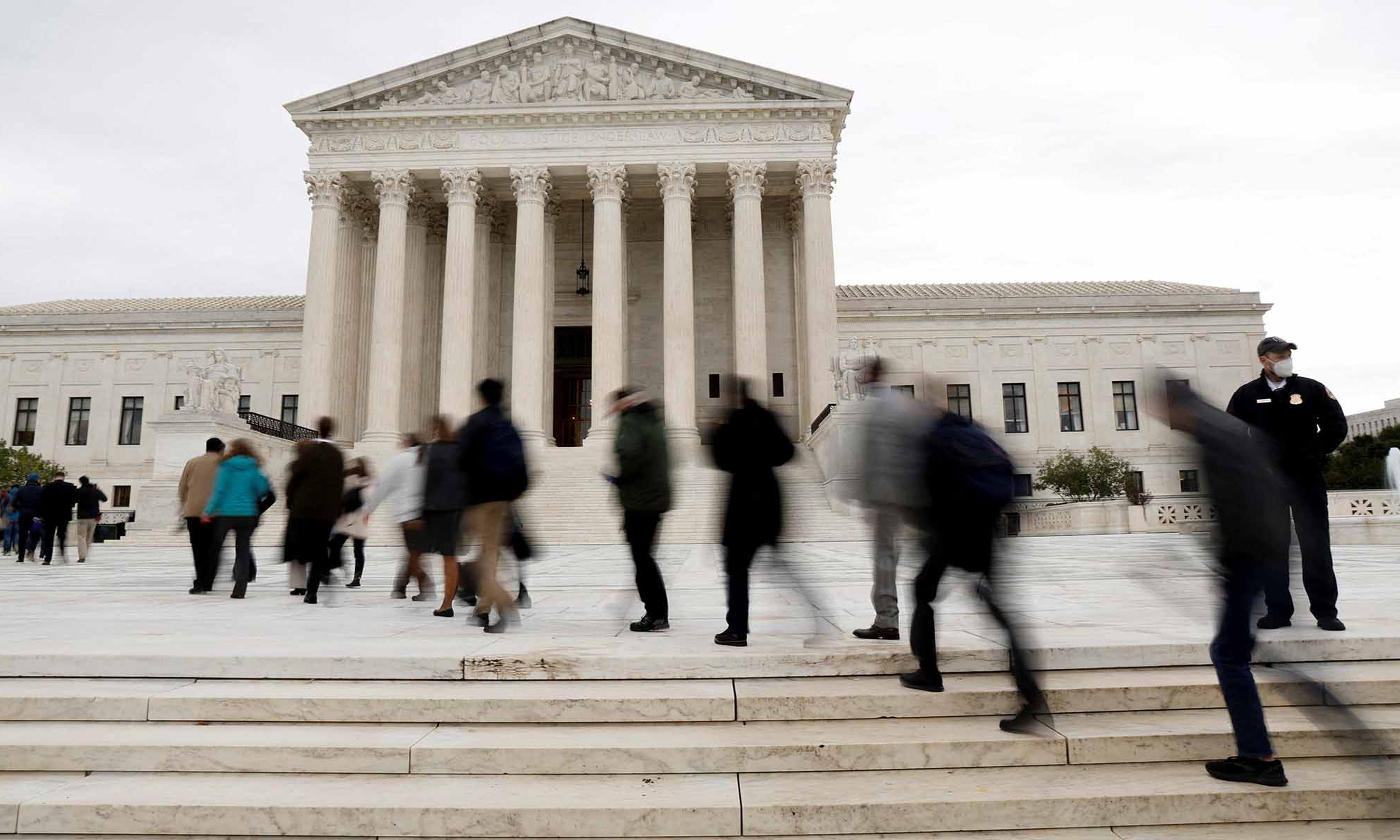
People walk across the plaza to enter the Supreme Court building in Washington, D.C., October 3, 2022.
Next week, the Supreme Court will hear the oral argument in the most consequential case on political money since Citizens United. Although the case centers on a relatively narrow question — whether limits on a political party’s ability to spend in coordination with its own candidates violates the First Amendment — the outcome’s implications could be far-reaching. What the justices say could signal whether the Court intends to maintain the status quo, use a scalpel to excise the party coordinated expenditure limit, or take a wrecking ball to the remaining pillars of campaign finance regulation.
The case, NRSC v. FEC, targets a provision of federal campaign finance law that treats any party communication made in cooperation or consultation with candidate as an in-kind contribution subject to strict limits. Because parties, like other speakers, may spend unlimited amounts only if they act independently, these coordination limits have forced party committees to create firewalled “independent expenditure” units that cannot communicate with candidates, which can result in inconsistent messaging between parties and their own nominees.
The GOP’s national campaign arms for the Senate and House brought the challenge, arguing that the limits unconstitutionally burden their First Amendment speech and associational rights by hampering the parties’ ability to work effectively with their candidates. Although the lower court upheld the limits, several judges noted that more recent developments in campaign finance law cast doubt on whether these restrictions can continue to stand and effectively invited Supreme Court review.
Here are the key things to watch for during the argument:
1. Corruption: A More Limited Definition Ahead?
The scope of the Court’s ruling — and its future direction in political spending cases — may turn on how narrowly it chooses to define “corruption.” Since Buckley v. Valeo (1976), the Court has held that preventing corruption or its appearance is the only legitimate rationale for upholding contribution limits. And in Citizens United (2010), the Court clarified that “corruption” means quid pro quo exchanges of official actions for political contributions.
During oral argument, watch if any justice asks whether the anti-corruption rationale should be further narrowed to exclude the “appearance” of corruption. Some scholars criticize the reliance on the appearance of corruption to justify the speech restrictions that contribution limits impose — arguing the standard rests on a “mirage” that contribution limits meaningfully increase trust in government.
Should the Court narrow the anti-corruption rationale further, additional campaign finance regulations would likely be swept away in this case’s wake.
2. A Narrow Fix or a Broader Shift?
Paying close attention to the tone and breadth of the justices’ questions may reveal how far they are prepared to go. Are the justices focused narrowly on the party coordination limit? Or are they more broadly calling into question the legal viability of the rules governing political money?
If several justices go beyond party coordination and focus more generally on First Amendment principles, that may indicate the Court’s willingness to dismantle more of the remaining campaign finance framework down the road — including last surviving plank of the 2002 McCain-Feingold reform bill: the ban on parties raising soft money.
3. The Uniqueness of Political Parties
Expect extensive discussion about the role of parties in our political system. As longstanding institutions that are indispensable in mobilizing voters and playing a moderating role in our politics, healthy parties are widely regarded as essential to a healthy democracy. Yet since Citizens United, super PACs and other outside groups have often overshadowed the parties in fundraising and influence. Limits on party coordinated spending further exacerbate this disparity by pushing more money to outside actors, many of which exist for only a single election cycle.
If the justices emphasize the unique importance of parties in our democratic system — and their need to be free from unnecessary obstacles in supporting their candidates — the challengers will be well-positioned to prevail.
4. The New Conservatives: Gorsuch, Kavanaugh, and Barrett
None of the Court’s three most recently appointed justices — Neil Gorsuch, Brett Kavanaugh, and Amy Coney Barrett — participated in Citizens United. And apart from a case about candidate loan repayments, these justices have not yet expressed their broader philosophy on money in politics. Their questioning could reveal whether the Court’s right flank wants to largely maintain the current campaign finance rules — or move aggressively to roll back what remains of them.
Do they view a party’s coordinated spending as creating bona fide corruption risks? Or do they express general skepticism toward the entire enterprise of campaign finance reform? These justices aren’t reticent questioners, and we should quickly get a sense of where they stand.
5. The Liberal Justices: Potential for Surprise
Many assume the Court’s progressives will vote to uphold the limits on party coordinated spending — but that assumption may be inaccurate. Some pro-campaign finance reform groups and liberal thinkers have criticized coordination restrictions, arguing they force parties and their candidates to operate at arm’s length from one another, leading to conflicting messaging and strategies; impose onerous compliance burdens; and have placed parties at a competitive disadvantage relative to outside groups. Lifting the coordination limits, they contend, could bolster parties by restoring accountability and transparency.
So watch for whether any member of the left wing picks up on those arguments. It’s possible that one or more of the liberal justices could surprise observers in this case.
By the end of the argument, Court watchers may better understand whether the Court intends to largely preserve — or significantly reshape — the legal framework regulating money in politics. If a majority of justices express doubts about the broader regulatory project, invalidating the party coordinated expenditure limits could be just the first domino to fall.
About the Author
Matthew Petersen is the former chairman of the Federal Election Commission and is a partner at Holtzman Vogel Baran Torchinsky Josefiak PLLC.
Featured Tags
Advertisement
Advertisement


Comments