Share this story
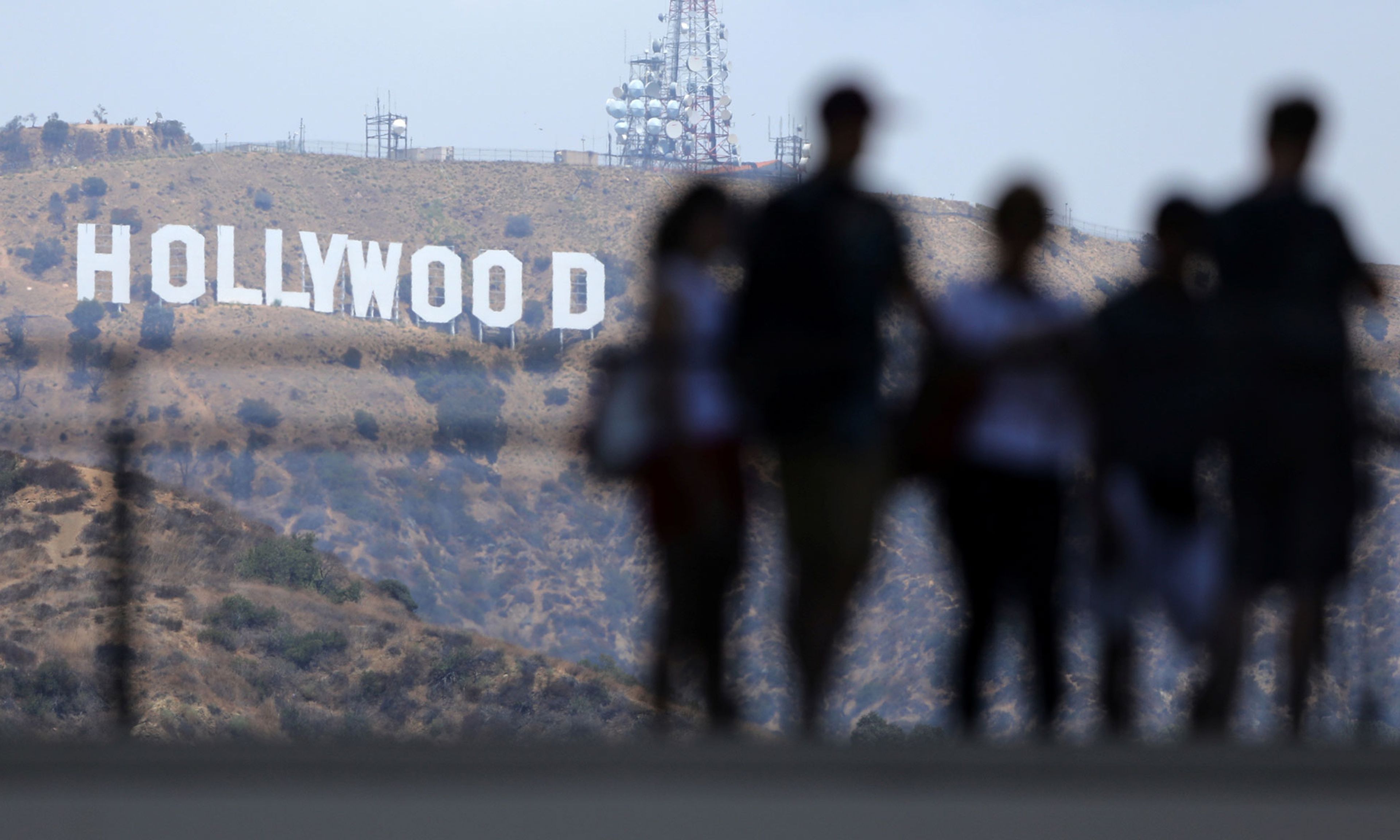
Tourists view the Hollywood sign from a shopping complex along Hollywood Boulevard in Hollywood, Calif., in 2017.
Greetings and welcome once again to the Carnival of Fools, our weekly gathering of headline-grabbing political clowns. Look at them tumble and twirl, each of them striving desperately for the spotlight in a world where emotive entertainment has rapidly overtaken sober policymaking as the focus of attention. Perhaps it’s a tribute to the eerily prescient name of this column — thanks for the tip, Rich! — that the worlds of politics and entertainment are now beginning to collide more obviously than ever before, albeit in the least predictable way.
Yes, folks — this column was once intended exclusively for such things as the president’s fascinating willingness to own the idea of “canceling Christmas,” but that was before he changed the subject at the last minute. Grab your popcorn and read on — it may well be the last time you head to the movies for a while.
Donald Trump Trolls for Attention
Before I even get into this week’s most ridiculous news, I want to make a note about the president’s use of his boutique social media outlet Truth Social. I cannot imagine who spends time there other than true believers and journalists who are monitoring the president’s account for the newest scandal, which is precisely why Trump’s machine-gun rate of “truthing” is remarkable. He will author 20 “truths” on any given night (and it genuinely seems that he’s the one doing both the writing and the “re-truthing”). Most of the time none of them will make any sort of news. When they do, it’s invariably for some truly remarkable provocation.
My decades-long familiarity with watching people — particularly those in isolation — succumb to the temptations of social media makes me inevitably wonder about how the process can play out for anybody who begins to live online more than in the real world. (See, for example, my many thoughts on the trajectory of Elon Musk.) Make no mistake: That description may well soon apply to nearly all of us in modern Western society, which is why the warping nature of AI and our atomizing, anomie-inducing daily life loom large in my mind.
In particular, it’s hard not to notice how Trump immediately turns to Truth Social to make a big random “splash” — not even to restart the news cycle but just to keep himself the center of it. Think about the low-level provocations he and his social media team have offered the world over the last week alone. Forget about Trump’s team depicting him as a Sith lord for “May the Fourth Be with You,” there isn’t even enough room in this column to give the whole “Trump as Pope” nontroversy its proper airing. (I thought it was mildly amusing, but then again, as a heathen Episcopalian, I would.)
Donald Trump Nukes Hollywood from Orbit, as the Only Way to Be Sure
The president capped off his weekend search for global attention with a true double whammy. In two important announcements late on Sunday — presumably concocted during a movie night showing of The Rock — Trump declared that (1) he was going to Make Federal Supermax Great Again by reopening the infamous San Francisco Bay Area island prison of Alcatraz; (2) he was also going to Make Hollywood Great Again the only way he knows how: by blowing up the entire industry with bizarre and crudely applied tariffs:
The Movie Industry in America is DYING a very fast death. Other Countries are offering all sorts of incentives to draw our filmmakers and studios away from the United States. Hollywood, and many other areas within the U.S.A., are being devastated. This is a concerted effort by other Nations and, therefore, a National Security threat. It is, in addition to everything else, messaging and propaganda! Therefore, I am authorizing the Department of Commerce, and the United States Trade Representative, to immediately begin the process of instituting a 100% Tariff on any and all Movies coming into our Country that are produced in Foreign Lands. WE WANT MOVIES MADE IN AMERICA, AGAIN!
Politico sought to associate these newly announced tariffs with the administration’s semi-honorary “ambassador to Hollywood,” actor Jon Voight. But from my reading of that story, these tariffs seem to have come from Trump and not from someone else who pitched him the idea. Bloomberg followed up with a story indicating as much: Voight and his manager Steven Paul apparently briefed Trump over the weekend on a plan for tax incentives and credits to encourage Hollywood to film more in the U.S. — rather middle-of-the-road stuff. Trump took that meeting and then — in a manner almost beyond parody — reached for the only tool in his policy kit: tariffs. Naturally, Hollywood is beside itself, as any industry that had just been dealt a massive and creatively destructive blow would be.
On a procedural level, Trump’s “reasoning” is galling enough. The casual way Trump defines as a “national security threat ” the entirely innocuous act of a country’s offering tax breaks to studios to film there, and the way he then immediately turns to use this as formal excuse to unilaterally impose tariffs, is so warped that I suspect it will be lost in the thicket of commentary about this issue. Leave aside the fact that Trump’s diagnosis of Hollywood’s problems reads like that of someone who stopped attending theaters 20 years ago; the fact that he is deploying such transparently capricious “reasoning” as a legal fig leaf for industry-shattering tariffs should be understood properly as an authentic constitutional problem.
Beyond that, nothing about this idea makes even the slightest lick of sense to anyone who would actually want to make Hollywood great again. Trump is essentially placing tariffs on the idea of filming on location — and, in so doing, telling Hollywood what kinds of stories it is now allowed to tell, unless it wants to start paying impossible amounts for the privilege of doing otherwise. Did you like Raiders of the Lost Ark? Steven Spielberg had to film the desert sequences of that film in Tunisia, because no place in America looked remotely plausible as a stand-in for Egypt. Did you enjoy a little film known as Star Wars? George Lucas also had to film the desert sequences of that movie in Tunisia, because Tatooine was too hard to get to on a mere $11 million budget.
What is Trump’s intended effect other than to swing the tariff club around some more, for lack of any other way to interfere with the economy? Surely, he cannot think this will “re-Americanize” the film industry? What could that possibly mean? Studios shooting exclusively in American locations? Good luck finding a way to represent on film a European or Asian city without traveling to . . . Europe or Asia. Perhaps Trump was told by someone that countries like Canada often attract television and film productions because of tax breaks and lower costs; it would be pathetically appropriate if Trump were to react to this not by wondering why filmmakers and studios have difficulty shooting in cities like Los Angeles or New York but rather by coming up with this tariff idea.
So, I wonder — is this an imposture? Is Donald Trump just trolling Hollywood? Because this is the sort of policy you would impose if you hated the film industry and wished for it to collapse altogether (outside of the occasional toy- or video-game-themed movie, that is). Why would Trump do this if not to put Hollywood in its grave once and for all? Tariffs wouldn’t improve Hollywood’s output or profit margins. If anything, the number of movies being made would shrink precipitously as labor costs inevitably ballooned.
The Carnival of Fools isn’t the proper place for a lengthy sociological rumination about the reasons for the decline of the film industry. (Many talented alcohol-sodden YouTube essayists have already covered this ground far better than I ever will.) But it is clear enough to me that the movie industry of my youth died not because other countries stole film production locations (as if this even needs saying) but rather because American tastes have permanently changed. With a multitude of modern homebound entertainment options, amidst changing cultural mores and rising prices, we just don’t have a need or desire to go to the movie theater as much as we once did. Hollywood changed accordingly, and much of its elite talent has either left or been left behind. Americans now go to theaters to see A Minecraft Movie, not Chinatown. No tariff policy will ever restore our tastes.
Until next week.

About the Author
Jeffrey Blehar is a National Review staff writer living in Chicago. He is also the co-host of National Review’s Political Beats podcast, which explores the great music of the modern era with guests from the political world happy to find something non-political to talk about.
Featured Tags
Advertisement
Advertisement

Comments