Share this story
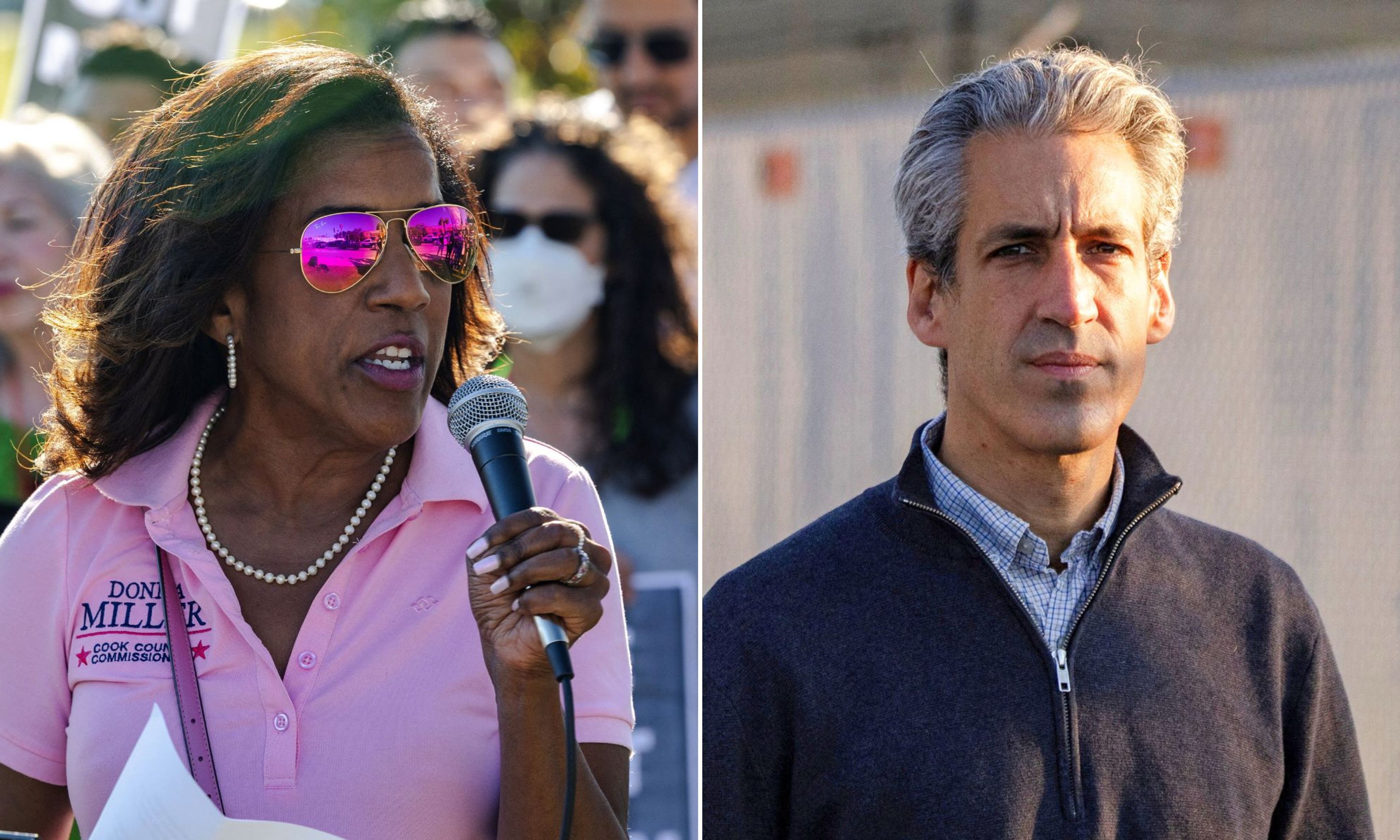
Left: Cook County Commissioner Donna Miller speaks at a press conference in Hines, Ill., September 15, 2025. Right: Evanston Mayor Daniel Biss stands outside a facility in Broadview, Ill., September 26, 2025.
The Democratic primary results out of Illinois are sure to frustrate political observers who were hoping to draw a clear lesson on the power of the American Israel Public Affairs Committee in a rapidly shifting political landscape.
AIPAC-funded spending groups had a mixed night on Tuesday, winning two of the four closely watched open Democratic House contests they invested in after spending nearly $22 million dollars boosting their preferred candidates.
AIPAC-preferred candidates were successful in two of the races: Cook County commissioner Donna Miller in the second congressional and former Congresswoman Melissa Bean in the eighth.
But anti-Israel groups, activists, and candidates are taking a victory lap in Illinois primary races where AIPAC-preferred candidates weren’t successful this week, including Evanston Mayor Daniel Biss in Illinois’s ninth district and La Shawn K. Ford in the seventh.
“AIPAC found out the hard way — the 9th District is not for sale Biss, whom AIPAC-aligned groups spent heavily against, told supporters at his election night party.
Tuesday’s primary results present an early test of how anti-Israel sentiment might play in the 2026 midterm elections and beyond, despite the monthslong ceasefire in Gaza and the fact that the bulk of the ads created by AIPAC-funded groups didn’t even mention Israel.
Tuesday’s elections also present new questions for pro-Israel activists and candidates about how they can calibrate their political strategy at a time when AIPAC is considered politically toxic by progressive activists, who often employ antisemitic tropes regarding pro-Israel groups’ alleged power to influence electoral outcomes.
Anti-Israel activists are hoping that any primary spending that is even remotely tied to the pro-Israel lobby will continue to be a lightning rod for candidates in future Democratic contests, even as cryptocurrency and artificial intelligence-backed super PACs spend millions boosting their preferred candidates and get far less criticism.
“21+ MILLION dollars shunted through a web of shell PACs only for AIPAC to go 50/50 in Illinois,” the anti-Israel account AIPAC Tracker wrote in a Wednesday morning social media statement. “Just a short time ago, a candidate who called Gaza a genocide, supported BDS, and demanded conditions on aid to Israel would have been laughed and spent out of relevance. Now those candidates are driving the narrative.”
“Guess that blood money just doesn’t spend like it used to,” the statement continued.
The Iran war has also introduced renewed criticism of Israel as would-be 2028 Democratic presidential candidates are making an early play to appease progressives who have long been critical of the Jewish state. California Governor Gavin Newsom, for example, recently accused Israeli Prime Minister Benjamin Netanyahu of pressuring the U.S. into war with Iran and praised people who are “talking about” Israel “appropriately as sort of an apartheid state.”
Asked recently whether he would accept money from AIPAC, Newsom said: “Never have and never will.”
Debates over pro-Israel groups’ spending role in primaries has been particularly robust this midterm cycle in Michigan, home to the Arab-majority city of Dearborn and the 2024 Uncommitted movement that declined to support Joe Biden’s reelection bid over his support for Israel.
Michigan’s 2026 Democratic Senate primary is a robust contest between three candidates: AIPAC-backed U.S. Representative Haley Stevens, anti-Israel progressive Abdul El-Sayed, and state legislator Mallory McMorrow, whose views toggle somewhere in between both other candidates.
“Abdul is the only candidate in this race with the courage to speak up — even if AIPAC and MAGA billionaires come after him for doing so,” El-Sayed’s campaign wrote in an August 4 fundraising email reviewed by National Review. “But this kind of honesty comes with a price. Those who profit from endless war, like AIPAC, are going to come after us.”

About the Author
Audrey Fahlberg was a politics reporter for National Review.
Featured Tags
Advertisement
Advertisement

Comments