Algerian Boxer Imane Khelif Admits to Having Male Chromosome After Fighting Women in '24 Olympics
Written by Kamden Mulder
Share this story
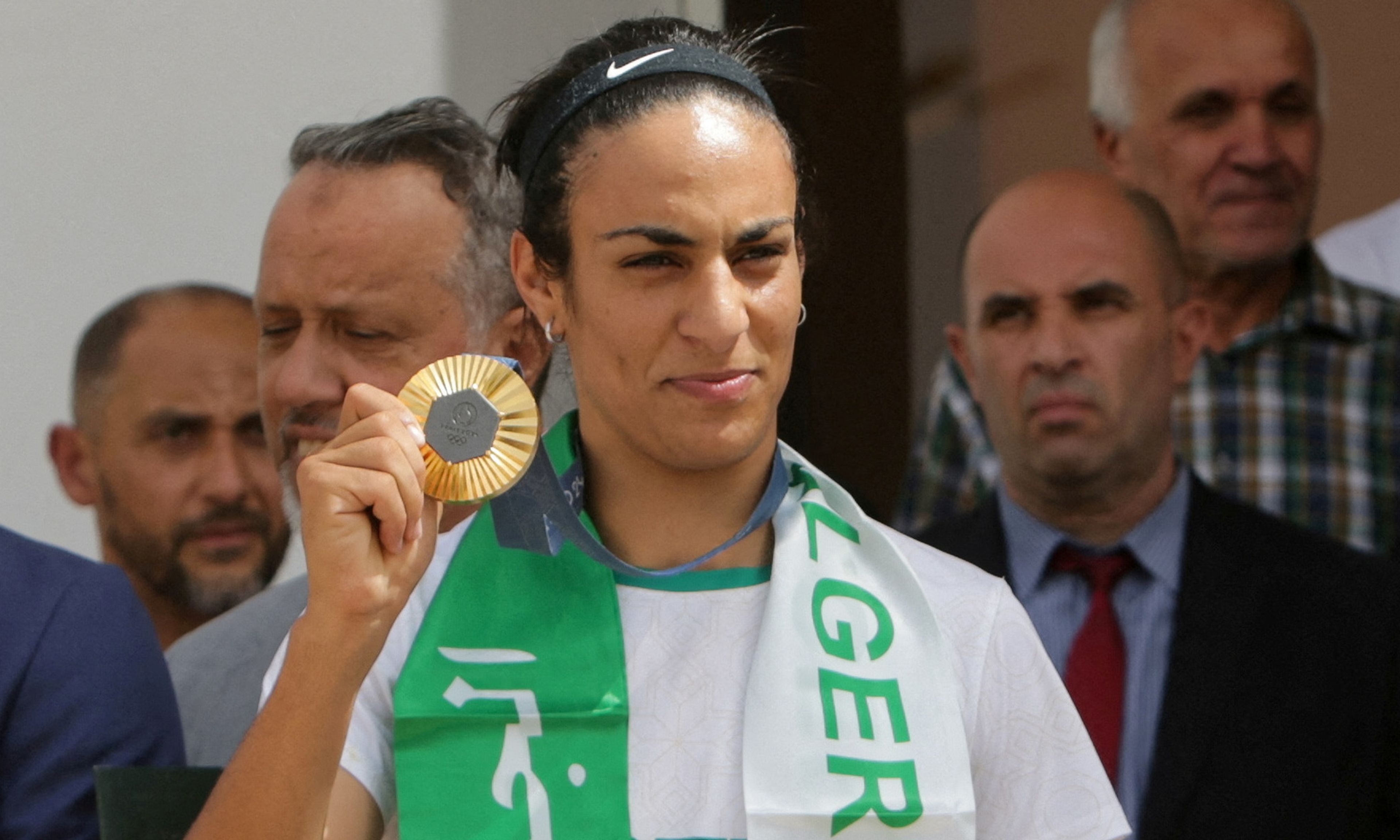
Algerian boxer Imane Khelif, who won the gold medal in the women's welterweight boxing at the Olympics, holds his medal upon his arrival at the airport in Algiers, Algeria, August 12, 2024.
Algerian Olympic boxer Imane Khelif has confirmed that he has the male chromosome, revealing the biological reality months after identifying as female in order to compete against women in the 2024 Paris Olympics.
Khelif admitted not only that he is a man, but also that he has elevated levels of testosterone, in an interview with the French sporting magazine L’Equipe.
"I have female hormones. And people don't know this, but I have taken hormone treatments to lower my testosterone levels for competitions," Khelif told L’Equipe, continuing to assert that he is not transgender, but is a woman.
The boxer has the "SRY" or Sex-determining Region of the Y gene, which is a gene only carried on Y chromosomes. The gene triggers typical male sexual development.
Further, Khelif said he plans to defend his title in the 2028 Summer Olympics in Los Angeles.
"For the next Games, if I have to take a test, I will. I have no problem with that," Khelif said. "I've already taken this test. I contacted World Boxing, I sent them my medical records, my hormone tests, everything. But I haven't had any response. I'm not hiding, I'm not refusing the tests."
Khelif was previously disqualified from competing in the International Boxing Association’s (IBA) Women’s World Boxing Championships after failing a sex-identification test. The International Olympic Committee, however, determined that Khelif was qualified to compete against women at the Olympics.
During the 2024 Paris Olympics, Khelif competed against Italian female boxer Angela Carini, who tapped out of the fight 46 seconds in, after Khelif punched her only twice. After the fight, Carini said the blows were the hardest she had ever encountered.
"I am heartbroken," Carini said at the time, following her match against Khelif. "I went to the ring to honor my father. I was told a lot of times that I was a warrior, but I preferred to stop for my health. I have never felt a punch like this."
The Paris 2024 Boxing Unit of the IOC defended its decision to allow Khelif to compete in the female division.
"All athletes participating in the boxing tournament of the Olympic Games Paris 2024 comply with the competition’s eligibility and entry regulations, as well as all applicable medical regulations set by the Paris 2024 Boxing Unit," the statement read.
Khelif did not openly identify as transgender, yet continued to participate against other female boxers. In the Olympics that year, Khelif ultimately won a gold medal, winning every round of competition.
The IBA, however, insisted that Khelif is male and should not compete against female boxers. The association's president, Umar Kremlev, said that after administering a sex test to both Khelif and Taiwanese boxer Lin Yu Ting, "it was proven they have XY chromosomes."
The Olympic Committee did not believe that chromosomes matter in the determination of one's sex.
"This is not a question of inclusion. . . . This is a question of justice," IOC President Thomas Bach said. "It is not as easy as some may, in this culture war, may now want to portray it, that the XX or the XY is the clear distinction between the men and women. This is scientifically not true anymore, and therefore these two are women and they have the right to participate in the women’s competition."
United Nations special rapporteur on violence against women and girls, Reem Alsalem, also spoke out against the situation, defending Carini.
"Angela Carini rightly followed her instincts and prioritized her physical safety, but she and other female athletes should not have been exposed to this physical and psychological violence based on their sex," Alsalem said.
Lin, who was also protected by the Olympic Committee's gender-identity policy, earned a gold medal in his respective weight class during the 2024 Paris Olympics.
"I respect everyone, and I respect Trump. Because he is the President of the United States. But he cannot distort the truth. I am not a trans woman, I am a girl. I was raised as a girl, I grew up as a girl, the people in my village have always known me as a girl," Khelif said.
Editor's note: This article has been updated to reflect an accurate definition of the SRY gene.

About the Author
Kamden Mulder is a William F. Buckley Jr. Fellow in Political Journalism. She is a graduate of Hillsdale College.
Featured Tags
Advertisement
Advertisement



Comments