DeSantis Talks Up Wife Casey as Potential Successor as Florida First Lady Teases Governor Run
Written by Audrey Fahlberg
Share this story
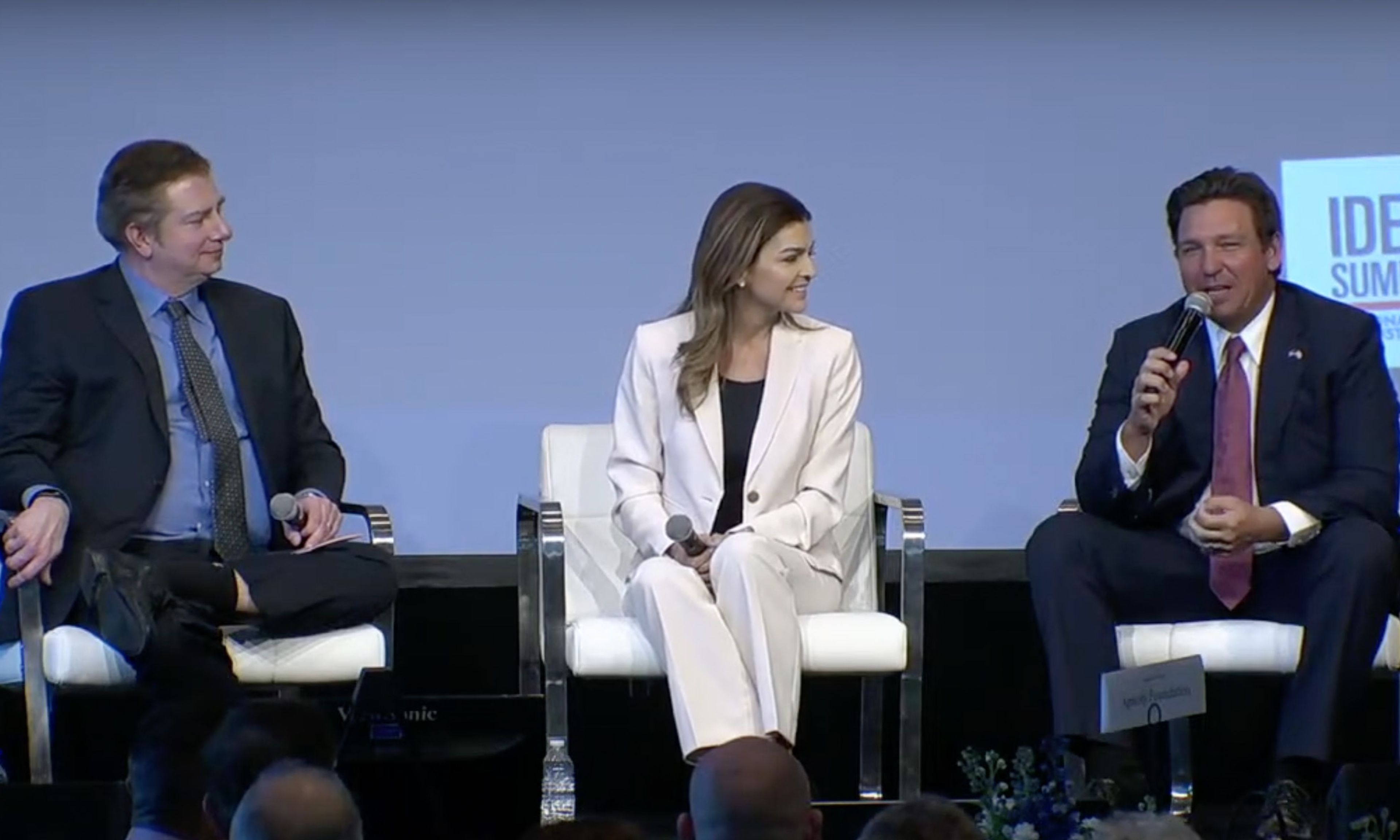
Florida Governor Ron DeSantis speaks as Florida First Lady Casey DeSantis, and <i>National Review</i>'s Jim Geraghty listen, at the National Review Institute's Ideas Summit in Washington, D.C., March 21, 2025.
National Harbor, Md. – Florida’s First Lady Casey DeSantis is not ruling out a run to become the Sunshine State’s chief executive in 2026, making clear at National Review Institute’s Ideas Summit on Friday she is considering hopping in the race to succeed her husband, two-term Governor Ron DeSantis, who will leave the governorship in January 2027.
Pressed by National Review's Jim Geraghty onstage Friday about whether she is considering running for governor in 2026, she lavished praise on her husband’s record, but characterized his achievements as “extremely fragile.”
“You could get somebody in and all of this revert back,” she said, taking a thinly veiled shot at her prospective competition, should she throw her hat in the ring. “I'll tell you, Florida, like in so many instances, it is the free state, and it is an inspiration to a lot of other states across the United States, for having the opportunity to travel around the world. People across the globe know about what he has done, and they are so proud.”
“So, it's the long-winded answer of saying, ‘We'll see,’ right?”
[video video="1817891" /]
During Friday’s panel, the governor characterized his wife as a staunch conservative and a strong prospective candidate in the race to succeed him, praising her efforts in helping the state expand access to cancer resources after her own bout with breast cancer, and the work she’s done overseeing the state Hope Florida initiative to help Floridians get off government assistance and connect them to jobs. The governor joked about how often the late conservative political commentator Rush Limbaugh would say that spouses often move politicians left. Not so with Casey.
DeSantis recalled being at an awards ceremony with Limbaugh a few years ago, where Casey was “raging against the machine.”
“He turned to me, you know, at the end, and he's like: ‘She should be governor after that,’” DeSantis recalled. “My view is just like, you know, she'd be great whatever she does, but I've been the most conservative governor in America. I've delivered the most conservative results, and they could say she would be as conservative or more conservative than me. So there you go.”
[video video="1817887" /]
After a long 2024 presidential run and a little less than two years before DeSantis’s second term is up, the pair is contemplating their own political future. If they go through with a run, they will have to figure out how to defeat Representative Byron Donalds (R., Fla.), whom President Donald Trump has already endorsed as his preferred 2026 gubernatorial candidate. Sources in the state say that a run from Casey would create a proxy war of sorts between the sitting governor and Trump’s political machine, which has many political operatives who have roots in Florida.
For his part, DeSantis has mended fences with the president, endorsing him after he suspended his own 2024 presidential campaign and later helping him fundraise in the lead-up to Election Day. Just this week, DeSantis attended the signing of Trump’s executive order dismantling the Department of Education.
During Friday’s panel, DeSantis praised his former 2024 campaign rival, President Donald Trump, for adopting what he called a “much more aggressive” effort to devolve power to the states in his second term and slash the administrative state. He characterized Trump’s leadership and executive actions thus far as a welcome relief from the regulatory policies of the Biden administration.
The pair also spoke about Casey’s struggle with breast cancer, Florida’s rightward shift in recent years since DeSantis was first elected in 2018, and his administration’s success in dozens of policy areas, from hurricane management and his handling of Covid, to cracking down on DEI policies in K-12 and college education.
“The lesson of Florida, for people not from there, we’ve shown you can beat the left,” the governor told Friday’s crowd. “We always used to think that it’s like just trying to mitigate the damage the left is going to do, and we’ve shown that you can actually beat them across the spectrum.”

About the Author
Audrey Fahlberg was a politics reporter for National Review.
Featured Tags
Advertisement
Advertisement



Comments