Dick Durbin, No. 2 Senate Democrat, Won't Seek Reelection
Written by James Lynch
Share this story
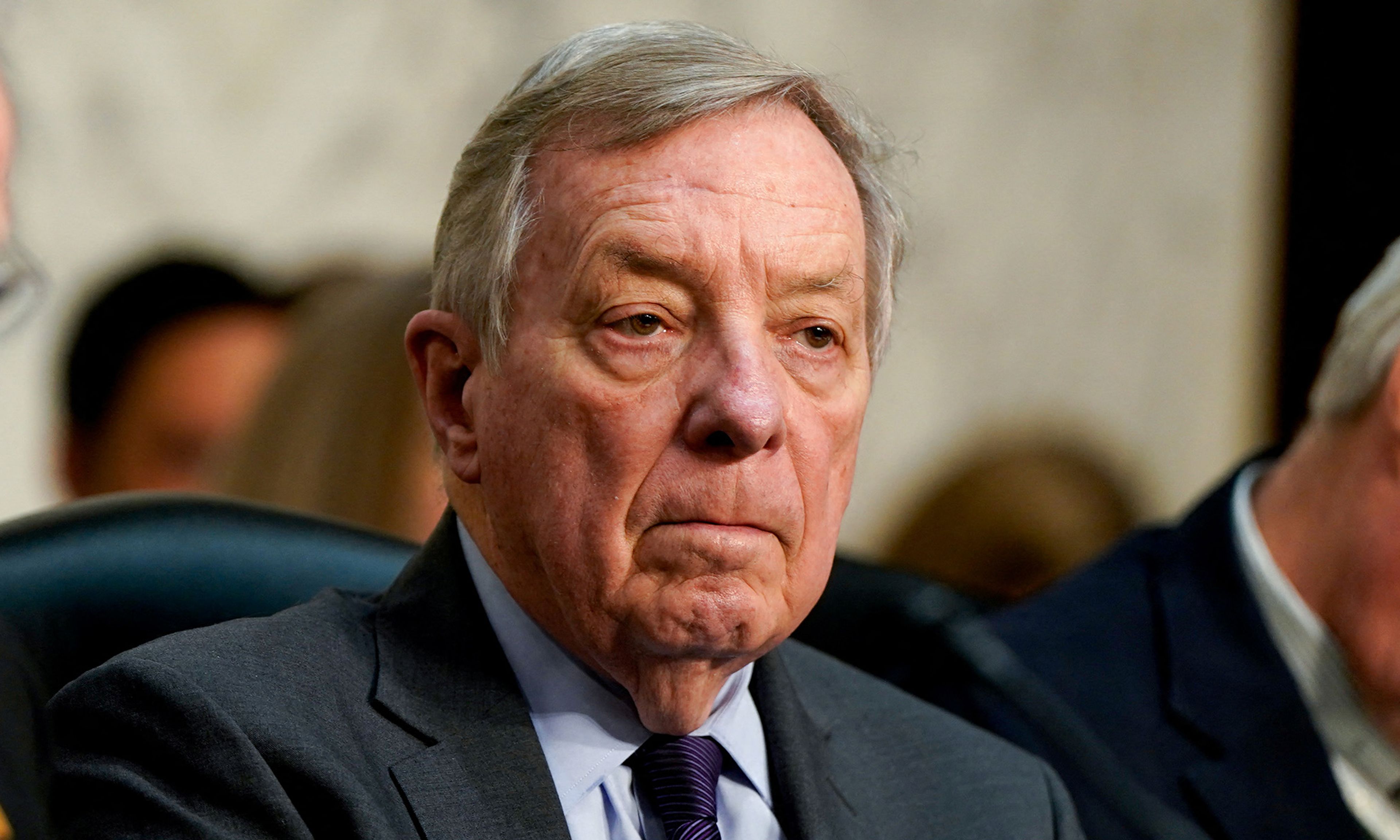
Senator Dick Durbin (D., Ill.), attends a confirmation hearing on Capitol Hill in Washington, D.C., January 15, 2025.
Senator Dick Durbin (D., Ill.), the second most powerful Senate Democrat, announced Wednesday his decision not to run for another term after nearly three decades in the world's greatest deliberative body.
Durbin, 80, is ending his Senate career after five terms, the longest tenure of any Senator in Illinois history. His retirement opens up a deep blue seat in 2026 and will create a leadership competition for Senate Democrats amid frustration with Senate Minority Leader Chuck Schumer (D., N.Y.) and generational turnover within the party.
"The decision of whether to run for re-election has not been easy. I truly love the job of being a United States Senator. But in my heart, I know it’s time to pass the torch. So, I am announcing today that I will not be seeking re-election at the end of my term," Durbin said in a video shared on X.
"The people of Illinois have honored me with this responsibility longer than anyone elected to the Senate in our state’s history, and I am truly grateful."
Durbin becomes the latest Senate Democrat to opt out of running for another term, joining the ranks of Senators Gary Peters (Mich.), Tina Smith (Minn.), and Jeanne Shaheen (N.H.). Peters's seat is expected to be one of the most competitive in the 2026 cycle, while Smith, Shaheen, and Durbin's vacancies are likely to remain in Democratic hands.
The Democratic primary to fill Durbin's seat is expected to be hyper-competitive because Illinois is a safely blue state. Former Vice President Kamala Harris won Illinois with 54.8 percent of the vote over President Donald Trump's 43.8 percent this past November.
Trump's comprehensive electoral victory over Harris helped the GOP reclaim the Senate 53-47 and retain the House, putting Democrats in the political wilderness for at least the next two years. Democrats are unlikely to take back the Senate majority in 2026, and an expensive and bruising Illinois primary could add further complications.
For the remainder of his term, Durbin promised to continue his Senate responsibilities and fight for the future of the country. He is currently the Ranking Member of the Senate Judiciary Committee and a member of the powerful Senate Appropriations Committee. He also sits on the Senate Committee on Agriculture, Nutrition, and Forestry.
As Chairman of the Senate Judiciary Committee, Durbin oversaw the confirmation of President Joe Biden's Supreme Court nominee Justice Ketanji Brown Jackson in 2022. Durbin has been Senate Democratic Whip since 2005 and spent his career being a reliably liberal vote for his party's priorities.
Throughout his tenure, Durbin prioritized immigration reform and criminal justice reform, playing a key role in the First Step Act signed by President Trump in 2018. Durbin also led the push to reverse 20th century laws harshly penalizing the usage of crack cocaine in comparison to powder cocaine.
Moreover, Durbin was known as a close advisor to former President Barack Obama, who served alongside Durbin for four years as Illinois's other Democratic Senator before getting elected president in 2008.
Before his distinguished Senate career, Durbin served Illinois's 20th congressional district for seven terms after first winning election narrowly in 1982. He defeated longtime incumbent Republican Paul Findley thanks to redistricting and an economic downturn, as well as support from pro-Israel groups.
He won his congressional race after unsuccessfully running for Illinois Lieutenant Governor and State Senate in prior years. Durbin was previously a lawyer serving in various state government roles and owned a pub in Springfield, Illinois.
Born in 1944, Durbin grew up in East St. Louis and eventually earned an undergraduate degree and law degree from Georgetown University. In college, Durbin interned for Senator Paul Douglas, whose seat he would later hold.
Durbin ran for Senate in 1996 to replace outgoing Senator Paul Simon, who Durbin worked for as legal counsel when Simon was Illinois Lieutenant Governor. Durbin won the 1996 Senate election by 15 points over Republican opponent Al Salvi on the heels of former President Bill Clinton's electoral victory. He won reelection four time each by comfortable margins, having never won by less than 10 points.

About the Author
James Lynch is a news writer for National Review. He previously was a reporter for the Daily Caller. He is a graduate of the University of Notre Dame and based in the Washington, D.C. area.
Featured Tags
Advertisement
Advertisement

Comments