DOJ Files Lawsuit Looking to Recoup Billions in Funding from Harvard over Campus Antisemitism
Written by Abigail Anthony
Share this story
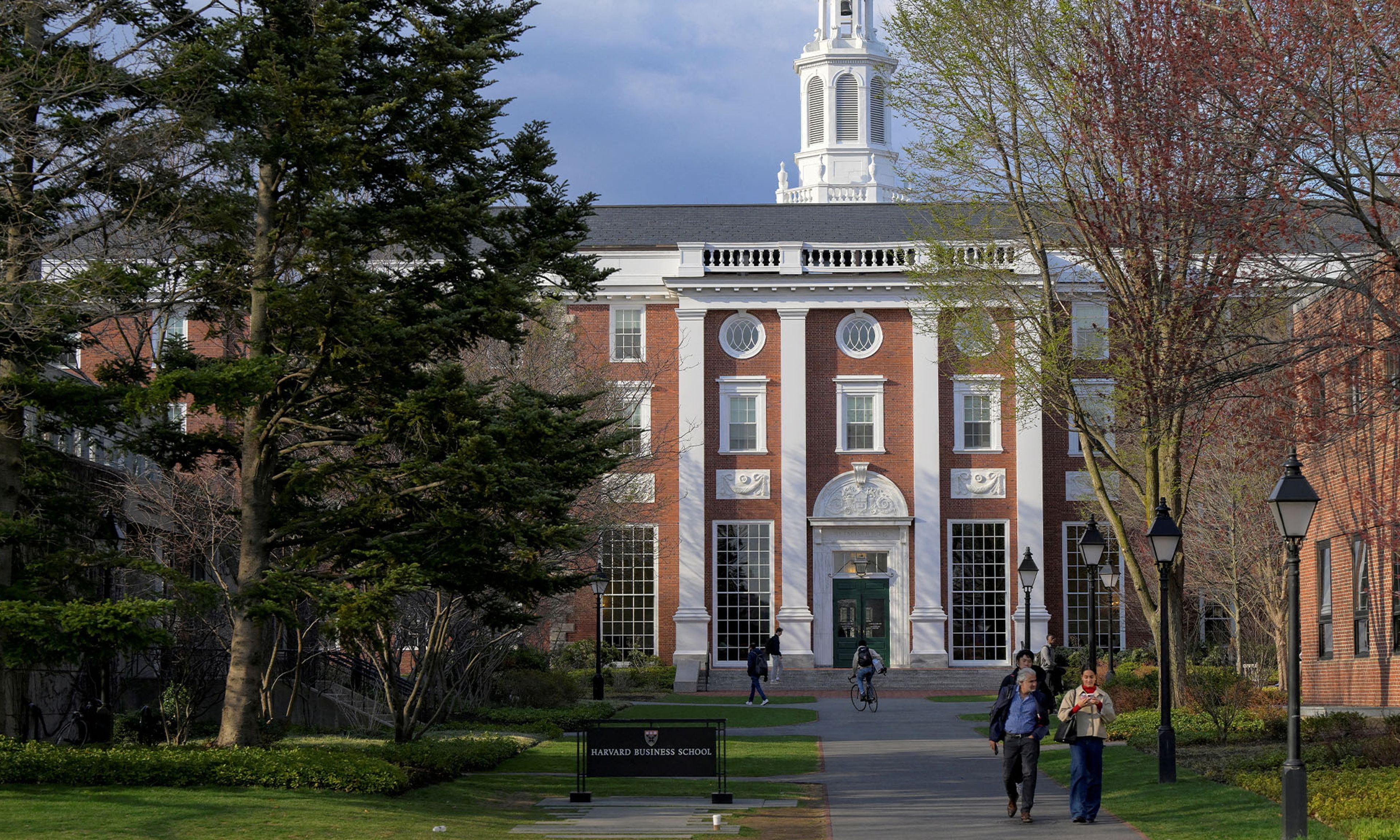
People walk on the Business School campus of Harvard University in Cambridge, Mass., April 15, 2025.
The Trump administration filed a lawsuit against Harvard University on Friday accusing the school of violating Title VI of the Civil Rights Act by failing to protect Jewish and Israeli students from harassment in the wake of the October 7, 2023, Hamas attacks.
As a result of “the severe, pervasive, and objectively offensive harassment” on campus, the complaint alleges that Jewish and Israeli students were denied equal access to the university’s benefits, resources, and opportunities.
“Harvard has failed to enforce its rules or meaningfully discipline the mobs that occupy its buildings and terrorize its Jewish and Israeli students,” reads the complaint. “Harvard instead rewarded students who assaulted, harassed, or intimidated their Jewish and Israeli peers.”
Harvard University receives billions of dollars in federal funding, including more than $2 billion through active grants from the Department of Health and Human Services (HHS) alone. As a recipient of federal financial assistance, the university is obligated to comply with the Civil Rights Act of 1964, which prevents discrimination on the basis of race, color, or national origin.
In early February 2025, Harvard University learned that HHS was investigating its response to antisemitic and anti-Israeli discrimination on campus. Four months later, HHS informed Harvard that its investigation found the school’s response to antisemitic and anti-Zionist discrimination, harassment, abuse, and retaliation against students on campus violated its legal obligations under Title VI.
The following month, HHS met with Harvard in an effort to secure the school’s voluntary compliance with the Civil Rights Act of 1964. The secretary of HHS and the attorney general have since determined that Harvard’s voluntary compliance cannot be achieved.
The complaint, filed on Friday in the U.S. District Court for the District of Massachusetts, contains a long list of antisemitic and anti-Zionist incidents on Harvard’s campus where perpetrators seemingly faced little to no punishment.
The lawsuit, which was brought by the Educational Opportunities Section of the Department of Justice’s Civil Rights Division, mentions a statement signed by the Harvard Undergraduate Palestine Solidarity Committee and 33 other student groups in the wake of the October 7 attacks that pinned the responsibility for “all unfolding violence” squarely on the “Israeli regime.”
One week after the October 7 attacks, students organized a demonstration outside a university library; some instructors even excused students from class to allow them to protest.
“For affected students, this replaced neutral educational opportunities (e.g., in-class learning) with an alternative (e.g., attending the demonstrations) that was explicitly hostile to Jewish and Israeli students as such,” reads the lawsuit. The complaint further states that it does not have information suggesting that instructors excused students from class to attend pro-Israel demonstrations.
The lawsuit identifies several “factors” indicating that the on-campus demonstrations amounted to direct, targeted actions against Jewish and Israeli students on the basis of race, ethnicity, or national origin. Those factors include explicit calls for the extermination of Jewish and Israeli people, and further directing such speech towards individuals who had been identified as Jewish or Israeli.
As examples, the lawsuit argues that chants like “from the river to the sea, Palestine will be free” and “globalize the intifada” are not “metaphors expressing political opposition to Israel,” but rather calls to “kill” or “expel” Jews. It further adds that “to a Jewish or Israeli ear, these chants are racial slurs.”
“This Complaint does not allege that Harvard violates Title VI by failing to end peaceful protests that annoy Jewish and Israeli students,” states the lawsuit. “Rather, these demonstrations featured outward hostility, harassment, and intimidation directed at Jewish and Israeli students intended to effectively exclude them from these academic spaces and deprive them of equal educational opportunities.”
The lawsuit also states that an Israeli Jewish student attempted to film students at an anti-Israel “die-in” protest but was “assaulted” by two graduate students, Ibrahim I. Bharmal and Elom K. Tettey-Tamaklo, who were both criminally charged.
The university nonetheless awarded Bharmal a $65,000 fellowship to work as an “Immigrants’ Rights Legal Fellow” at the Counsel on American-Islamic Relations in Los Angeles, and he was later selected for the prestigious position of class marshal. National Review previously reported that Tettey-Tamaklo was relieved of his supervisor position for undergraduates after the incident.
The lawsuit claims protests violated the university’s time, place, and manner regulations. For example, the university’s free-expression policies do not permit blocking other university members from accessing campus buildings. The guidelines also prevent demonstrations in classrooms or “spaces designated for study” like libraries, unless a particular school within the university makes an explicit exception.
The complaint states that hundreds of people — including individuals unaffiliated with the university who bypassed the identification scanners and thus trespassed— marched through university buildings in late October 2023 while using noisemakers, drumsticks, buckets, and megaphones to chant “from the river to the sea,” to accuse Israel of “genocide,” and to demand that Harvard “divest[] from Israeli apartheid that is funding genocide in Gaza.” The lawsuit states that, despite the protesters violating school policies by disrupting classes, the Harvard University Police did not intervene.
"The demonstrators disrupted multiple classes and caused enough alarm that Jewish and Israeli students hid or ran away, sometimes covering or removing Jewish symbols. Some students were unable to run away without passing through the demonstrators,” says the complaint.
“When Jewish Harvard students went to report this problem to the law school’s campus diversity bureaucrats, they found the Office of Community Engagement, Equity, and Belonging was locked, with the staff themselves hiding from the demonstrators,” it added. “The staff apologized briefly but did nothing.”
The lawsuit mentions several instances when the anti-Israel activists defied the school’s regulations and occupied campus buildings.
Protesters began occupying the Caspersen Student Center on October 30, 2023, and remained there for the semester, where they “stopped, targeted, and accosted Jewish students” and “forc[ed] Jewish students to stop using the law school’s primary student lounge,” per the lawsuit.
In mid-November 2023, students began occupying University Hall and demanded that the school establish a committee to “investigate Islamophobia,” and two deans responded by giving food or candy to the protesters.
In April 2024, anti-Israeli protesters established an encampment on school grounds.
“[Members of the encampment] displayed signs showing or calling for the eradication of Israel, i.e., slaughtering Jews,” says the lawsuit. “This was particularly terrifying to Jewish and Israeli students. The encampment violated university rules. Harvard, however, did not timely break up the encampment or meaningfully punish the individuals that acted in violation of university policy.”
Although a dean at Harvard stated in campus-wide communications that the encampment violated university policies and further warned that students involved would face disciplinary consequences if it continued, Harvard University Police Department Chief Victor A. Clay affirmed that students had the “right” to “protest peacefully … and we are going to support that.” The encampment continued into May.
President Alan Garber later negotiated with Harvard Out of Occupied Palestine, an unofficial student group that organized the encampment. Garber agreed to reinstate more than 20 students who had been placed on involuntary leaves of absence for their participation in the encampment, and he further offered protesters a meeting with members of the university’s governing bodies about divestment, per the complaint.
“The lesson was clear: if demonstrators occupy campus property in violation of Harvard’s time, place, and manner restrictions long enough, they will face no meaningful consequences and be rewarded with privileged access to Harvard’s leadership — at least if the violation intimidated and harassed Jewish and Israeli students or was designed to deny Jewish and Israeli students equal access to educational opportunities,” the lawsuit says of university’s response to the encampment participants.
The lawsuit argues that Harvard University administrators had advance knowledge of a “study-in” demonstration at a library that occurred in September 2024, but they did not take meaningful action to prevent the protest, nor did the university “meaningfully punish” the participants. The lawsuit further alleges that professors held a “study-in” demonstration at a library on October 16, 2024, in defiance of school policies, but the university did not take any action against the professors. The following day, another “study-in” demonstration was held by law students in the law school’s library.
“Like the other study-ins, this created a hostile environment by combining flagrant violations of Harvard’s rules, intimidation and heckling directed at Jewish and Israeli students, and posters depicting anti-Israeli Hamas propaganda,” says the lawsuit.
In late October, Harvard University’s librarian published an essay emphasizing that, although the “sit-in” and “study-in” demonstrations that had been held inside the college’s libraries were “silent form[s] of protest,” they were nevertheless disruptive.
“In the study-ins in our spaces, we heard from students who saw them publicized and chose not to come to the library,” wrote Martha Whitehead, who is currently the vice president for the Harvard Library, and the university librarian. “During the events, large numbers of people filed in at once, and several moved around the room taking photos or filming. Seeking attention is in itself disruptive.”
The lawsuit alleges there were at least twelve “antisemitic direct action[s]” following October 7, 2023, that were intended to thwart Jewish and Israeli students’ access to libraries on campus.
“This conduct would have been unthinkable if directed at any other racial, ethnic, or national group. But the tacit and explicit support for antisemitism on display from Harvard faculty and staff, and the lack of meaningful discipline for rule violators with an anti-Israeli agenda, allowed Harvard’s climate of antisemitism to grow to the point where the hostility resulted in Jewish and Israeli students being excluded from Harvard’s federally funded educational program on the ground of national origin, race, or ethnicity,” says the lawsuit.
As evidence of the university’s indifference to Jewish and Israeli students, the complaint mentions instances where Harvard did censor speech that was unrelated to Israel or Jewish identity. As one example, the lawsuit cites National Review’s reporting that Harvard’s English Department cancelled a lecture that featured a speaker who holds views critical of the transgenderism movement.
As another example, the lawsuit mentions that Harvard’s executive vice president “swiftly” responded to a truck that displayed names and photos of students whom a group unaffiliated with the school had deemed “Harvard’s Leading Antisemites,” but the university did not “promptly condemn comparable antisemitic activity.”
The Department of Justice is seeking both injunctive relief and the recovery of federal funds. It further asks the court to appoint an independent monitor to oversee Harvard’s compliance with the law. The Justice Department also asks that Harvard Corporation enforce university policies, impose punishment on individuals who violate such policies, and establish policies that require the university to cooperate with law enforcement to arrest protesters who impede the freedom of movement.
Harvard itself has admitted that Israeli students have experienced immense difficulties on campus, both socially and academically.
The university announced a “Task Force on Combating Antisemitism” in January 2024. The task force released a report in June 2024 with preliminary recommendations for improving the campus environment, which included the suggestions to “institute anti-harassment training for all students,” as well as incorporating mentions of “antisemitism and anti-Israeli bias” when discussing “issues of oppression and injustice” during orientations for new students.
“The situation of Israeli students at Harvard has been dire. They have frequently been subject to derision and social exclusion. Discrimination, bullying, or harassment based on an individual’s Israeli nationality is a gross violation of University policy and, beginning immediately, must be both publicly condemned and subject to substantive disciplinary action,” the task force said in a document published in June 2024.
The task force further confirmed that it had received “disturbing reports” of teaching staff discriminating or harassing students because they are Israeli or hold pro-Israel views.
The final report, released by the task force in April of last year, seemingly concedes that individuals on campus were targeted for being Israeli and/or Jewish.
“Due to aspects of their identity, including their religion and national origin, these students have faced bias, suspicion, intimidation, alienation, shunning, contempt, and sometimes effective exclusion from various curricular and co-curricular parts of the University and its community — clear examples of antisemitism and anti-Israeli bias,” says the final report.
National Review reported in February that the Justice Department’s Civil Rights Division filed a lawsuit against Harvard University that accused administrators of withholding the data necessary to determine whether there is continued racial discrimination in admissions.

About the Author
Abigail Anthony is a staff writer at National Review.
Featured Tags
Advertisement
Advertisement

Comments