How Montana Is Keeping Fraudsters Off the Welfare ‘Trampoline’
Written by Kamden Mulder
Share this story
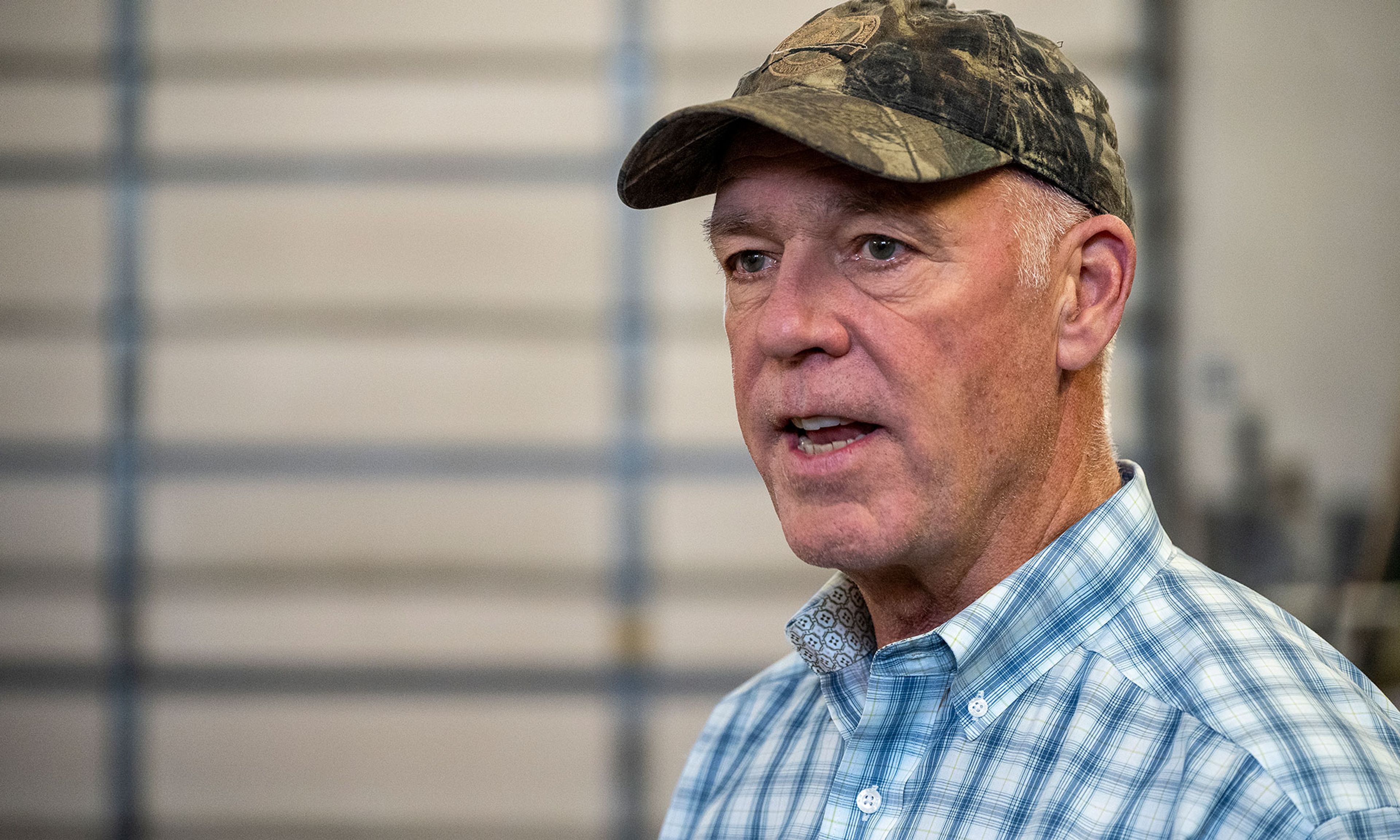
Montana Governor Greg Gianforte visits the Wilcoxson Ice Cream factory as part of a small business tour in Livingston, Mon., October 1, 2025.
As Governor of Montana, Greg Gianforte made it his mission to ensure that people like Heather Marie Bugni could no longer steal from taxpayers.
An employee with the Department of Public Health and Human Services, Bugni, 34, used her familiarity with the state’s welfare application system to fraudulently apply for benefits on behalf of her daughter while posing as her boyfriend. She knew, according to prosecutors, that providing the correct address and information would render her ineligible for benefits.
Bugni — whose role within DPHHS included processing applications, conducting interviews, and approving benefits for entitlement programs — used incorrect addresses, wage information, and different identities to steal $11,309 from taxpayers through the SNAP program. In total, Bugni stole at least $90,000 from entitlement programs. She pleaded guilty to theft of government money, property, or records in 2023.
That a state employee who was directly involved in the welfare application system felt comfortable trying her hand at fraud speaks volumes about the entrenched nature of the problem Gianforte was confronting.
The situation does, however, seem to be improving: Since Gianforte took office in 2021, SNAP fraud has decreased by almost 20 percent, the governor told National Review. The improvement, according to the governor, is due to his allocation of additional resources to ensuring eligibility compliance and his recent decision to require all existing beneficiaries to re-apply to ensure they were still eligible. Montana’s wage growth, which has outpaced inflation, has also helped the situation, Gianforte said.
“We need these programs so people don’t fall through the cracks, but we have to make sure the resources are there for the people that actually qualify,” Gianforte said. “I track this every single month since I’ve been in office, the last five years, and we’ve really instituted strong protections at the Montana Department of Health and Human Services that started with the requalification of every SNAP recipient.”
Gianforte’s administration began working to address welfare fraud since long before the subject came to dominate national headlines thanks to recent revelations out of Minnesota, where one federal prosecutor estimates there has been more than $18 billion in Medicaid fraud perpetrated since 2018 alone.
Like Medicaid, SNAP, a federal food assistance program, offers a ripe target for fraudsters.
In April, agents from the U.S. Department of Agriculture, the Office of the Inspector General, and Homeland Security Investigations launched an investigation into suspected SNAP fraud by Twin City retailers.
The operation, dubbed Operation Cold SNAP, resulted in multiple criminal search warrants served to retailers accused of fraud, as well as administrative charging letters to 20 different stores, all accused of SNAP trafficking and other violations.
While SNAP is a federal program, each individual state runs the day-to-day operations, including determining eligibility, issuing benefits, and managing applications. Therefore, states have not only the power, but the significant responsibility, to root out fraud.
SNAP is a mandatory entitlement program, meaning it does not require annual appropriations from Congress. The amount of money allocated to the program ebbs and flows based on the number of Americans who claim benefits.
“The automatic nature of mandatory spending tends to lead to even higher improper payment rates,” according to a report on fraud issued by Advancing American Freedom earlier this month.
In 2025, the federal government shelled out approximately $93.51 billion toward SNAP entitlement payments, 10.9 percent, or $10.2 billion, of which constituted improper payments, according to AAF.
Improper SNAP payments include overpayments and payments to families who are ineligible to receive benefits. The figure also captures underpayments.
If handled correctly, SNAP payments should reflect the unemployment rate, rising and falling with the percentage of Americans who are looking for work.
Nationally, however, SNAP benefits have not reflected those trends, as “the number of SNAP recipients and the amount of SNAP spending have exploded despite low unemployment,” AAF said. “The U.S. spent more on SNAP benefits in 2025 ($102 billion) when the unemployment rate averaged 4.3 percent than it did in 2011 ($68 billion) when the unemployment rate averaged 9.6 percent.”
Under Gianforte, Montana has managed to get its SNAP benefits in line with the state’s unemployment rate.
Throughout 2025, Montana consistently placed in the top five states across the nation for lowest unemployment rates.
“We feel across all of these social welfare programs, with Medicare, Medicaid, TANF, SNAP, with the exception of people with long term disabilities, these should be essentially a trampoline that allows someone to get back on their feet, not a hammock you climb into and spend the rest of your life there,” Gianforte said. “No one starts off life saying, ‘I hope to grow up and become dependent on the government.’”
Currently, ten states — including Montana — have applied for and received a SNAP Fraud Framework Implementation Grant. These grants are part of a competitive federal program that helps state agencies mitigate SNAP fraud. States are given the resources to implement the SNAP Fraud Framework, a toolkit created to strengthen program integrity and protect taxpayer dollars.
Minnesota also received one of these grants, but its inability to implement measures to mitigate fraud and prove to the federal government that fraud had lessened prompted the USDA to attempt to freeze all SNAP funding to the state in January 2026.
The $129 million in SNAP money was reinstated after U.S. District Court Judge Laura Provinzino issued a preliminary injunction, barring the USDA from cutting said funding from Minnesota.
“We found that most of the fraud we see in Montana is not the kind of systemic fraud that they’re seeing in Minnesota and some of these other states,” Gianforte said. “It’s people that have applied for benefits in Montana, and they’re also applying in Wyoming or Idaho.”
Because of this framework, Montana has the ability to eradicate SNAP fraud, Gianforte said.
“These programs exist for a good reason, but if we let everybody climb onto the hammock, it’s going to collapse under the weight,” Gianforte said.

About the Author
Kamden Mulder is a William F. Buckley Jr. Fellow in Political Journalism. She is a graduate of Hillsdale College.
Featured Tags
Advertisement
Advertisement


Comments